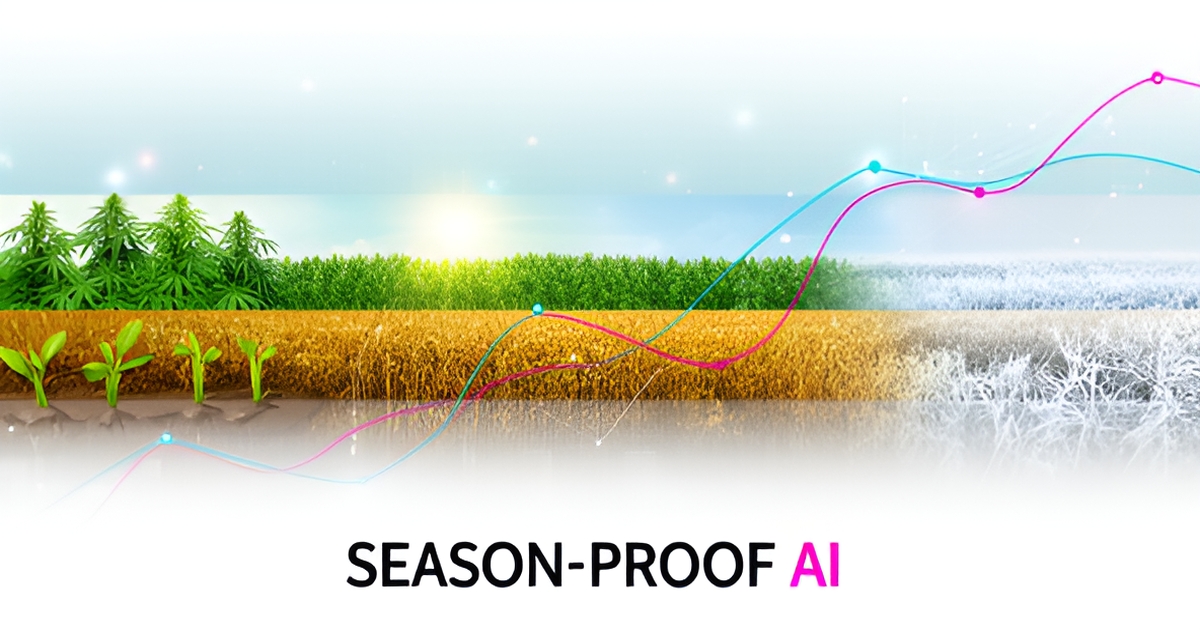
Can AI Handle Seasonal Variations in Hemp Farming? How It Works
Key Facts
- Proper seasonal handling is reported to deliver roughly a 40% improvement in forecast accuracy across retail and agricultural domains according to machine learning research
- AI-powered forecasting is cited at up to 95% accuracy versus roughly 60-70% for manual methods that rely on static seasonal assumptions per inventory forecasting analysis
- 67% of retail businesses are affected by seasonal demand patterns that mirror agricultural cycles as noted in seasonality research
- Modern data can contain 12+ overlapping seasonal cycles, from daily to annual rhythms that interact and evolve according to time series analysis
- Manual forecasting can take up to a quarter to update, leaving growers relying on outdated data for months per AI versus manual forecasting comparison
- Hempie's AI grows smarter with each log entry, continuously refining models for better seasonal recommendations as demonstrated by the hemp farming platform
- AI in vertical farming maintains ideal climate conditions irrespective of external weather variations through real-time monitoring according to precision agriculture research
Hire a team member that works 24/7 — for less than a part-time wage.
AI receptionists, SDRs, dispatchers and 99+ roles. Trained on your business, fully managed.
Not sure where to start? Ask our AI planner
Why Seasonal Variation Is The Core Challenge For Hemp Growers
Hemp does not grow on a fixed schedule. It responds to shifting day length, temperature swings, precipitation and soil conditions that change week to week. Static plans assume the season will behave the same way it did last year, and that assumption is where yield loss begins.
Seasonality is systematic and cyclical, not random noise. Machine learning guidance on seasonality explains that properly addressing these patterns is crucial for preventing misleading forecasts. When seasonality isn't properly addressed, even sophisticated models can produce misleading forecasts and insights.
Modern hemp production faces multifaceted cycles that overlap and evolve. Research on time series seasonality notes 12+ common seasonal cycles can exist within business data, with daily, weekly, monthly and annual rhythms interacting. For hemp, that means germination windows, vegetative growth, flowering triggers and harvest timing all shift with weather and soil, not the calendar.
Manual plans smooth out those variations. Analysis of AI versus manual forecasting shows manual methods often rely on basic monthly averages, which can smooth out demand spikes and miss critical variations. Manual forecasting can take up to a quarter to update, leaving growers relying on outdated data for months.
The cost shows up as missed windows, stress and loss. Seasonality research finds 67% of retail businesses are affected by seasonal demand, and proper seasonal handling is reported to deliver a 40% improvement in forecast accuracy. In agriculture, the equivalent is mistimed irrigation, nutrient application and harvest.
AI systems adapt because they are trained on seasonal data and learn continuously. Hempie's AI approach demonstrates that AI systems can be trained on seasonal data to provide accurate and dynamic recommendations for hemp farming, adapting to changing seasons, weather patterns and soil conditions. The platform's models refine with each log entry, ensuring an always improving assistant and better results.
Precision agriculture principles from vertical farming transfer directly. AI in vertical farming shows algorithms can analyze historical data, weather patterns and sensor inputs to predict crop behavior and health, enabling preemptive measures for disease or nutrient deficiencies. AI can also optimize climate control by monitoring temperature, humidity and CO2 to maintain ideal conditions irrespective of external weather variations.
What makes seasonal variation the core challenge is the need for dynamic response:
- Predictable patterns that are not static, they evolve with weather and soil
- Overlapping cycles from daily light to annual climate that interact
- Risk of misleading forecasts when seasonality is ignored
- Manual updates lag behind real conditions by weeks or months
AIQ Labs trains custom AI models on seasonal data to ensure accurate, dynamic recommendations year after year. Continuous learning lets the system spot early stress signals and adjust guidance before damage occurs. With AI-powered forecasting cited at up to 95% accuracy versus roughly 60-70% for manual methods, growers gain a decision layer that moves with the season instead of fighting it. If seasonal planning is the workflow costing you the most, an AI Workflow Build rebuilds it at a fixed price, in phases.
How AI Learns Seasonality And Adapts Recommendations In Real Time
Seasonal swings can make or break a hemp crop, and AI is learning to read those cycles in real time instead of reacting after the fact.
Models are trained on layered seasonal data — historical weather, sensor inputs and grow logs — to recognize systematic, predictable patterns rather than random noise. Machine learning guidance on seasonality notes that properly addressing these patterns is crucial for preventing misleading forecasts, with a reported 40% improvement in forecast accuracy from proper seasonal handling. The same research highlights that 67% of retail businesses are affected by seasonal demand and that 12+ common seasonal cycles can exist within business data.
Hempie shows how this works in practice for hemp. The app uses machine learning to analyze grow data, spot issues early, and provide personalized advice tailored to specific growing conditions. "Hempie grows smarter with each log entry. Every bit of data refines our AI models, ensuring you benefit from an always improving assistant and better results." Hempie's continuous learning approach means recommendations tighten as more season-specific logs are added.
Vertical farming AI applies the same principle to precision control. AI algorithms can analyze historical data, weather patterns, and sensor inputs to predict crop behavior and health. Vertical farming AI research explains that by foreseeing potential issues such as disease outbreaks or nutrient deficiencies, farmers can implement preemptive measures. The system enables precision agriculture where each plant's individual needs are precisely monitored and met through real-time data collection and analysis.
Dynamic adaptation happens across several inputs:
- Seasonal data and cyclical feature transformation using sine and cosine representations to preserve cyclical relationships
- Lag features from same day last week or same month last year plus rolling seasonal statistics
- External variables including weather data, temperature, precipitation and calendar events
In controlled environments, AI optimizes climate control by monitoring and adjusting temperature, humidity and CO2 levels. AI vertical farming analysis states this maintains ideal conditions irrespective of external weather variations. Real-time decision making then drives automated irrigation, fertilization and climate control.
This adaptive loop mirrors how AIQ Labs trains custom AI models on seasonal data to ensure accurate, dynamic recommendations year after year. The approach aligns with AI for Agriculture & AgriTech, where continuous learning from sensor streams and grow logs replaces static calendars with responsive guidance. When models can examine seasonality across multiple dimensions and learn from each log entry, advice stays relevant as weather patterns and soil conditions shift.
From Data Collection To Predictive Action On The Farm
The transition from raw sensor readings to autonomous farm decisions follows a structured pipeline that turns seasonal complexity into operational clarity. In vertical farming environments, sensors and cameras continuously capture real-time data on temperature, humidity, CO2 levels, and plant health, feeding algorithms that determine the precise water, nutrients, and light each plant requires for optimal growth according to precision agriculture research. This granular monitoring creates the foundation for predictive action across outdoor hemp operations as well.
AI-driven decision making layers intelligence onto this data stream. Algorithms analyze historical patterns, weather forecasts, and live sensor inputs to predict crop behavior and flag potential issues — disease outbreaks, nutrient deficiencies, or demand shifts — before they impact yield as demonstrated in controlled environment agriculture. The system then executes automated control: adjusting irrigation, fertilization, and climate systems in response to predictions rather than reactions. For hemp farmers, this means maintaining consistent crop performance despite shifting seasons and soil conditions through continuously learning models that refine recommendations with every new data point.
Feature engineering makes this accuracy possible. Cyclical transforms using sine and cosine functions encode time as a continuous circle, preserving the relationship between December and January that categorical month labels break as machine learning practitioners emphasize. Lag features pull in data from the same week last year or the same day last month, while rolling seasonal statistics capture evolving trends. External variables — weather data, calendar events, market indicators — complete the picture. Tree-based ensemble methods like Random Forests and Gradient Boosting then capture these non-linear interactions automatically without extensive preprocessing, with reported accuracy gains of up to 40% when seasonality is properly handled across retail and agricultural domains.
- Real-time sensor networks feed continuous environmental and plant-health data
- Cyclical feature transforms preserve seasonal continuity across year boundaries
- Lag features and rolling statistics capture multi-year dependency patterns
- Tree-based ensembles model complex weather-yield interactions natively
- Automated control loops execute preemptive adjustments before stress appears
AIQ Labs applies this same architectural discipline to agricultural AI systems, training custom models on multi-season data so recommendations stay accurate as conditions evolve. The result is a closed loop where every harvest enriches the next season's intelligence.
Building Seasonal AI That Owns And Improves Year After Year
The real advantage of AI in agriculture isn't just seasonal adaptation—it's continuous improvement that compounds year after year. Generic subscription tools offer static recommendations that quickly become stale as climate patterns shift and farm-specific conditions evolve. AIQ Labs breaks this cycle by building custom models trained exclusively on a farm's own historical data, creating systems that learn from each planting cycle and get smarter with every season.
Our approach starts with collecting multi-year data on planting dates, weather events, soil tests, pest occurrences, and harvest outcomes—then engineering models that recognize the unique seasonal rhythms of that specific operation. Unlike off-the-shelf solutions that treat all farms the same, these custom systems detect subtle patterns like how a late spring frost affects cannabinoid production in certain soil types or how specific cover crop rotations influence moisture retention through summer droughts. As noted in research on time series seasonality, properly handled cyclical patterns can improve forecast accuracy by a reported 40%, but only when models are trained on the farm's actual historical behavior rather than regional averages.
The true power emerges through continuous learning: each season's data automatically refines the model's understanding of local microclimates and soil interactions. This mirrors the self-improving capability seen in platforms like Hempie, where AI grows smarter with each log entry, refining recommendations based on real-world outcomes. When a model correctly predicts that increased rainfall in June will require adjusted nitrogen application to prevent leaching, that insight becomes permanent knowledge for future seasons. Over time, the system anticipates not just standard seasonal shifts but emerging patterns—like how changing jet stream patterns are altering traditional growing windows in Nova Scotia.
This ownership model transforms AI from a recurring expense into an appreciating asset. Rather than paying for tools that reset their intelligence each year, farmers invest in systems they own outright and that accumulate wisdom about their land. Research suggests AI-powered forecasting can reach up to 95% accuracy by continuously learning from new data—well beyond the 60-70% typical of manual methods that rely on static seasonal assumptions. When farmers own their AI, they control how it evolves, ensuring recommendations stay aligned with their specific goals whether maximizing CBD yield, optimizing fiber quality, or adapting to new regulatory requirements. For operations that want this intelligence woven through everything—planning, scheduling, compliance, harvest logistics—an AI Operating System builds one connected layer across the business, in phases, owned outright.
The result is a self-reinforcing cycle: better data leads to better models, which produce better harvests, which generate even more valuable data for next year's improvements. This is how AI stops being a seasonal tool and becomes a permanent advantage—one that grows more valuable with every harvest cycle, every weather event, and every lesson learned from the land itself.
Still paying for 10+ subscriptions that don’t talk to each other?
We build custom AI systems you own outright. No vendor lock-in. Full control.
Not sure where to start? Ask our AI planner
Frequently Asked Questions
How does AI actually handle the unpredictable weather and shifting seasons that mess up hemp farming schedules?
Is AI forecasting really that much better than the spreadsheets and calendars we already use?
Can AI work for outdoor hemp farming, or is it only for controlled environments like vertical farms?
What happens after the first season — does the AI just keep using the same model, or does it actually get smarter?
Do I need to hire a data scientist or buy expensive sensors to make this work on my farm?
How does AI decide when to irrigate, fertilize, or harvest if conditions keep changing week to week?
Turning Seasonal Uncertainty Into Farming Certainty
Seasonal variation isn't just a challenge for hemp farmers—it's a predictable pattern that AI can learn, adapt to, and improve upon year after year. By training custom models on a farm's own data, AI systems move beyond static calendars to deliver dynamic recommendations that evolve with weather, soil, and crop cycles. This continuous learning loop means each season builds on the last, improving forecast accuracy, reducing waste, and helping growers maintain consistent performance despite shifting conditions. The result is a self-reinforcing advantage where better data leads to better decisions, which in turn generate even more valuable insights for the future. For hemp farmers ready to move from reactive planning to proactive, intelligence-driven cultivation, the next step is the 2-minute Fit Check — free, no obligation, and it maps your biggest bottlenecks so you can see where AI can deliver real, measurable value before you commit to anything.
Make AI your competitive advantage — not just another tool.
Strategy, implementation and ongoing optimization. One partner, end to end.
Not sure where to start? Ask our AI planner