Can AI Replace a Brewery's Bar Tending Staff? A Realistic Look at Automation in Customer Experience
Key Facts
- Consumer AI handles text and conversations, while industrial AI processes sensor data and simulations judged on ROI, uptime, and safety according to industrial AI analyst Jeff Winter
- Brewery wastewater can carry a biochemical oxygen demand of around 60,000 mg/l compared to roughly 300 mg/l for domestic sewage according to brewery waste management research
- The global Industrial AI market was estimated at $43.6 billion in 2024, with projections of continued rapid growth through 2030 according to industrial AI implementation research
- Production automation typically becomes cost-effective for breweries only after annual output exceeds approximately 1,500 hectoliters according to ESONIC's craft brewing automation platform
- An NHS AI system analyzing 7,500 employees predicts staff resignations while explicitly keeping employment decisions with human judgment according to TechRadar's coverage
- One manufacturer reported lifting overall equipment effectiveness from 62% to 77% in six months using production-based maintenance scheduling according to Oxmaint's FMCG maintenance data
- Industrial AI spending represents a small fraction of manufacturing revenue despite the market's rapid growth according to industrial AI market analysis
Hire a team member that works 24/7 — for less than a part-time wage.
AI receptionists, SDRs, dispatchers and 99+ roles. Trained on your business, fully managed.
Not sure where to start? Ask our AI planner
The Myth of Full Automation in Brewery Taprooms
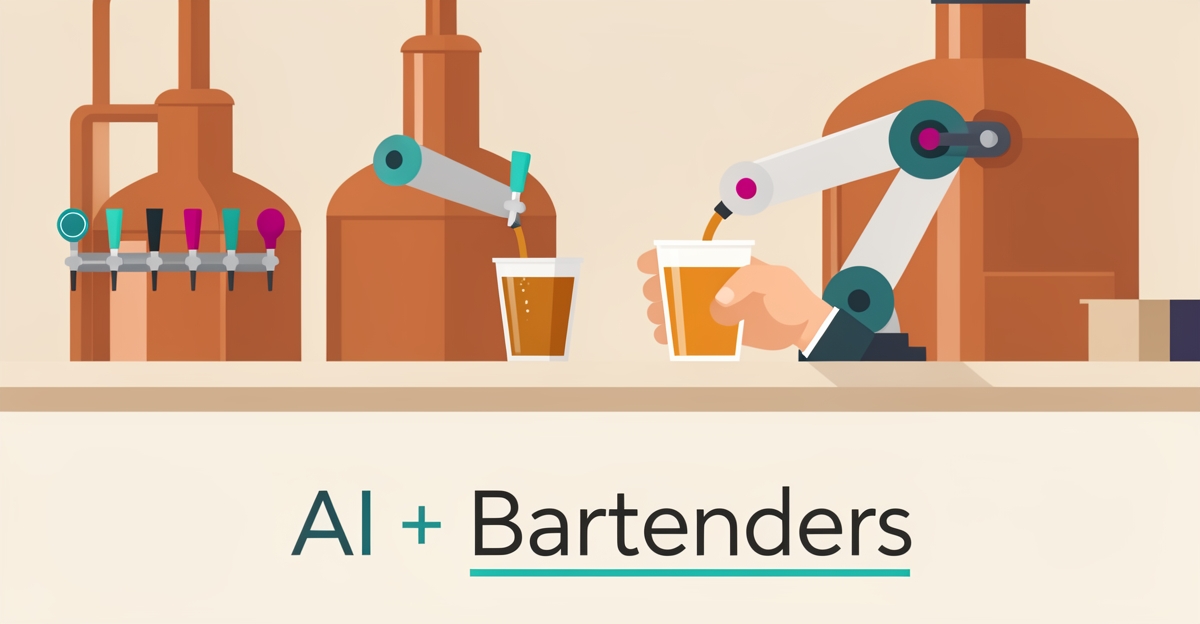
Picture a robot arm pulling a pint, cracking a joke, and noticing a regular's mood shift from across the room. It's a fun image, and a completely unrealistic one. The evidence on automation in breweries points not to replacing bartenders, but to something far more practical: AI handling the operational background work while humans own the taproom floor.
The confusion starts with a category error. As automation expert Jeff Winter explains, "Where consumer AI deals with text, images, and conversations, Industrial AI deals with sensor data, machine vision, and simulations." Consumer AI gets judged on creativity; industrial AI gets judged on ROI, uptime, and safety.
Bartending sits almost entirely in the first category. Reading a room, defusing a tense exchange, remembering that a couple just got engaged, these are acts of social intelligence and empathy that no current system can replicate. That's why the automation already transforming breweries targets production and operations, not hospitality.
Consider where AI actually works in brewing today:
- Process control platforms like ESONIC Craft Brewing automate fermentation, filtration, and recipe management, typically worthwhile for breweries producing over 1,500 hectoliters annually
- Maintenance systems such as Oxmaint schedule equipment servicing based on units produced, not calendar dates
- Labor forecasting tools from Workforce.com help taproom managers staff the most profitable shifts
- Waste monitoring, where brewery wastewater can reach 60,000 mg/l BOD versus roughly 300 mg/l for domestic sewage, is ripe for AI-driven alerting and compliance documentation
Notice the pattern: every one of these systems supports human decision-making rather than eliminating it. Even the NHS's award-winning AI that predicts staff resignations was built on the explicit principle that "employment decisions still rest with human judgement," according to TechRadar's coverage.
The same logic applies behind the bar. AI can flag when a keg runs low, forecast Saturday's staffing needs, or answer routine customer questions, but it can't pour a beer with a story attached. That's the philosophy behind hybrid AI-human systems: automate the repetitive, data-heavy tasks, and keep people where connection matters. If you want to see what that looks like in practice, AIQ Labs' AI Employees handle the routine front-of-house and back-office work, reception, scheduling, dispatch, so your human staff stay on the floor.
Full automation of a taproom isn't just technically out of reach, it's commercially backwards. The customer experience that drives repeat visits is precisely the part AI is worst at, and the operational drudgery is precisely the part AI is best at. Smart breweries will let machines handle the spreadsheets and sensors, and let their bartenders do what no algorithm can: make someone's night better.
Where AI Actually Creates Value in Brewery Operations
The most valuable AI in a brewery has nothing to do with pouring pints or chatting with regulars. It works quietly in the background, keeping production consistent, schedules tight, and equipment running.
The distinction matters more than most operators realize. As industrial AI analyst Jeff Winter explains, consumer AI handles text and conversation, while industrial AI processes sensor data, machine vision, and simulations, judged on ROI, uptime, and safety rather than creativity. That second category is where breweries see real returns.
Production automation is already proven territory. Platforms like ESONIC's craft brewing system deliver recipe management, fermentation control, and remote monitoring for small and mid-sized breweries, with automation typically paying off once annual production exceeds roughly 1,500 hectoliters. The beer gets made more consistently, but a person still hands it across the bar.
Workforce forecasting offers another practical win. Tools like Workforce.com's brewery platform use AI-guided staffing levels based on sales data and foot traffic, ensuring the best bartenders work the most profitable shifts. The AI informs the schedule; humans deliver the experience.
Inventory and waste monitoring round out the operational picture. Brewery wastewater carries a biochemical oxygen demand of roughly 60,000 mg/l compared to 300 mg/l for domestic sewage, making automated monitoring and compliance documentation genuinely valuable.
Maintenance alerts complete the picture. Production-based maintenance scheduling helped one manufacturer lift overall equipment effectiveness from 62% to 77% in six months, catching problems before they shut down a taproom on a Friday night.
The pattern across every use case:
- AI handles data, monitoring, and prediction
- Staff handle customers, judgment, and atmosphere
- Managers retain final decision authority
This is precisely the philosophy behind AIQ Labs' approach, deploy AI for real-time alerts and operational intelligence, then free your people to do what no algorithm can: make guests feel welcome. When one specific workflow, keg tracking, scheduling, maintenance, is the bottleneck, a fixed-price Workflow Build rebuilds just that piece, in phases, without a rip-and-replace project.
The Hybrid AI-Human Model for Customer Experience
The evidence across industries tells a consistent story: the most effective AI deployments don't replace people, they remove the friction that keeps people from doing their best work. In a brewery taproom, that means using AI to handle the repetitive, data-heavy tasks that distract from hospitality, not to simulate it. This is the hybrid model in practice: AI monitors, alerts, and forecasts while humans connect, adapt, and decide.
Industrial AI operates on a fundamentally different plane than consumer-facing chatbots. As Jeff Winter notes, it deals with sensor data and simulations in environments that can't afford to fail, judged on ROI and uptime rather than creativity. For breweries, this distinction matters because the AI systems delivering real value today, predictive maintenance, quality inspection, labor forecasting, run in the background, not behind the bar. The industrial AI market's rapid growth as of the mid-2020s reflects this operational focus, not a push toward automated customer service.
- Real-time inventory alerts that prevent stockouts during peak service
- Automated draft-line maintenance scheduling triggered by volume, not calendar dates
- Labor forecasting aligned to sales patterns, weather, and event calendars
- Waste-stream monitoring for compliance documentation and cost control
AIQ Labs applies this same principle through hybrid AI-human systems that handle real-time operational alerts and administrative tasks while preserving human staff for relationship building and complex service decisions. The NHS workforce prediction tool, which analyzes data across 7,500 employees to flag resignation risk, captures the philosophy precisely: the system is "meant to give managers more to work with, not replace them, since employment decisions still rest with human judgement." Breweries adopting this approach gain operational clarity without sacrificing the human element that defines the taproom experience.
Implementation Roadmap for Brewery Bar Support
Implementing AI support in a brewery starts with clear problem definition, pinpointing operational pain points where AI adds value without touching customer interaction. According to the IoT Analytics framework, this means identifying and quantifying where AI can create tangible value, backed by KPIs that align with strategic goals industrial AI research. For taprooms, this often includes inventory tracking, draft line maintenance scheduling, labor forecasting, or waste stream monitoring, tasks that support staff but don't replace the human elements of hospitality.
Next, assess automation readiness by evaluating whether your operation justifies the investment. ESONIC notes automation becomes worthwhile for breweries planning annual production above approximately 1,500 hectoliters brewery automation threshold. For operational AI like scheduling or forecasting, the threshold may be lower, but data infrastructure costs must still be weighed against expected efficiency gains. Smaller taprooms might start with lightweight tools that integrate POS and inventory data before scaling.
Then, build the technical foundation: set up edge devices, data pipelines, and security protocols to enable reliable AI function Industrial AI framework. This could mean connecting keg sensors to monitoring systems, linking temperature logs to maintenance alerts, or integrating staff scheduling with sales data. Clean, contextualized data is essential, garbage in, garbage out, so prioritize data governance early to ensure AI outputs are trustworthy and actionable for bar managers and staff. AIQ Labs helps breweries navigate this phase with Workflow Builds for single high-cost workflows, or an AI Operating System when you want one connected layer across the whole operation, built in phases and owned outright, with no ongoing rental of your own infrastructure.
Still paying for 10+ subscriptions that don’t talk to each other?
We build custom AI systems you own outright. No vendor lock-in. Full control.
Not sure where to start? Ask our AI planner
Frequently Asked Questions
Can AI actually replace bartenders in a brewery taproom?
Where does AI actually create value in a brewery?
Is industrial AI different from the chatbots I see online?
Will AI take jobs away from taproom staff?
What's the practical threshold for automation in brewing?
How do breweries use AI for staffing without losing the human touch?
Pouring the Future: AI as the Brewery's Silent Partner
The evidence is clear: AI won't be pulling taps or sharing stories behind the bar anytime soon. Instead, its real value lies in the background, optimizing fermentation, forecasting staffing needs, monitoring waste, and preventing equipment downtime. By automating the data-heavy, repetitive tasks that distract from hospitality, breweries free their teams to do what machines cannot: create memorable, human-centered experiences that keep customers coming back. This hybrid approach, where AI supports, not replaces, staff, is already delivering measurable returns in operations, from improved equipment effectiveness to smarter scheduling. For breweries ready to strengthen their foundation without losing their soul, the next step is identifying where AI can quietly lift the load. Start with the two-minute Fit Check to map your highest-impact opportunities, no obligation, just clarity on where AI can work for you.
Make AI your competitive advantage — not just another tool.
Strategy, implementation and ongoing optimization. One partner, end to end.
Not sure where to start? Ask our AI planner