Can AI Replace a Stylist? Not Quite, But It Can Take Over the Administrative Work
Key Facts
- Hairdressers, hairstylists, and cosmetologists consistently rank in the low-risk category for automation, thanks to dexterity, trust, and creative judgment
- Industry research has repeatedly found that the bulk of a stylist’s time goes to technical routine, leaving a small share for creativity and client connection
- As of late 2026, projections for personal care work still show only a minority of hours being automated, mostly scheduling and back-office tasks
- Salons that automate booking, reminders, and follow-ups typically report fewer no-shows and better chair utilization
- Virtual try-on tools like L'Oréal's ModiFace assist color consultations but still fall short of a trained eye in real-world lighting
Hire a team member that works 24/7 — for less than a part-time wage.
AI receptionists, SDRs, dispatchers and 99+ roles. Trained on your business, fully managed.
Not sure where to start? Ask our AI planner
The Real Threat Isn't Replacement, It's Burnout
The fear that AI will take the scissors is loud, but the evidence tells a different story. Stylists are not on the verge of replacement; they are on the verge of exhaustion from everything around the chair.
Automation risk assessments consistently place hairdressers, hairstylists, and cosmetologists in the low-risk category. Analysis of personal care work suggests that only a minority of work hours are likely to be automated in the coming years, with most of that impact landing in scheduling and back-office tasks. The profession remains protected by dexterity, trust, and creative interpretation.
The real pressure point is time. Industry research on digitalization in styling has repeatedly found that the majority of a stylist’s time is consumed by technical routine, editing, collages, checking dimensions, leaving only a small fraction for creativity and communication. That imbalance is the core driver of burnout.
When routine eats the day, artistry shrinks. Stylists spend hours on admin that does not require a human eye, while the moments that build loyalty, reading emotion, translating “something fresh” into a flattering cut, holding a conversation, get squeezed. AI does not remove the human value; it removes the friction around it.
The shift is already visible in salons that automate the repetitive layer:
- 24/7 online booking with automated confirmations and reminders that reduce no-shows
- CRM tracking that records preferences and triggers follow-ups without manual logging
- Inventory tracking that auto-reorders supplies and prevents stockouts
- Content generation for captions, before-and-after posts, and appointment prompts
This is the 80/20 problem in practice: automate the routine work so the creative, relational work can thrive. As the research puts it, neural networks aren’t killing the stylist profession, they’re killing burnout from meaningless routine.
A balanced view of AI in beauty services shows it doesn’t replace stylists, it frees them from scheduling, follow-ups, and admin tasks. Change management and training matter here, because adoption is the real risk. AIQ Labs supports this shift with training and change management, ensuring staff feel empowered rather than replaced as administrative work moves to automation, the same approach we bring to AI Employees across service businesses.
The future belongs to hybrid teams where AI handles the heavy lifting and stylists own the human moments clients pay for.
Why Human Stylists Remain Irreplaceable
Despite advances in AI, human stylists remain irreplaceable in key areas where technical and emotional nuance matters. AI struggles with assessing fabric weight and texture, how materials will drape, reveal, or behave in motion. This limitation stems from AI’s inability to physically interact with materials, a gap that shows up whenever choices are made from images alone. Smartphone cameras also introduce color-rendering variance, particularly in the red spectrum, which can distort skin tone analysis and lead to inaccurate color recommendations, even when virtual try-on tools like L'Oréal's ModiFace perform well in controlled settings.
Beyond physical limitations, AI faces a cold-start problem, requiring substantial behavioral data before delivering personalized suggestions. Human stylists, by contrast, excel in initial consultations by interpreting body language, asking clarifying questions, and building rapport from the first moment. This emotional intelligence is especially critical during life’s pivotal moments, weddings, career transitions, grief-related wardrobe shifts, or post-health-change adaptations. In these situations, clients don’t just need outfit advice; they need empathy, validation, and a trusted guide who can navigate vulnerability with sensitivity. The stylist’s value here is relational, not technical, a dimension AI cannot replicate.
AIQ Labs supports this human-AI partnership by automating the administrative tasks that consume most of a stylist’s time, scheduling, follow-ups, and client communication, so professionals can focus on the work that requires creativity and connection. Through change management and training, AIQ Labs helps salons integrate AI not as a replacement, but as a tool that reduces burnout and amplifies the stylist’s irreplaceable role in delivering meaningful, personalized experiences.
The Hybrid Advantage: AI Handles Admin, You Handle Artistry
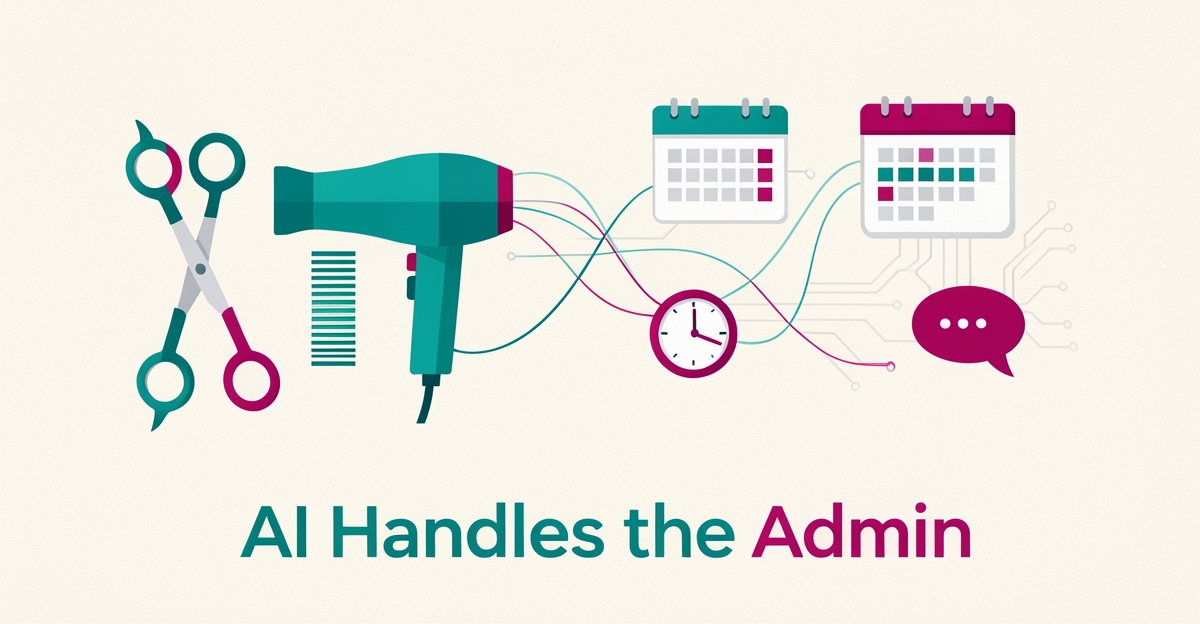
The real power of AI in beauty services isn't about replacing the stylist, it's about removing the administrative drag that steals time from the chair. When routine tasks like scheduling, inventory tracking, and client follow-ups are automated, stylists reclaim hours previously lost to non-creative work. This shift allows them to focus on what truly drives client loyalty and satisfaction: the artistry, empathy, and personalized connection that only a human can provide.
Salons that have adopted targeted automation, typically modest monthly investments in booking tools, AI assistants, and local search optimization, commonly report meaningful gains in new client volume and revenue. Meanwhile, salon platforms with AI-powered scheduling are widely used to optimize chair utilization through predictive scheduling, automated waitlist management, and 24/7 booking capabilities that reduce no-shows and maximize operational efficiency.
AI excels in specific, high-impact areas where automation creates immediate value:
- Scheduling optimization that fills gaps in real-time and reduces idle chair time
- Inventory management that tracks usage patterns and auto-reorders supplies to prevent stockouts
- Automated client communication including appointment confirmations, reminders, and personalized follow-ups
- Content creation support for social media, blogs, and marketing materials that maintains brand voice while saving hours weekly
These aren’t theoretical gains, they’re operational improvements that directly affect the bottom line. By handling the routine work identified in industry studies (editing, collage creation, dimensional checks, and the like), AI frees stylists to dedicate more time to what truly matters: creative interpretation, client consultation, and the nuanced artistry that builds lasting relationships.
AIQ Labs supports this transition through strategic change management and training, ensuring teams see AI not as a threat but as a force multiplier for their expertise. For salons that want to start with a single high-cost workflow, booking, follow-ups, no-show recovery, our AI Workflow Builds rebuild that one process at a fixed price. The goal isn’t automation for its own sake, it’s creating space for stylists to do what they do best: transform clients with skill, vision, and a human touch that no algorithm can replicate.
Implementing AI Without Losing Your Team
The biggest risk in bringing AI into a salon isn't the technology, it's how your team feels about it. When stylists hear "AI," many hear "replacement," even though the evidence tells a different story. The profession remains low-risk for automation, and job outlook projections for hairdressers and cosmetologists have remained positive in recent forecasts.
The key is framing. As practitioners in the stylist-to-digital space put it, neural networks aren't killing the stylist profession, they're killing burnout from meaningless routine. That framing matters in every staff conversation you have about new tools.
Start with low-risk, high-relief automations. Booking, reminders, and follow-ups are the natural first steps because they remove work nobody loves. Salon automation guidance consistently recommends beginning with online booking that lets clients schedule 24/7, automated reminders 24–48 hours before appointments, and post-appointment follow-ups with rebooking prompts. These tasks don't touch the artistry of the chair, they simply stop the front desk from eating your stylists' energy.
A practical rollout sequence:
- Deploy online booking with automated confirmations and waitlist management first.
- Add templated SMS and email reminders, birthday messages, and FAQ responses.
- Introduce AI as a creative assistant for captions, blog posts, and content strategy, with staff editing everything to keep their voice.
- Hold off on anything client-facing and emotionally sensitive until the team is comfortable.
Train staff to treat AI as a creative tool, not competition. Stylists who initially feared AI would threaten their careers have often found the opposite: using it for captions and hooks can grow their social reach substantially. Creative directors across the industry echo the same point, using AI takes trial and error, research, and practice. Build that practice time into training rather than expecting instant fluency.
Finally, establish workflows that keep humans in control of client relationships while AI handles the routine. The salon chair conversation, reading emotions, building trust, is a deeply human experience central to retention, and no automation should stand in front of it. AI should draft, remind, and schedule; your stylists should decide, connect, and create.
This is exactly the shift AIQ Labs supports: role-specific team training, change management strategies, and human-in-the-loop workflows so staff feel empowered rather than replaced. For salons ready to connect booking, reminders, follow-ups, and reporting into one system they own outright, our AI Operating Systems approach builds that layer in phases. The goal isn't an AI-run salon, it's a salon where your people spend their hours on what only they can do.
Still paying for 10+ subscriptions that don’t talk to each other?
We build custom AI systems you own outright. No vendor lock-in. Full control.
Not sure where to start? Ask our AI planner
Frequently Asked Questions
Will AI actually replace my stylist or hairdresser?
What part of a stylist’s job will AI take over first?
Is AI just a threat to stylists, or can it help them make more money?
Can AI really understand hair color and skin tone accurately?
Why do stylists still matter if AI can give outfit suggestions?
How do I introduce AI without my team feeling replaced?
Keep the Chair, Lose the Admin
The evidence is clear: stylists aren’t being replaced, they’re being weighed down. The threat isn’t the scissors, it’s burnout from the hours lost to routine admin, booking, and follow-ups. AI wins where it should: scheduling, reminders, inventory, and content drafts. Humans win where they must: reading emotion, translating vague requests into flattering cuts, and guiding clients through pivotal life moments. The hybrid salon is already here, automate the friction, protect the artistry. Start by mapping your own 80/20: which repetitive tasks drain your team each week, and what would happen if those hours returned to the chair? If you want a practical roadmap without the hype, start the 2-minute Fit Check at https://aiqlabs.ai/apply for a free 30-minute strategy call to identify high-ROI automation opportunities. You can also reach us directly at [email protected]. AIQ Labs supports this shift with change management and training so staff feel empowered, not replaced.
Make AI your competitive advantage — not just another tool.
Strategy, implementation and ongoing optimization. One partner, end to end.
Not sure where to start? Ask our AI planner