Can AI Replace Electricians in High-Risk Industrial Environments? The Reality Check
Key Facts
- About 51% of analyzed risks in AI systems are attributed to the AI itself, not human error, according to MIT's AI Risk Repository
- Roughly 65% of AI risks emerge after deployment, not during development, making real-world monitoring critical per MIT's analysis
- Even the most thorough individual risk framework overlooks approximately 30% of identified risks across all reviewed sources per MIT's consolidated review
- AI system safety, failures, and limitations are the most frequently addressed risk domain, cited in 76% of documents across 43 frameworks per MIT's AI Risk Repository
- CISA guidance calls for human oversight through defined operator roles and escalation paths for AI in operational technology as outlined in official OT safety guidance
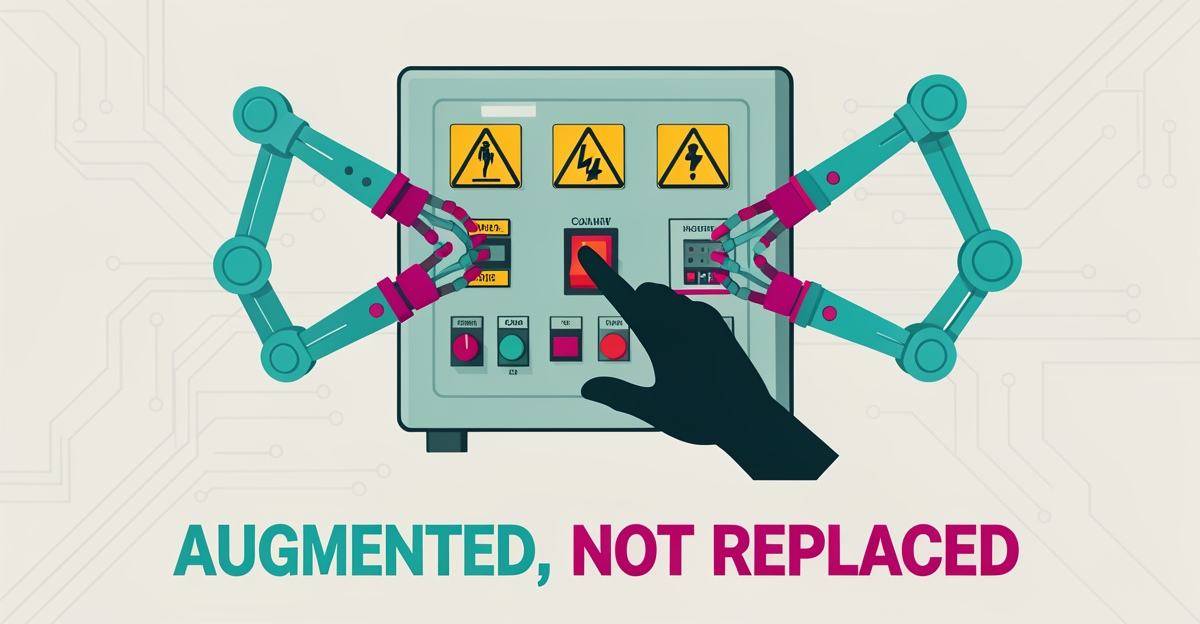
- AI augments, not replaces, skilled technicians in high-risk industrial environments where safety cannot be delegated to a model
Hire a team member that works 24/7 — for less than a part-time wage.
AI receptionists, SDRs, dispatchers and 99+ roles. Trained on your business, fully managed.
Not sure where to start? Ask our AI planner
The Dangerous Myth of Full Automation in Industrial Electrical Work
The promise of fully autonomous electrical work collides with what the risk data actually shows.
Industrial electrical tasks demand instant, context-aware judgment where a single error can cause injury, equipment loss, or downtime. The push for full automation ignores that AI failures in these settings are not theoretical, they are documented, recurrent, and often invisible until deployment.
According to MIT’s AI Risk Repository analysis, AI system safety, failures, and limitations are the most frequently addressed risk domain, cited in 76% of documents. That is not a fringe concern; it is the dominant risk theme across 43 frameworks and over 700 documented risks. The repository also finds that most risks (roughly 65%) emerge after AI is deployed rather than during development, meaning testing alone cannot guarantee safety in live electrical environments.
The attribution pattern is equally telling. The same analysis attributes about 51% of analyzed risks to AI systems as opposed to humans, who account for roughly 34%. In high-risk industrial work, that shift of risk to the system is unacceptable without robust human control.
CISA guidance on AI integration in Operational Technology reinforces this reality. Successful deployment requires comprehensive risk assessment, robust governance, continuous testing, and crucially, human oversight through defined operator roles and escalation paths. That aligns with how AIQ Labs approaches AI implementation, starting with a focused workflow build that keeps clear boundaries around human oversight, not as a replacement for skilled technicians.
Full automation also creates blind spots. Even the most thorough individual framework overlooks approximately 30% of the risks identified across all reviewed frameworks, according to MIT’s consolidated review. In electrical work, those overlooked risks can manifest as misread schematics, missed arc-flash conditions, or unsafe lockout decisions.
A realistic deployment model treats AI as augmentation, not substitution:
- Human-in-the-loop controls for critical decisions and overrides
- Pre-deployment assessment with hardware-in-the-loop and safety-critical edge cases
- Continuous monitoring for model drift, anomalies, and post-deployment risk emergence
- Defined escalation paths so electricians retain authority when AI confidence is low
AI augments, not replaces, skilled technicians in environments where safety cannot be delegated to a model. The data makes clear that system safety failures dominate risk discussions, most risks surface after deployment, and human oversight is a requirement, not an option.
What the Data Reveals: AI as Augmentation, Not Replacement
The numbers tell a story that should make every facility manager pause: roughly 51% of analyzed risks are attributed to AI systems, while humans account for about 34%, according to MIT's AI Risk Repository. This isn't evidence that AI is dangerous, it's proof that AI operates differently than human workers, with distinct failure modes that require new safety frameworks.
The repository, which documents over 700 risks across 43 frameworks, reveals that most risks emerge after deployment, not during development. This finding carries profound implications for high-risk electrical environments where a post-deployment failure could mean arc flash incidents or electrocution. The data also shows that even thorough individual frameworks miss approximately 30% of identified risks, creating blind spots that become critical when AI touches power systems.
This risk distribution explains why CISA guidance for operational technology calls for specific human oversight structures. The framework requires defined operator roles, escalation paths, and controls to verify AI outputs and override automated actions. These aren't suggestions, they're prerequisites for any AI deployment in environments where mistakes are measured in lives, not lost productivity.
The guidance outlines four non-negotiable principles for OT environments:
- Rigorous pre-deployment assessment of AI systems before they touch operational technology
- Robust governance mechanisms integrated into existing security frameworks
- Continuous testing and evaluation throughout the AI lifecycle
- Safe-failure mechanisms that allow immediate reversion to manual control
These requirements reflect a fundamental truth: AI in industrial settings functions as augmentation, not replacement. The technology excels at pattern recognition and continuous monitoring, but lacks the contextual judgment and physical dexterity that electricians rely on when diagnosing complex faults or working in unpredictable environments.
At AIQ Labs, we evaluate whether organizations can meet these requirements before building anything. We've seen too many businesses rush deployment without establishing the human oversight structures that regulators and safety experts demand. The goal isn't to slow adoption, it's to ensure that when AI augments your electrical teams, it does so within boundaries that protect both workers and infrastructure.
The 51% statistic isn't an indictment of AI; it's a roadmap for implementation. When you understand that most risks emerge post-deployment and stem from the AI system itself, you build the monitoring, escalation paths, and manual overrides that make augmentation safe. That's how you harness AI's analytical power without surrendering the human judgment that keeps industrial environments safe.
The Hidden Gaps: Why Single Frameworks Miss 30% of Risks
Overreliance on single risk assessment frameworks creates dangerous blind spots in high-risk electrical environments. According to MIT's AI Risk Repository, even the most thorough individual framework overlooks approximately 30% of the risks identified across all reviewed frameworks. This significant gap means critical safety hazards, from arc flash potentials to cascade failure scenarios, can remain undetected when assessments lack diverse expertise.
Multidisciplinary teams bridge these gaps by combining field-tested intuition with technical analysis. Electricians contribute practical knowledge of live-panel behaviors and legacy system quirks that engineers might overlook in schematics. Safety staff add regulatory awareness of lockout/tagout nuances and confined-space protocols, while engineers model complex fault currents and harmonic distortions. This collaborative approach ensures risks are evaluated through operational, technical, and compliance lenses simultaneously.
AIQ Labs builds this principle into every engagement, recognizing that effective risk identification in industrial settings requires human judgment across specialties. Rather than relying on algorithmic checklists alone, our process integrates frontline technician insights with engineering analysis to uncover hidden vulnerabilities. This mirrors CISA's guidance that successful AI deployment in operational technology demands human oversight through defined roles and cross-functional validation, especially when system errors could trigger life-threatening electrical incidents. By combining AI's pattern recognition with multidisciplinary expertise, organizations achieve risk coverage that no single framework, or autonomous system, can provide.
Building Safe AI Integration: From Readiness Assessment to Human-in-the-Loop
Building safe AI integration requires a structured approach that prioritizes human safety while leveraging technological capabilities. A readiness assessment forms the critical foundation for this process, ensuring organizations evaluate their technological maturity, data infrastructure, and workforce preparedness before any deployment begins. This pre-deployment evaluation directly addresses the finding that most AI risks emerge after deployment rather than during development, making early assessment essential for high-risk environments like industrial electrical work.
The implementation framework follows CISA guidance through layered safety controls. First, organizations must conduct comprehensive risk assessments using multidisciplinary teams that include electricians, safety officers, and technical staff, a practice aligned with workplace safety frameworks requiring hazard identification and risk reduction. Second, AI-aware threat modeling specifically examines adversarial attacks, data poisoning, and exploitation of AI-enabled features, acknowledging that roughly half of analyzed risks originate from AI systems themselves rather than human factors.
Continuous monitoring represents the third critical pillar, with systems designed to track performance anomalies, model drift, and decision traceability in real-time. This capability becomes vital given that even the most thorough individual risk framework overlooks approximately 30% of identified risks across all reviewed sources. When anomalies occur, established fallback mechanisms automatically revert control to human operators or conventional systems, maintaining operational safety during AI failures or cyber incidents.
Human oversight remains non-negotiable throughout this process, with defined operator roles, escalation paths, and verification controls ensuring technicians can override automated actions when needed. This approach directly supports CISA's emphasis on maintaining oversight through controls that verify AI outputs and enable manual intervention, a principle that reinforces why AI augments rather than replaces skilled electricians in high-risk industrial environments where split-second judgments and physical dexterity remain irreplaceable.
The AIQ Labs Approach: Drawing the Line
The hardest part of bringing AI into high-risk electrical environments isn't the technology, it's knowing where to draw the line. Deploy AI carelessly and you've added a new failure mode to a system where failures can be fatal. That's why any credible implementation starts with a structured readiness assessment, not a pilot project chosen on enthusiasm.
The stakes of getting this wrong are well documented. According to MIT's AI Risk Repository, which catalogs over 700 risks from 43 frameworks, roughly 51% of analyzed risks are attributed to AI systems themselves, and most risks emerge only after deployment, not during development. In an industrial setting, that means the danger isn't visible at the demo stage; it surfaces months later, when the system is live and people are counting on it.
This is where a readiness assessment earns its keep. At AIQ Labs, the process begins by mapping where AI genuinely creates value in an electrical operation, typically data analysis, anomaly detection, and continuous monitoring, while identifying the workflows that must never be automated. The distinction matters because the most frequently addressed risk domain across all 43 frameworks is AI system safety, failures, and limitations, cited in 76% of documents. Even the most thorough individual framework overlooks roughly 30% of the risks identified across all reviewed frameworks, which is why a multi-perspective evaluation beats any single checklist.
The assessment also establishes hard boundaries around human authority. CISA guidance on AI in operational technology environments is explicit on this point: maintain oversight through defined operator roles, escalation paths, and controls to verify AI outputs and override automated actions when needed. Translated to the electrical trade, that means:
- AI handles data analysis, monitoring, and anomaly detection, never energized work
- Licensed electricians retain final authority over all safety-critical decisions
- Defined escalation paths exist for any situation that exceeds AI's scope
- Fallback mechanisms allow systems to revert to manual control during errors or abnormal behavior
A readiness assessment also surfaces the uncomfortable findings. If the data infrastructure can't support reliable monitoring, or if the ROI doesn't justify the investment, a good assessment says so. Many companies see no return from AI investments, often because they automated the wrong things or skipped the evaluation phase entirely.
From there, the work gets built in phases. A workflow build rebuilds the one process that costs you the most, fixed price, delivered in milestones, while keeping safety-critical decisions in human hands. For operations ready to connect everything, an AI operating system layers monitoring, alerts, and scheduling across the business, built in phases and owned outright. The outcome is a clear contract: AI augments the skilled technicians you already have, and humans stay in charge of anything that can hurt someone.
Still paying for 10+ subscriptions that don’t talk to each other?
We build custom AI systems you own outright. No vendor lock-in. Full control.
Not sure where to start? Ask our AI planner
Frequently Asked Questions
Can AI actually replace electricians in high-risk industrial environments?
What makes AI risky for electrical work specifically?
When do AI risks tend to show up?
Why do single risk frameworks miss important hazards?
What does safe AI integration look like for electricians?
Is readiness assessment really necessary before piloting AI?
The Bottom Line: AI Won't Replace Electricians, But It Can Make Them Safer
The evidence is clear: AI is a powerful tool for augmenting skilled electricians, not replacing them. With most AI risks emerging only after deployment and roughly half attributed to AI systems themselves, the path forward demands human oversight, robust governance, and clear boundaries around what AI should, and shouldn't, do in high-risk electrical environments. The organizations that succeed won't be those rushing to automate everything; they'll be the ones who start with a structured readiness assessment, map where AI genuinely adds value, and establish ironclad protocols for human control over safety-critical decisions. If you're considering AI for your industrial operations, the question isn't whether to adopt it, it's whether you're ready to do it safely. Start with clarity, not hype. AIQ Labs' two-minute Fit Check at https://aiqlabs.ai/apply can help you assess whether your infrastructure, data, and workflows are ready for AI, or whether you need to address foundational gaps first.
Make AI your competitive advantage — not just another tool.
Strategy, implementation and ongoing optimization. One partner, end to end.
Not sure where to start? Ask our AI planner