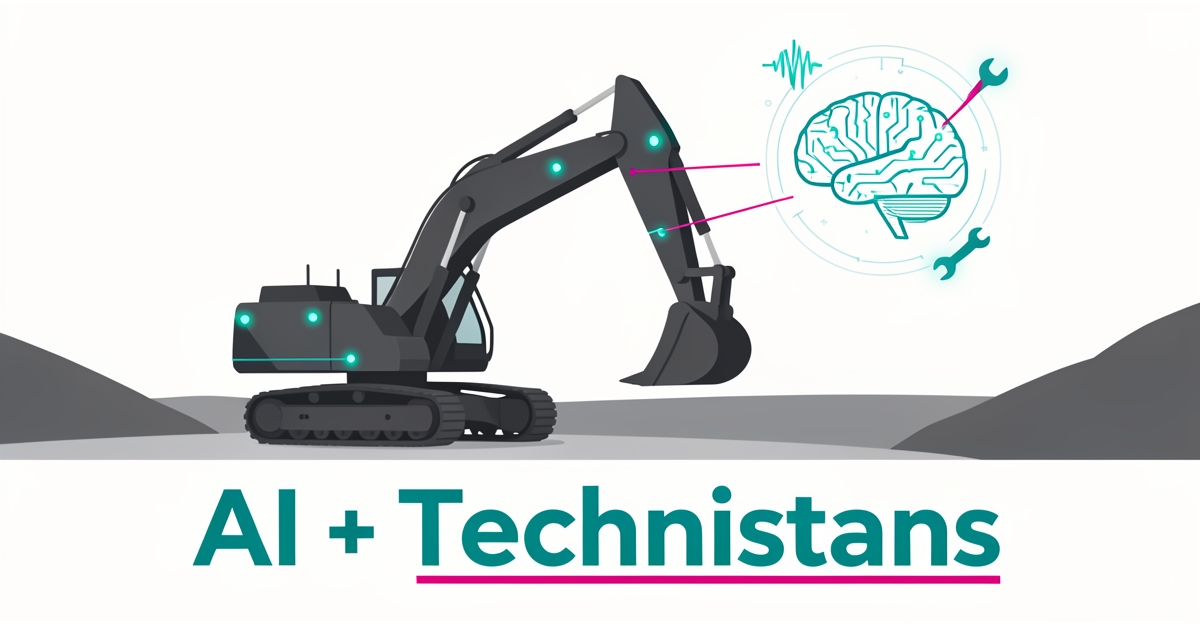
Can AI Replace Field Technicians? The Truth About AI in Mining Equipment Support
Key Facts
- 66% of frontline employees reported burnout at work according to Microsoft's 2023 Work Trend Index
- 50% of field service organizations faced delays due to resource and expertise shortages per Microsoft's 2023 Work Trend Index
- AI augments technicians by handling diagnostics, logs, and scheduling, not replacing human judgment on complex repairs
- The SanAI project found AI-driven predictive maintenance can improve equipment uptime by detecting anomalies early through sensor data analysis
- AI Employees typically cost roughly 80% less than an equivalent human hire while operating around the clock with zero missed calls
- Jaroslav Nosek emphasizes combining practical experience with AI and advanced data processing for optimal results
- AIQ Labs builds custom AI systems clients fully own, no vendor lock-in, no platform dependencies
Hire a team member that works 24/7 — for less than a part-time wage.
AI receptionists, SDRs, dispatchers and 99+ roles. Trained on your business, fully managed.
Not sure where to start? Ask our AI planner
The Technician Shortage and Burnout Crisis in Field Service
Field service is hitting a breaking point long before AI can step in. Technicians are stretched thin, organizations are short on expertise, and the pressure is showing up in burnout and delayed repairs.
According to Microsoft's 2023 Work Trend Index report, 66% of frontline employees reported being burned out at work, a signal that fatigue is not isolated but systemic across field teams.
The strain translates directly into operational risk. The same Microsoft research found 50% of field service organizations experienced delays due to lack of resources and expertise. When a technician is unavailable or overwhelmed, equipment stays down and customer satisfaction drops.
Readers in mining equipment support are asking the right question: can AI fill the gap where humans can't? The more accurate framing is augmentation, not replacement. AI can handle routine, data-heavy tasks so technicians focus on high-value judgment work.
This is where augmenting human teams with AI tools and AI Employees becomes practical. AIQ Labs approaches equipment support as a partnership between human expertise and AI assistance, not a substitution of one for the other. The goal is to reduce friction, not remove people.
In practice, AI support for technicians looks like:
- Real-time information and guidance on the job site to speed diagnostics
- Automating routine tasks and workflows such as maintenance logs and work order routing
- Improving inventory management and technician scheduling to reduce wait times
- Enhancing customer satisfaction and reducing delays through faster first-time fixes
The burnout crisis is also a retention crisis. When technicians spend hours on paperwork, chasing parts, or navigating outdated systems, their expertise is wasted on low-value work. AI can absorb those repetitive loads and surface the right context at the right moment.
Mining equipment support amplifies the challenge. Machines generate continuous sensor data, maintenance histories are complex, and downtime is costly. Technicians need real-time decision support, not more dashboards to check.
A balanced view of AI in equipment support recognizes limits. Data quality, integration with existing systems, and security all shape outcomes. Human expertise remains essential for complex diagnostics, safety-critical decisions, and customer relationships.
The question is not whether AI replaces field technicians. It is how AI can reduce burnout, close the expertise gap, and let technicians do the work only they can do.
What AI Actually Does Well: Diagnostics, Logs, and Work Order Routing
AI is proving most valuable in mining equipment support not by replacing technicians, but by handling the repetitive, data-intensive tasks that slow them down. From sensor-driven diagnostics to automated logs and smarter scheduling, AI tools are streamlining workflows so human experts can focus on complex problem-solving and on-site judgment. This shift matters given that two-thirds of frontline employees reported burnout in Microsoft's 2023 Work Trend Index, highlighting the urgent need to reduce cognitive load and administrative burden.
Sensor-driven predictive maintenance stands out as a core strength of AI in this space. By continuously analyzing vibration, temperature, and pressure data from equipment, AI models can detect subtle anomalies long before they lead to failure, enabling maintenance teams to act proactively. The SanAI project found this approach improves equipment uptime and reduces unplanned downtime by identifying patterns invisible to manual inspections. This doesn't eliminate the need for skilled technicians, it gives them earlier, more accurate warnings so they can intervene at the optimal time.
Beyond diagnostics, AI excels at automating maintenance logs and routine workflows. Natural language processing can convert voice notes or technician entries into structured, searchable logs, while automation handles ticket updates, parts ordering, and compliance reporting. These capabilities directly address the delays reported by half of field service organizations, freeing up time previously lost to manual data entry and administrative chasing.
Finally, AI enhances work order routing and technician scheduling by matching job requirements with technician skills, location, and availability in real time. Integrated with CRM and ERP systems, these tools reduce response times and improve first-time fix rates. For companies exploring AI adoption, AIQ Labs' Workflow Builds focus on rebuilding the one workflow that costs the most, often dispatch or work order routing, so technicians can focus on what machines can't: nuanced decision-making, complex repairs, and building trust with operations teams on the ground.
Why Human Expertise Still Wins the Job Site
Despite advances in AI-powered tools, human expertise remains irreplaceable on the job site, particularly in complex mining equipment support scenarios. While AI can process data and flag anomalies, it lacks the contextual judgment needed for nuanced repairs and unexpected equipment behaviors. Technicians bring years of hands-on experience that allows them to interpret subtle cues, like unusual vibrations or fluid inconsistencies, that algorithms may overlook due to incomplete or noisy data streams.
This limitation is especially critical given that 66% of frontline employees reported burnout in Microsoft's 2023 Work Trend Index, which can impair decision-making and increase reliance on accurate, real-time support systems. When technicians are fatigued, AI should augment, not replace, their ability to triage issues, prioritize safety, and apply adaptive problem-solving in dynamic environments. AIQ Labs' AI Employees reflect this balance: they handle routine diagnostics and work order routing, freeing technicians to focus on high-value, judgment-intensive tasks.
Human technicians also excel in edge cases where data is sparse or contradictory, situations where AI models often fail without sufficient training examples. As noted by Jaroslav Nosek, project lead for TUL, the true value lies in combining practical experience with AI's analytical power: "Our goal is to combine practical experience with the possibilities offered today by artificial intelligence and advanced data processing." This synergy enables faster root-cause analysis while preserving the technician's role as the final authority on repair validity and operational safety.
Ultimately, AI cannot replicate the physical dexterity, situational awareness, or accountability required for field repairs. Tasks like replacing worn components, aligning hydraulic systems, or performing welds demand tactile feedback and spatial reasoning beyond current robotic or algorithmic capabilities. Instead of viewing AI as a substitute, forward-thinking organizations use it as a force multiplier, reducing administrative burden and improving response times while keeping skilled technicians at the center of equipment reliability and site safety.
The Augmentation Playbook: Implementing AI Alongside Your Field Team
When it comes to AI in mining equipment support, the goal isn't replacement, it's smart augmentation. By focusing on one broken workflow at a time, companies can introduce AI in a way that complements their field team's expertise. AIQ Labs recommends starting with work order routing, a common pain point where delays and misassignments drain productivity and morale.
According to Microsoft's 2023 Work Trend Index, 66% of frontline employees reported burnout at work, and half of field service organizations experienced delays due to lack of resources and expertise. These pressures make streamlining workflows not just efficient, but essential for team sustainability.
Integrating AI with existing dispatch and inventory systems allows for dynamic prioritization based on equipment criticality, parts availability, and technician location, reducing response times without overhauling legacy tools. Keeping human-in-the-loop controls ensures that complex diagnostics or safety-critical decisions remain in skilled hands, while AI handles repetitive scheduling and data entry.
Technicians should be trained to use AI as a decision-support tool, not a replacement for judgment. This approach builds trust, accelerates adoption, and turns AI into a force multiplier, freeing up time for high-value tasks like root-cause analysis and preventive maintenance planning. Over time, this incremental strategy scales confidence and capability across the entire field team. For organizations ready to go further, an AI Operating System connects those individual wins into one operating layer, built in phases and owned outright.
Getting Started Without the Hype: Your First AI Win in Field Service
You don't need a massive overhaul to start seeing the benefits of AI in field service. In fact, the most successful implementations often begin with a single, well-defined bottleneck. For many organizations, this means focusing on high-friction areas like scheduling inefficiencies or dispatch delays.
Consider this: Microsoft's 2023 Work Trend Index found that 50% of field service organizations faced delays due to resource constraints, while 66% of frontline employees reported burnout. These aren't abstract problems, they're daily operational hurdles that AI can help alleviate.
The key is to start small and target a specific pain point. Rather than attempting a company-wide transformation, identify one area where AI can deliver immediate value:
- Intelligent scheduling: Optimize technician routes and appointment booking to reduce downtime.
- Automated dispatch: Streamline work order routing to ensure the right technician is assigned to the right job.
- Enhanced intake: Use AI to triage incoming service requests, improving response times and accuracy.
Once you've pinpointed your bottleneck, run a focused pilot. This allows you to test AI's impact in a controlled environment and measure tangible results. For example, research from the SanAI project highlights how AI can automate routine tasks and provide real-time guidance, freeing up technicians to focus on more complex issues.
At AIQ Labs, we advocate for a practical, no-nonsense approach. Our 2-minute Fit Check and free 30-minute strategy call are designed to help you identify your highest-ROI opportunity without any obligation. We'll assess your current systems, pinpoint potential quick wins, and map out a strategic implementation plan. If we don't see a clear path to value, we'll tell you.
The goal isn't to replace your skilled technicians but to empower them. By strategically integrating AI tools, you can augment your team's capabilities, reduce burnout, and ultimately deliver better service. The first step is simply to identify where to begin.
Still paying for 10+ subscriptions that don’t talk to each other?
We build custom AI systems you own outright. No vendor lock-in. Full control.
Not sure where to start? Ask our AI planner
Frequently Asked Questions
Can AI really replace field technicians in mining equipment support?
How does AI help reduce technician burnout in field service?
What specific tasks can AI handle in mining equipment support?
Why is human expertise still essential even with AI tools in place?
What's a practical first step for a mining company looking to use AI in field service?
Does AI improve first-time fix rates and reduce equipment downtime?
Augment, Don't Replace: The Smarter Path Forward
AI will not replace field technicians in mining equipment support, but it can relieve the pressures that are burning them out. The real value is augmentation: real-time decision support, automated logs and work order routing, smarter scheduling, and sensor-driven diagnostics that let skilled technicians focus on complex repairs, safety-critical judgment, and customer trust. With 66% of frontline employees reporting burnout at work according to Microsoft's 2023 Work Trend Index, reducing repetitive admin and surfacing the right context at the right moment is both a retention and reliability imperative. A balanced approach keeps humans in the loop for edge cases and physical work while AI handles the predictable, data-heavy tasks. If you want to see where that balance applies to your team, start with a focused bottleneck and test it. Take the 2-minute Fit Check at https://aiqlabs.ai/apply, then book a free 30-minute strategy call at https://aiqlabs.ai/book to map your highest-ROI opportunity. If we don't see a clear path to value, we'll tell you.
Make AI your competitive advantage — not just another tool.
Strategy, implementation and ongoing optimization. One partner, end to end.
Not sure where to start? Ask our AI planner