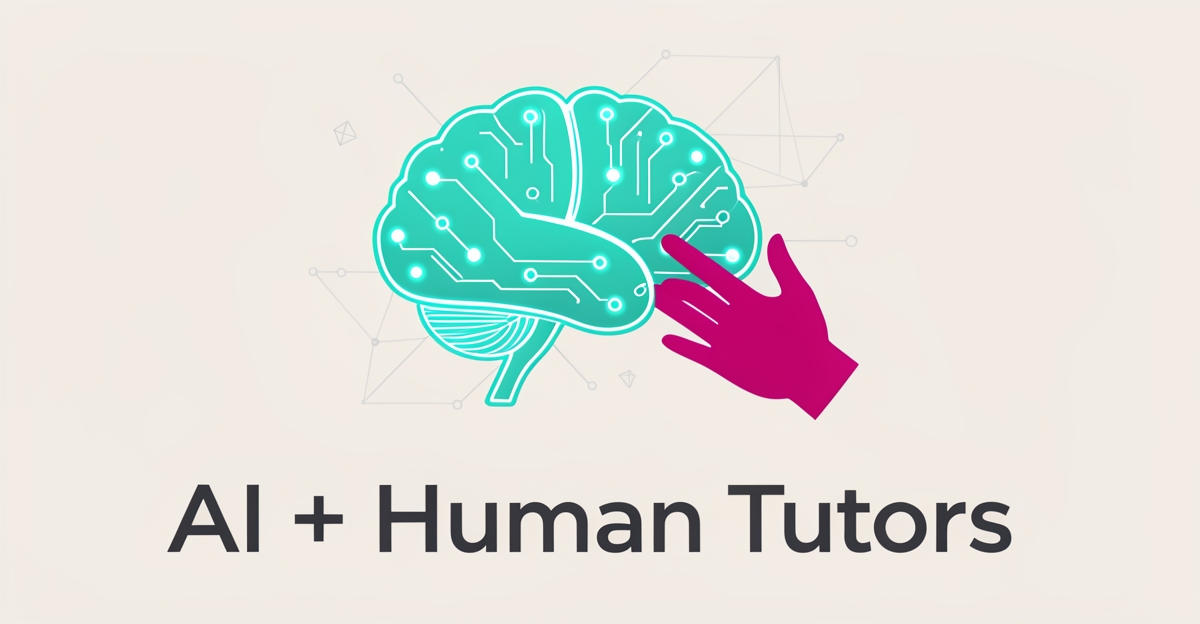
Can AI Replace Human Tutors in Online Courses? A Realistic Look at the Role of AI in Education
Key Facts
- AI tutors achieved median post-test 4.5 vs 3.5 for in-class active learning in a Harvard trial
- Learning gains were over double for AI-tutored students vs traditional in the Scientific Reports study
- 70% of AI-tutored students finished in under 60 minutes, median 49 minutes per the Harvard research
- Schoolhouse.world has served over 205,000 students with hundreds of thousands of live tutoring sessions on its platform
- The MIT AI Risk Repository documents over 700 AI risks, with roughly 65% emerging after deployment according to ZDNet
- Only about 12% of AI risk documents mention concerns about damaging information ecosystems per the MIT repository analysis
Hire a team member that works 24/7 — for less than a part-time wage.
AI receptionists, SDRs, dispatchers and 99+ roles. Trained on your business, fully managed.
Not sure where to start? Ask our AI planner
AI Tutoring Outperforms Traditional Methods in Controlled Settings
When a randomized controlled trial at Harvard University pitted AI tutors against in-class active learning, the gold standard of traditional instruction, the results challenged long-held assumptions about educational effectiveness. Students using AI tutors didn't just match their classroom-taught peers; they significantly outperformed them.
The study published in Scientific Reports found that students using AI tutors achieved median post-test scores of 4.5, compared to just 3.5 for those receiving in-class active learning. More striking still, the learning gains relative to baseline (median M=2.75) were over double for the AI-tutored group. With statistical significance reaching z=-5.6, p<10^-8, these weren't marginal improvements, they represented a substantial leap in educational outcomes.
What drove these results? The research identified several key advantages that well-designed AI tutors deliver:
- Personalized feedback that responds to individual student questions as they arise
- Adaptive pacing that adjusts to each learner's ability level, eliminating the one-speed-fits-all constraint of lectures
- Consistent engagement maintained throughout the entire learning session
- Time efficiency, 70% of students completed lessons in under 60 minutes, with a median of just 49 minutes
The Harvard researchers emphasized that their AI tutor wasn't simply an answer-generating chatbot. It was carefully designed using pedagogical best practices, including targeted, content-rich prompt engineering informed by educational psychology. This distinction matters enormously. The system managed cognitive load, fostered growth mindset, and structured interactions to promote genuine understanding rather than surface-level memorization.
This is precisely the approach that separates effective AI tutoring systems from digital gimmicks. When teams like AIQ Labs' AI Employees build AI tutors with human oversight embedded from the start, they're applying the same principle: technology amplifies good pedagogy, but it can't replace sound educational design. The AI handles personalization and scalability; the pedagogical framework ensures students actually learn.
The time efficiency finding deserves particular attention. In traditional settings, students often sit through lectures that move too quickly for some and too slowly for others. The AI tutor eliminated this mismatch, with 70% of students completing the material in less than an hour while achieving superior outcomes. That's not just more effective, it's more respectful of learners' time.
These results don't suggest human teachers are obsolete. Rather, they demonstrate that AI tutors, when properly designed, can deliver certain types of instruction more effectively than even the best traditional methods. The question isn't whether AI belongs in education, it's how to deploy it where it creates the most value.
Why Human Connection Remains Irreplaceable in Education
Human tutors deliver something no model can replicate from a prompt: presence. While AI tutors can adapt pacing and provide instant feedback, the motivational and emotional scaffolding that sustains learning remains distinctly human.
Platforms built around real connection show the scale of demand for it. Schoolhouse.world has served over 205,000 students with hundreds of thousands of sessions through peer-to-peer tutoring that emphasizes real human connection. The model pairs students with trained volunteer tutors who have been exactly where they are, offering support that is free, community-based, and delivered live via Zoom.
Student outcomes reflect more than content delivery. Testimonials on the platform describe real score improvements and dialogue sessions students would sign up for again. These stories point to motivation, encouragement, and personalized guidance that persist after the lesson ends.
Human tutors provide nuanced guidance that AI struggles to replicate:
- Emotional support and accountability that keeps students engaged when material gets difficult
- Reading subtle cues, frustration, or confidence and adjusting tone and approach in real time
- Mentorship beyond the subject, including study strategies, mindset coaching, and career advice
- Community belonging that reduces isolation in online learning environments
This is why a hybrid approach is gaining traction in the category of AI Education & E-Learning Solutions. AIQ Labs builds AI tutors that assist students while maintaining human oversight, ensuring quality and trust in course delivery. The intent is not replacement but augmentation, using AI for scalability and personalization while preserving human judgment for the moments that matter most.
Research reinforces the limits of automation alone. The MIT AI Risk Repository identifies over 700 documented AI risks, with human-computer interaction and misinformation among the least-addressed concerns. That gap matters in education, where trust, safety, and accurate feedback are foundational.
AI can manage cognitive load and deliver consistent content, as shown in controlled trials. It cannot yet replicate the relational trust that makes a student feel seen, supported, and willing to persist. In online courses, that connection remains the irreplaceable core of learning.
A Hybrid Approach: AI as a Supplement with Human Oversight
What if the most effective education system isn't a choice between AI and human tutors, but a strategic fusion of both? While Harvard research shows AI tutors can deliver personalized instruction with impressive results, students achieved median post-test scores of 4.5 compared to 3.5 for traditional active learning, the MIT AI Risk Repository documents over 700 risks, with roughly 65% emerging after deployment rather than during development. This reality demands a model where AI handles scalability while humans ensure quality and ethical integrity.
AIQ Labs builds AI tutoring systems that function as intelligent supplements rather than replacements. By leveraging AI for personalization and 24/7 availability, these systems adapt to individual learning paces and provide immediate feedback. However, human educators maintain oversight for complex problem-solving, emotional support, and ethical guidance, areas where platforms like Schoolhouse.world demonstrate the irreplaceable value of human connection through peer-to-peer tutoring serving over 205,000 students.
The hybrid approach addresses critical gaps in pure AI implementation. While the majority of AI risk documents address system safety and failures, only about 12% mention concerns about AI damaging information ecosystems. Human oversight provides the necessary guardrails for these less-addressed vulnerabilities, ensuring that AI recommendations align with pedagogical goals and ethical standards.
Effective hybrid models integrate specific roles where each excels:
- AI-driven personalization for adaptive content delivery and immediate feedback
- Human mentorship for motivation, complex problem-solving, and emotional intelligence
- Continuous monitoring to catch the majority of risks that emerge post-deployment
- Ethical guardrails to address bias and ensure equitable learning outcomes
This balanced methodology mirrors workforce transformations where AI serves as a collaborative partner rather than a replacement. By combining AI's scalability with human wisdom, educational providers can deliver personalized learning at scale without sacrificing the trust and quality that only human oversight provides. For organizations ready to move beyond a single pilot, a phased build, starting with the one workflow that costs the most, as in AI Workflow Builds, and growing toward a full AI Operating System, keeps risk low and ownership clear.
Still paying for 10+ subscriptions that don’t talk to each other?
We build custom AI systems you own outright. No vendor lock-in. Full control.
Not sure where to start? Ask our AI planner
Frequently Asked Questions
Can AI tutors actually teach better than human instructors in a classroom?
If AI tutors are so effective, why do we still need human tutors?
What are the real risks of using AI tutors in education?
How does a hybrid AI-human tutoring model actually work in practice?
Is AI tutoring just faster, or do students actually learn more deeply?
What makes an AI tutor effective versus just a chatbot that gives answers?
The Future of Learning: Augmentation, Not Replacement
The evidence is clear: AI tutors can outperform traditional instruction in controlled settings, delivering personalized feedback and adaptive pacing that help students master material more efficiently. Yet as platforms like Schoolhouse.world demonstrate through over 205,000 students served, human connection remains irreplaceable for motivation, mentorship, and emotional support. The most effective path forward isn't choosing between AI and human tutors, it's strategically combining both. AIQ Labs builds AI tutoring systems that leverage this hybrid approach, using AI for personalization and scalability while maintaining human oversight to ensure quality and trust. For educational providers and course creators, the question isn't whether to adopt AI, but how to implement it thoughtfully. Start by identifying where AI can handle personalization and immediate feedback, then preserve human involvement for complex problem-solving and emotional guidance. Ready to explore how AI tutors can enhance your educational offerings while maintaining the human connection students need? Start the Fit Check to discover your highest-impact opportunities, or book a free 30-minute strategy call to map out your implementation.
Make AI your competitive advantage — not just another tool.
Strategy, implementation and ongoing optimization. One partner, end to end.
Not sure where to start? Ask our AI planner