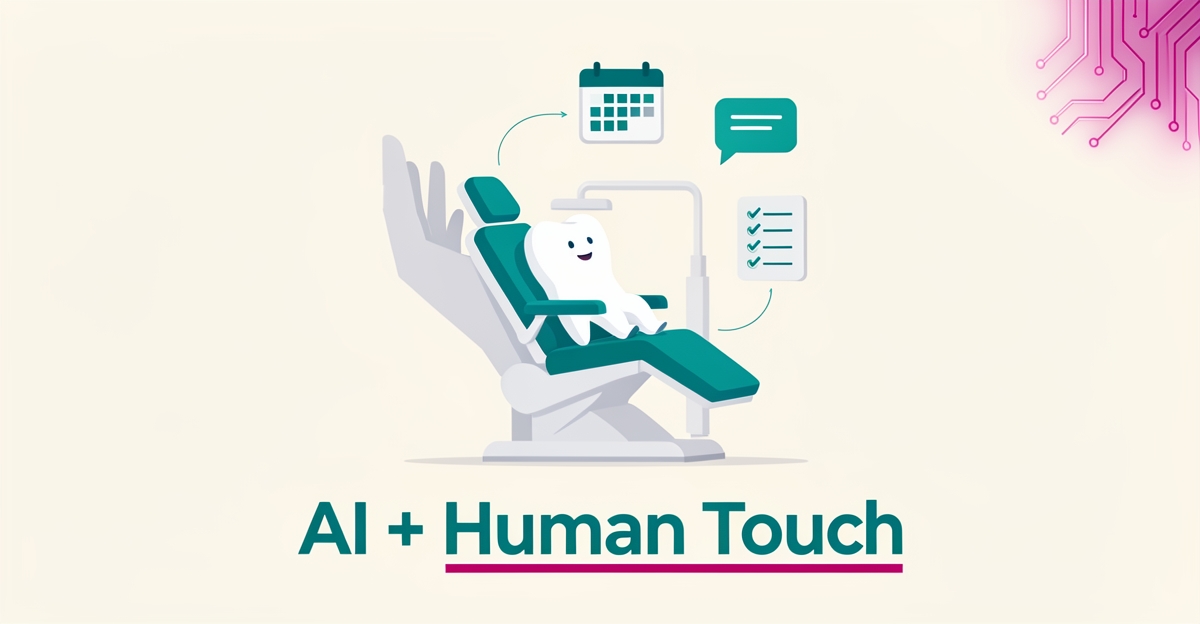
Can AI Replace the Dental Assistant? A Realistic Look at AI's Role in Pediatric Dentistry
Key Facts
- Industry analyses generally rate dental assistants as facing moderate, not high, AI automation risk, with exposure concentrated in administrative tasks rather than chairside care.
- The most automatable parts of the role are scheduling, record-keeping, insurance verification, and patient intake, repetitive, rule-based work.
- Practices adopting AI-driven admin systems commonly report meaningful productivity gains within the first few months of deployment.
- AI diagnostic support tools can flag early dental issues with high accuracy when used as decision-support aids, but they work best alongside human clinical judgment.
- Pediatric care depends on emotional regulation, trust-building, and hands-on adaptability, skills current AI cannot replicate.
Hire a team member that works 24/7 — for less than a part-time wage.
AI receptionists, SDRs, dispatchers and 99+ roles. Trained on your business, fully managed.
Not sure where to start? Ask our AI planner
The Anxiety Around AI and Dental Assistant Jobs
In pediatric dental practices, the question of whether AI will replace dental assistants weighs heavily on teams already stretched thin by staffing shortages. The anxiety isn't unfounded, as of late 2026, industry analyses consistently rate dental assistants as facing moderate automation exposure, signaling real disruption to the administrative side of the role. But the data points to a shift in responsibilities rather than wholesale elimination, particularly where human connection is non-negotiable.
In pediatric care, where calming a frightened child or reading subtle emotional cues during a procedure defines success, AI's limitations become clear. While algorithms excel at scheduling appointments, processing insurance claims, or organizing patient records, tasks that account for a substantial portion of administrative workload, they cannot replicate the empathy required to soothe a toddler's first dental visit or adapt mid-procedure when a child unexpectedly panics. These uniquely human skills, rooted in emotional intelligence and real-time judgment, remain beyond AI's current reach, especially in settings where trust is built through tone, touch, and patience.
For practices navigating this transition, the focus is increasingly on augmentation rather than replacement. AI tools can take over repetitive data entry, appointment reminders, and record-keeping, freeing dental assistants to concentrate on what matters most: building rapport with young patients, assisting with complex procedures, and responding to the unpredictable moments that define pediatric dentistry. By leveraging AI for efficiency in the background, teams can redirect their energy toward the interpersonal and clinical nuances that technology cannot mimic, ensuring that innovation enhances, rather than erodes, the human core of pediatric dental care. AIQ Labs supports this evolution with AI Employees that handle routine workflows, allowing dental teams to focus on the compassionate care that defines their practice.
What AI Actually Automates in Pediatric Dentistry
Artificial intelligence is already reshaping daily operations in pediatric dental practices by taking over repetitive, data-heavy tasks that once consumed significant staff time. Practices implementing AI-driven admin systems commonly report noticeable productivity gains within the first few months, allowing teams to redirect focus toward patient interaction and clinical support. Automated scheduling and patient communication tools handle appointment bookings, reminders, and follow-ups without manual entry, reducing no-shows and freeing up front desk capacity for more nuanced responsibilities.
In the revenue cycle, AI streamlines insurance verification and claim processing with measurable impact, automated payment posting and claim scrubbing cut manual processing time significantly and help catch errors before submission, reducing denials and accelerating reimbursement cycles. This matters in an environment where many practices report rising claim denials year over year. Preliminary diagnostic analysis also benefits: AI tools can flag early signs of dental issues with high accuracy when used as decision-support aids, though they work best alongside, not instead of, human clinical judgment.
- Automated appointment scheduling and reminders
- Insurance eligibility verification and claim scrubbing
- Payment posting and revenue cycle management
- Radiograph analysis for early caries detection
- Patient intake form processing and data entry
While AI excels at these structured, rule-based functions, it cannot replicate the human elements essential to pediatric care, such as calming a frightened child, adapting communication to developmental stages, or providing chair-side reassurance during procedures. AIQ Labs designs AI Employees to handle these automatable workflows, working alongside dental assistants to enhance efficiency without replacing the irreplaceable human touch in patient care. By offloading administrative burdens, AI allows staff to invest more time in building trust, delivering personalized education, and supporting complex clinical workflows where judgment and empathy are paramount.
Why Human Dental Assistants Remain Irreplaceable in Pediatric Care
Pediatric dentistry demands more than efficiency; it requires the steady hands and calm presence that only a trained human can provide. While AI is reshaping back-office work, the bedside skills that define pediatric care remain firmly human.
Current industry analyses support a measured view of risk. Dental assistants carry a moderate automation risk score, and that exposure is concentrated in repetitive, rule-based work such as scheduling, record-keeping and appointment follow-up, not in direct patient interaction.
Human skills are the differentiator in pediatric settings. Managing anxious children requires real-time emotional reading, storytelling, and co-regulation that AI cannot replicate. Complex hands-on procedural assistance, adapting to unpredictable movements, and responding to sudden distress demand adaptability and critical thinking in the moment. Building trust with a child and family over time is a relational skill set, not a data task.
Skills overlap analysis reinforces this. The role shares substantial skills overlap with occupations like occupational therapy assistants, physical therapist assistants, and social workers, fields grounded in empathy, communication, and nuanced human support rather than pure data processing.
The comparison of work types is clear:
- AI-driven tasks are repetitive, rule-based and data-driven, such as scheduling and preliminary diagnostic support.
- Human-centric tasks are complex, nuanced and emotionally driven, such as patient comfort, complex procedures and emergency response.
- Future outlook shows automation rising for admin, while human skills remain essential and highly valued.
This is where upskilling creates value. Dental assistants can focus on areas AI augments rather than replaces, using the time freed by automation for enhanced patient care.
Upskilling opportunities that align with pediatric care include:
- Enhanced patient care and rapport building to reduce anxiety
- Complex procedural assistance and hands-on dexterity
- Problem-solving and critical thinking for unpredictable scenarios
- Technology proficiency to work alongside AI tools
AIQ Labs works with practices through AI Workflow Builds that handle data entry, record-keeping and appointment follow-up, enhancing rather than replacing existing staff. That approach improves efficiency without compromising the human connection central to pediatric dentistry.
Augment, Don’t Replace: Building an AI-Supported Pediatric Team
The fear that AI will replace dental assistants overlooks how technology actually transforms roles in healthcare settings. Rather than eliminating positions, AI excels at handling repetitive, data-intensive tasks that consume valuable staff time, freeing dental assistants to focus on what humans do best: providing empathetic, complex care. Industry analyses as of late 2026 consistently rate dental assistants at moderate automation risk, with significant potential for AI to streamline administrative workflows without replacing the core human elements of the role.
AI-powered systems can automate time-consuming responsibilities like appointment scheduling, insurance verification, and patient record management, tasks highly susceptible to automation due to their rule-based, data-driven nature. Practices implementing such solutions commonly report tangible efficiency gains within the first few months of adoption. This shift allows dental assistants to redirect their energy toward patient interaction, procedural support, and clinical judgment, areas where AI currently falls short due to limitations in emotional intelligence and physical dexterity.
AIQ Labs supports this augmentation approach through three entry points. AI Employees provide managed AI staff, receptionists, schedulers, and other roles, at a fraction of the cost of a human hire, deployed monthly with predictable costs. AI Workflow Builds rebuild the one workflow that costs your practice the most, at a fixed price and in phases. And AI Operating Systems connect everything into one operating layer your practice owns outright. Whichever path fits, the goal is the same: technology handles the routine so your team can focus on the irreplaceable human connection at the heart of pediatric dental care. Start with the two-minute Fit Check to see which entry point matches your practice.
Still paying for 10+ subscriptions that don’t talk to each other?
We build custom AI systems you own outright. No vendor lock-in. Full control.
Not sure where to start? Ask our AI planner
Frequently Asked Questions
Will AI actually replace my dental assistant job in a pediatric practice?
What specific tasks can AI automate in a pediatric dental office?
Why can't AI handle the patient care side of pediatric dentistry?
How accurate is AI when it comes to dental diagnostics?
What skills should dental assistants focus on to stay relevant with AI adoption?
How can AI help with dental insurance claims and billing issues?
The Human Advantage in an AI-Augmented Practice
AI is reshaping pediatric dentistry by taking on repetitive, data-heavy work, scheduling, insurance verification, claim scrubbing, payment posting and radiograph analysis, while dental assistants remain essential where empathy, adaptability and hands-on care matter most. Current analyses point to augmentation, not elimination, freeing teams to focus on calming anxious children, building trust and managing unpredictable clinical moments. Practices that lean into this shift can redirect staff time from admin to patient care, with efficiency gains typically showing up within the first few months of adoption. The future role is upskilled and AI-enabled, not replaced. AIQ Labs supports this evolution with AI Employees, AI Workflow Builds, and AI Operating Systems that handle routine workflows so pediatric teams can focus on the compassionate care that defines their practice. Start the two-minute Fit Check at https://aiqlabs.ai/apply to map your biggest bottleneck, then book a free 30-minute strategy call to explore your highest-ROI automation opportunities.
Make AI your competitive advantage — not just another tool.
Strategy, implementation and ongoing optimization. One partner, end to end.
Not sure where to start? Ask our AI planner