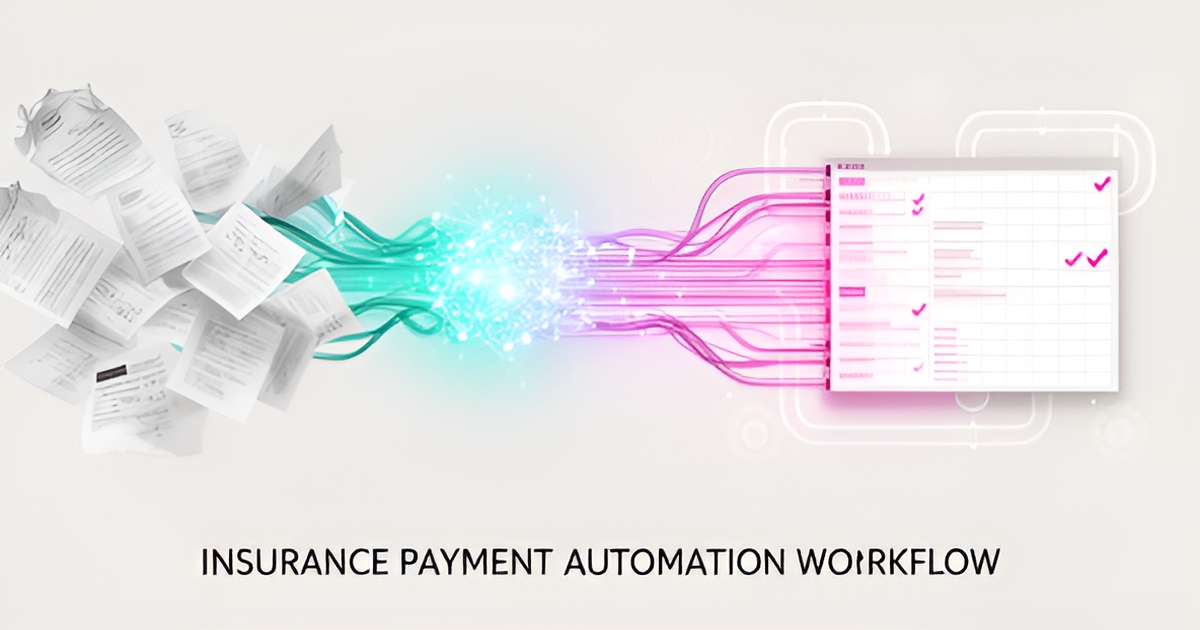
Finance Payment Automation for Insurance Accounting Processes
Key Facts
- Legacy insurance systems cause settlement delays of 60 to 120+ days after claim approval, according to industry analysis.
- One insurer's legacy ERP bank reconciliation module achieved auto-match rates of just 25-30%, per vendor case studies.
- After implementing transaction-level matching, Pan-American Life's auto-match rate jumped from 25-30% to over 96%.
- Insurers using advanced matching tools report a 96% decrease in time spent on reconciliation and 75% faster close cycles.
- 51% of claimants who hired an attorney received a higher payout than initially offered, one analysis found.
- A global insurance leader saved 2,000+ hours monthly through reconciliation automation.
- McKinsey predicts more than half of claims processing activities will be managed by technology in 2025.
One AI employee doing one job, 24/7, for less than a part-time wage.
Receptionist, lead follow-up, intake or dispatch. Trained on your business and fully managed. From $700/mo.
The Settlement Gap
The claim is approved. The check clears. Then the money moves.
This transition from approval to payment is where most insurance firms lose control. It is the settlement gap.
Once a claim clears triage, it enters the accounting phase for settlement. This step involves calculating final amounts, managing partial payments, and coordinating with billing systems.
Most legacy systems fail here. They treat this phase as a separate, manual task. Data must be re-entered across disconnected platforms.
This friction creates significant delays. Legacy systems often result in processing delays of 60, 90, or even 120+ days according to industry analysis.
The root cause is a lack of transaction-level intelligence. Traditional ERP modules often only perform simple 1:1 matches. They cannot handle complex scenarios like one-to-many or many-to-one matching.
This limitation is quantifiable. A Pan-American Life Insurance client using a legacy module saw an auto-match rate of only 25–30% per vendor case studies.
Manual reconciliation is slow and error-prone. It creates a bottleneck that frustrates staff and customers alike.
The specific pain points include:
- Disconnected financial systems causing data silos between claims and general ledgers
- Inability to automate suspense, custodial, and Fed rec accounts
- High volume of manual data entry for journal entries
- Lack of traceability for audit trails required by IFRS 17 and GAAP
Modern automation shifts the focus from balance-level checks to transaction-level matching. This approach identifies breaks and resolves exceptions automatically.
Leading implementations report a 96% decrease in time spent on reconciliation using advanced matching tools.
The goal is not to replace accountants. It is to remove the repetitive noise.
AIQ Labs builds custom AI systems that bridge this gap. These systems verify, match, and reconcile data across disparate platforms.
This ensures payments are accurate, timely, and properly recorded. You gain full ownership of the solution, avoiding vendor lock-in.
Transaction-Level Intelligence
The gap between what legacy accounting tools can match and what insurance accounting actually requires is where most reconciliation hours disappear. Simple balance-level checks, like comparing a bank balance to a general ledger total, tell you something is off. They rarely tell you what.
Traditional ERP bank reconciliation modules typically perform only 1:1 matching, such as tying a check number to a single ledger entry. That approach breaks down fast in insurance, where one premium payment might cover several policies, or one carrier settlement bundles dozens of claims into a single deposit. According to industry case data, one insurer's legacy ERP module achieved auto-match rates of just 25-30%, meaning the vast majority of transactions still landed on an accountant's desk.
This is where transaction-level intelligence changes the math. AI agents built on multi-agent architectures can reason through the messy matching scenarios that rule-based tools can't handle:
- One-to-many matching, where a single settlement payment maps to multiple claims or policies
- Many-to-one matching, where several customer payments roll up into one bank deposit
- Suspense, custodial, and Fed rec account reconciliation, where partial payments and timing gaps create routine breaks
- Exception identification, where the system flags only the transactions that genuinely need human judgment
The results from insurers who have made this shift are substantial. In the Pan-American Life case, auto-match rates jumped from that 25-30% baseline to over 96% after implementing intelligent transaction-level matching. The same reported outcomes include a 96%+ reduction in time spent on reconciliation and close cycles running 75% faster. These are vendor-reported figures, so treat them as directional, but the pattern is consistent across implementations.
The design philosophy matters as much as the match rate. AI shouldn't replace the accountants; it should absorb the repetitive matching work so skilled people can focus on exception review and financial analysis. That's the approach AIQ Labs takes with its custom reconciliation systems: agents verify and match the routine 90-96% of transactions automatically, apply validation layers before anything posts to the ledger, and escalate genuine exceptions to humans with full audit trails attached. Every match, adjustment, and journal entry remains traceable from source system to general ledger, which is exactly what IFRS 17, GAAP, and Solvency II reporting demand.
For insurance accounting teams, the practical takeaway is this: if your reconciliation tool can only match one check to one entry, you don't have an automation problem. You have an intelligence problem, and it's solvable.
Compliance and Audit Trails
Regulators don't accept "the AI decided" as an answer. When you automate insurance payments and reconciliation, every dollar that moves needs a documented trail: where the data came from, what logic matched it, and who signed off on the exception. Full traceability isn't optional in insurance accounting, it's the baseline that keeps you compliant with NAIC guidance, IFRS 17, GAAP, and Solvency II.
The NAIC has issued guidance requiring insurers to verify that AI-driven processes remain fair, transparent, and unbiased. That means any automation touching claims settlement or financial reporting needs to expose its reasoning, not hide behind an opaque model. Industry analysis from n2uitive reinforces this: the goal is to support adjusters and accountants, not replace their judgment.
AIQ Labs builds systems with that principle baked in. Every automated action logs its inputs, its matching logic, and its output, creating a complete audit trail from the source system to the general ledger. When a transaction falls outside normal parameters, the system flags it and routes it to a human reviewer rather than forcing a decision.
The controls that matter most in a regulated environment look like this:
- Validation layers that verify every action before it executes against your ledger
- Human-in-the-loop escalation when a situation exceeds the AI's configured authority
- Complete logging of every match, adjustment, and journal entry for auditor review
- Guardrails that set hard limits on what the system can do without approval
This approach also solves a practical problem. Trintech's insurance research notes that the relationship between accounting and operational activities has historically been a "pitch-this-over-the-wall" exercise with insufficient transparency. Integrated reconciliation with built-in audit trails closes that gap by giving both teams a shared, documented record.
For your auditors, this means you can trace any payment back to its origin claim, show the matching logic applied, and identify the human who approved any exception. No reconstruction after the fact. No spreadsheets held together with hope.
The result is automation you can defend. The AI handles the repetitive matching and data entry, your team retains authority over the decisions that carry risk, and your compliance documentation writes itself along the way. That's how you get the efficiency gains without adding regulatory exposure.
Owning Your Automation Stack
Every reconciliation platform you subscribe to is a bill you pay forever, and every policy your accounting team touches still gets processed on someone else's rules. For insurance firms weighing how to automate payments and reconciliation, the real decision isn't which vendor to pick. It's whether you want to rent automation or own it.
The subscription model dominates this space. Most reconciliation and payment automation tools on the market are SaaS point solutions, priced monthly and configured around generic accounting logic. That works until it doesn't. Insurance accounting is structurally different from standard bookkeeping because each policy generates multiple transaction types: premium billing, commissions, carrier settlements, and trust accounting, which is why industry analysis identifies reconciliation as one of the largest accounting bottlenecks in the sector. Generic SaaS often can't encode your specific accounting policies, your suspense account conventions, or your carrier settlement rules.
The performance ceiling matters too. A Pan-American Life Insurance client running a legacy ERP bank rec module achieved only a 25–30% auto-match rate, improving to over 96% only after moving to transaction-level automation that handles one-to-many and many-to-one matching across suspense, custodial, and Fed rec accounts, according to case studies in the insurance sector. Point solutions that only do 1:1 matching leave most of the work on your team's desk.
This is where the ownership argument gets concrete. A custom-built system becomes a digital asset rather than a recurring expense:
- Long-term cost control: no per-seat or per-transaction subscription creep as claim volumes grow.
- Customization depth: the system encodes your accounting policies, not a vendor's defaults.
- Integration freedom: direct connections to your claims platform, billing system, and general ledger without waiting on a vendor's roadmap.
- No lock-in: your data, code, and logic stay yours if priorities change.
The stakes of getting this right are real. When settlement and payment phases run on disconnected systems, delays and reconciliation errors follow, and the financial consequences can be severe: one analysis found that 51% of claimants who hired an attorney received a higher payout than initially offered. Slow, error-prone payment processes invite exactly that outcome.
AIQ Labs builds these systems as owned infrastructure. Its approach uses multi-agent architectures to handle the transaction-level matching that legacy modules can't, with full audit trails and human-in-the-loop controls so the automation stays transparent and compliant with NAIC guidance and GAAP reporting requirements. Clients can build in milestones, paying per phase and keeping everything shipped so far, or own the system outright, with code, agents, and data transferring on completion.
The math over a five-year horizon tends to favor ownership for firms with meaningful claim volume. The subscription is predictable, but so is the dependency. Owning the system means the automation improves as your team refines it, and the asset appreciates instead of the invoice.
Still paying for 10+ subscriptions that don’t talk to each other?
We build connected AI systems you own. Pay upfront or on a payment plan; the code is yours once it’s paid off.
Frequently Asked Questions
Why does money get stuck after a claim is approved?
Our ERP already does bank reconciliation, why isn't that enough for insurance?
What kind of improvement can we realistically expect from automating reconciliation?
If AI handles our payments, how do we prove compliance to auditors?
Will automation replace our accounting team?
Why build a custom system instead of subscribing to a reconciliation SaaS tool?
From Settlement Gap to Strategic Advantage: The Insurance Accounting Decision That Compounds
The settlement gap isn't a technology problem, it's an intelligence problem. Legacy ERP modules that only perform 1:1 matching leave 70% or more of transactions on your accountants' desks, and that friction compounds into 60-, 90-, even 120-day delays. Transaction-level intelligence changes the math: AI agents that reason through one-to-many and many-to-one matching, suspense and custodial accounts, and exception routing push auto-match rates from that 25–30% baseline to 96% and beyond in reported implementations. But efficiency without traceability is a liability. Every match, adjustment, and journal entry needs a documented trail that satisfies NAIC guidance, IFRS 17, GAAP, and Solvency II. And the ownership question matters as much as the technology: renting point solutions indefinitely means renting your accounting logic too. The practical next step is a focused assessment of where your reconciliation hours actually go, the exceptions, the manual journal entries, the systems that don't talk to each other. That's exactly what AIQ Labs maps in a free 30-minute strategy call, with no obligation and no pitch. Start with the two-minute Fit Check at aiqlabs.ai/apply, then book your call at aiqlabs.ai/book.
See what AI would actually do in your business, in 60 seconds.
The planner shows which step fits, the agents we’d build and the published price. No email needed.