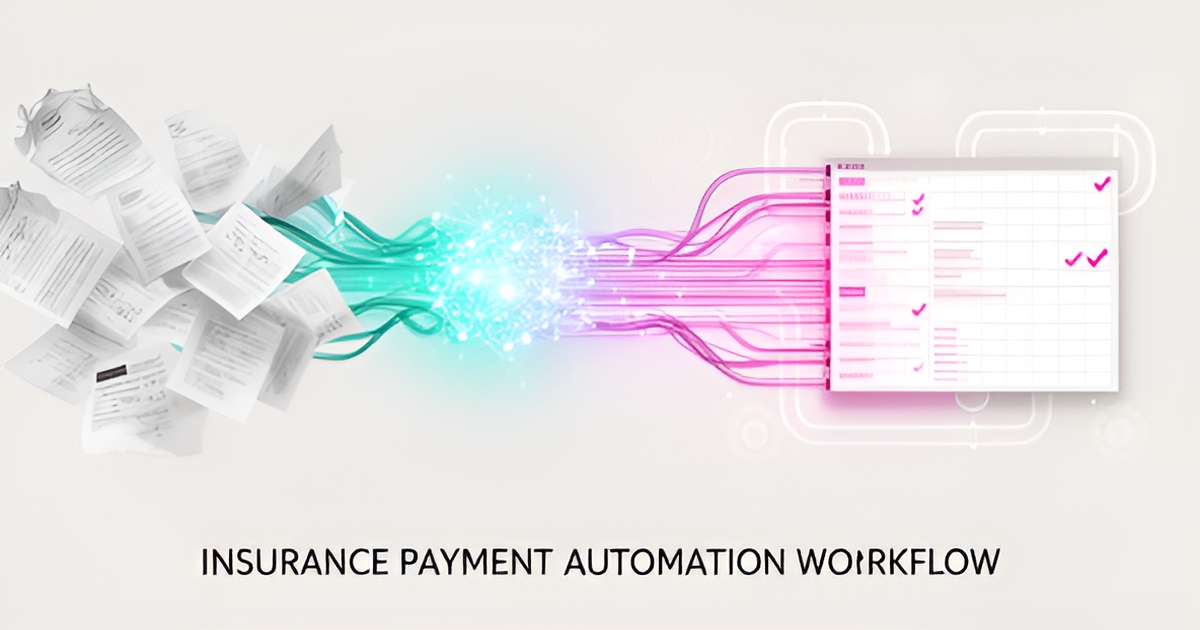
Finance Payment Automation for Insurance Accounting Processes
Key Facts
- 70% of claims documents arrive as unstructured data, but a document intelligence pipeline achieved 70% automatic extraction with near real-time processing, per the EY case study.
- A multiline insurer cut claims costs by $37.4 million over four years while boosting productivity 25% and reducing handoffs 40%, according to Cognizant.
- Insurance AI leaders generated 6.1x the Total Shareholder Return of laggards over five years, McKinsey research shows.
- Only 45% of surveyed US insurance executives believe gen AI's benefits outweigh its risks, Deloitte's survey of 200 executives found.
- 76% of US insurers have implemented gen AI in at least one business function, yet most initiatives remain stuck in the scoping stage, per Deloitte's adoption data.
- Lack of business line support, not underfunding, was the top-cited reason insurance AI implementations failed, Deloitte reports.
- Regulators may require insurers to explain exactly how AI tools are used in claims decisions, with the insurer fully responsible for compliance, per NAIC guidance.
One AI employee doing one job, 24/7, for less than a part-time wage.
Receptionist, lead follow-up, intake or dispatch. Trained on your business and fully managed. From $700/mo.
Why Insurance Payment Workflows Break at the Reconciliation Step
Insurance payment workflows rarely fail at the initial intake. They break when the data hits the reconciliation step.
You manage two distinct cash flows. Premiums come in, while claims, refunds, and broker commissions go out. Each direction demands precise matching.
The problem starts with the documents. Most claims arrive as unstructured images or PDFs. Bills, invoices, and medical diagnoses lack standard formatting.
A Nordic insurer documented this friction. Agents had to manually open every file. They examined and categorized each scan by hand. This process stalled the entire payment cycle.
Manual review creates a bottleneck. It delays disbursements and frustrates policyholders. The cost isn't just time. It’s operational drag.
Consider the scale of the issue. Industry analysis confirms that 70% of claims documents arrive as unstructured data. Without automation, your team processes this volume manually.
Reconciliation requires matching these payments to invoices. It also demands splitting revenue across partners. Finally, it feeds clean data into your accounting system.
Manual reconciliation fails in three specific ways:
- Data fragmentation prevents real-time visibility into cash flow status.
- Human error introduces discrepancies that require costly corrections later.
- Delayed settlements damage customer relationships and carrier trust.
A well-run payment system eliminates this manual work. It reduces errors and maintains predictable cash flow. Payment processing frameworks show that automated reconciliation matches payments in real time. This feeds accurate data directly to your ledger.
The solution isn't just faster typing. It's structural change. Consulting firms warn against layering AI on top of broken processes. You must rewire the workflow end-to-end.
AIQ Labs approaches this by rebuilding the workflow. We integrate document intelligence with payment routing. This ensures every claim matches its invoice automatically.
The goal is clean data. It moves from the claim to the ledger without human intervention. This reduces handoffs and accelerates the close.
You don't need to guess where the money went. You need a system that tells you instantly.
What Actually Works: Document Intelligence Plus Process Redesign
The insurers seeing real results from payment automation aren't the ones buying a single tool. They're the ones pairing document intelligence with a genuine redesign of how the work flows. That combination is what separates measurable gains from stalled pilots.
Consider the unstructured data problem first. At a Nordic insurer, claims agents had to manually open individual images and PDF scans of bills, invoices, cash receipts, and medical diagnoses, then examine and categorize each one. The fix was a document intelligence pipeline combining image cleansing, layout analysis, OCR, and NLP, which converted that unstructured data into structured records fed directly into the core claims system. According to the EY case study, 70% of documents are now extracted and interpreted automatically, with near real-time processing, and the system keeps improving as it processes more documents. Just as important, outputs flow through a controlled set of confidence levels, avoiding a black-box implementation, so humans review what falls below threshold.
But extraction alone doesn't produce the financial results. When Cognizant worked with a multiline insurer, the engagement analyzed 80 claims-related processes, eliminated non-value-adding activities, standardized rote tasks for automation, and built automatic routing routines. The redesign produced an intake workflow manageable by a single person, fewer repeat information requests, and faster disbursements. The numbers: a 25% increase in claims processing productivity, a 40% reduction in handoffs, and $37.4 million in cost reductions over four years, as documented in the Cognizant case study.
McKinsey draws the same conclusion from a different angle. Insurers, they argue, must "deeply, fundamentally rewire" operations rather than layering AI on top of existing processes, or worse, inserting an extra step in a workflow with an unnecessary AI tool. Their research on insurers who did this well shows domain-level rewiring delivering 10-20% improvements in conversion rates and 20-40% reductions in customer onboarding costs. Best-in-class players revamp one function comprehensively, like claims, instead of scattering use cases across the organization.
That end-to-end philosophy is how we approach payment automation at AIQ Labs: rather than bolting a tool onto a broken process, we rebuild the workflow itself, from document intake through extraction, approval routing, payment scheduling, and reconciliation into the accounting system. Clean data flowing straight into your books is the outcome that matters, because that's where month-end close time and reconciliation errors live.
The pattern across all three sources is consistent:
- Automate document extraction first, since unstructured paperwork is the core barrier
- Redesign the surrounding process, eliminating handoffs and non-value-adding steps
- Route results through confidence levels so humans review what needs judgment
- Feed structured output directly into the claims and accounting systems
None of these work in isolation. The 70% extraction rate and the $37.4 million in savings came from the same underlying discipline: treat the workflow as the unit of change, and let the technology serve it.
The Governance Layer Regulators Expect You to Build
Speed without a governance layer is a liability in insurance finance. The moment an AI system touches a claims payment decision, it enters territory regulators already watch closely.
The NAIC's position on AI in insurance is clear: state regulators may require insurers to explain exactly how AI tools are used in claims decisions, and the insurer stays fully responsible for compliance, fairness, and accuracy. NAIC also emphasizes that AI is more likely to support human workers than replace them, with claims professionals retaining judgment and review roles. Translation: any payment automation you deploy has to be explainable to a regulator and supervised by a person.
The risks are concrete, not theoretical. Deloitte's survey of 200 US insurance executives flags algorithmic bias in claims processing, hallucinations, and "black box" opacity that makes regulatory explainability harder. Only 45% of surveyed leaders said they believe gen AI's benefits outweigh its risks, and that skepticism is sharpest among smaller insurers.
The good news is that governance has a proven design pattern. When a Nordic insurer automated claims document processing, EY built the pipeline with a controlled set of confidence levels, avoiding black-box implementation. Documents the system could extract with high confidence flowed straight through; everything else routed to a human. The result was 70% automatic extraction with near real-time processing, and no unreviewed AI decision touching a payment.
That's the pattern worth copying, and it breaks down into a few non-negotiables:
- Confidence thresholds that route uncertain extractions and payment matches to human review, so automation only acts when it's demonstrably right.
- Human-in-the-loop escalation for anything that exceeds the AI's authority, which NAIC's guidance treats as a baseline expectation rather than an option.
- Complete audit trails on every decision, since regulators may ask you to reconstruct why a claim was paid, adjusted, or held.
- Explainability by design, so a claims professional can interpret, accept, or override any output.
Treat governance as a design requirement from day one, because retrofitting explainability onto a black-box system rarely works. This is why AIQ Labs builds validation layers, guardrails, and audit logging into its insurance payment automation builds before a single claim payment moves, rather than bolting them on after. McKinsey's research on AI in insurance makes the same point from the strategy side: insurers that rewire processes end to end capture the value; those that layer AI on top of existing workflows mostly don't. Governance belongs in that rewiring, at the architecture stage, where it costs almost nothing to include and a fortune to add later.
How to Scope and Sequence an Insurance Payment Automation Build
You don't need a twelve-month roadmap to start. You need one workflow that bleeds the most time, and a delivery model that lets you stop if it isn't working.
For most insurance finance teams, that first workflow is either invoice and AP automation or claims document intake. The intake side is where the pain concentrates: a Nordic insurer's manual process required agents to open individual images and PDF scans, including bills, invoices, cash receipts, and medical diagnoses, before any of it could be processed. An OCR and NLP pipeline achieved 70% automatic extraction with near real-time handling, and the system improves as it processes more documents.
That is the case for starting narrow. AIQ Labs delivers this through Build in Milestones: one workflow, split into phases, paid per phase as it ships. You approve each phase, and if you stop, you keep everything built so far. Scope options run from a single workflow fix to a full department system, so the first build stays proportionate to the problem.
Sequencing looks like this:
- Pick the workflow with the highest manual cost, usually invoice/AP or claims intake.
- Map it end to end before automating anything, since point tools layered on broken processes don't hold.
- Ship phase one, measure, then decide whether phase two is worth funding.
- Connect reconciliation and clean data handoff to your accounting systems once intake is stable.
The sequencing rule comes from the research, not from us. Cognizant's work with a multiline insurer analyzed 80 claims-related processes and combined process redesign with automation, producing a 25% productivity increase and 40% fewer handoffs. McKinsey is blunter: processes need revamping end to end rather than layering AI on top of them, or inserting an extra workflow step with an unnecessary AI tool.
Then there's the gap most builds fall into. McKinsey calls change management "half the effort" and says insurers should spend at least another dollar on adoption and scaling for every dollar of development. Deloitte's survey of 200 US insurance executives found lack of business line support was the top-cited reason implementations failed, ahead of data foundations and legacy IT. Underfunding wasn't a major factor. That means your finance and claims staff need to be in the room from phase one, not handed a finished tool at the end.
Governance belongs in the sequence too. Regulators may require insurers to explain how AI is used in claims decisions, and the insurer remains responsible for compliance and accuracy. Confidence thresholds, human review, and audit trails aren't add-ons you bolt on later. They're phase-one requirements.
If you're weighing where to start, the Fit Check takes two minutes, and the free 30-minute strategy call is a working session with an AI engineer to map your biggest bottleneck. If there's no clear win, we'll tell you that.
Still paying for 10+ subscriptions that don’t talk to each other?
We build connected AI systems you own. Pay upfront or on a payment plan; the code is yours once it’s paid off.
Frequently Asked Questions
Why does insurance payment automation usually fail at reconciliation?
How much of our claims paperwork can actually be automated?
What kind of results have insurers seen from payment and claims automation?
Can we just buy an AI tool and layer it on top of our existing process?
Will regulators allow AI to be involved in claims payment decisions?
Where should an insurance finance team start with automation?
See what AI would actually do in your business, in 60 seconds.
The planner shows which step fits, the agents we’d build and the published price. No email needed.
What would AI do for your business?
Pick what eats your week. In about a minute you'll see which step fits, the agents we'd build and the published price. You don't need to give an email to see it.
AI agents from $700/mo · AI departments from $15K · company systems from $50K. Or book 30 minutes
Related Resources
AI payment automation for insurers
Cut invoice processing 80% and close the books 3-5 days faster with AI payment automation built for insurance accounting.
automated claims reconciliation
Automate insurance claim payments and reconciliation with AI, cutting 15+ hours of manual matching weekly.