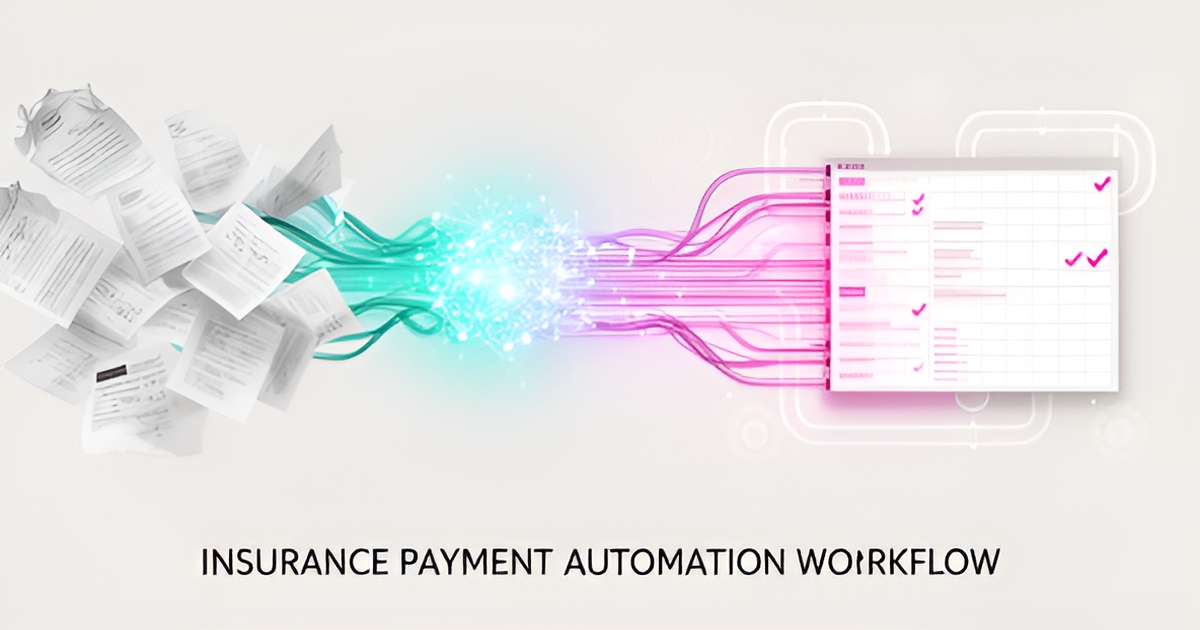
Finance Payment Automation for Insurance Accounting Processes
Key Facts
- Insurance reconciliation errors often start upstream in source documents, not in the matching process itself, per reconciliation research.
- Insurance is the industry most stressed by manual processes, according to industry analysis.
- The EU AI Act classifies insurance claims AI as high-risk, mandating documented decision logic and audit trails.
- 76% of US insurer executives report generative AI in at least one function, but only 7% reach scale.
- AI-enabled claims automation cuts resolution times from 30 days to 7.5 days, a 75% reduction.
- One US life insurer cut suspense accounts by 50% in under six months, with 75% less manual intervention.
- 91% of $10B+ carriers deploy AI versus only 58% of mid-market carriers, per industry adoption data.
One AI employee doing one job, 24/7, for less than a part-time wage.
Receptionist, lead follow-up, intake or dispatch. Trained on your business and fully managed. From $700/mo.
Why Insurance Payment and Reconciliation Work Still Breaks
Every payment that flows through an insurance accounting team starts life as a document: a PDF claim file, a scanned invoice, an email attachment, a medical report. By the time a mismatch shows up in reconciliation, the real problem usually happened weeks earlier, in how that document was read and keyed in.
That's the uncomfortable finding at the heart of reconciliation research: many reconciliation errors originate from poor data quality in source documents rather than the matching process itself. Teams spend their days fixing downstream symptoms while the upstream cause keeps producing new exceptions. The same analysis notes that many organizations still rely on manual checks to resolve these mismatches, which increases the risk of missed errors, delayed reporting, and revenue leakage.
The manual burden isn't limited to accounting. One industry analysis describes insurance as the industry most stressed by manual processes, with cumbersome manual interventions spanning new business, claims, and accounting. A single claim payment touches document intake, data extraction, approval, disbursement, posting, and reconciliation, and a human handoff at each stage multiplies both cost and error surface.
Layered on top of this is regulatory pressure that now shapes architecture decisions, not just audit prep:
- The EU AI Act classifies AI used in insurance claims and underwriting decisions as high-risk, mandating documented decision logic, human oversight, and audit trails.
- Reconciliation is essential for meeting statutory and accounting requirements including NAIC, Solvency II, and IFRS 17, which demand traceable financial reporting and accurate reserve and liability reporting.
- Black-box models that cannot expose their reasoning don't meet these requirements and can't be deployed in regulated insurance workflows within EU jurisdictions.
So why does so much of this work still break? Partly because the industry is stuck at pilot stage. While 76% of surveyed US insurer executives reported generative AI implemented in at least one function, only 7% in a global study successfully brought AI systems to scale, and roughly two-thirds remained in piloting, according to aggregated industry statistics. Point tools solve one step, like document digitization or appraisal, but fail on end-to-end requirements such as ERP integration, exception handling, and multi-jurisdiction compliance.
This is the gap AIQ Labs builds against: full workflow automation from document intake through payment posting and reconciliation, with IDP-first data structuring to fix errors before they enter core systems, and deterministic, explainable architecture with audit trails and human-in-the-loop controls designed for regulated environments. The payment and reconciliation problem was never really a matching problem. It's a data and orchestration problem, and it needs to be solved as one connected system.
What End-to-End Payment Automation Actually Requires
What separates a working pilot from a production system is architecture, not model choice. Four requirements show up in the research again and again, and each one has downstream consequences that reach well past the claims desk.
The first is data structuring before entry. Many reconciliation errors trace back to poor data quality in source documents rather than the matching step itself, which is why IDP-first workflows that validate data before it reaches core systems reduce preventable exceptions and lift match rates. Reconciliation automation and document data readiness are complementary, not competing.
The second is orchestration across the full path. Point tools solve single steps but fail on ERP integration, exception handling, and simultaneous compliance. The industry is moving toward agentic straight-through processing, claims flowing from intake to payment with minimal manual intervention, and that only works when one system owns the whole chain.
The third is deterministic, explainable decision logic. The EU AI Act classifies insurance claims AI as high-risk, mandating documented decision logic, human oversight, and audit trails. Black-box models that can't expose their reasoning don't meet that bar.
The fourth is exception handling that survives scrutiny. Reconciliation underpins statutory reporting under NAIC, Solvency II, and IFRS 17, so every exception needs a traceable resolution path. Get these four right and the payoff compounds:
- AI-enabled claims automation cuts resolution times from roughly 30 days to 7.5 days
- Cost per standard claim drops 30% to 40%
- One US life insurer cut suspense accounts by 50% in under six months
This is the architecture AIQ Labs builds toward: systems clients own outright, with IDP, orchestration, and audit trails designed in from the first phase rather than bolted on later. If you want to pressure-test where your own claim-to-reconciliation path breaks, start with the two-minute Fit Check, then a free 30-minute strategy call.
Building the ROI Case That Insurance Leaders Actually Accept
The fastest way to kill an automation proposal in insurance accounting is to pitch it as "time saved." Insurance leaders have heard that pitch for years, and they've stopped buying it. Jennifer Kessel, COO at USG Insurance Services, put it bluntly in a recent executive roundtable: "I hear a lot of we're saving X amount of time... For us, that's not in our ROI." What she wants to know is what happens to the gained time. Does it convert to revenue, better client outcomes, or reduced outsourcing spend? That's where the calculation starts.
This reframing matters because the evidence for hard savings is now substantial. Kate Grasman, CIO at Heffernan Group, reported $600,000 in annual savings by managing cost offsets against BPO spend through technology implemented for proposals, certificates of insurance, and policy checks. One agency in the Big I's 2025 Best Practices Study achieved a 3,807% ROI from an AI-powered policy checking tool. And a US life insurer cut its suspense accounts by 50% in under six months with 75% less manual intervention, per a documented automation case.
Before any of these numbers can be claimed, though, the baseline has to exist. Kessel again: "You have to look through the rearview mirror before you look through the windshield." Her team established a baseline before every implementation, and Heffernan spent three years building the discipline of tracking cost offsets before reaching measurable ROI. Ryan Deeds, Head of AI and Enablement at ALKEME, frames it the same way: know your current state, define future state, measure the gap, then set success criteria. Skipping this step is why so many automation projects can't prove their value after go-live.
For payment automation specifically, the outcomes worth targeting are concrete:
- Reduced improper payments and leakage. Medicare Fee-for-Service alone reported a 6.55% improper-payment rate totaling $28.83 billion, showing how much money walks out the door on bad data.
- Lower cost per claim. AI-enabled claims automation reduces cost per standard claim by 30% to 40%, according to industry analysis.
- Fewer suspense accounts and manual exceptions, the direct driver of month-end close delays and reconciliation rework.
- Faster settlement cycles that improve carrier and claimant relationships rather than just internal metrics.
One more finding deserves attention when choosing a solution. The Big I study found ROI is highest when automation is embedded within existing workflows rather than operating as a standalone tool. That tracks with what we see at AIQ Labs: a payment automation system that connects directly to your accounting platform, claim systems, and document flows outperforms a bolt-on tool that staff have to remember to use. Point tools solve one step and leave the ERP integration, exception handling, and compliance requirements to you.
The pitch that gets accepted, then, is disciplined: establish the baseline, tie automation to hard savings like reduced BPO spend and eliminated leakage, and measure whether freed capacity actually lands on the bottom line. As Kristen Skender, Chief Growth Officer at Jimcor Agencies, asks about any investment: will it help us write more policies? Efficiency is nice. Revenue is the validator.
How Mid-Market Carriers and Agencies Can Start
The gap between carriers with over $10 billion in revenue and those in the $100 million to $500 million range is stark. While 91% of the largest insurers are deploying AI, only 58% of mid-market carriers are doing the same, according to industry adoption data. This disparity often stems from a lack of clear starting points rather than a lack of need. You do not need to overhaul your entire finance department to see value. You need one high-volume workflow that currently consumes the most manual hours.
Start by picking a single process, such as claims payment intake or suspense account reconciliation. These areas generate the most friction and offer the quickest path to measurable results. Establish a baseline before you change anything. As Jennifer Kessel, COO at USG Insurance Services, notes, you must look through the rearview mirror before looking through the windshield. You cannot calculate return on investment if you do not know your starting point.
Once you have that baseline, deploy automation in phases rather than all at once. This approach reduces risk and allows your team to adjust to the new workflow. A recent case study highlighted by Sutherland Global showed a US life insurer reducing suspense accounts by 50% in less than six months. They achieved this by automating the reconciliation process, which also cut manual intervention by 75%.
To structure your rollout effectively, consider these four steps:
- Identify the specific workflow with the highest volume and error rate.
- Document current manual steps and time spent per transaction.
- Implement an Intelligent Document Processing layer to clean data before it enters your core system.
- Measure outcomes against hard financial metrics, not just time saved.
Many insurers mistakenly focus on "time saved" as their primary metric. However, the industry is shifting toward tangible value creation. Heffernan Group, for example, reported saving $600,000 in a single year by managing offsets against BPO costs through technology, according to Insurance Business Magazine. This shift from efficiency to bottom-line impact is critical for securing executive buy-in.
AIQ Labs supports this phased approach through its Build in Milestones model. This structure allows you to approve and pay for each phase as it ships. If you decide to stop at any point, you keep everything built so far. This eliminates the risk of large upfront investments with uncertain outcomes.
Compliance is another factor that must be addressed from day one. The EU AI Act classifies AI in insurance claims as high-risk, requiring documented decision logic and audit trails. Point tools often fail here because they lack end-to-end orchestration. A deterministic, explainable architecture ensures that your automation meets regulatory standards while reducing manual errors.
The goal is to move from isolated pilots to a sustainable capability. By focusing on one workflow, establishing a clear baseline, and measuring hard outcomes, you create a proof point that justifies further expansion. This methodical approach ensures that your investment in automation delivers real, measurable value to your bottom line.
Still paying for 10+ subscriptions that don’t talk to each other?
We build connected AI systems you own. Pay upfront or on a payment plan; the code is yours once it’s paid off.
Frequently Asked Questions
Why do reconciliation errors keep happening even after we've automated the matching step?
What ROI should we actually promise our CFO from payment automation, is 'time saved' enough?
Can't we just use a point tool for document digitization instead of a full end-to-end system?
How do we keep AI payment automation compliant with the EU AI Act and audit requirements?
We're a mid-market carrier, is payment automation realistic for us, or is it only for the $10B+ insurers?
How do we prove value before committing to a big automation project?
From Broken Reconciliations to Bottom-Line Results
The pattern across this article is hard to ignore: insurance payment and reconciliation work doesn't break at the matching step, it breaks upstream, in how source documents are read, keyed, and validated. That's why point tools keep underdelivering while end-to-end systems deliver results like a 50% suspense account reduction in under six months. The playbook for getting there is disciplined: pick your highest-friction workflow, establish a baseline before changing anything, deploy in phases, and measure against hard financial outcomes, reduced BPO spend, eliminated leakage, faster closes, not just hours saved. Compliance belongs in the architecture from day one, with documented decision logic and audit trails that satisfy NAIC, Solvency II, IFRS 17, and the EU AI Act. If you want to pressure-test where your own claim-to-reconciliation path breaks, start with AIQ Labs' two-minute Fit Check, then book a free 30-minute strategy call. If there isn't a clear win, we'll tell you that too.
See what AI would actually do in your business, in 60 seconds.
The planner shows which step fits, the agents we’d build and the published price. No email needed.