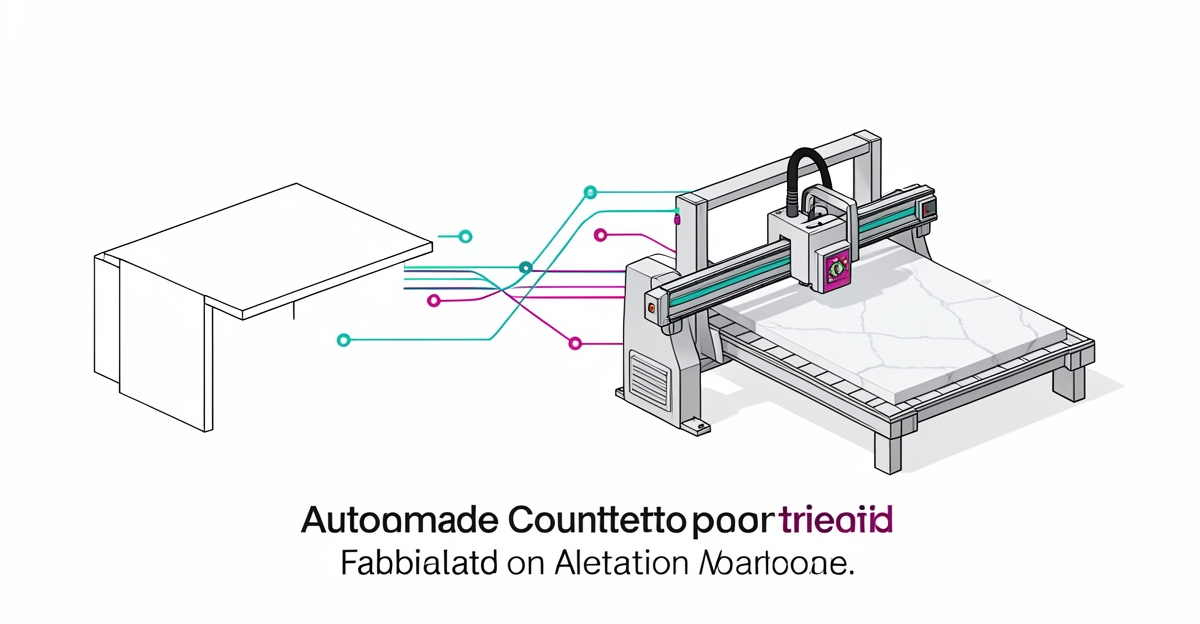
# From Design Draft to Production: How AI Can Automate Countertop Fabrication Workflows
**Quick Answer:** From design draft to production, AI automates countertop fabrication workflows, cutting errors, speeding delivery, and boosting scalability. As of late 2026, AI adoption is mainstream across industries, and shops that automate estimation, lead validation, and tracking are pulling ahead. Start the free [Fit Check](/apply) to see how AIQ Labs can help your shop.
## Key Facts
- Design automation can significantly impact fabrication businesses by streamlining workflows, reducing errors, and improving scalability, as noted by industry research.
- AI-powered design tools can automate repetitive design tasks, leading to cost savings, improved efficiency, and increased scalability.
- Generative design can explore a wider range of possibilities than traditional methods, surfacing layouts that minimize waste or simplify fabrication.
- AI-driven design tools increase scalability and can generate personalized content, opening up new possibilities for targeted marketing and customized customer experiences.
- Design automation advocates such as Autodesk and DriveWorks highlight increased efficiency, reduced errors, and improved productivity as core benefits.
## Table of Contents
1. [The Hidden Cost of Manual Workflows in Countertop Shops](#the-hidden-cost-of-manual-workflows-in-countertop-shops)
2. [Where AI Fits Across the Fabrication Lifecycle](#where-ai-fits-across-the-fabrication-lifecycle)
3. [Automating Design, Estimating, and Production Tracking Step by Step](#automating-design-estimating-and-production-tracking-step-by-step)
4. [Avoiding the Pitfalls: Quality, Ownership, and Getting Started](#avoiding-the-pitfalls-quality-ownership-and-getting-started)
## The Hidden Cost of Manual Workflows in Countertop Shops
The countertop fabrication industry is ripe for AI-driven automation. As of late 2026, generative AI is no longer a novelty, it's a competitive necessity, and the shops adopting it early are the ones winning bids on turnaround time and accuracy.
Manual workflows in countertop shops are plagued by inefficiencies, from design takeoffs to material estimation, lead validation, and production tracking. These processes are not only time-consuming but also prone to errors, resulting in costly rework, wasted materials, and lost orders. Industry research on design automation consistently points to the same levers: streamlined workflows, fewer errors, and better scalability.
The fabrication lifecycle is complex, involving multiple stakeholders, materials, and timelines. Manual workflows lead to disconnected production tracking, making it difficult to identify bottlenecks. AI can automate these workflows, enabling shops to respond quickly to changes in demand, reduce lead times, and improve overall quality. Key benefits include:
- Improved accuracy in material estimation and design takeoffs
- Enhanced lead validation and qualification
- Real-time production tracking and monitoring
- Increased scalability and flexibility in response to changing demand
By leveraging AI-powered design tools, countertop shops can automate various design tasks, leading to **cost savings, improved efficiency, and increased scalability**. AI-driven design tools also democratize design, empowering businesses to create compelling visuals without extensive design expertise. AIQ Labs, with 200+ multi-agent systems deployed and four live SaaS products we run daily, is well-positioned to help countertop shops navigate this transition.
The cost of manual workflows isn't just financial, it includes the opportunity cost of projects you can't take on, markets you can't enter, and customers you can't serve as well as you'd like. By automating workflows and leveraging AI-driven insights, shops can **reduce errors, improve productivity, and increase competitiveness**.
## Where AI Fits Across the Fabrication Lifecycle
The countertop fabrication process involves many detailed steps, and AI can make each one faster and more accurate. From design to delivery, AI-driven automation reduces manual work and improves consistency across projects.
Design automation tools, highlighted by vendors like Autodesk and DriveWorks, increase efficiency, reduce errors, and free up time for more strategic work. AI can generate detailed drawings and manufacturing instructions automatically, helping fabricators move from concept to production with fewer delays.
Generative AI adds another layer of value by exploring multiple layout options quickly. Fabricators can test different designs and find the most efficient use of materials, which leads to cost savings and better customer outcomes. Modern AI des
AI Employees
Hire a team member that works 24/7 — for less than a part-time wage.
AI receptionists, SDRs, dispatchers and 99+ roles. Trained on your business, fully managed.
See If You’re a Fit — AI Employees from $700/mo
Not sure where to start? Ask our AI planner
ign platforms also support scalability by automating repetitive design tasks.
AI can also improve cost estimation and material planning. By analyzing project details, AI systems can provide accurate cost estimates and material requirements, reducing waste and preventing costly mistakes. Additionally, AI-driven lead validation helps prioritize high-quality prospects, increasing sales productivity.
- Automated drawing and manufacturing instruction generation
- Generative AI for exploring layout alternatives
- AI-driven cost estimation and material planning
- Lead validation and production tracking automation
AIQ Labs specializes in building full-cycle AI systems that integrate these capabilities into a seamless workflow. Depending on where your bottleneck sits, that might mean a single [AI workflow build](/workflow-builds) targeting your costliest process, managed [AI employees](/ai-employees) handling lead intake and follow-up, or a full [AI operating system](/ai-operating-systems) connecting estimation, scheduling, and tracking in one layer you own outright.
With AI adoption now mainstream across industries as of late 2026, the countertop fabrication industry is well positioned to benefit. Embracing AI can lead to faster turnaround times, fewer errors, and a stronger competitive edge.
## Automating Design, Estimating, and Production Tracking Step by Step
A countertop shop that still estimates jobs on paper and tracks slabs on a whiteboard loses hours every day to work a machine could do. The path from design draft to production becomes dramatically smoother when you break the workflow into discrete automation targets and tackle them one at a time.
Start by identifying where manual effort accumulates. For most fabricators, three areas stand out: **material estimation, lead validation, and production tracking**. These steps consume significant staff time, are prone to transcription errors, and directly affect quoting accuracy and delivery dates. Mapping each one, who touches it, what data moves between systems, and where delays occur, gives you a clear automation roadmap before any tool is chosen.
Next, select AI-powered design tools that fit your workflow. Design automation software can generate designs, manufacturing instructions, and cost estimates for custom products automatically. Platforms like Design.com show how AI design tools deliver increased efficiency, reduced errors, and improved productivity, while manufacturing automation vendors like DriveWorks offer practical examples of manufacturers freeing up time for more strategic work.
Once your tools are in place, deploy generative design to explore alternatives. Rather than drafting a single layout, you input goals and constraints, slab dimensions, cutout positions, edge profiles, and let the software generate multiple options. This approach can explore a wider range of possibilities than traditional methods, surfacing layouts that minimize waste or simplify fabrication.
With design handled, integrate estimates directly into quoting and shop floor systems. When cost estimates flow automatically from the design into your quote, and approved quotes flow into production schedules, you eliminate the re-entry errors that plague most shops. This is precisely where connected AI systems pay off, AIQ Labs builds workflows that reduce manual input across estimation, scheduling, and tracking, ensuring consistent quality from order to delivery.
Finally, monitor results and keep human expertise in the loop. Automation should complement your fabricators' judgment, not replace it, unchecked AI output can produce low-quality filler. Build in review checkpoints:
- Review AI-generated layouts before releasing them to the saw
- Spot-check estimates against actual material usage weekly
- Track cycle times and error rates to measure automation impact
- Retrain or adjust tools as your product mix changes
Treated as a step-by-step rollout rather than a single overhaul, AI automation turns your design-to-production pipeline into a measurable, continuously improving system.
## Avoiding the Pitfalls: Quality, Ownership, and Getting Started
The fastest way to waste money on AI is to automate the wrong things. With adoption now widespread as of late 2026, the gap between shops that implement thoughtfully and shops that chase shiny tools is widening fast.
The first pitfall is quality drift. AI tools are powerful, but they carry a documented risk of generating filler content and low-quality outputs when left unchecked. In a fabrication context, that translates to estimates that miss edge cases, quotes built on thin assumptions, and production documents nobody trusts.
The second pitfall is over-automation. Research on AI design tools consistently emphasizes that these systems work best when they complement human creativity and expertise rather than replace it. Your templaters' e
AI Development
Still paying for 10+ subscriptions that don’t talk to each other?
We build custom AI systems you own outright. No vendor lock-in. Full control.
See If You’re a Fit — AI Employees from $700/mo
Not sure where to start? Ask our AI planner
ye for a tricky seam and your installer's judgment on site conditions are not inefficiencies to eliminate, they're the craftsmanship your reputation is built on.
A practical framework for avoiding both traps:
- **Keep humans in the loop** on anything customer-facing or structurally critical, AI drafts, your team approves.
- Automate the repetitive middle (data entry, lead routing, status updates) before touching design or craftsmanship.
- Audit outputs weekly at first, then monthly, so quality drift gets caught before a customer does.
- Treat every AI output as a first draft, not a final answer.
The third pitfall is subtler: subscription sprawl. Many fabricators stack five or six disconnected AI subscriptions, one for design, one for estimates, one for follow-ups, and end up with fragmented data, rising monthly costs, and no single source of truth. Design automation research shows the real gains come from streamlined, connected workflows, not isolated tools.
That's why **custom-built, owned AI systems** are gaining ground over rented tool stacks. When your estimation engine, lead validation, and production tracking live in one system you own outright, there's no vendor lock-in, no integration gaps, and no per-seat pricing eating your margins as you grow.
At AIQ Labs, this is exactly how we approach fabrication workflows, building systems the shop owns, with human-in-the-loop controls baked in from day one. We offer flexible payment models: start monthly, build in milestones, or own it outright. The goal isn't to replace your craftspeople; it's to give them back the hours they lose to manual admin work.
If you're weighing where automation fits in your shop, or whether it fits at all, start with the [two-minute Fit Check](/apply) and a free 30-minute strategy call. It's a working session with an AI engineer, not a sales pitch, and if there isn't a clear win for your operation, we'll tell you that too.
## Frequently Asked Questions
**How can AI help reduce errors in countertop fabrication workflows?**
AI can automate material estimation, lead validation, and production tracking, reducing manual input and transcription errors that lead to costly rework and wasted materials. Design automation solutions are widely recognized for increasing efficiency and reducing errors in fabrication processes.
**What are the key benefits of using AI for design automation in countertop shops?**
AI-powered design tools improve accuracy in material estimation, enhance lead validation, enable real-time production tracking, and increase scalability to respond to changing demand. These tools can also democratize design by allowing businesses to create compelling visuals without extensive design expertise.
**Is there a risk of AI generating low-quality outputs in fabrication workflows?**
Yes, AI tools can generate filler content or low-quality outputs when left unchecked, leading to inaccurate estimates or untrusted production documents. To avoid this, AI outputs should be treated as first drafts and reviewed by human experts before release.
**How does generative AI improve countertop design and material usage?**
Generative AI explores multiple layout options quickly by analyzing goals and constraints like slab dimensions and cutout positions, helping fabricators find designs that minimize waste and simplify fabrication. This approach can uncover more efficient solutions than traditional methods.
**Why should countertop shops consider building their own AI systems instead of using multiple subscriptions?**
Stacking disconnected AI subscriptions leads to fragmented data, rising costs, and no single source of truth. Custom-built, owned AI systems eliminate vendor lock-in, integration gaps, and per-seat pricing that erodes margins as the business grows.
**How widely adopted is generative AI as of 2026?**
As of late 2026, generative AI adoption is mainstream across industries, with a majority of companies using it in at least one business function. For fabrication shops, that means the competitive window for getting ahead with automation is still open, but narrowing.
## Turn Your Design-to-Production Pipeline Into a Competitive Advantage
Manual takeoffs, estimates, and whiteboard tracking are costing countertop shops time, material, and orders. AI can automate the repetitive middle of the fabrication lifecycle, from automated drawing and manufacturing instruction generation to generative layout exploration, AI-driven cost estimation and material planning, and real-time production tracking, while keeping human judgment in the loop for quality and craftsmanship. The result is fewer errors, faster quotes, less waste, and the scalability to take on more work without adding headcount. With AI adoption now mainstream as of late 2026, the gap is widening between shops that automate thoughtfully and those that don't. Map your three biggest manual pain points, start with one workflow, and build review checkpoints to protect quality. If you're weighing where automation fits, start the [two-minute Fit Check](/apply) for a free 30-minute strategy call with an AI engineer, a working session to map your bottleneck and identify high-ROI opportunities, with no sales pitch. Questions? Reach us at [email protected].
AI Transformation Partner
Make AI your competitive advantage — not just another tool.
Strategy, implementation and ongoing optimization. One partner, end to end.
See If You’re a Fit — AI Employees from $700/mo
Not sure where to start? Ask our AI planner