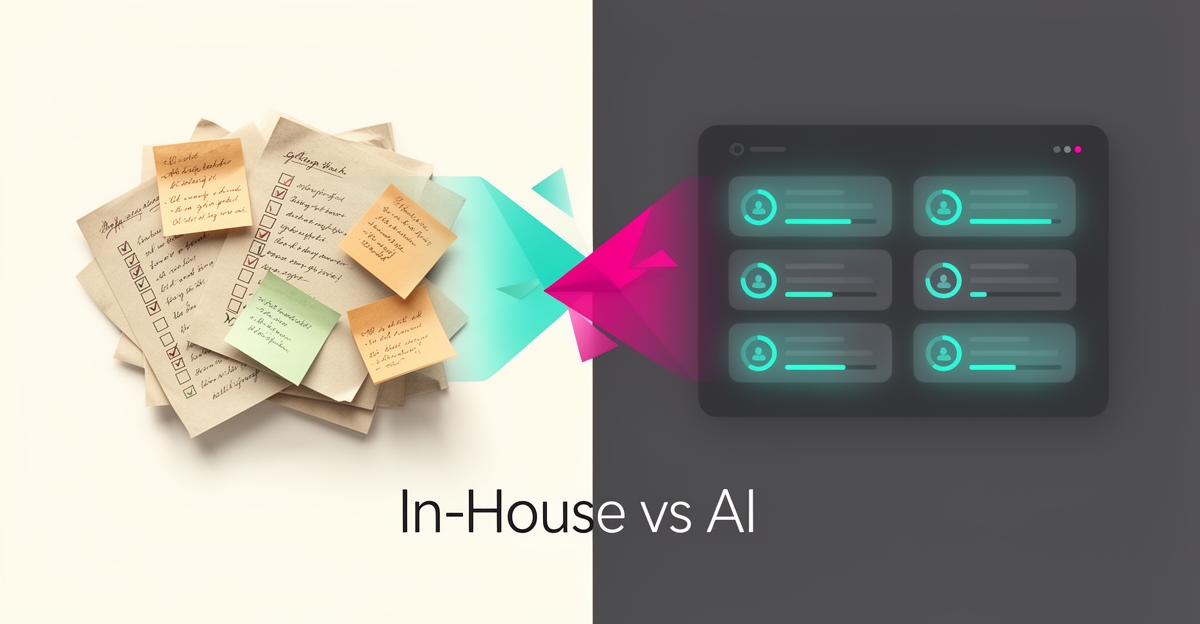
From In-House to AI: Which Is Better for Managing Client Deliverables?
Key Facts
- Manual tracking with spreadsheets and email threads creates inconsistent status updates and frequent oversights as client volume grows
- AI milestone tracking logs every deliverable stage in real time, so problems surface before they become escalations
- Automated lead qualification and follow-up typically improve response consistency and let teams prioritize high-intent prospects
- Industry surveys as of late 2026 show widespread AI adoption across service businesses, but many organizations still provide little or no team training—a critical adoption gap
- AIQ Labs has deployed 200+ multi-agent systems and runs 4 live SaaS products daily, so its recommendations are proven in live deployment
Hire a team member that works 24/7 — for less than a part-time wage.
AI receptionists, SDRs, dispatchers and 99+ roles. Trained on your business, fully managed.
Not sure where to start? Ask our AI planner
The Hidden Cost of Manual Deliverable Tracking
Manual deliverable tracking in-house creates hidden costs that erode efficiency and client satisfaction. Teams often juggle spreadsheets, email threads, and disjointed tools to monitor progress, leading to frequent oversights and duplicated efforts. This fragmented approach consumes valuable time that could be spent on strategic client work or relationship building. The lack of a centralized system means status updates are inconsistent, and critical details can slip through the cracks during handoffs or absences.
In service industries, teams routinely spend excessive hours on administrative tracking rather than high-value activities like client engagement or deal closing. These time sinks accumulate quickly, especially as client volume grows, making scalability a persistent challenge for in-house processes. Without automation, each new client adds linear effort, straining existing resources and pushing teams toward reactive firefighting instead of proactive management.
Error rates in manual tracking further compound inefficiencies. Misplaced files, incorrect status updates, and missed deadlines are common when reliance falls on human memory and inconsistent procedures. Such mistakes not only delay deliverables but also damage trust, requiring additional effort to correct and reassure clients. The absence of real-time visibility means problems are often discovered late, turning minor issues into costly escalations. These inconsistencies undermine accountability and make it difficult to measure team performance objectively.
- Manual tracking increases administrative overhead by diverting staff from core responsibilities
- Inconsistent processes lead to variable deliverable quality and client experience
- Scaling in-house methods requires proportional increases in headcount and oversight
- Lack of audit trails complicates compliance and performance reviews
- Reactive issue resolution replaces proactive workflow management
These limitations drive organizations to seek transformation paths that enhance consistency and visibility without sacrificing the human touch. Moving beyond manual tracking isn't just about saving time—it's about building reliable systems that support growth while maintaining service quality. The hidden cost of inaction includes missed opportunities, avoidable errors, and diminished team morale, all of which impact long-term competitiveness. Addressing these inefficiencies is the first step toward a more resilient deliverable management approach.
How AI Transforms Consistency, Visibility, and Accountability
AI transforms how teams manage client deliverables by driving measurable gains in consistency, visibility, and accountability. AI systems can automate lead follow-up, transaction milestone tracking, and routine documentation, freeing teams to focus on higher-value activities like relationship building and deal closure. This shift reduces manual effort while ensuring critical steps in the deliverable lifecycle are never missed or delayed.
Processing speed is one of the most impactful improvements. Workflows that once required hours of manual coordination—status chasing, data entry, follow-up reminders—run continuously in the background. At the same time, AI-powered lead qualification typically improves consistency and prioritization, enabling teams to focus on high-intent prospects with greater confidence. These gains compound as volume grows: AI systems scale without the linear headcount increases that manual processes demand.
- Automated milestone tracking ensures every deliverable stage is logged and visible in real time
- Consistent data capture reduces variability in how client information is recorded and acted upon
- Audit trails improve accountability by showing exactly what happened and when
- Real-time alerts flag delays or bottlenecks before they impact timelines
- Centralized visibility allows managers to monitor progress across teams and projects instantly
AIQ Labs helps organizations implement these capabilities through three entry points: AI Employees for managed AI staff, Workflow Builds to rebuild the one workflow that costs you the most, and AI Operating Systems for a single connected layer across your business. With 200+ multi-agent systems deployed and 4 live SaaS products the company runs daily, these aren't theoretical recommendations—they're patterns proven in production. By integrating AI into core operations, businesses gain not just efficiency, but a more reliable, transparent system for managing client deliverables at scale.
Balancing Automation with the Human Touch
Many businesses worry that shifting client deliverable management to AI will erode the personal connections that build trust and loyalty. While automation excels at handling routine tasks like lead follow-up and milestone tracking, preserving the human element requires intentional design and workflow integration.
When AI absorbs the administrative burden—status updates, data collection, deadline monitoring—teams get hours back for the relationship-building activities that machines cannot replicate. This shift allows professionals to dedicate more time to understanding client needs, offering tailored advice, and providing empathetic support during complex transactions. The key is using AI to eliminate administrative work, not replace meaningful interaction.
To maintain personalization while leveraging automation, organizations should implement strategies that keep humans at the center of high-touch moments. This includes using AI to gather and organize client data so agents enter conversations fully informed, setting up alerts for milestone achievements that prompt personal check-ins, and designing handoff protocols where AI manages data collection but humans deliver insights and recommendations. Training teams to interpret AI-generated reports and translate them into customized client communications ensures technology enhances rather than replaces expertise.
AIQ Labs supports this balanced approach with change management and training built into every engagement, helping teams adapt to new workflows while preserving relationship-driven practices. By integrating AI tools with existing CRM and communication platforms, businesses create seamless experiences where automation handles visibility and accountability, and human agents provide the empathy, judgment, and customization clients value. The result is a system that improves efficiency without sacrificing the personal touch that drives long-term satisfaction and retention.
Your Path Forward: Assess, Integrate, and Scale
Transitioning from in-house deliverable management to AI doesn't require a full overhaul—it starts with a clear assessment of where your team spends the most time on repetitive, error-prone tasks. Begin by mapping your current workflows to identify bottlenecks in lead follow-up, milestone tracking, or documentation—areas where AI consistently delivers measurable gains in consistency and visibility.
Next, integrate AI solutions that align with your existing tools and processes to minimize disruption. Successful adoption depends on seamless connection with CRM, scheduling, and communication platforms, ensuring AI augments rather than replaces human judgment. Teams that prioritize integration report smoother transitions and higher trust in automated systems, especially when AI handles routine updates while humans focus on nuanced client interactions. This balanced approach preserves the personal touch while scaling operational reliability.
Finally, scale with intention by training your team to work alongside AI and establishing feedback loops for continuous improvement. Upskilling staff to interpret AI outputs and manage exceptions increases confidence and reduces resistance to change. Organizations that invest in training see faster realization of benefits, including improved accountability and faster turnaround on deliverables. As your confidence grows, expand AI into adjacent workflows—such as invoice tracking or client reporting—building on early wins to create a cohesive, intelligent system that evolves with your business.
For SMBs ready to take this step, AIQ Labs offers a structured path: start with an AI Employee to take over a specific deliverable role, commission a fixed-price Workflow Build for the workflow that costs you the most, or grow into a full AI Operating System in phases. Payment models are flexible—start monthly, build in milestones, or own it outright. Take the 2-minute Fit Check to see if AIQ Labs is a match, then book a free 30-minute strategy call to map your biggest bottleneck and identify where AI can deliver the clearest win.
Still paying for 10+ subscriptions that don’t talk to each other?
We build custom AI systems you own outright. No vendor lock-in. Full control.
Not sure where to start? Ask our AI planner
Frequently Asked Questions
What are the hidden costs of manually tracking client deliverables in-house?
How much time can AI save on routine deliverable tasks compared to manual methods?
Will using AI for deliverable management eliminate the need for human interaction with clients?
How does AI improve accuracy in lead qualification and deliverable tracking?
What steps should a business take to successfully integrate AI into client deliverable management?
How does AIQ Labs help businesses make this transition?
Turning Deliverable Chaos into Competitive Advantage
The hidden costs of manual deliverable tracking—scattered tools, inconsistent updates, and reactive firefighting—don't just waste time; they erode client trust and limit scalability. AI transforms this reality by automating routine tasks like milestone tracking and lead follow-up, freeing teams to focus on high-value, relationship-driven work. The real power lies not in replacing the human touch, but in using AI to eliminate administrative burden so your team can invest more energy where it matters most: understanding client needs, offering tailored guidance, and building lasting loyalty. AIQ Labs helps SMBs make this shift with purpose—starting with a clear assessment of where time is lost, integrating AI seamlessly with existing tools, and scaling through training and feedback loops. With 200+ multi-agent systems deployed and 4 live SaaS products running daily, the approach is proven in production, not theory. The result is a system that delivers consistency, visibility, and accountability without sacrificing the personal connection clients value. Ready to see where AI can unlock your biggest win? Take the 2-minute Fit Check and book a free strategy call to map your bottleneck and explore the clearest path forward.
Make AI your competitive advantage — not just another tool.
Strategy, implementation and ongoing optimization. One partner, end to end.
Not sure where to start? Ask our AI planner