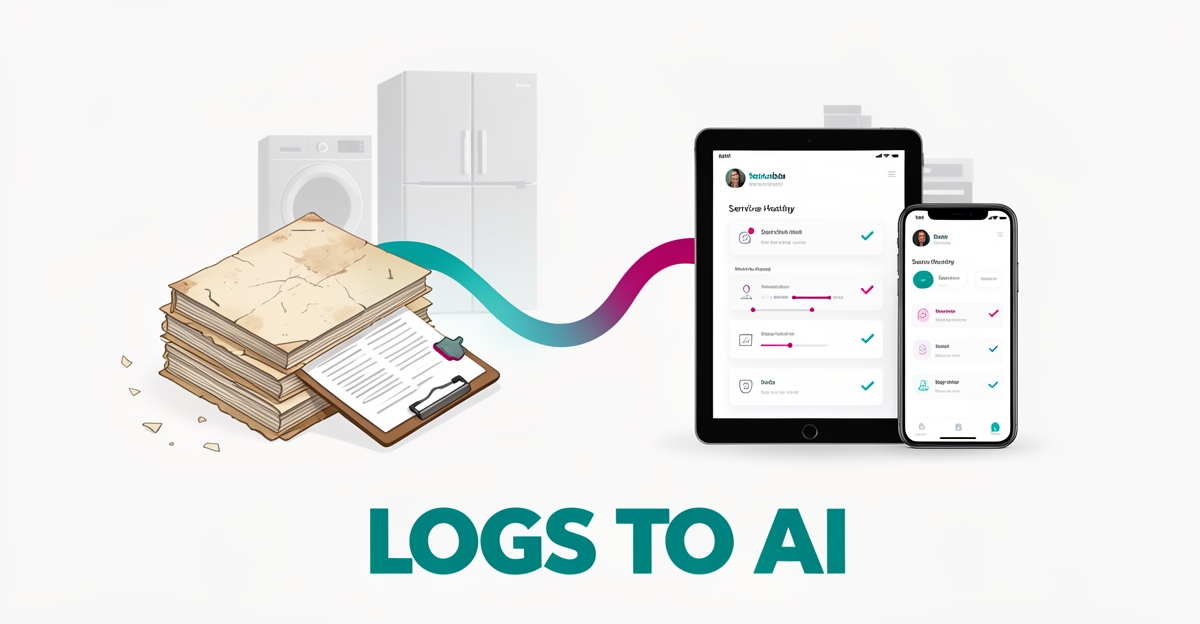
From Manual Logs to AI: How Appliance Repair Shops Can Automate Service History Tracking
Key Facts
- Missed calls typically mean lost revenue, every unanswered ring is a customer booking with a competitor instead
- Technicians with instant access to service history, model numbers, and warranty status typically fix more jobs on the first visit
- AI can draft preventative maintenance tasks by scanning asset manuals and historical data, speeding up setup
- Generative AI can automate tasks like drafting SOPs, summarizing notes, and translating work orders, saving significant administrative time
- AI can analyze historical service data to surface patterns that help predict failures and reduce unplanned downtime
- AI can dynamically manage spare parts based on real demand, reducing stockouts and over-ordering
- AI can correlate failure events and maintenance actions to highlight likely root causes of problems
Hire a team member that works 24/7 — for less than a part-time wage.
AI receptionists, SDRs, dispatchers and 99+ roles. Trained on your business, fully managed.
Not sure where to start? Ask our AI planner
The Hidden Cost of Paper Logs in Appliance Repair
Every paper log sitting on a clipboard represents a conversation that never happened and a customer who may never return. Appliance repair shops running on manual systems absorb a hidden tax on every missed call, when no one answers the phone, that job typically goes to the next shop on the search results page.
The cost compounds quietly. Technicians arrive at jobs without the model number, the last repair note, or the warranty status because that information lives in a filing cabinet three towns away. Without instant access to service history, first-time fix rates drop and callback rates climb. Administrative hours vanish into transcription, filing, and hunting for records that should take seconds to retrieve.
- Revenue evaporates with every unanswered call
- Callbacks increase when technicians lack historical context
- Administrative overhead consumes billable hours
- Diagnostic accuracy suffers without pattern recognition across jobs
- Customer trust erodes with every repeat visit for the same issue
AIQ Labs works with field service businesses to replace these paper bottlenecks with AI systems that capture, categorize, and surface repair history the moment a technician needs it. For shops whose biggest pain is the phone itself, [AI Employees](/ai-employees) put managed AI receptionists and dispatchers on the line, answering every call, booking jobs, and logging details automatically, typically at a fraction of the cost of a human hire. The shift from reactive record-keeping to proactive intelligence changes the economics of every service call, turning lost context into retained revenue.
How AI Transforms Service History Into a Proactive Asset
Service history stops being a filing cabinet and starts working for the shop the moment AI reads it. AI turns scattered logs into active intelligence that predicts failures, guides repairs, and documents itself.
Predictive maintenance shifts the workflow from reactive to proactive. AI can analyze historical service data and, where sensor data is available, real-time equipment information to flag likely failures before they happen. That foresight lets teams schedule work before a breakdown costs a customer.
Diagnostic assistance becomes faster and more consistent at the truck. AI can analyze symptoms and asset history to provide technicians with potential diagnoses and troubleshooting steps. Computer vision adds another layer, extracting manufacturer, model, and serial numbers from asset nameplates using image recognition. Root cause analysis also improves as AI correlates failure events and maintenance actions to highlight likely root causes of problems.
Administrative overhead drops because documentation writes itself. Generative AI can automate tasks like drafting SOPs, summarizing notes, and translating work orders, saving significant time. Natural language summaries translate complex reports into easily understandable updates for stakeholders. AI can also automatically draft preventative maintenance tasks by scanning asset manuals and historical data, speeding up setup.
The practical impact shows up in fewer repeat visits and better use of parts. Technicians with the right information and parts the first time typically reduce callbacks and improve customer satisfaction. Inventory stays tighter as AI dynamically manages spare parts based on real demand, reducing stockouts and over-ordering.
Shops moving from paper logs to AI-powered service records typically see three shifts:
- History becomes searchable and retrievable in natural language instead of manual digging
- Service records auto-categorize and summarize, creating a clean, consistent knowledge base
- Predictive signals trigger work orders before customers call
This is where AI document processing changes the game for repair operations. A step-by-step transition from paper logs to AI-powered service records helps shops store, categorize, and retrieve repair history with confidence. If the paper problem runs deeper than one workflow, [AI Workflow Builds](/workflow-builds) rebuild the single workflow that costs you the most at a fixed price, phased so you see results before scaling. And for shops ready to connect scheduling, records, invoicing, and customer history into one layer they own outright, [AI Operating Systems](/ai-operating-systems) deliver that connected foundation. AIQ Labs has deployed 200+ multi-agent systems and runs four live SaaS products daily, these are systems we use ourselves, built to be owned, not rented.
Implementing AI Service Tracking: A Practical Roadmap for Repair Shops
Transitioning from paper logs to an AI-powered service history system doesn't happen overnight, but a structured roadmap makes the shift manageable and measurable. Start by auditing your current workflow: map how technicians capture job details, where data gets lost, and which manual steps consume the most time. This baseline reveals the highest-impact automation targets and sets clear success metrics for the new system.
- Audit current processes to pinpoint data gaps and bottlenecks
- Define requirements around predictive maintenance, automated scheduling, and diagnostic support
- Evaluate platforms for CRM and accounting integration, mobile access, and AI feature depth
- Migrate and cleanse historical records so the AI engine has quality training data
- Train technicians and office staff with role-specific, hands-on sessions
- Launch a pilot on one service line, measure results, then scale shop-wide
Platform selection should prioritize deep two-way API integrations with your existing CRM, accounting software, and dispatch tools so service records flow automatically into invoices, inventory, and customer profiles. Generative AI can automate SOP drafting, note summarization, and work-order translation, cutting administrative overhead significantly. Meanwhile, AI voice agents and automated scheduling can close the missed-call gap by ensuring every call gets answered. AIQ Labs helps shops navigate this evaluation by mapping each option's capabilities to the shop's actual workflow, not a generic feature checklist, and with payment models like Start Monthly, Build in Milestones, or Own It Outright, you choose how you pay, with no fake pricing or lock-in.
Data migration is often the hidden risk. Incomplete or inconsistent historical records degrade predictive accuracy, so allocate time for cleansing model numbers, serial numbers, and failure codes before go-live. Pair the technical rollout with a change-management plan: short daily stand-ups during the pilot, a dedicated internal champion, and a feedback loop that feeds technician insights back into system tuning. AI-driven diagnostic assistance and nameplate OCR extraction only improve when the underlying data set grows richer with each completed job. Phase the deployment, start with work-order automation and history lookup, then layer on predictive parts forecasting and proactive maintenance alerts as confidence builds.
Still paying for 10+ subscriptions that don’t talk to each other?
We build custom AI systems you own outright. No vendor lock-in. Full control.
Not sure where to start? Ask our AI planner
Frequently Asked Questions
How much revenue are we actually losing from missed calls at our repair shop?
Will AI actually help our technicians fix appliances on the first visit?
How does AI use our old paper logs to predict future breakdowns?
Do we have to manually enter all our old paper records into the new system?
What kind of administrative time savings can we realistically expect?
What's the biggest risk when switching from paper to AI service tracking?
Turn Your Service History Into Your Shop's Smartest Asset
From missed calls to technicians flying blind without repair history, paper logs are silently draining your appliance repair shop's potential. AI transforms those scattered records into proactive intelligence, predicting failures, guiding faster fixes, and automating the admin work that steals billable hours. The result? Fewer callbacks, tighter inventory, and customers who trust you to get it right the first time. Shops that make this shift don't just catch up, they gain an edge built on data they already own. Ready to see where your biggest bottleneck is? Start with a free two-minute [Fit Check](/apply), then book a no-obligation 30-minute strategy call with our team to map your path forward, no pressure, just clarity. Questions first? Reach us at [email protected].
Make AI your competitive advantage — not just another tool.
Strategy, implementation and ongoing optimization. One partner, end to end.
Not sure where to start? Ask our AI planner