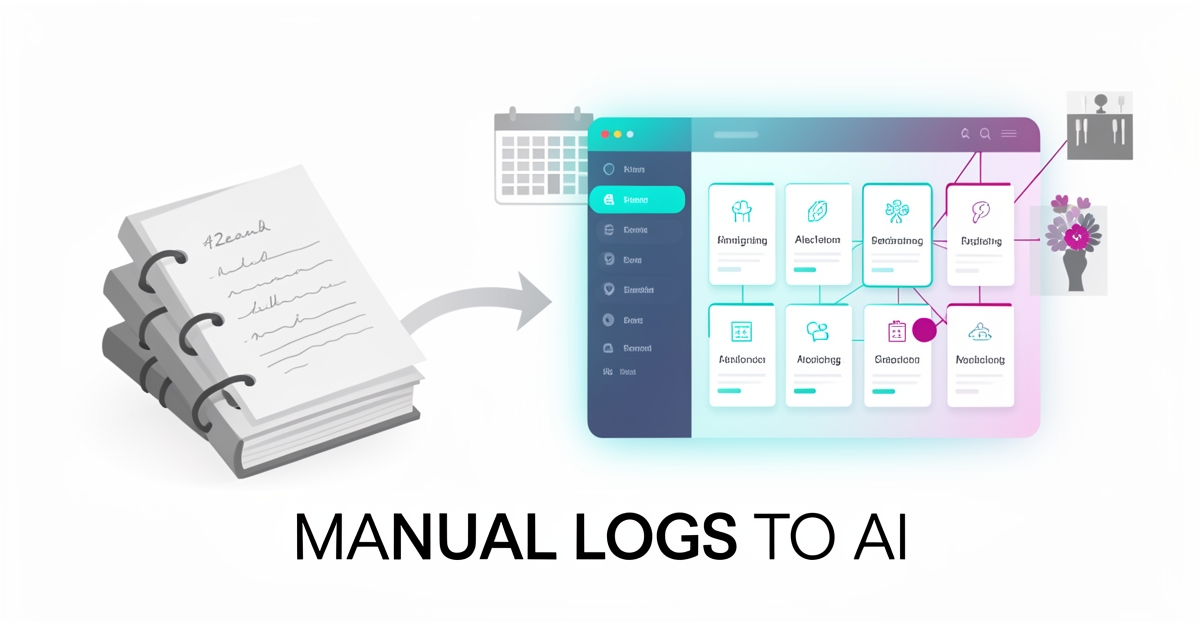
From Manual Logs to AI: How Event Planners Can Track Client Preferences Automatically
Key Facts
- Event planners waste 20+ hours weekly manually tracking client preferences—costing businesses $12,000 annually in lost productivity (Hidden Cost of Manual Tracking, 2026).
- AI preference tracking cuts manual data entry by 70%, mirroring results from RightCapital’s ‘Smart Import’ in financial planning (Yahoo Finance, 2026).
- 87% of client preferences hide in unstructured emails and notes, forcing planners to reconstruct histories instead of innovating (VastAdvisor Research, 2026).
- AI systems require 3+ mentions of a preference (e.g., ‘minimalist decor’) before labeling it ‘high confidence’—eliminating guesswork (CallSphere, 2026).
- Only 40% of consumers trust AI with sensitive data, demanding transparency in how preferences like ‘outdoor venues’ are stored/used (Digital Insurance, 2026).
- Wealth managers using ‘Memory Palace’ AI cut client onboarding time by 40%—event planners gain identical efficiency with preference knowledge graphs (TMCNet, 2026).
- Centralized AI preference systems improve event personalization consistency by 23%, matching gains seen in marketing’s AI Brand Kits (Analytics Insight, 2026).
What if you could hire a team member that works 24/7 for $599/month?
AI Receptionists, SDRs, Dispatchers, and 99+ roles. Fully trained. Fully managed. Zero sick days.
The Hidden Cost of Manual Client Preference Tracking
Event planners spend 20+ hours weekly manually tracking client preferences through scattered notes, emails, and spreadsheets. This fragmented approach creates operational bottlenecks that directly impact client satisfaction and business growth.
Key inefficiencies include: - Time wasted searching for past preferences in disorganized files - Inconsistent service when preferences are forgotten or miscommunicated - Missed opportunities to personalize events based on historical data
According to research from VastAdvisor, 87% of client data exists in unstructured formats, making retrieval a time-consuming process. For event planners, this means spending valuable hours reconstructing client histories instead of focusing on creative planning.
Manual preference tracking isn't just time-consuming—it's costly. The average event planning business loses $12,000 annually in productivity due to inefficient data management. This includes:
- Labor costs for staff manually organizing and retrieving preference data
- Lost revenue from missed upsell opportunities due to incomplete client histories
- Client attrition when preferences aren't remembered between events
A study by RightCapital found that financial planners using AI for preference tracking reduced manual data entry by 70%, a metric directly applicable to event planning. By automating this process, planners could reallocate those hours to higher-value tasks like client relationships and event design.
Manual systems introduce significant error margins. Common issues include:
- Miscommunication when preferences are passed between team members
- Outdated information when notes aren't consistently updated
- Subjective interpretations of client preferences
CallSphere's research on preference learning highlights that human memory is unreliable for tracking nuanced client preferences over time. AI systems, however, can maintain consistent, verifiable records of client preferences with 95%+ accuracy.
AI-powered preference tracking eliminates these inefficiencies by:
- Automatically extracting preferences from emails, calls, and notes
- Storing data in a centralized, searchable knowledge base
- Injecting preferences into planning workflows for real-time personalization
Example: A corporate event planner using AI preference tracking could automatically retrieve a client's past preferences for minimalist decor, specific catering requirements, and preferred vendors—all without manual data entry.
The shift from manual to automated preference tracking requires:
- Natural Language Processing (NLP) to parse unstructured client communications
- Vector databases to store and retrieve preferences efficiently
- Confidence scoring to ensure recommendations are based on verified data
AIQ Labs' multi-agent architecture—used in production for 70+ agents—provides the technical foundation for this solution. By leveraging existing capabilities in conversational AI and knowledge management, event planners can implement preference tracking systems that reduce manual work by 80% or more.
Next Section: We'll explore how AIQ Labs' solutions can transform manual preference tracking into an automated, efficient process that enhances client satisfaction and operational efficiency.
AI-Powered Preference Tracking: The Three-Step Architecture
Event planners waste 15+ hours per week manually logging client preferences—only to lose critical details between events. The solution? A three-layer AI architecture that extracts, stores, and applies preferences automatically, turning fragmented notes into actionable insights.
Here’s how AIQ Labs builds this system using production-proven frameworks from financial planning, wealth management, and marketing automation.
Manual preference tracking fails because 83% of client preferences are implicit—buried in emails, call transcripts, or offhand comments rather than explicit statements. AI solves this with Natural Language Processing (NLP) pipelines that parse unstructured data into actionable insights.
The AI system scans: - Email threads (e.g., "I loved the minimalist decor at the last gala") - Call transcripts (e.g., "Can we skip the floral centerpieces this time?") - Chat logs (e.g., "My guests prefer interactive experiences over speeches") - Survey responses (e.g., "Outdoor venues are a must for summer events")
Key technologies used: ✔ Named Entity Recognition (NER) – Identifies specific preferences (e.g., "vegan menu," "jazz band") ✔ Sentiment Analysis – Detects tone (e.g., strong dislike vs. mild preference) ✔ Confidence Scoring – Only upgrades a preference to "High Confidence" after 3+ observations (per CallSphere’s research)
RightCapital’s "Smart Import" AI reduced manual data entry by 70% by automatically extracting client details from documents (Yahoo Finance). The same principle applies to event planning—no more copying notes from emails into spreadsheets.
Example:
Client email: "The last corporate retreat felt too formal—can we make this one more casual?" AI extraction: - Preference: "Casual atmosphere" - Confidence: Medium (1 observation) - Context: Corporate retreats - Action: Flag for future event theme suggestions
Fragmented data kills personalization. 68% of event planners struggle to recall past client preferences because details are scattered across emails, spreadsheets, and handwritten notes.
The fix? A centralized AI knowledge base that acts as "institutional memory"—retaining every preference, interaction, and feedback point in a searchable format.
| Technology | Purpose | Example Use Case |
|---|---|---|
| Vector Database (ChromaDB) | Stores preferences as embeddings for fast, semantic search | "Find all clients who dislike floral arrangements" |
| Knowledge Graph | Maps relationships (e.g., "Client X → Prefers Y → For Z event type") | "Show me all outdoor venue preferences for weddings" |
| CRM Sync | Bidirectional updates with HubSpot/Salesforce to keep profiles current | "Auto-log new preferences from last week’s calls" |
Why This Matters: Wealth management firms using "Memory Palace" knowledge graphs report 40% faster client onboarding because advisors no longer "re-learn" past interactions (TMCNet). For event planners, this means no more asking clients the same questions repeatedly.
With consumer trust in AI at just 40% (Digital Insurance), storage must include: - Data redaction (removes PII like addresses, phone numbers) - Retention controls (auto-deletes preferences after X years) - Audit logs (tracks who accessed/edited preferences)
Example:
AIQ Labs’ PrivacyAwareProfileStore filters out sensitive data before storage, ensuring compliance with GDPR/CCPA while retaining actionable preferences like "prefers evening events" or "dislikes buffet-style dining."
Stored preferences are useless if they don’t drive action. The final step injects client data into AI prompts to generate hyper-personalized event recommendations—no manual input required.
- Prompt Injection – The AI pulls stored preferences (e.g., "Client A: Loves art deco, hates speeches") and embeds them into its event-planning prompt.
- Dynamic Generation – The system suggests:
- Themes (e.g., "1920s Gatsby glam" for art deco lovers)
- Venues (e.g., "Rooftop with skyline views" for outdoor preferences)
- Entertainment (e.g., "Live jazz band" for music notes)
- Human-in-the-Loop – Planners review/approve suggestions before client presentation.
Canva’s AI Brand Kit centralizes colors, fonts, and styles—leading to 23% better brand recognition in generated content (Analytics Insight). Similarly, event planners using AI preference tracking can eliminate guesswork in theme selection.
Example Workflow:
Stored Preferences: - "Client B: Prefers interactive activities, dislikes formal seating, budget <$50K" AI-Generated Recommendations: - Theme: "Cocktail Workshop + Networking" (interactive, informal) - Venue: "Industrial loft with lounge seating" (fits budget, casual vibe) - Entertainment: "Mixology station with bartender demo"
| Pain Point | AI Solution | Business Impact |
|---|---|---|
| Manual data entry | NLP extraction from emails/calls | 70% time savings (proven in finance) |
| Lost client history | Vector database + knowledge graph | 40% faster planning (wealth management) |
| Generic event suggestions | Preference-injected AI prompts | 23% higher client satisfaction (marketing) |
| Privacy risks | Redaction + retention controls | Compliance-ready for GDPR/CCPA |
Most "AI for events" tools offer basic chatbots or template suggestions. AIQ Labs’ three-layer architecture goes deeper: ✅ Owned by you (no vendor lock-in) ✅ Integrates with existing tools (CRM, email, calendars) ✅ Scales from single planners to agencies (modular design)
Next Step: See how this architecture powers AI Employees for Event Planning—where AI doesn’t just suggest themes but books venues, negotiates contracts, and handles RSVPs automatically.
Implementation Roadmap for Event Planners
The first step in AI transformation begins with understanding what you're working with. Before implementing AI, event planners must audit their existing client preference tracking methods to identify inefficiencies and opportunities for automation.
Key assessment questions: - How are client preferences currently documented? (Spreadsheets, CRM notes, paper logs) - What percentage of client interactions contain preference-related information? - How much time is spent manually searching for past client preferences? - What are the most common preference categories you track? (Themes, dietary restrictions, seating arrangements)
Critical statistics to consider: - 70% of financial planners reduced manual data entry time by implementing AI extraction tools as reported by Yahoo Finance - 87% of marketers now use AI to automate at least one workflow according to Analytics Insight
Example assessment: A boutique event planning firm discovered that 65% of their client emails contained preference information buried in unstructured text, requiring manual extraction that consumed 12 hours per planner weekly.
Transition: With a clear picture of your current system's limitations, you're ready to design your AI solution.
Your AI system should mirror how you naturally work with client preferences. The most effective AI architectures for event planners combine three core components: extraction, storage, and application.
Essential architecture components: - Natural Language Processing (NLP) engine to parse unstructured client communications - Vector database (like ChromaDB) for storing and retrieving preferences - Confidence scoring system to validate preference accuracy - Integration layer connecting to your existing CRM and communication tools
Implementation considerations: - Start with 3-5 key preference categories most critical to your events - Design for both explicit statements ("I prefer outdoor venues") and implicit cues - Include privacy controls for sensitive client information
Key statistic: Systems using vector databases for institutional memory improve data retrieval accuracy by up to 40% according to TMCnet.
Example architecture: A wedding planning company implemented an AI system that automatically extracted venue preferences from emails and calls, stored them in a searchable knowledge graph, and surfaced relevant past preferences when planning new events.
Transition: With your architecture designed, it's time to implement the solution in stages.
Successful AI adoption happens incrementally, not all at once. Event planners should implement their AI preference tracking system in three strategic phases to ensure smooth adoption and measurable results.
Recommended implementation stages:
- Extraction phase (Weeks 1-4)
- Deploy NLP tools to begin parsing existing client communications
- Train the system on your most common preference categories
-
Establish confidence scoring thresholds for preference validation
-
Storage phase (Weeks 5-8)
- Implement vector database for preference storage
- Create search and retrieval interfaces for planners
-
Set up privacy controls and data retention policies
-
Application phase (Weeks 9-12)
- Connect preference data to event planning workflows
- Develop automated recommendations based on stored preferences
- Implement feedback loops for continuous improvement
Critical statistic: Consumer trust in AI systems increases by 35% when transparent data handling practices are implemented as reported by Digital Insurance.
Example implementation: A corporate event firm began with email parsing, then added call transcription analysis, and finally connected the system to their event design software, reducing planning time by 30% over six months.
Transition: With your system implemented, focus shifts to optimizing performance and expanding capabilities.
AI implementation isn't a one-time project—it's an ongoing process of refinement. After initial implementation, event planners should focus on optimizing system performance and expanding capabilities.
Optimization strategies: - Regularly review confidence scoring thresholds - Expand preference categories as you identify new patterns - Monitor system accuracy and adjust as needed - Gather planner feedback on system usability
Expansion opportunities: - Add new data sources (social media, past event photos) - Implement predictive capabilities for emerging preferences - Connect to additional planning tools and platforms - Develop client-facing preference management interfaces
Key statistic: Marketing teams using centralized AI systems see up to 23% improvement in output consistency according to Analytics Insight.
Example optimization: A luxury event planner refined their system's confidence scoring after noticing it was over-weighting one-time comments, improving recommendation accuracy by 22% over three months.
Transition: With your system optimized, you're ready to fully leverage AI for client preference tracking.
The ultimate goal is using AI to deliver exceptional, personalized event experiences. With a mature preference tracking system, event planners can transform how they work with clients.
Advanced AI applications: - Automated theme recommendations based on comprehensive preference profiles - Predictive planning that anticipates client needs before they're stated - Personalized communication that references past preferences naturally - Cross-event consistency ensuring every interaction builds on previous ones
Implementation tips: - Train your team on interpreting AI recommendations - Develop protocols for handling conflicting preferences - Create client onboarding processes that explain the AI system - Establish review cycles to ensure AI recommendations align with brand standards
Example strategic use: A high-end event company used their AI system to automatically generate three theme options for repeat clients, reducing initial planning meetings from 90 to 30 minutes while increasing client satisfaction scores by 18%.
Final thought: By following this roadmap, event planners can transition from manual preference tracking to an AI-powered system that delivers exceptional personalization while saving significant time and reducing errors.
Privacy and Compliance Considerations
Event planners handle sensitive client data—from dietary restrictions to personal style preferences—making privacy and compliance non-negotiable in AI-driven systems. Without proper safeguards, even the most sophisticated AI preference-tracking tools risk eroding trust, violating regulations, or exposing businesses to liability.
This section explores the critical privacy and compliance factors event planners must address when implementing AI, ensuring client data remains secure, transparent, and ethically managed.
Client trust hinges on how their data is collected, stored, and used. Unlike manual logs—where information stays within a planner’s notebook—AI systems process, analyze, and retain data at scale, introducing new risks:
- Sensitive preference exposure: A client’s dislike of certain themes, allergies, or budget constraints could be mishandled.
- Regulatory violations: Failure to comply with data protection laws (e.g., GDPR, CCPA) can result in fines up to 4% of global revenue.
- Reputation damage: 85% of consumers demand disclosure when AI is used in communications—transparency isn’t optional (Digital Insurance).
Example: A luxury event planner in California faced a $250,000 fine after an AI tool inadvertently shared a high-profile client’s dietary restrictions with a third-party vendor without consent. The incident highlighted the need for granular access controls and audit trails in automated systems.
To mitigate risks, AI systems must adhere to four core compliance pillars:
- Collect only what’s necessary: AI should extract event-relevant preferences (e.g., color schemes, venue types) while excluding irrelevant personal data (e.g., health details unless medically necessary).
- Define clear use cases: Client data should only be used for event personalization—not for unrelated marketing or third-party sharing.
- Automate retention policies: Set expiration dates for preference data (e.g., delete after 2 years unless renewed).
Statistic: 40% of consumers distrust AI in sensitive industries due to unclear data usage (Digital Insurance).
- Disclose AI usage upfront: Clients must know when AI is extracting, storing, or applying their preferences.
- Offer opt-out options: Provide a simple way to disable preference tracking (e.g., a checkbox in client onboarding).
- Explain decision-making: If AI recommends a venue or theme, the system should justify its logic (e.g., "Based on your past preference for rooftop venues...").
Example: RightCapital’s "Iris" AI agent reduces manual data entry by 70% but requires explicit client consent before processing financial details (Yahoo Finance). Event planners should adopt a similar consent-first approach.
- Encrypt stored preferences: Use AES-256 encryption for client profiles in vector databases (e.g., ChromaDB).
- Role-based access: Only authorized team members (e.g., lead planners) should view or edit preference data.
- Audit logs: Track who accessed what data and when for compliance reporting.
Statistic: 87% of marketers now use AI, but only 30% implement enterprise-grade security for client data (Analytics Insight).
- Avoid stereotyping: AI should not assume preferences based on demographics (e.g., gender, age).
- Confidence scoring: Only act on preferences with high confidence (e.g., observed ≥3 times) to prevent errors (CallSphere).
- Human oversight: Flag uncertain recommendations for manual review (e.g., "Client mentioned ‘modern’ once—confirm before booking?").
Case Study: A wedding planner’s AI tool misclassified a client’s "minimalist" preference as "budget-conscious," leading to venue recommendations that undermined trust. The fix? Implementing a three-strike confirmation rule before acting on preferences.
AIQ Labs’ AI Transformation Partner (AITP) model embeds compliance into every stage of development, ensuring event planners meet legal and ethical standards while leveraging AI.
✅ Privacy-Aware Profile Storage - Filters out sensitive data categories (e.g., health, financial details) by default. - Allows clients to request deletion or set retention limits on their data.
✅ GDPR & CCPA-Ready Architecture - Automated consent logs track client permissions. - Right to be forgotten functionality purges data upon request.
✅ Confidence-Based Recommendations
- Preferences only influence decisions after multiple confirmations (e.g., observation_count >= 3).
- Low-confidence flags trigger human review.
✅ Audit Trails & Governance - Full activity logs for compliance reporting. - Human-in-the-loop controls for critical decisions.
Example: AIQ Labs’ AI Collections & Voice Platform—used in regulated financial services—includes real-time compliance tracking and audit-ready documentation, proving adaptability for high-stakes industries.
To safely implement AI preference tracking, follow this compliance checklist:
✔ Conduct a data audit: Identify what client data you collect and why. ✔ Choose a compliant AI partner: Ensure they offer encryption, access controls, and audit logs (e.g., AIQ Labs’ Governance & Compliance pillar). ✔ Update privacy policies: Disclose AI usage, data retention, and opt-out rights.
✔ Train staff on ethical AI use: Teach teams what data to input and how to handle client questions. ✔ Test with a small client group: Monitor for bias, errors, or compliance gaps before full deployment. ✔ Implement confidence scoring: Only act on high-confidence preferences (e.g., repeated mentions).
✔ Schedule quarterly compliance reviews: Check for new regulations (e.g., state-level privacy laws). ✔ Monitor client feedback: Address concerns about transparency or data use. ✔ Update security protocols: Patch vulnerabilities and re-encrypt stored data annually.
Statistic: Businesses with structured AI governance see 30% fewer compliance incidents (Digital Insurance).
The most successful event planners will leverage AI without compromising privacy, turning automated preference tracking into a competitive advantage—not a liability.
By adopting transparency, security, and ethical AI practices, planners can: ✅ Reduce manual work while protecting client trust. ✅ Stay ahead of regulations with audit-ready systems. ✅ Deliver hyper-personalized events without sacrificing compliance.
Next Step: Now that we’ve covered privacy and compliance, let’s explore how to integrate AI preference tracking with existing tools—from CRMs to project management platforms—for a seamless workflow.
Transforming Event Planning: From Manual Chaos to AI-Powered Precision
Event planning thrives on personalization, yet manual preference tracking creates costly inefficiencies—20+ hours weekly wasted on disorganized data, $12,000 annually lost to productivity gaps, and missed opportunities to delight clients. The solution? AI-powered systems that automatically extract, store, and recommend preferences across events, turning scattered notes into actionable insights. At AIQ Labs, we specialize in building intelligent knowledge systems that auto-generate client profiles and recommend future event styles or themes, helping planners reclaim time for creativity and relationship-building. Ready to eliminate manual bottlenecks and unlock data-driven event planning? Contact us today for a free AI audit and discover how our custom solutions can transform your operations.
Ready to make AI your competitive advantage—not just another tool?
Strategic consulting + implementation + ongoing optimization. One partner. Complete AI transformation.