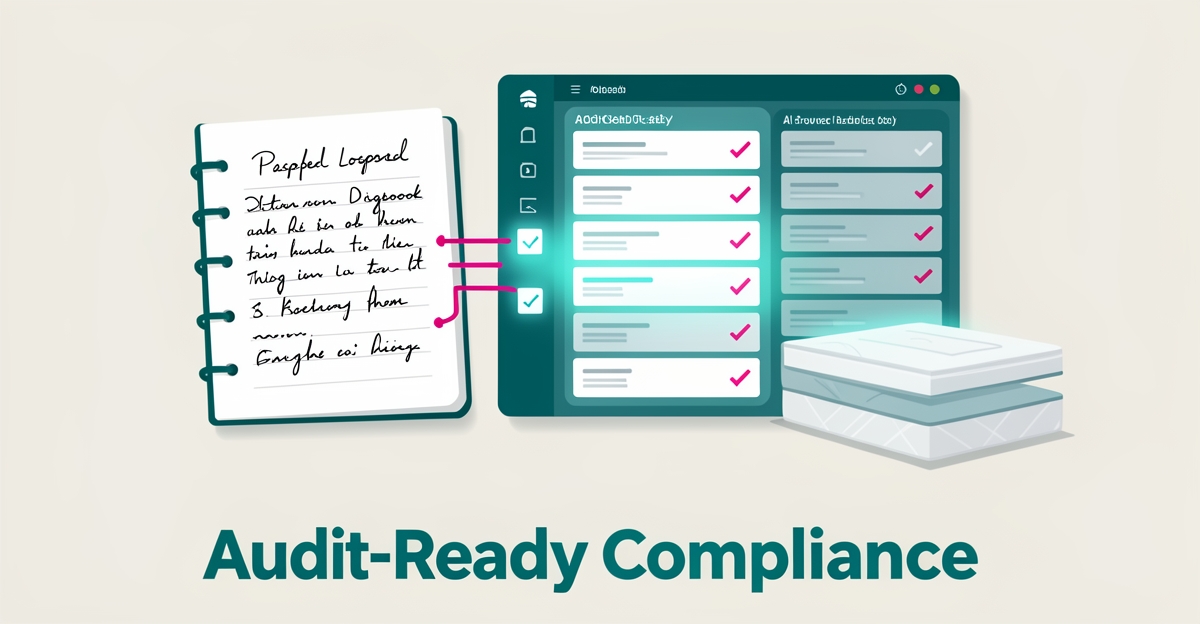
From Manual Logs to AI: How Mattress Disposal Companies Can Track Disposal Compliance
Key Facts
- Manual disposal logging typically introduces three failure points: inconsistent formats, lost or degraded paper records, and retroactive data entry backlogs.
- AI document processing uses optical character recognition and natural language processing to extract facility IDs, weights, timestamps and material classifications from manifests.
- Structured, centralized records in consistent formats make disposal data searchable and audit-ready.
- Immutable audit trails, records that cannot be altered after creation, are a core requirement for legally defensible compliance evidence.
- Phased implementation, starting with a single disposal stream, lets companies automate compliance without disrupting existing operations.
Hire a team member that works 24/7 — for less than a part-time wage.
AI receptionists, SDRs, dispatchers and 99+ roles. Trained on your business, fully managed.
Not sure where to start? Ask our AI planner
The Compliance Burden: Why Manual Disposal Logs Fail
For mattress disposal companies, compliance documentation isn't just paperwork, it's the legal shield that protects operations from regulatory penalties and environmental liability. Yet many operators still rely on paper logbooks, spreadsheets, or disconnected digital tools that create more risk than they mitigate.
Manual logging systems introduce three critical failure points that compound across multi-location operations. Drivers record disposal details by hand at transfer stations, supervisors transcribe those notes into spreadsheets back at the office, and compliance managers piece together fragmented records when auditors arrive. Each handoff increases the probability of missing timestamps, incorrect facility codes, or lost weight tickets, gaps that regulators treat as violations.
- Inconsistent data formats across locations prevent centralized oversight
- Paper records degrade, get misplaced, or become illegible during transport
- Retroactive data entry creates backlogs that delay billing and reporting
- No audit trail exists to prove who recorded what and when
Sound recordkeeping practice, whatever the industry, emphasizes structured, centralized records in consistent formats. Paper-based disposal logs simply cannot meet that standard. Clear, consistent, secure records are foundational requirements for any system that has to withstand regulatory scrutiny, and ad-hoc manual logging fails on all three counts.
When audits occur, companies face a scramble: pulling drivers off routes to locate tickets, cross-referencing weight slips with customer manifests, and reconstructing timelines from memory. This reactive posture doesn't just consume labor hours, it signals to regulators that compliance infrastructure is fragile. The operational bottleneck intensifies during peak seasons when disposal volumes spike but administrative capacity remains fixed.
AIQ Labs works with waste management operators to replace these fragile workflows through AI Workflow Builds, rebuilding the one workflow that costs the most, at a fixed price and in phases. The same principle that guides AI automation generally, delegating repetitive, structured tasks to intelligent agents while maintaining human oversight, applies directly to compliance documentation. By automating the extraction of facility IDs, weights, timestamps, and material classifications from heterogeneous documents, companies eliminate the transcription errors and delays that trigger regulatory scrutiny.
What AI Can Actually Do: Scanning, Categorizing, and Storing Disposal Records
AI-powered document processing transforms how mattress disposal companies manage compliance records by eliminating manual data entry. AI systems can scan disposal manifests, extract key compliance data like location, date, disposal method, and volume, and organize this information into searchable, audit-ready databases. This automation directly addresses the repetitive documentation burden that consumes staff time and increases error risk in regulated waste operations. AI is well suited to exactly this kind of repetitive work, data extraction and documentation, freeing human workers to focus on higher-value operational tasks.
The technology leverages natural language processing and optical character recognition to interpret various document formats, from paper manifests to digital PDFs. Once extracted, data is automatically categorized using predefined compliance tags and stored in centralized systems that follow consistent formatting and secure centralization. Structuring and centralizing records in a consistent format ensures they are both secure and easily retrievable for audits. AI systems enforce these standards automatically, reducing the risk of non-compliance due to inconsistent or incomplete recordkeeping.
By automating the intake, validation, and storage of disposal records, AI creates a continuous compliance trail that supports regulatory reporting and internal oversight. Staff no longer need to manually transcribe data from manifests into spreadsheets or legacy systems, cutting processing time and minimizing transcription errors. This shift allows teams to redirect effort toward route optimization, customer service, or fleet management, core operational activities that directly impact service quality and cost efficiency. AIQ Labs builds document processing systems that businesses own outright, ensuring sensitive disposal data remains under your control while meeting environmental compliance requirements. The result is a resilient, auditable recordkeeping system that scales with business growth without proportional increases in administrative overhead.
Building a Compliant System: Security, Structure, and Audit Trails
Building a compliant system for mattress disposal tracking requires more than just automation, it demands a secure, structured foundation that protects sensitive business information while meeting environmental compliance standards. AIQ Labs designs AI-powered logging systems that align with established best practices for data integrity and audit readiness.
Good logging practice means creating clear, consistent, and secure records of what happens in systems, ensuring every disposal event is traceable and verifiable during regulatory inspections. Structure and centralize logs in a central location using consistent formats, which enables seamless integration with AI processing pipelines and simplifies data retrieval for audits. Protect sensitive data by avoiding recording confidential information in logs, such as customer identifiers or proprietary operational details, focusing instead on disposal timestamps, material types, and facility destinations.
To build a resilient compliance tracking system, implement these core technical requirements: use structured logging with standardized schemas to ensure uniformity across all disposal records; deploy centralized storage solutions that aggregate logs from multiple collection points into a single, searchable repository; apply encryption and access controls to safeguard data at rest and in transit; establish automated backup protocols to prevent data loss; and maintain immutable audit trails that cannot be altered after creation, preserving the integrity of compliance evidence. These measures ensure records remain accessible, accurate, and legally defensible throughout their retention period.
Implementation Roadmap: From Paper Trails to Automated Compliance
Transitioning from paper-based disposal logs to AI-powered compliance tracking requires a structured approach that aligns with operational realities. Mattress disposal companies can begin by mapping their current documentation workflows to identify manual entry points, duplication, and error-prone steps. This assessment reveals where automation delivers the greatest impact, such as capturing disposal timestamps, material types, and destination facilities without human intervention.
Established practice emphasizes structuring logs in consistent formats and centralizing records in secure systems, foundations AI can enforce automatically. Companies should prioritize automating repetitive tasks such as data extraction from disposal manifests, categorization by material composition, and storage in compliant repositories. AI handles the boilerplate work while preserving human oversight for complex decisions.
- Audit existing logs for gaps in required compliance fields
- Identify high-volume document types for initial automation
- Map integration points with scales, hauling software, and reporting tools
- Define AI agent responsibilities for data capture and validation
- Establish human-in-the-loop checkpoints for exception handling
Integration should start with a pilot focused on one disposal stream, such as residential pickups, before scaling to commercial or municipal contracts. AIQ Labs supports this phased rollout by building systems that ingest data from existing tools via secure APIs, ensuring businesses retain full ownership of their compliance data. As disposal volumes grow, the system adapts, reducing manual effort while maintaining audit-ready records. For operators ready to go further, an AI Operating System connects compliance tracking with dispatch, billing and reporting in one owned operating layer. This approach transforms compliance tracking from an administrative burden into a strategic asset for operational transparency.
Still paying for 10+ subscriptions that don’t talk to each other?
We build custom AI systems you own outright. No vendor lock-in. Full control.
Not sure where to start? Ask our AI planner
Frequently Asked Questions
How does AI-powered document processing actually work for tracking mattress disposal compliance?
What are the biggest risks of continuing to use manual logs or spreadsheets for disposal tracking?
Will implementing AI for disposal tracking require us to overhaul our entire operations or replace our existing software?
How does AI ensure our disposal records are secure and compliant with data protection standards?
What kind of ROI or efficiency gains can we expect from switching to AI-driven disposal tracking?
Is AI document processing reliable enough to handle the variety of disposal documents we receive, like paper manifests and PDFs?
Turn Compliance From Burden Into Business Advantage
Manual logs, spreadsheet handoffs and paper tickets create the gaps regulators penalize, missing timestamps, illegible records and no audit trail. AI document processing closes those gaps by scanning manifests, extracting facility IDs, weights and timestamps, and storing them in structured, centralized, audit-ready records built for consistency and security. The result is faster reporting, fewer transcription errors, and a continuous compliance trail that scales with volume without adding administrative overhead. For mattress disposal operators, the shift is from reactive scramble during audits to proactive oversight built into daily operations. Mapping current workflows, piloting automation on a single disposal stream, and defining human-in-the-loop checkpoints makes the transition practical and low risk. If you want to see where automation fits your operation, start the two-minute Fit Check at https://aiqlabs.ai/apply, then book a free 30-minute strategy call at https://aiqlabs.ai/book to map your biggest bottleneck. You can also reach the team at [email protected].
Make AI your competitive advantage — not just another tool.
Strategy, implementation and ongoing optimization. One partner, end to end.
Not sure where to start? Ask our AI planner