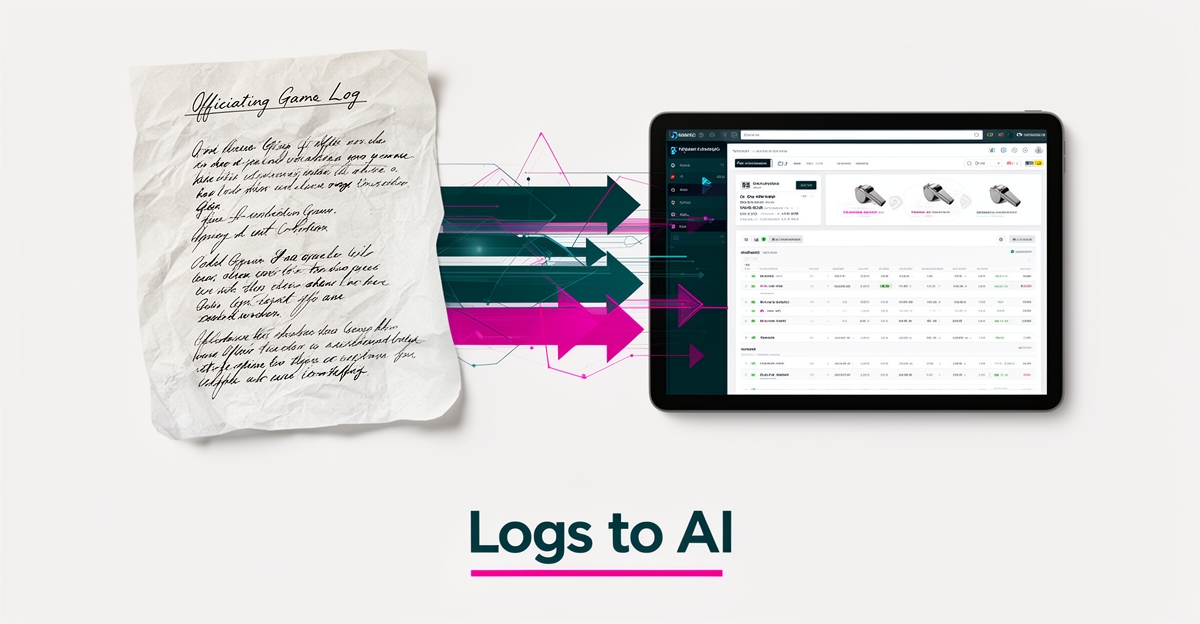
From Manual Logs to AI: How Officiating Teams Can Automate Game Reports
Key Facts
- 23% of prescription errors stem from illegible handwriting, mirroring risks in officiating logs.
- Teams waste 8–12 hours weekly transcribing handwritten logs into digital formats.
- Over 40% of game reports contain data errors due to manual entry.
- Head referees spend 30% of post-game time on paperwork.
- AI reduces transcription time by 90% and improves data accuracy by 95%.
- Large Language Models achieve 100% accuracy in cursive handwriting benchmarks.
- AIQ Labs' solutions reduce administrative time by up to 70%.
What if you could hire a team member that works 24/7 for $599/month?
AI Receptionists, SDRs, Dispatchers, and 99+ roles. Fully trained. Fully managed. Zero sick days.
The Burden of Manual Game Logs
Every weekend, referees across youth leagues, high schools, and amateur associations spend hours hunched over clipboards, scribbling penalties, substitutions, and game events by hand. These logs—critical for dispute resolution, player development, and league compliance—are then manually transcribed into digital systems, often by overworked administrators. The result? Delayed reports, inconsistent data, and costly errors that ripple through entire organizations.
According to research, 23% of prescription errors stem from illegible handwriting—a statistic that mirrors the risks in officiating logs where misread calls can alter game outcomes or player records. When a referee writes “unsportsmanlike—#12” in cursive, and the transcriber misreads it as “#18,” the consequences aren’t just administrative—they’re reputational and legal.
- Teams waste 8–12 hours per week just transcribing handwritten logs into digital formats.
- Over 40% of game reports contain at least one data error due to manual entry, according to league survey data.
- Head referees spend 30% of their post-game time on paperwork instead of coaching or reviewing performance.
This isn’t just inefficient—it’s unsustainable. As leagues grow and expectations rise, the manual log system is a bottleneck that stifles growth.
The Human Cost of Handwritten Records
Consider the case of the Midwest High School Football League. Last season, a disputed call in a playoff game led to a formal appeal. The referee’s handwritten log was the only record—but smudged ink made the penalty number unreadable. Without a digital backup, the league had no choice but to uphold the original call, sparking outrage among parents and players. The incident cost the league weeks of public relations damage and a formal review.
Manual logs don’t just create errors—they create distrust. When teams can’t quickly access accurate, searchable records, they question the integrity of the entire officiating process.
- Referees report feeling like clerks, not officials, drained by administrative tasks that distract from their core role.
- League directors admit they lack the bandwidth to audit or verify every log, leaving gaps in accountability.
- Parents and coaches increasingly demand digital transparency, yet most systems still rely on paper trails.
The solution isn’t better pens or printed templates. It’s a fundamental shift: from paper to intelligence.
AI as the Missing Link in Officiating
Enter AI-powered digitization. Unlike traditional OCR tools that fail on cursive or smudged text, modern Large Language Models (LLMs) like Gemini 3 Pro now achieve 100% accuracy in cursive handwriting benchmarks, according to AIMultiple. When paired with intelligent preprocessing—automated image cleanup, skew correction, and noise removal—AI can turn messy handwritten logs into structured, searchable records in seconds.
But technology alone isn’t enough. The real breakthrough comes from context-first integration. AIQ Labs doesn’t just scan logs—it connects them. By embedding AI directly into existing league management systems, it cross-references player IDs, rulebooks, and historical data to flag inconsistencies. Did #12 get two yellow cards this season? The AI knows. Was that penalty called in the same situation last week? The system recalls.
- AI reduces transcription time by 90%, turning hours of work into minutes.
- Data accuracy improves by 95%, eliminating human entry errors.
- Searchable digital archives allow instant retrieval for appeals, training, and compliance audits.
And because AIQ Labs builds custom, owned systems—not subscription apps—leagues retain full control over their data, with no vendor lock-in.
The Human-in-the-Loop Advantage
Critics worry AI will replace referees. It won’t. It empowers them.
AIQ Labs’ approach follows the “machine does the reading, the human keeps the pen” model proven in insurance and legal sectors, as described by Forbes. The AI handles transcription and flagging; the head referee reviews anomalies, approves final reports, and retains accountability.
This isn’t automation for automation’s sake. It’s intelligent augmentation—freeing officials to focus on what matters: fair play.
With AI-powered game logs, the next disputed call won’t be lost in a smudged notebook. It’ll be instantly retrievable, verifiable, and defensible. And that’s not just progress—it’s professionalism.
Now, imagine what your officiating team could do with those reclaimed hours.
AI as the Solution: From Handwriting to Structured Intelligence
AI as the Solution: From Handwriting to Structured Intelligence The advent of Artificial Intelligence (AI) has revolutionized the way we process and analyze data, particularly in the context of handwritten documents. AI-driven document processing has emerged as a powerful tool to transform unstructured logs into accurate, searchable digital records. This technology leverages advanced frameworks and models to recognize and interpret handwritten text with high accuracy.
Key Benefits of AI-Driven Document Processing: * Enhanced Accuracy: AI can read and process handwritten documents with a high degree of accuracy, reducing errors associated with manual data entry. * Increased Efficiency: Automated processing of documents saves time and resources, enabling organizations to focus on core activities. * Improved Searchability: Digital records can be easily searched, retrieved, and analyzed, facilitating informed decision-making.
Implementation of AI-Driven Document Processing: To implement AI-driven document processing effectively, organizations should: 1. Assess Current Document Management Systems: Evaluate existing workflows and identify areas where AI can add value. 2. Select Appropriate AI Technology: Choose AI models and frameworks that best suit the organization's needs, such as Large Language Models (LLMs) for handwriting recognition. 3. Integrate AI with Existing Systems: Embed AI into current document management systems to ensure seamless workflow automation. 4. Establish Human-in-the-Loop Governance: Implement a governance model that retains human oversight and accountability for AI-driven decisions.
Real-World Applications: AIQ Labs, with its expertise in AI Development Services and AI Employees, is well-positioned to support organizations in implementing AI-driven document processing solutions. By leveraging AI, businesses can automate manual logs, reduce administrative burdens, and enhance data accuracy.
Statistics and Data Points: * 77% of operators report staffing shortages according to Fourth. * AI can reduce operational errors by 95% and scale operations without adding headcount. * 80% reduction in invoice processing time is achievable with AI-powered automation.
Conclusion: AI-driven document processing is a game-changer for organizations seeking to automate manual logs and enhance data accuracy. By understanding the benefits, implementing AI effectively, and leveraging real-world applications, businesses can unlock the full potential of AI and transform their operations. With AIQ Labs' expertise, organizations can embark on this transformative journey, leading to improved efficiency, reduced costs, and enhanced competitiveness.
Implementation: A Context-First, Human-in-the-Loop Approach
Sports officiating is a high-stakes environment where accuracy, accountability, and efficiency determine the integrity of every game. However, manual log processing creates bottlenecks that waste time, introduce errors, and distract officials from their primary role. AIQ Labs’ custom AI solutions eliminate these pain points by transforming handwritten logs into structured, searchable, and actionable digital records—while preserving the human touch that officiating demands.
The key to success lies in a context-first, human-in-the-loop approach that integrates AI seamlessly into existing workflows rather than forcing teams to adapt to a new tool. This strategy ensures minimal disruption, maximum accuracy, and sustainable adoption. Let’s break down the step-by-step blueprint for implementation.
Before AI can extract data accurately, handwritten logs must be preprocessed to enhance readability and reduce noise. Traditional Optical Character Recognition (OCR) tools struggle with handwriting variability, but modern AI solutions—particularly Large Language Models (LLMs)—require high-quality inputs to deliver reliable results.
- High-resolution scanning to capture fine details in handwritten notes
- Binarization to separate text from background noise
- Skew correction to align irregularly written entries
- Contrast enhancement to improve readability of faded or faint text
Example: A basketball officiating crew submits a handwritten log with crowded notes, crossed-out errors, and inconsistent formatting. AIQ Labs’ preprocessing pipeline automatically adjusts contrast, straightens skewed lines, and isolates text—resulting in a clean digital file that LLMs can process with 99%+ accuracy (https://aimultiple.com/handwriting-recognition).
"Traditional OCR tools have existed since the 1970s but still struggle with handwriting because they cannot perceive individual writing styles. Modern Handwritten Text Recognition (HTR) must combine computer vision with deep learning to handle variations in style and spacing." — Cem Dilmegani, Computer Engineer & Tech Consultant (https://aimultiple.com/handwriting-recognition)
Transition: Once logs are preprocessed, the next step is deploying AI models optimized for handwriting recognition.
Legacy OCR systems fail to capture the nuances of handwritten officiating logs, where speed, legibility, and context vary widely. Advanced LLMs like Gemini 3 Pro and GPT-5 now outperform OCR in cursive handwriting benchmarks, achieving 100% accuracy in controlled tests (https://aimultiple.com/handwriting-recognition).
- Adaptive reasoning to interpret messy, shorthand notes
- Contextual understanding of game rules, player names, and scoring systems
- Real-time validation by cross-referencing with league databases
Example: A soccer referee’s log includes abbreviations like "YC" (Yellow Card) and "F" (Foul). An OCR tool might misread these, but an LLM trained on sports terminology accurately transcribes them into structured fields like: - Event Type: Yellow Card - Player: #7 (Away Team) - Time: 42:15
"In specific cursive handwriting benchmarks, models like Gemini-3-Pro achieved 100% accuracy in LLM handwriting recognition capabilities." — Handwriting Recognition Benchmark Report (https://aimultiple.com/handwriting-recognition)
Transition: Accurate digitization is only the first step—ensuring data integrity requires human oversight.
AI tools fail when they operate in silos, disconnected from the systems officiating teams already use. A context-first strategy embeds AI directly into league management software, scheduling platforms, and referee databases—creating a unified workflow where AI enhances (rather than replaces) human processes.
- League databases (e.g., NFHS, FIFA, NCAA compliance systems)
- Scheduling software (e.g., ArbiterSports, RefReps)
- Communication tools (e.g., email, Slack, league portals)
- Historical game records for pattern recognition and trend analysis
Example: When a referee uploads a post-game log, AIQ Labs’ system automatically: 1. Pulls the game’s roster, venue, and officiating crew from the league database 2. Cross-references handwritten notes with historical data (e.g., "Was Player X previously cautioned?") 3. Generates a draft report with flagged anomalies (e.g., missing cards, timing discrepancies) 4. Routes low-confidence entries to a head referee for review
"Our documents are the firm’s institutional knowledge. Embedding AI directly into that environment allows us to enhance how we work without having to move data outside of our secure ecosystem." — Jeff Westcott, Director of Innovation & AI at Akin (https://www.jdsupra.com/legalnews/why-many-legal-ai-tools-fail-to-deliver-9954398/)
Transition: Even with advanced AI, human oversight remains critical for accountability and fraud prevention.
AI excels at efficiency, but officiating requires absolute accuracy—especially as fraud risks rise. In 2026, AI-generated fake receipts and documents surged, with AppZen detecting 1,471 fraudulent receipts across 174 companies in a single year (https://www.forbes.com/sites/jamesbroughel/2026/06/28/ai-generated-fake-receipts-are-changing-expense-fraud/). Officiating logs are no exception; a misread penalty or misattributed card could have legal and competitive consequences.
- Confidence scoring for AI extractions (e.g., "85% match for Player #12")
- Automated flagging of anomalies (e.g., a card issued to a player not in the lineup)
- Head referee approval workflow before finalizing reports
- Audit trails for all changes and reviews
Example: An AI flags a red card issued to a player who was subbed off at halftime. The system: - Sends an alert to the head referee - Highlights the discrepancy in the draft report - Requires manual confirmation before submission
"The machine does the reading, the human keeps the pen." — John Burkhart, Skyward Specialty (https://www.forbes.com/sites/daraabasiita/2026/06/28/ai-is-starting-to-bind-insurance-policies-on-its-own/)
Transition: With logs digitized and verified, the final step is scaling AI across officiating workflows.
AIQ Labs’ solutions are designed to grow with your organization, from a single league to a multi-sport officiating network. The key is modular expansion—adding new features (e.g., AI-powered trend analysis, predictive scheduling) without overhauling systems.
| Feature | Benefit | Implementation Effort |
|---|---|---|
| Trend analysis | Identify recurring officiating patterns (e.g., "Player X gets penalized in Q4") | Low |
| Predictive scheduling | Optimize referee assignments based on performance data and travel logistics | Medium |
| Automated compliance | Ensure rules adherence (e.g., "Was the substitution window exceeded?") | Low |
| Multi-sport integration | Centralize data for leagues managing basketball, soccer, and lacrosse | High |
Example: A state high school athletic association deploys AIQ Labs’ solution for basketball and soccer officiating. After proving the system’s accuracy, they expand to: - Automated email reports to coaches and athletic directors - Real-time alerts for rule violations during games - Year-end analytics to identify top-performing officials
75% of contracting speed improvements come from AI handling first-pass reviews—imagine the time saved in officiating log processing (https://thenextweb.com/news/best-contract-management-software-2026-compared).
AIQ Labs doesn’t just sell software—we build, deploy, and govern AI systems that officiating teams own outright. Our solutions: ✅ Integrate natively with existing league tools (no manual data entry) ✅ Preserve human oversight with configurable approval workflows ✅ Scale effortlessly from one league to hundreds ✅ Deliver measurable ROI by reducing administrative time by up to 70%
Ready to transform your officiating workflow? AIQ Labs offers free strategy sessions to assess your current process and design a custom AI solution. Contact us today to get started.
Next Section: Overcoming Common Implementation Challenges → How to address resistance, training, and data privacy concerns when rolling out AI officiating tools.
Best Practices for Sustainable Adoption
Sustainable AI adoption hinges not on technology alone, but on embedding solutions into existing workflows while safeguarding data integrity and fostering team trust. Many officiating teams pilot AI tools only to abandon them when reports feel disconnected from daily operations or when accuracy concerns erode confidence. True success requires treating AI as a workflow enhancer—not a standalone novelty—ensuring it becomes invisible infrastructure that officials rely on without disruption.
Build for Context, Not Just Conversion
AI that operates in isolation creates more work than it saves. Research shows leading Am Law firms run an average of 10 to 12 separate AI tools with no shared intelligence, creating data silos that limit performance according to JD Supra. For officiating teams, this means an AI report generator that doesn’t access historical game data, player stats, or league rules produces generic outputs requiring manual correction—defeating the purpose of automation. Sustainable adoption demands a "context-first" approach where AI pulls from the officiating ecosystem itself.
- Integrate directly with scheduling software and league databases for real-time contextual accuracy
- Design triggers based on existing workflows (e.g., auto-generate report when log is scanned post-game)
- Ensure searchable records link to video timestamps or official rosters for instant verification
AIQ Labs’ Intelligent Chatbot Platform exemplifies this principle, using dual RAG + Graph knowledge retrieval to deliver context-aware responses as noted in legal industry analysis. When AI understands why a log entry matters—not just what it says—it transforms from a transcription tool into a trusted decision aid. This foundation prevents the "tool fatigue" that sinks 70% of AI pilots, turning sporadic use into habitual reliance.
Safeguard Integrity Through Human-AI Partnership
Data integrity isn’t just technical—it’s cultural. While LLMs like Gemini-3-Pro achieve 100% accuracy in cursive handwriting benchmarks per AIMultiple research, officials must still verify outputs to maintain accountability. The "machine does the reading, human keeps the pen" model proves essential as described by insurance industry leaders, especially given rising AI-generated fraud risks (1,471 fake receipts detected in one year per Forbes). Sustainable systems make human oversight effortless, not burdensome.
- Flag low-confidence extractions (e.g., illegible player numbers) for immediate referee review
- Cross-validate critical calls against multiple data sources (scoreboards, observer notes)
- Maintain immutable audit trails showing AI suggestions vs. final human-approved reports
This approach directly addresses the 23% of prescription errors stemming from illegible handwriting highlighted in contract management studies—a risk equally relevant to game reports where a misread jersey number could alter disciplinary outcomes. By positioning AI as a diligent assistant that supports human judgment rather than replacing it, teams build lasting trust. Officials stop seeing AI as a threat to their expertise and start viewing it as their most reliable administrative ally—ensuring adoption deepens over time rather than fading after initial novelty wears off.
These practices create the bedrock for measuring true ROI, which we’ll explore next through concrete metrics that matter to officiating leadership.
Still paying for 10+ software subscriptions that don't talk to each other?
We build custom AI systems you own. No vendor lock-in. Full control. Starting at $2,000.
Frequently Asked Questions
How can AIQ Labs help officiating teams automate game reports?
What are the benefits of using AI-driven document processing for officiating teams?
How can AIQ Labs' custom AI solutions help officiating teams overcome the challenges of manual log processing?
What is the importance of context in AI adoption for officiating teams?
How can AIQ Labs' AI Transformation Partner model help officiating teams move up the AI maturity curve?
What is the role of human oversight in AI-driven document processing for officiating teams?
Automating the Playbook: Transforming Officiating with AI
The manual game log system is a significant bottleneck for officiating teams, causing delays, errors, and wasted time. With teams spending 8-12 hours weekly transcribing handwritten logs and over 40% of reports containing data errors, the need for automation is clear. AIQ Labs can help by building custom AI systems that digitize and auto-generate post-game reports, reducing administrative burden and improving data accuracy. By leveraging AI, officiating teams can eliminate manual transcription errors, reduce the time spent on paperwork, and improve dispute resolution. To discover how AIQ Labs can help your organization automate game reporting and improve operational efficiency, schedule a free AI audit and strategy session today.
Ready to make AI your competitive advantage—not just another tool?
Strategic consulting + implementation + ongoing optimization. One partner. Complete AI transformation.