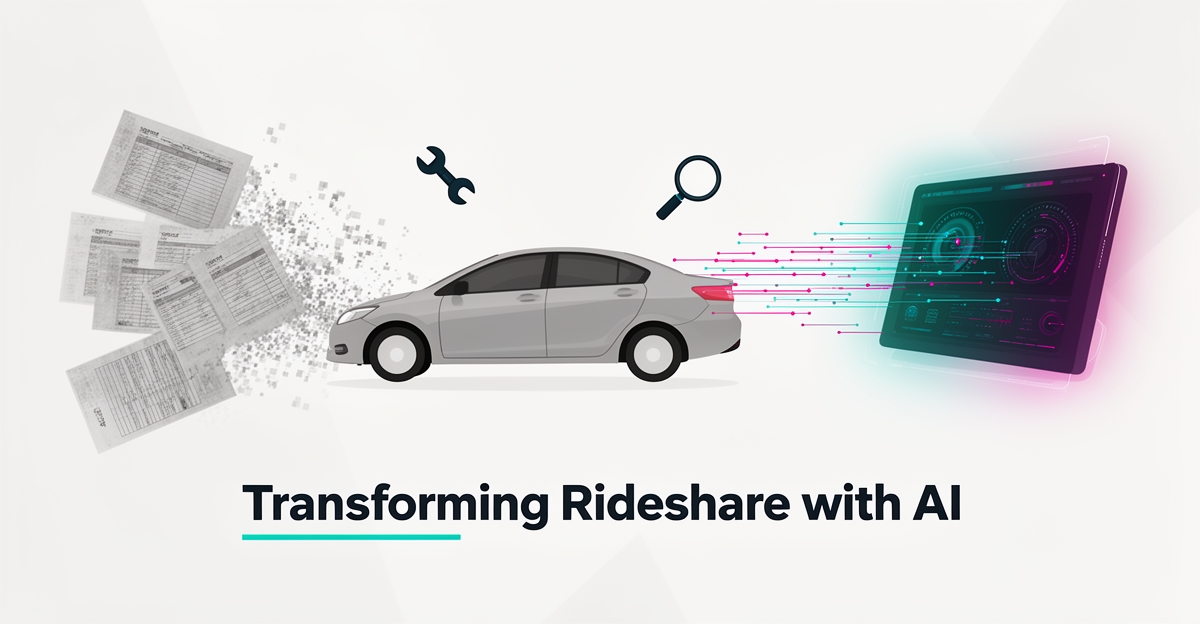
From Manual Logs to AI: Modernizing Rideshare Fleet Maintenance Tracking
Key Facts
- Fragmented maintenance data—paper logs, spreadsheets, and siloed telematics—is the leading cause of reactive repairs and compliance gaps in rideshare fleets
- AI maintenance tracking works best as a governed assistant: automation handles scanning and coordination, humans keep final authority over repairs
- A unified vehicle health record is the prerequisite—AI can only act on context it can see
- The Associated Press builds intelligent workflows around the principle that editorial judgment stays human, always on its workflow site
- Wikipedia publicly tracks AI-generated content issues, including thousands of declined drafts and multiple categories of suspected AI text in its AI resources
- AIQ Labs has deployed 200+ multi-agent systems and runs 4 live SaaS products daily, so these patterns are proven in production, not theory
Hire a team member that works 24/7 — for less than a part-time wage.
AI receptionists, SDRs, dispatchers and 99+ roles. Trained on your business, fully managed.
Not sure where to start? Ask our AI planner
The Hidden Cost of Fragmented Maintenance Tracking
When a single vehicle in a rideshare fleet goes down unexpectedly, it’s not just a repair bill—it’s lost revenue, a frustrated driver, and a potential hit to your service reputation. Yet many fleet managers are still trying to prevent these breakdowns with paper logs, scattered spreadsheets, and siloed apps that create more confusion than clarity.
The problem isn’t a lack of data; it’s that the data is fragmented. Driver reports live in one system, GPS telematics in another, and service histories in a third. This creates dangerous operational blind spots where a missed oil change or a worn brake pad goes unnoticed until it becomes a costly emergency. The Associated Press identified this exact challenge in newsroom workflows, noting that disconnected systems each hold only a fragment of the story, causing metadata to get lost at handoffs and preventing AI tools from acting on context they cannot see.
Manual entry compounds the issue. Every time a driver scribbles a mileage note or a manager transcribes a text message into a spreadsheet, the risk of human error climbs. These small mistakes accumulate into operational blind spots that obscure a vehicle’s true health. Without a unified view, you’re essentially driving blind, reacting to failures instead of preventing them.
Fragmented tracking typically breaks down in three critical areas:
- Data decay: Paper logs and static spreadsheets become outdated the moment they’re filed, making real-time decision-making impossible.
- Compliance gaps: Disconnected records make it difficult to prove consistent maintenance for insurance or regulatory audits.
- Reactive repairs: Without predictive alerts, minor issues escalate into major mechanical failures that sideline vehicles for days.
This mirrors the governance challenges seen in other industries adopting AI. Wikipedia’s public tracking of AI-generated content—including thousands of drafts declined as suspected LLM output—shows how automated systems without proper oversight can generate chaos rather than clarity. In fleet management, an AI that can’t access the full context of a vehicle’s history isn’t just unhelpful—it’s a liability.
The solution lies in shifting from fragmented record-keeping to a unified, intelligent system. Just as the AP advocates for rethinking underlying architecture so that context travels with the content, modern fleets need maintenance data that flows seamlessly between drivers, managers, and AI systems. When AI can scan driver reports, cross-reference GPS data, and flag service needs automatically, you transform maintenance from a reactive chore into a strategic advantage that keeps vehicles on the road and revenue flowing.
AI as a Governed Assistant for Maintenance Workflows
For rideshare fleet managers drowning in fragmented maintenance logs, AI offers a path forward—not as a replacement for human expertise, but as a governed assistant that handles the coordination and monitoring work. This approach aligns directly with the Associated Press principle that "editorial judgment stays human. Always," ensuring AI handles the logistics of scanning driver reports, GPS data, and service histories while humans retain final authority over critical maintenance decisions. According to AP, their intelligent workflows are built around assistance, not autonomy, with every action logged to maintain editorial control—a model perfectly suited for safety-critical fleet operations where audit trails are non-negotiable.
AI agents excel at automating the multi-step, repetitive tasks that consume maintenance coordinators' time. They can scan unstructured driver notes for early warning signs, cross-reference GPS mileage with service intervals, and flag vehicles needing attention—all while operating within strict guardrails. Modern agentic systems demonstrate this kind of multi-step reasoning in production environments, handling complex tasks like research, comparisons, and bookings by weighing multiple inputs simultaneously—a critical trait when interpreting subtle vehicle health indicators across diverse driver reports.
To ensure trust and compliance, these AI assistants must operate within governed, auditable systems where every action is traceable. Wikipedia’s extensive framework for managing AI-generated content underscores the necessity of robust oversight. Their public tracking shows that even collaborative environments require clear policies and human-in-the-loop controls to mitigate risks like hallucinations or false citations, which in maintenance tracking could lead to missed safety issues or unnecessary repairs.
The true power emerges when AI unifies fragmented data sources into a coherent vehicle health narrative. Rather than treating each log entry as isolated, AI systems can organize maintenance around the vehicle’s continuous service history—much like AP’s Story Object Model rethinks newsroom architecture around the story itself. AP emphasizes that intelligent agents only work effectively when operating within governed systems that prevent context loss at handoffs between disconnected tools. For fleets, this means connecting spreadsheets, telematics, and driver apps into a single auditable view where AI assists without overstepping.
- Automates scanning of driver reports and GPS data for maintenance triggers
- Generates service reminders based on unified vehicle health history
- Maintains complete audit trails for compliance and oversight
- Flags anomalies requiring human expert review
- Reduces manual log processing while keeping decisions human-led
By positioning AI as a meticulous assistant rather than an autonomous decision-maker, fleet managers gain efficiency without sacrificing control. The technology handles the preparatory work—identifying patterns, scheduling checks, and drafting reports—while humans apply contextual knowledge to approve repairs, override false alerts, or prioritize based on real-world conditions. This balance of automation and oversight creates a system that’s both more reliable and more trustworthy than purely manual logs or unchecked AI, turning maintenance tracking from a burdensome chore into a streamlined, auditable process that supports vehicle uptime and safety. For businesses seeking to implement such governed AI assistance, AIQ Labs builds these systems through AI Workflow Builds—rebuilding the one workflow that costs the most, at a fixed price, in phases.
Unifying Fleet Data for Actionable AI Insights
Fragmented records kill fleet uptime. Maintenance logs live in spreadsheets, driver reports sit in email, and GPS data stays trapped in telematics dashboards. An AI system can only act on the context it can see.
A unified vehicle health record brings those fragments together. The Associated Press faces the same problem in newsrooms, where disconnected systems each hold a fragment of the story and metadata gets lost at handoffs. Their Story Object Model is designed so every system can share context about a story, making the story—not the output—the organizing structure.
Rideshare fleets need the same architecture. When maintenance logs, driver reports, and GPS data are merged into one health record, AI can move from passive retrieval to active execution. Agentic AI is already transforming how teams operate by automating tasks, personalizing experiences, and acting as intelligent assistants. The goal is a shift from searching to executing tasks.
That execution looks like scanning a driver report for brake noise, cross-referencing mileage from GPS, checking the last service date, and booking a slot before a safety window closes. AI-powered agents are rapidly automating everything from research and price comparisons to bookings and routine business tasks. The pattern maps directly to fleet operations.
Governance matters as much as integration. AP’s approach to intelligent workflows is built around one principle: editorial judgment stays human. Always. Assistance, not autonomy. Every action is logged. Control stays with your team at every step. For fleet managers, that means AI handles coordination, monitoring and preparation work while humans approve major repairs and override reminders with contextual knowledge.
A governed, auditable system also reduces risk. Wikipedia publicly tracks thousands of drafts declined as suspected LLM output and maintains multiple categories for suspected AI-generated texts, showing how errors and hallucinations require oversight. In maintenance, an incorrect diagnosis can create safety hazards.
Unifying data enables the multi-step reasoning that modern agents demonstrate in production. AIQ Labs has deployed 200+ multi-agent systems and runs 4 live SaaS products daily, so these patterns are proven at scale. That capability is what turns fragmented records into actionable AI insights.
AIQ Labs builds custom AI systems that turn fragmented records into actionable insights, cutting down errors and improving vehicle uptime by scanning driver reports and GPS data for maintenance signals. The result is a health record that supports prediction, not just history.
A unified vehicle health record typically consolidates:
- Maintenance logs and service history with parts and labor details
- Driver-reported issues and check-in notes from mobile forms
- GPS telematics for mileage, harsh braking, idle time, and route stress
- Service reminders and compliance deadlines for inspections and recalls
With context unified, AI can predict needs and schedule service inside governed, auditable systems. For fleets, owning the vehicle health conversation means fewer breakdowns and more uptime.
From Pilot to Performance: Implementing AI Maintenance Tracking
Manual logs stall fleet growth long before a vehicle breaks down. Moving to AI-driven maintenance tracking works best as a phased shift from quick wins to governed scale.
Start with workflow fixes that remove the most painful manual steps. AI agents are rapidly transforming how teams handle routine operations by automating everything from research and comparisons to bookings and routine business tasks. The same agentic pattern applies to scanning driver reports, extracting mileage and fault codes, and triggering service reminders. Early pilots focus on one vehicle class or depot, proving value without rebuilding the whole operation.
Integration comes next. AI tools cannot act on context they cannot see, and right now most operations run on disconnected systems that each hold a fragment of the story. Metadata gets lost at handoffs. For fleets, maintenance logs, driver check-ins, GPS data, and service history must converge into a unified view before automation is reliable. AIQ Labs’ AI Workflow Builds rebuild the one workflow that costs the most—at a fixed price, delivered in phases—so you prove value before committing further. When you’re ready for a single connected layer across the whole operation, AI Operating Systems tie it together, built in phases and owned outright.
Scale requires governance, not just more automation. The Associated Press frames intelligent workflows around one principle: editorial judgment stays human. Always. Assistance, not autonomy, with every action logged and control staying with the team at every step. That model fits maintenance tracking, where AI handles coordination, monitoring and preparation work while managers retain final approval on repairs and overrides.
A phased approach typically includes:
- Assessment and strategy to map data sources, readiness, and high-ROI automation targets
- Agent and system development with custom AI agents built on multi-agent frameworks and production monitoring
- Integration with telematics, scheduling, and accounting systems for a single source of truth
- Governance and compliance with audit trails, data security, and human-in-the-loop controls
- Adoption and change management with role-based training and feedback loops
The shift mirrors broader market dynamics. Entrenched habits slow adoption even when better tools exist—teams keep using familiar spreadsheets long after they stop serving the operation. Success depends on making the new workflow easier than the old logbook.
Governance remains the differentiator. AI is already inside most operations. The question isn’t whether to use it — it’s whether it’s working inside a governed, auditable system or around the edges of one. With structured pilots, unified data, and clear oversight, manual maintenance tracking evolves into performance-driven uptime.
Still paying for 10+ subscriptions that don’t talk to each other?
We build custom AI systems you own outright. No vendor lock-in. Full control.
Not sure where to start? Ask our AI planner
Frequently Asked Questions
Why do paper logs and spreadsheets fail for rideshare fleet maintenance?
Will AI replace my fleet maintenance manager?
How does AI catch maintenance problems before breakdowns happen?
What happens if the AI makes a mistake or hallucinates a vehicle issue?
How do we roll out AI maintenance tracking without disrupting operations?
Can AI actually schedule repairs, or does someone still have to book everything manually?
Turning Vehicle Data into Your Fleet's Competitive Edge
Modernizing rideshare fleet maintenance isn't just about replacing paper logs—it's about transforming fragmented data into a unified, actionable view that prevents costly breakdowns and keeps vehicles on the road. As the article highlighted, AI excels not as an autonomous decision-maker, but as a governed assistant that scans driver reports, cross-references GPS data, and flags service needs while keeping humans in control of critical judgments. This approach directly combats the operational blind spots caused by data decay, compliance gaps, and reactive repairs that erode uptime and revenue. For fleet managers ready to move from reactive fixes to predictive maintenance, the path forward starts with unifying your data sources and implementing AI within auditable, human-led workflows. Start with the 2-minute Fit Check to see whether your operation is a match, then book your free 30-minute strategy call to map where AI can deliver immediate value in your fleet operations.
Make AI your competitive advantage — not just another tool.
Strategy, implementation and ongoing optimization. One partner, end to end.
Not sure where to start? Ask our AI planner