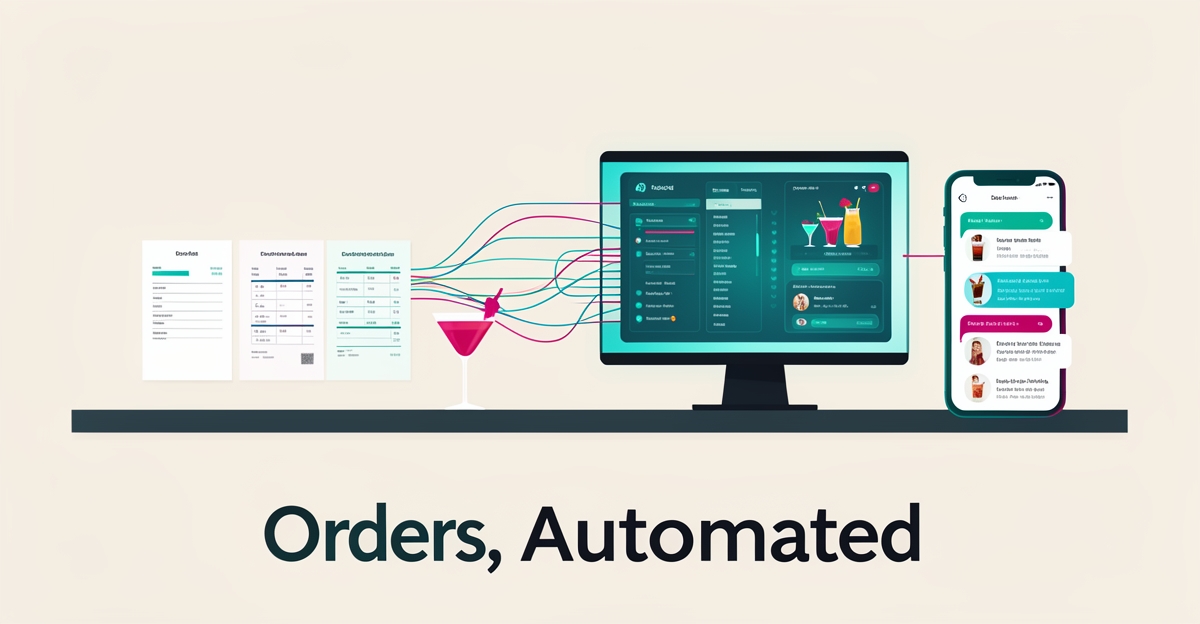
From Manual Orders to AI: How a Halifax Bartending Service Could Automate Its Drink Ordering System
Key Facts
- Manual order entry typically costs several dollars per order in staff time, while AI agents process the same volume for a small fraction of that, the gap is where the savings live.
- Manual multi-item orders commonly take 10 minutes or more to transcribe and enter; AI agents typically complete them in seconds.
- Manual data entry is widely reported to carry error rates of roughly 1% to 3% per field, and errors compound on multi-line orders.
- AI validation against POS or ERP data typically pushes order accuracy to 99%+ by catching mistakes at the point of entry.
- A phased rollout, one order format, run in parallel, then exception-only review, typically takes four to six weeks for the first workflow.
- Once the first format is stable, adding channels like voice or handwritten tickets usually takes days, not weeks.
Hire a team member that works 24/7 — for less than a part-time wage.
AI receptionists, SDRs, dispatchers and 99+ roles. Trained on your business, fully managed.
Not sure where to start? Ask our AI planner
The Hidden Cost of Manual Order Entry in Hospitality
Every mis-keyed drink order, every lost ticket, and every hour spent reconciling handwritten notes chips away at a bar's already thin margins. For small hospitality venues, manual order entry isn't just old-fashioned, it's a compounding operational tax.
The true expense goes well beyond paper and pens. When a bartender or server stops to transcribe a multi-item order into a POS, that's several minutes of skilled labor per order, time not spent pouring, serving, or reading the room. On a busy Friday night in a Halifax bar, that latency creates a bottleneck that ripples through service times and table turnover.
Error rates compound the problem. Manual data entry is widely reported to carry a 1% to 3% error rate per field, which means on a multi-line order the probability of at least one mistake climbs quickly. Each error triggers downstream costs, remade drinks, wasted product, comped items, and service recovery, and those costs add up month after month.
The scalability ceiling is the biggest constraint of all. Manual entry operates under rigid limitations:
- Linear staffing requirements, doubling order volume means doubling headcount
- Business-hours dependency, processing stops when staff clock out
- Fatigue degradation, accuracy drops as shifts lengthen
- Single-format bottlenecks, staff can only handle one order at a time
These constraints explain why growing hospitality businesses hit a wall. As order volume increases, the administrative burden grows linearly while service quality suffers. AIQ Labs has seen this pattern across Halifax's hospitality sector: owners recognize the inefficiency but lack the technical resources to rebuild their workflows without disrupting daily operations. That's exactly what AI Workflow Builds are designed for, rebuilding the one workflow that costs the most, at a fixed price, in phases.
The financial case for automation becomes hard to ignore at scale. A full-time order entry clerk costs tens of thousands of dollars a year once you include benefits and training. An AI order agent handles the same intake for a small fraction of that, and unlike a new hire, it doesn't call in sick on Saturday night. The exact savings depend on your volume, which is why AIQ Labs doesn't quote numbers before understanding your workflow. What's consistent is the direction: the higher your order volume, the faster the math works in automation's favor.
How AI Order Entry Transforms Accuracy and Speed
AI order entry automation changes both speed and accuracy in drink ordering systems. Where manual entry takes minutes per multi-line order, AI agents typically process the same intake in seconds. That drop, from minutes to seconds, removes bottlenecks during peak service hours and lets staff focus on customers rather than data entry.
Accuracy improvements matter just as much. Manual entry's per-field error rate means costly mistakes in drink specifications, quantities, or pricing. AI order agents, by contrast, validate every order in real time against your POS or inventory data, typically achieving 99%+ order accuracy. That precision reduces waste, prevents incorrect preparations, and cuts the customer friction caused by wrong orders.
Cost per order also drops substantially with automation. Instead of minutes of paid staff time per order, an AI agent handles intake for a small fraction of the cost. The exact figures depend on your volume and formats, but for a busy venue, the savings come from two directions at once: lower labor cost per order, and fewer error-related expenses like remakes and comps.
- Processing time drops from minutes per order to seconds
- Accuracy improves through real-time validation against POS data, typically reaching 99%+ order accuracy
- Cost per order falls sharply, since AI intake doesn't consume skilled staff time
By automating routine order entry, a custom workflow keeps service consistent at high volume without adding staff. The system handles standard orders autonomously while flagging exceptions for human review, allowing bartenders to prioritize craft and conversation over clerical tasks. This balance of automation and human expertise is what drives both efficiency and guest satisfaction in a fast-paced hospitality environment.
From Pilot to Profit: Implementing AI in a Halifax Bar
Transitioning from manual to AI-powered order entry doesn't require an all-at-once overhaul. Here's how a phased rollout would work for a Halifax bartending service, the same approach AIQ Labs uses when building workflow automation for SMBs in food and hospitality: start with one workflow, prove it, then scale.
The bar would begin by routing its most common drink orders, say, standard cocktail orders submitted via text, through the AI system while keeping manual entry as a backup. For two weeks, every order runs in parallel, enabling direct comparison of speed, accuracy, and completeness. This validation phase matters: real-world testing ensures the system adapts to local nuances like slang, abbreviations, and frequent substitutions. Once confidence is established, the team shifts to exception-only review, focusing human attention only on orders the AI flags, unclear modifiers, out-of-stock ingredients, unusual requests.
With the first format stabilized, expanding to additional channels, voice calls, handwritten tickets from servers, typically takes days per format, since the POS integration and validation rules are already in place. That scalability means growing businesses can absorb significantly more order volume without adding headcount, turning what was once a bottleneck into a competitive advantage. Within the first month or two, most routine order intake can run autonomously, freeing staff to engage with customers during peak hours instead of transcribing tickets. The result isn't just fewer errors, it's a smoother, more responsive service that lets the team focus on what machines can't do: reading the room, recommending pairings, and turning first-time visitors into regulars.
Still paying for 10+ subscriptions that don’t talk to each other?
We build custom AI systems you own outright. No vendor lock-in. Full control.
Not sure where to start? Ask our AI planner
Frequently Asked Questions
How much does it cost to process a drink order manually compared to using AI?
Will AI order entry actually improve accuracy, or will it make more mistakes than manual entry?
How long does it take to switch from manual to AI order entry without disrupting operations?
Can AI handle messy, real-world drink orders like voice calls or handwritten notes from servers?
What happens to my staff when we automate order entry, will they lose their jobs?
Is AI order entry only for big chains, or can a small Halifax bar afford it?
From Bottleneck to Competitive Edge
Manual drink ordering isn't a fixed cost of doing business, it's a compounding tax on margins, speed, and service. Moving from handwritten tickets and re-keying to an AI workflow that validates orders against POS data in seconds cuts processing time from minutes to moments, lifts accuracy through real-time validation, and frees staff to focus on craft and conversation during peak hours. The phased approach, parallel run, exception-only review, then format expansion, shows how a small venue can automate without disruption and absorb more volume without adding headcount. AIQ Labs builds these systems in phases at a fixed price, integrated with your existing POS, and you own the result outright, not a subscription. Start the 2-minute Fit Check at aiqlabs.ai/apply, then book a free 30-minute strategy call to map your highest-ROI automation opportunity. Prefer email? Reach the team at [email protected].
Make AI your competitive advantage — not just another tool.
Strategy, implementation and ongoing optimization. One partner, end to end.
Not sure where to start? Ask our AI planner