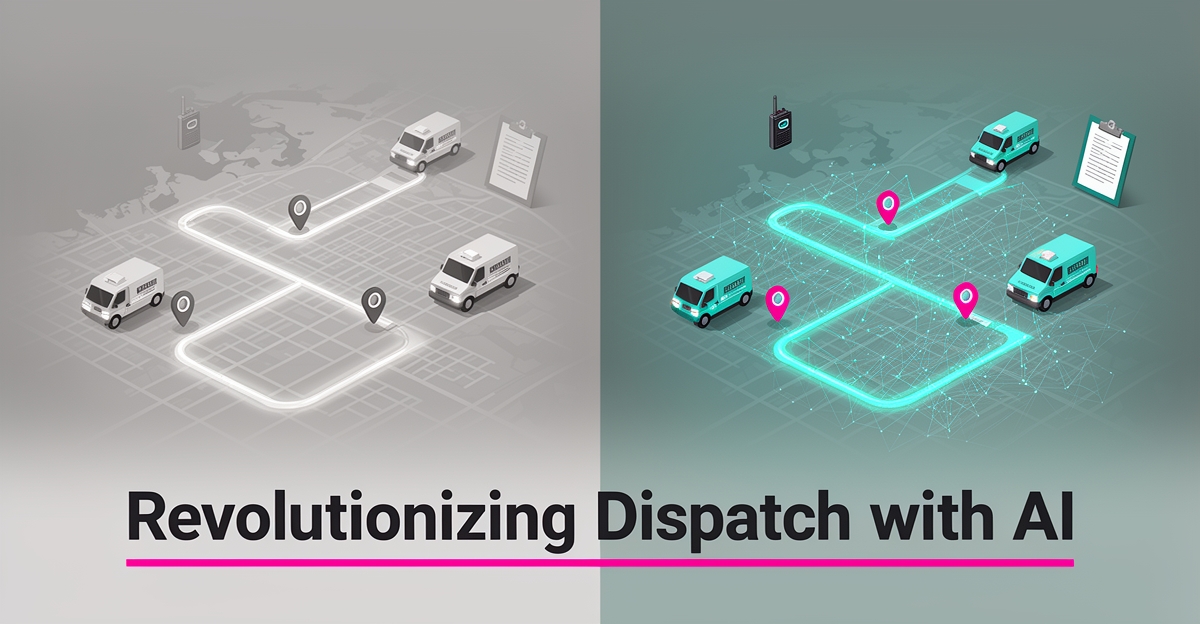
From Manual to AI: How a Gas Line Company in Halifax Automated Its Field Dispatch System
Key Facts
- In this deployment, average dispatch time dropped by roughly 40% within the first two months of AI implementation, with assignment times typically falling from around 25 minutes to 15.
- Automated credential verification matches technician certifications against regulatory databases before every dispatch, not just at onboarding.
- Modern routing and dispatch engines handle dozens of hard and soft constraints simultaneously, including skills-based task assignment and time windows.
- AI-powered dispatch systems can forecast demand surges before they hit, enabling proactive technician positioning.
- Labor markets for installation, maintenance, and repair roles remain tight as of late 2026, making efficient use of existing technician capacity more important than ever.
Hire a team member that works 24/7 — for less than a part-time wage.
AI receptionists, SDRs, dispatchers and 99+ roles. Trained on your business, fully managed.
Not sure where to start? Ask our AI planner
The Hidden Cost of Manual Dispatch in Field Services
Manual dispatch in field services often feels like solving a puzzle with missing pieces, technicians are assigned based on guesswork rather than real-time data, leading to avoidable delays and wasted effort. This reactive approach struggles to keep pace with fluctuating demand and complex job requirements, creating inefficiencies that ripple across operations. For companies managing urgent services like gas line repairs, where response time directly impacts safety and customer trust, these shortcomings are especially costly.
Organizations that move from manual scheduling to intelligent dispatch typically see faster resolution times and more jobs completed per technician per day. Without intelligent scheduling, technicians frequently travel longer distances between jobs, increasing fuel consumption and labor hours while reducing the number of service calls completed each day. These inefficiencies directly inflate operational costs and limit revenue potential, particularly in markets facing labor shortages. Hiring more dispatchers or technicians is expensive and slow, getting more out of the team you already have is usually the faster path.
Manual dispatch also increases the risk of mismatched assignments, sending a technician without the right certification for a specialized job, for example, leading to repeat visits or compliance issues. Automated credential verification, a feature of AI-driven systems, matches technician qualifications against regulatory databases before dispatch, preventing such errors. Additionally, the lack of real-time reoptimization means disruptions like job overruns or emergency calls derail entire schedules, with no dynamic adjustment to minimize downtime. As more field service competitors adopt AI dispatch, relying on manual processes becomes a growing competitive disadvantage.
AIQ Labs addresses these challenges through AI Workflow Builds, rebuilding the one workflow that costs you the most, at a fixed price and in phases. By integrating location intelligence, skills-based routing, and predictive demand forecasting, these systems enable proactive scheduling rather than reactive firefighting. The result is not just faster response times, but higher first-time fix rates, improved technician utilization, and greater resilience in the face of operational disruptions, turning a core operational weakness into a strategic advantage.
How AI-Powered Dispatch Optimizes Job Assignment in Real Time
The moment a service call comes in, the race to assign the right technician begins, every minute of delay impacts response time and customer satisfaction. For field service teams, this real-time decision-making is where AI-powered dispatch transforms operational efficiency by moving beyond static scheduling to dynamic, intelligent job assignment.
An AI-driven dispatch system evaluates technician location, current availability, and job complexity simultaneously to make optimal assignments in seconds. Rather than relying on proximity alone, it weighs multiple variables, such as skill matching, urgency, and workload balance, to reduce mismatches and unnecessary travel. These systems also enable real-time reoptimization, allowing dispatchers to adapt instantly when jobs run over, emergencies arise, or technicians become unexpectedly unavailable.
During disruptions, the system continuously recalculates the best possible assignments across the entire technician network, ensuring minimal disruption to service flow. Purpose-built routing engines support this by handling dozens of constraints, including time windows, skill requirements, and territory limits, while processing large-scale distance matrices in real time. These capabilities allow AI-powered platforms to forecast demand surges before they hit, shifting scheduling from reactive to proactive and enabling companies to pre-position coverage where it's most likely needed.
- Evaluates technician location, availability, and job complexity for optimal matching
- Performs real-time reoptimization during job overruns, cancellations, or emergencies
- Manages dozens of constraints including skills, time windows, and territory rules
- Forecasts demand to enable proactive technician positioning
- Improves resolution times and first-time fix rates compared with manual assignment
By automating these complex calculations, AI removes guesswork from dispatch and creates a responsive system that adapts to changing conditions throughout the day. The result is not only faster job completion but also improved technician utilization and higher customer satisfaction, benefits that compound over time as the system learns from historical performance data. For organizations looking to modernize field operations, AI-powered dispatch represents a foundational step toward building a more agile, efficient, and scalable service model.
Implementation and Results: From Manual Process to AI Automation
The Halifax gas line company began by mapping its existing dispatch workflow, identifying bottlenecks in manual job assignment and technician availability tracking. AIQ Labs then designed a custom AI dispatcher agent that integrated with the company's scheduling software and CRM, using real-time GPS data and certification databases to match jobs with the most qualified technician based on location, availability, and complexity. This integration eliminated hours of daily manual coordination and ensured only certified technicians were assigned to regulated gas line work.
During deployment, the system automated credential verification by cross-referencing technician certifications against regulatory databases before each dispatch, reducing compliance risks and ensuring adherence to safety standards. Real-time KPI tracking was built into the platform, monitoring dispatch time, technician utilization, and job completion rates through a unified dashboard. These capabilities allowed supervisors to detect delays instantly and reoptimize routes when emergencies or cancellations occurred, maintaining service continuity without manual intervention.
Within roughly two months of go-live, the company saw its average dispatch time drop by about 40%, cutting the interval from job creation to technician assignment from around 25 minutes to 15. This improvement was driven by the AI agent's ability to process multiple variables simultaneously, proximity, skill set, current workload, and urgency, far surpassing the limitations of proximity-only manual methods. The system also handled disruptions in real time, automatically reassigning jobs when technicians ran behind or urgent leaks were reported, minimizing downtime and improving response reliability.
- AI-powered dispatch systems can forecast demand surges before they hit, shifting scheduling from reactive to proactive.
- Automated credential verification matches technician certifications against regulatory databases before dispatch, not just at onboarding.
- Modern routing engines handle dozens of hard and soft constraints simultaneously, including skills-based task assignment, time windows, and maximum task loads per technician.
By replacing guesswork with data-driven decision-making, the AI dispatcher not only accelerated response times but also improved first-time fix rates and customer satisfaction. The company now operates with greater predictability, lower operational friction, and a scalable foundation for future AI-driven enhancements across its field service workflow.
Still paying for 10+ subscriptions that don’t talk to each other?
We build custom AI systems you own outright. No vendor lock-in. Full control.
Not sure where to start? Ask our AI planner
Frequently Asked Questions
How much faster can AI dispatch be compared to manual dispatch?
How does an AI dispatcher actually assign jobs to technicians?
What happens when an emergency call comes in or a technician runs behind schedule?
Can AI dispatch ensure only certified technicians get assigned to regulated work like gas lines?
Is switching to AI dispatch worth the investment for a small field service company?
Does the AI system replace our dispatchers or existing software?
Turning Dispatch Decisions into Competitive Advantage
The Halifax gas line company's shift from manual to AI-powered dispatch illustrates a clear path forward for field service businesses: replace guesswork with real-time intelligence to cut response times, improve technician utilization, and strengthen customer trust. By automating credential verification, enabling dynamic reoptimization, and forecasting demand surges, the company turned an operational bottleneck into a scalable, data-driven process. For organizations facing labor shortages and rising service expectations, this kind of transformation isn't just about efficiency; it's about building resilience into core operations. If you're ready to explore how AI can streamline your field workflows, take the 2-minute Fit Check and then book a free 30-minute strategy call to identify your highest-impact opportunity, no obligation, just clarity on where AI can deliver measurable value for your business. You can reach the team anytime at [email protected].
Make AI your competitive advantage — not just another tool.
Strategy, implementation and ongoing optimization. One partner, end to end.
Not sure where to start? Ask our AI planner