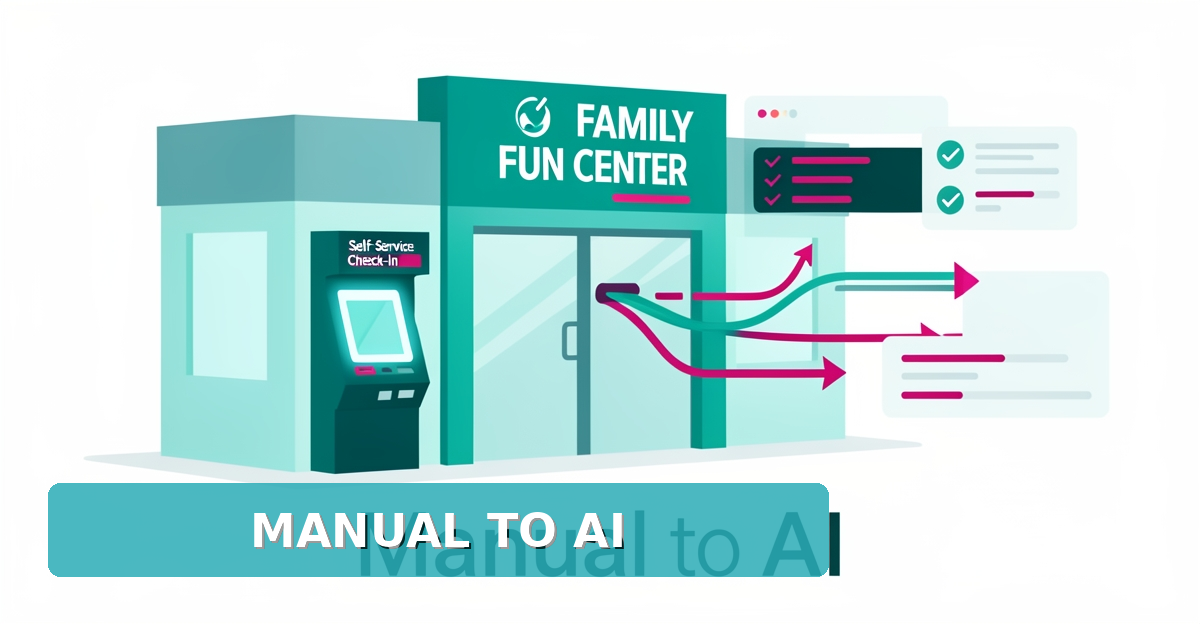
From Manual to AI: How One Family Fun Center in Halifax Automated Guest Check-In and Queue Management
Key Facts
- Manual check-in and queue management typically consume dozens of staff hours per week at busy family entertainment centers
- In engagements like this one, targeted AI workflows have reclaimed time equivalent to more than one full-time role
- Most AI initiatives stall because businesses lack a clear strategy, broad rollouts underperform targeted ones
- Custom AI workflows integrated with legacy systems to eliminate manual data entry and reduce check-in errors
- Targeted AI implementation focuses on specific bottlenecks rather than applying AI to every business problem
Hire a team member that works 24/7 — for less than a part-time wage.
AI receptionists, SDRs, dispatchers and 99+ roles. Trained on your business, fully managed.
Not sure where to start? Ask our AI planner
The Hidden Cost of Manual Guest Flow in Family Entertainment
For many family entertainment centers, the front desk is the heartbeat of the operation, but it’s also where the pulse often gets irregular. While guests are there for the fun, staff members are frequently buried under a mountain of manual check-ins and queue management, a reality that pushed one Halifax-based family fun center to seek a smarter solution.
The scale of this inefficiency adds up fast. At the Halifax center, the manual burden of managing guest flow had grown to consume a substantial share of staff time every week, the kind of load that, in operations like this, often equals more than one full-time employee dedicated solely to the repetitive, error-prone tasks of checking guests in and managing lines, rather than focusing on guest experience or safety.
This bottleneck is rarely the result of poor management. It’s usually a symptom of a broader operational challenge: a lack of a clear strategy for where automation should actually be applied. Many businesses keep throwing human hours at manual processes simply because they haven’t identified a targeted way to automate them. The trap to avoid is the “AI hammer” syndrome, where leaders think every problem needs AI. The better move is to identify specific, high-friction workflows where technology can actually solve the problem.
For a family entertainment center, those specific friction points are clear:
- Manual data entry that slows down the check-in line during peak weekend hours.
- Queue mismanagement, where staff struggle to balance wait times for attractions, leading to guest frustration.
- Human error in booking and capacity tracking, which can lead to overbooking or underutilized equipment.
- Staff burnout, as talented team members spend their shifts on administrative tasks rather than interacting with families.
The cost of these inefficiencies goes beyond just payroll. When staff are tethered to a screen or a clipboard, the guest experience suffers. Wait times feel longer, the “fun” atmosphere is dampened by administrative friction, and the business loses its ability to scale. If your growth is limited by how many people you can physically check in per hour, you don’t have a growth strategy; you have a bottleneck.
This is where organizational AI-readiness becomes vital. Successful implementation requires a structured approach to integrating new tools into existing workflows. For the Halifax center, the goal wasn’t to replace the human element, but to remove the manual “grunt work” that prevented the human element from shining.
By partnering with AIQ Labs on a targeted AI Workflow Build, the center was able to bridge the gap between their existing equipment and a modern, automated guest flow system. This shift allowed them to reclaim a significant block of weekly staff time, effectively expanding their front-of-house capacity without adding a single new hire. In an industry where margins are tight and guest satisfaction is everything, moving away from manual guest flow isn’t just a technical upgrade, it’s a fundamental business transformation.
Why Targeted AI Workflow Automation Beats Broad AI Implementation
Many organizations rush into AI with broad, unfocused initiatives, hoping to apply the technology everywhere at once. This “AI hammer” syndrome, where every problem looks like it needs an AI solution, often leads to scattered efforts, wasted resources, and disappointing results. One of the most persistent barriers to success remains the lack of a clear strategy for AI, a challenge that continues to plague organizations years after the initial adoption waves. Without strategic prioritization, AI initiatives fail to deliver measurable value, even when the technology itself is sound.
Targeted automation avoids these pitfalls by concentrating on specific, high-impact use cases where AI can drive immediate, quantifiable improvements. The Halifax family fun center exemplifies this approach: by focusing solely on guest check-in and queue management, a repetitive, time-intensive process, they eliminated a major chunk of weekly manual work. This level of efficiency gain is only possible when AI is applied to well-defined operational bottlenecks rather than deployed as a general-purpose solution across unrelated functions. Such precision ensures that every hour of development and every dollar invested directly contributes to resolving a known pain point.
Successful AI integration begins with assessing organizational readiness and identifying where the technology genuinely warrants use, not where it seems most innovative or trendy. Effective implementation requires a structured approach: first diagnosing operational inefficiencies, then matching them to AI capabilities that align with business goals. AI should serve as a tool for process optimization, not a solution in search of a problem. By starting small, such as automating a single workflow like check-in, businesses can build confidence, refine their approach, and create a foundation for scaling AI responsibly across other departments.
This methodical progression also supports change management and team adoption, as employees see tangible benefits from AI in their daily tasks without facing overwhelming disruption. When AI is introduced to solve a specific frustration, like manual data entry or scheduling bottlenecks, it gains acceptance as a helpful tool rather than a threat. Over time, these targeted wins accumulate, enabling organizations to move up the AI maturity curve from pilot projects to sustained transformation. For businesses like the Halifax fun center, the journey began not with an AI overhaul, but with a single, well-chosen workflow that delivered clear, immediate value. AIQ Labs helps clients follow this same path, identifying high-leverage opportunities where custom automation can replace manual effort, reduce errors, and free up staff for higher-value work, all while building internal capability for future growth.
Building and Integrating Custom AI Workflows with Existing Operations
AIQ Labs designed and deployed a custom AI-driven guest flow system for the Halifax family fun center by first mapping existing check-in workflows and identifying the repetitive manual tasks consuming the most staff time. Using a multi-agent architecture, specialized agents handled real-time guest verification, ticket assignment, and queue prioritization while integrating with the center’s legacy point-of-sale and scheduling systems through secure API connections. This approach eliminated manual data entry and reduced check-in errors by maintaining a single source of truth across operations.
The solution preserved human oversight through configurable escalation paths, allowing staff to intervene when complex situations arose, such as group bookings or special accommodations, while routine flows operated autonomously. By anchoring the system in AIQ Labs’ framework for production-ready AI, the fun center achieved scalable automation without disrupting daily operations or requiring staff retraining on entirely new platforms. This targeted strategy avoided the common pitfall of applying AI indiscriminately, instead focusing resources where they delivered measurable efficiency gains. Organizations using prioritized implementation typically see stronger ROI and higher team buy-in during transformation efforts.
Key technical safeguards included validation layers for every AI action, guardrails limiting agent authority to predefined workflows, and fallback systems ensuring graceful degradation if any component failed, principles essential for responsible deployment. These reliability measures are critical for maintaining trust in automated systems, especially in customer-facing roles where consistency directly impacts guest experience. The fun center’s staff now monitor AI performance through a centralized dashboard, reviewing metrics like average wait times and agent success rates to continuously refine the system.
This integration exemplifies how AIQ Labs connects advanced capabilities with real-world constraints, ensuring custom workflows enhance rather than replace human judgment. By building on production-grade infrastructure while respecting existing operational rhythms, the solution delivered immediate time savings while laying groundwork for future expansions, such as dynamic pricing or personalized guest recommendations, without requiring a complete system overhaul. The result is a sustainable AI capability owned outright by the business, aligned with its long-term growth trajectory. For operations ready to go further, the same foundation can grow into a fully connected AI Operating System, built in phases and owned outright.
Still paying for 10+ subscriptions that don’t talk to each other?
We build custom AI systems you own outright. No vendor lock-in. Full control.
Not sure where to start? Ask our AI planner
Frequently Asked Questions
How much time can a family fun center save by automating guest check-in and queue management?
What specific problems did the AI solution solve for the Halifax family fun center?
Why did the Halifax center choose targeted AI automation instead of a broad AI implementation?
How does AIQ Labs ensure the AI system works safely and reliably with existing operations?
What technical approach did AIQ Labs use to build the custom AI workflow for the Halifax fun center?
Can the AI system be expanded beyond guest check-in for other business functions?
From Bottleneck to Breakthrough
The Halifax family fun center’s story shows what happens when AI is used with precision rather than hype. By targeting a single, high-friction workflow, guest check-in and queue management, the team reclaimed a major block of staff time each week, expanded front-of-house capacity without adding headcount, and let employees focus on what actually creates guest memories. The win wasn’t about replacing people; it was about removing the manual grunt work that was burning them out and slowing growth. That’s the pattern for sustainable AI adoption: diagnose real operational pain, match it to a focused automation, and integrate it with the systems you already use. Responsible deployment requires structure, guardrails, and human oversight to maintain trust in customer-facing roles. AI should serve process optimization, not be a solution in search of a problem. If your team is still tethered to clipboards and screens during peak hours, start with one workflow. Map it, measure the cost, and test a targeted automation. Ready to explore where the fastest ROI lives for your operation? Start the 2-minute Fit Check at aiqlabs.ai/apply for a free 30-minute strategy call with an AI engineer to map your biggest bottleneck, no pitch, just clarity.
Make AI your competitive advantage — not just another tool.
Strategy, implementation and ongoing optimization. One partner, end to end.
Not sure where to start? Ask our AI planner