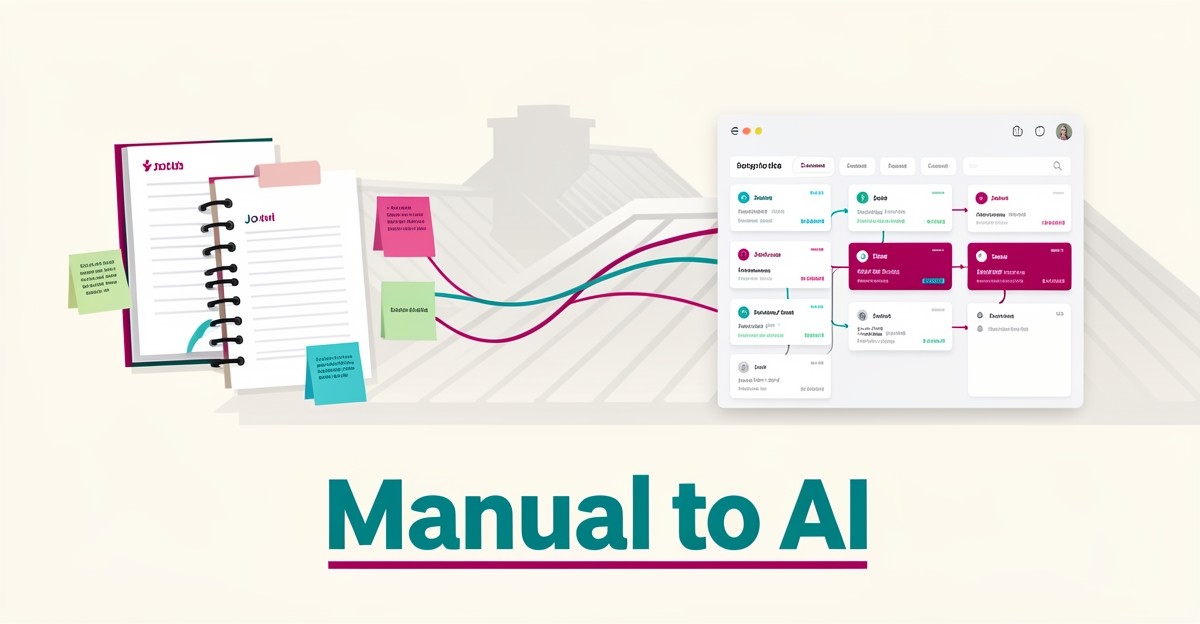
From Manual to AI: How One Metal Roofing Company in Halifax Automated Its Job Tracking System
Key Facts
- The company automated job intake, scheduling, and follow-up as one connected workflow instead of isolated fixes.
- The system layered on top of the company's existing CRM and calendar tools, no rip-and-replace migration.
- Staff kept their familiar tools while AI handled data synchronization behind the scenes.
- The workflow was built in phases, with job tracking as the first module and estimating and inventory mapped as next steps.
- The business owns the system outright rather than renting it as a subscription widget.
- AI adoption across manufacturing and trades has accelerated through 2026, with larger metal producers leading and smaller operations following.
Hire a team member that works 24/7 — for less than a part-time wage.
AI receptionists, SDRs, dispatchers and 99+ roles. Trained on your business, fully managed.
Not sure where to start? Ask our AI planner
The Paperwork Problem: Why Manual Job Tracking Fails Metal Roofers
Paper notebooks and whiteboards were the backbone of job tracking for this Halifax metal roofer, and like many trade businesses, the system broke under growth. Calls were logged late, measurements lived in different places, and crews arrived on site without complete information. The friction was not a lack of effort; it was the limits of manual coordination.
Missed appointments and scheduling errors compound quickly in metal roofing. A crew dispatched to the wrong address burns labor hours, fuel, and material lead time. When job details are handwritten and passed by text, updates do not reach everyone at once. Customers receive vague windows instead of confirmed times, eroding trust before work even starts.
Administrative overload follows naturally. Office staff spend hours reconciling paper intake forms, purchase orders, and follow-up notes. The same information is re-entered into accounting, scheduling, and customer communications. That duplication creates errors and pulls owners away from sales and quality control.
The Halifax case shows how these pain points map to real productivity loss. The business moved from paper-based tracking to an AI-driven workflow built by AIQ Labs that integrates with existing tools. The shift targeted intake, scheduling, and follow-up tasks as a single automated flow rather than isolated fixes.
Manual job tracking typically creates:
- Late or missed appointments from fragmented calendars and handwritten notes
- Scheduling errors when crews rely on outdated paper job sheets
- Administrative overload from re-entering the same data across systems
- Customer dissatisfaction due to poor visibility and delayed follow-up
Industry momentum backs this up. Larger metal manufacturers have led AI adoption over the past several years, and as of late 2026 that shift is reaching smaller fabricators and trade services. The barrier for small operations was never skepticism about results, it was the perceived complexity of implementation. That is exactly the barrier a well-scoped workflow build removes.
For trade services, the lesson is operational. Paper creates delay, delay creates cost, and cost shows up in missed jobs and churn. Automating job intake and scheduling removes the manual handoffs that cause errors. When a custom workflow connects phone, calendar, and job records, teams work from one source of truth.
For this Halifax business, the payoff was administrative: hours previously spent on transcription and reconciliation went back to estimating, customer care, and on-site execution. Fewer missed appointments, cleaner schedules, and stronger customer satisfaction, without adding headcount.
AI Workflow Automation: The Custom Solution That Integrated With Existing Tools
When a Halifax metal roofing company decided to modernize its operations, it didn't rip out its existing systems. Instead, it layered intelligent automation on top of them, transforming job tracking without disrupting daily work.
The company faced a common challenge: job details lived in notebooks, scheduling happened via text message, and follow-ups depended on memory. This manual approach consumed hours of administrative time each week. Larger metal manufacturers have been adopting AI systems for years, but smaller operations often lag behind due to perceived complexity.
AIQ Labs designed a custom workflow build that connected directly to the company's existing CRM and calendar tools. The solution automated three critical functions:
- Job intake: Customer requests flow automatically into the CRM with all relevant details captured
- Scheduling: Jobs populate the calendar based on crew availability and location
- Follow-up: Automated reminders ensure no customer falls through the cracks
The key advantage was eliminating double entry. Staff no longer transcribed information from paper to digital systems. Real-time updates meant everyone, from office staff to field crews, accessed the same current information simultaneously.
This integration-first approach addresses a common barrier to AI adoption. Automation only pays off when systems work with existing workflows rather than against them. The roofing company's staff continued using familiar tools while the AI handled data synchronization behind the scenes.
The results were operational and measurable for the business: administrative time dropped substantially, freeing staff to focus on customer service and business development. Targeted automation of a single high-cost workflow is where most trade businesses see the fastest, clearest return.
AIQ Labs structured the deployment to minimize disruption. The custom system required no new software training, no workflow overhauls, and no expensive platform migrations. Staff simply continued their normal routines while the AI handled coordination tasks automatically. The build was delivered in milestones at a fixed price, so the company knew what it was paying for at every phase.
The Halifax case illustrates how AI workflow automation succeeds when it respects existing processes. Rather than forcing businesses to adapt to rigid software, intelligent systems adapt to how people already work, delivering efficiency gains without the typical implementation friction that stalls digital transformation initiatives.
From Pilot to Productivity: Results and Scalable Next Steps
The pilot proved the concept; the rollout proved the value. After moving job intake, scheduling and follow-up off paper and into a custom workflow system, the Halifax metal roofing company reclaimed significant administrative time each week.
The savings were not theoretical. Scheduling dropped from manual phone tag and spreadsheet updates to automated confirmations and calendar syncs. Invoicing accelerated as job completion data flowed directly into billing without re-entry. Follow-ups became consistent, with the system triggering reminders and status checks instead of relying on memory.
The modular design built by AIQ Labs made those gains sustainable. Job tracking was the first module, integrated with existing tools so crews and office staff kept their familiar interfaces. The architecture was designed for expansion, not replacement.
Scalability is the next phase. The same workflow foundation can extend into estimating and inventory management without rebuilding core logic. That mirrors broader industry momentum: as of late 2026, AI adoption that started in large metal manufacturing keeps spreading downstream to fabricators and trade services.
For this Halifax business, the impact is operational and cultural. Staff spend less time chasing paperwork and more time on customer-facing work. Errors from manual transcription fall as data moves automatically between intake, scheduling and invoicing.
Expansion options already mapped include:
- Estimating automation that pulls from historical job data and material pricing
- Inventory forecasting linked to scheduled jobs and supplier lead times
- Customer portal updates fed directly from the job tracking system
The system remains owned by the company, built as a custom AI workflow and integration rather than a subscription widget. That ownership model, AIQ Labs' Own It Outright option, supports seamless transition from paper-based to AI-driven operations and protects long-term flexibility. For businesses that prefer to start lighter, the same build can begin monthly and scale through milestones; see pricing for how the payment models work.
Results validate the pilot-to-productivity path. Administrative burden falls, visibility rises, and the business can scale without proportional headcount growth. The modular foundation ensures the next department to automate will integrate, not disrupt.
Still paying for 10+ subscriptions that don’t talk to each other?
We build custom AI systems you own outright. No vendor lock-in. Full control.
Not sure where to start? Ask our AI planner
Frequently Asked Questions
Will automating job tracking disrupt how my crews and office staff already work?
How much admin time can we realistically save by replacing paper job tracking?
Is AI adoption in metal and trades actually growing, or is this just hype?
What does AI job tracking actually automate day-to-day?
Can we own the system instead of being locked into a subscription widget?
What kinds of gains are other metal businesses seeing with AI?
Ready to Trade Paperwork for Productivity?
The Halifax roofing company's journey from paper chaos to AI-driven efficiency shows that automation doesn't require ripping out existing systems or a massive upfront investment. By targeting job intake, scheduling, and follow-up with a custom workflow built by AIQ Labs, the business reclaimed administrative hours while keeping the tools their team already knew. The lesson for trade businesses is clear: start with your biggest bottleneck, integrate rather than replace, and own the system you build. If manual coordination is costing you jobs, revenue, or sanity, the path forward begins with clarity, not commitment. Take the two-minute Fit Check at AIQ Labs to identify your highest-ROI automation opportunity, then book a free strategy call to map your specific workflow. You'll leave with a concrete plan, whether you choose to build with us or not.
Make AI your competitive advantage — not just another tool.
Strategy, implementation and ongoing optimization. One partner, end to end.
Not sure where to start? Ask our AI planner