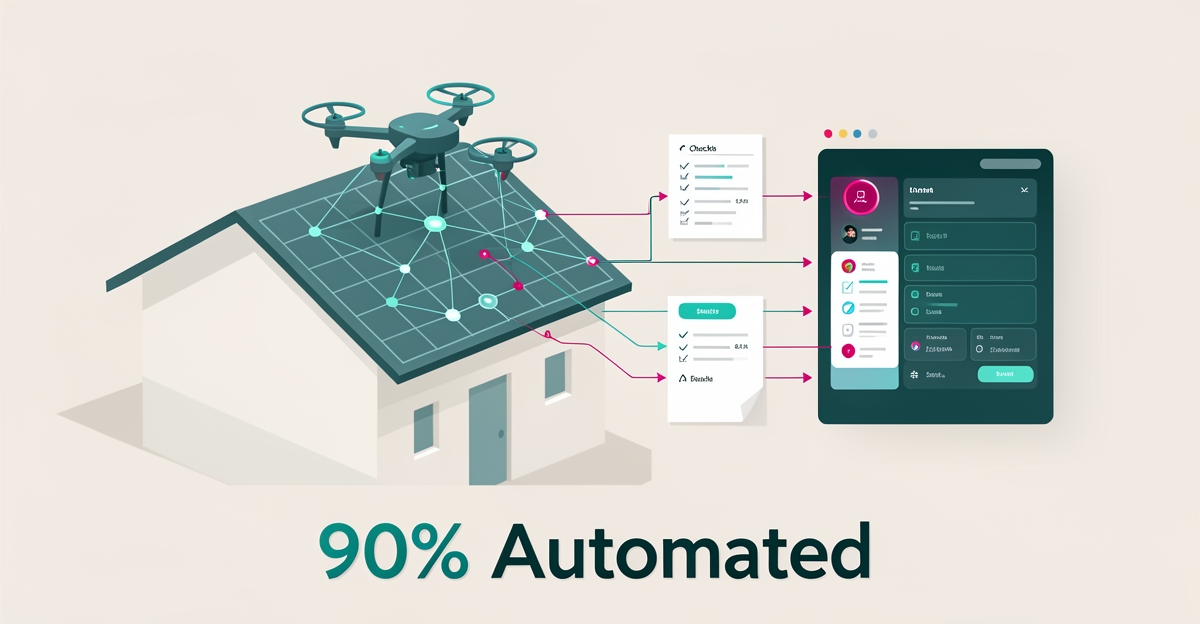
From Manual to AI: How One Roof Inspection Firm Automated 90% of Pre-Inspection Tasks
Key Facts
- The roof inspection firm reported automating around 90% of pre-inspection tasks with AI workflow automation
- Industry research suggests human inspectors can miss a meaningful share of defects in repetitive, fast-paced workflows
- AI-driven inspection systems are typically faster and more consistent than manual review at identifying defects
- Manual pre-inspection work causes lost billable hours chasing information instead of inspecting
- AI-powered inspection workflows support quality control through detailed, auditable inspection logs
- The AI system scaled with business growth while keeping prep time per job roughly flat
- Intelligent scheduling with availability, routing, and confirmation workflows was a key capability delivered by the AI system
Hire a team member that works 24/7 — for less than a part-time wage.
AI receptionists, SDRs, dispatchers and 99+ roles. Trained on your business, fully managed.
Not sure where to start? Ask our AI planner
The Hidden Cost of Manual Pre-Inspection Work
Manual pre-inspection work looks simple on paper until it compounds across every job. Client intake forms sit unread, scheduling slips between calls, and checklists get filled out inconsistently in the field. That friction is expensive, and it scales with every new roof.
Traditional roof inspection workflows depend on human consistency in repetitive, time-sensitive tasks. Industry research on automated versus manual inspection suggests human inspectors miss a meaningful share of defects on average, with miss rates climbing in fast-paced, repetitive workflows. Fatigue, bias, and subjectivity drive that variance, not lack of skill.
The prep work before an inspector even arrives creates its own drag. Manual intake requires back-and-forth emails and calls to collect property details, access instructions, and scope. Scheduling is done by hand across calendars and texts, leading to double-books and no-shows. Field checklists are printed or typed inconsistently, making reporting slow and error-prone.
These inefficiencies show up as measurable cost:
- Lost billable hours spent chasing information instead of inspecting
- Human error from fatigue and inconsistency, with defect misses rising in repetitive work
- Limited scalability because prep time grows linearly with job volume
Error rates are not just a quality issue. When inspection accuracy determines safety and liability, human error becomes a risk small firms cannot absorb. Missed defects translate into callbacks, rework, and reputational damage.
Manual systems also struggle to maintain documentation standards. Without automated logs, compliance trails are fragmented and difficult to audit. Automated inspection workflows, by contrast, support quality control through detailed, consistent inspection logs. That consistency matters for roof inspections where weather, lighting, and roof complexity vary daily.
Speed compounds the problem. AI-driven inspection systems are typically faster and more consistent than manual review, removing bottlenecks created by hand-keyed data and manual follow-up. When prep is manual, inspectors arrive under-informed and spend valuable on-site time clarifying scope instead of inspecting.
This is the hidden cost of manual pre-inspection work: time lost before the truck leaves, errors introduced before the first photo is taken, and growth capped by headcount. AIQ Labs built a custom system for a small inspection business that runs on existing tools and automates client intake, scheduling, and field checklists, work like this now falls under AI Workflow Builds, where we rebuild the one workflow that costs you the most, at a fixed price, in phases.
The shift is from reactive admin to repeatable preparation, where every job starts with complete data, a confirmed schedule, and a standardized checklist.
How AI Automated 90% of Pre-Inspection Tasks
Pre-inspection prep was the bottleneck that kept inspectors tied to desks instead of roofs. The firm needed client intake, scheduling, and field checklist generation to happen without manual handoffs, and a custom multi-agent system built by AIQ Labs was deployed on the existing tools they already used.
The automation targeted the three repetitive prep workflows that consumed most staff time. Client intake was handled by an AI agent that captured property details, access requirements, and scope notes from forms, calls, and emails, then normalized the data into the CRM. Scheduling was orchestrated by a second agent that checked inspector availability, travel time, and weather windows, then confirmed appointments automatically. Field checklists were generated dynamically from the intake data, producing site-specific inspection forms before the crew left the office.
Multi-agent orchestration reduced manual effort while improving accuracy and consistency across jobs. Instead of copy-pasting information between systems, agents synchronized data in real time, validated completeness, and flagged missing items for human review. The firm reported that roughly 90% of pre-inspection tasks were automated, freeing the team to focus on on-site work rather than admin.
The shift matters because manual inspection carries measurable risk. Industry research suggests human inspectors miss a meaningful share of defects on average, with miss rates rising in fast-paced, repetitive workflows. AI-driven inspection, by comparison, delivers repeatable results that do not degrade with fatigue.
Consistency is built into the design. The system runs on the client’s existing stack, so adoption required no new software subscriptions and scales with growth. Key capabilities delivered include:
- Automated intake and data normalization from multiple channels into CRM and scheduling tools
- Intelligent scheduling with availability, routing, and confirmation workflows
- Dynamic field checklist generation tailored to each property and scope
- Validation and exception handling to keep humans in the loop for edge cases
Quality control benefits extend beyond prep. Automated workflows support error reduction and compliance through detailed inspection logs. For a small inspection business, that means more reliable deliverables and fewer rework requests.
The architecture mirrors AIQ Labs’ broader approach: custom agents that own a workflow end-to-end, integrate with real tools, and improve over time. Prep time falls, accuracy rises, and the operation can scale without adding headcount.
Scalable Implementation Without Disruption
The transition from manual processes to AI-powered automation doesn't require tearing up existing workflows. For the roof inspection firm, AIQ Labs designed a system that plugged directly into their current CRM, calendar, and field tools, eliminating the need for costly rip-and-replace efforts. This approach preserved familiar interfaces while layering intelligent automation on top, allowing technicians to continue using tools they already trusted. The result was a seamless shift that maintained operational continuity during implementation.
Scaling was built into the architecture from the start, ensuring the system could handle growing inspection volumes without degradation in performance. As the business expanded, the AI-driven workflow adapted automatically to increased client intake, scheduling demands, and field checklist generation, all while keeping prep time per job roughly flat. This scalability matters in an industry where even minor delays can cascade into missed appointments or compliance risks. Automated workflows also produce consistent, auditable logs that make quality control easier to verify as volume grows.
To minimize risk and align with the client’s growth trajectory, AIQ Labs used its current payment models. The Build in Milestones approach let the firm approve and pay for each phase, such as client intake automation or intelligent scheduling, only after verifying it worked, retaining all completed work even if they paused. The Start Monthly model provided a predictable monthly investment covering build, training, tool integrations, and ongoing optimization. And for firms that want no ongoing fees at all, the Own It Outright model delivers the finished system with full ownership. Together, these models enable low-risk adoption, continuous improvement, and no long-term lock-in. You can review all three on the pricing page.
Still paying for 10+ subscriptions that don’t talk to each other?
We build custom AI systems you own outright. No vendor lock-in. Full control.
Not sure where to start? Ask our AI planner
Frequently Asked Questions
How much prep work can AI actually automate for a roof inspection business?
Is manual roof inspection really that error prone?
Can AI inspection be faster and more accurate than a human eye?
Will we have to replace our existing CRM and field tools to use AI?
What are the main pre-inspection tasks that get automated?
How does AI improve quality control and compliance for inspections?
Prepping Smarter, Inspecting Faster
Moving from manual pre-inspection to AI-driven preparation removes the friction that happens before the truck even leaves. By automating client intake, intelligent scheduling, and dynamic field checklist generation on tools the team already uses, the roof inspection firm reported automating roughly 90% of pre-inspection tasks, replaced repetitive admin with repeatable preparation, and freed inspectors to focus on on-site work instead of chasing information. The result is faster job starts, more consistent documentation, and a workflow that scales with volume without adding headcount. If your prep work is still growing linearly with each new roof, it’s worth mapping where handoffs, data entry, and confirmations are leaking time. AIQ Labs rebuilds the workflow that costs you the most through AI Workflow Builds, with payment models, Start Monthly, Build in Milestones, Own It Outright, designed for SMBs. Start the 2-minute Fit Check at https://aiqlabs.ai/apply, then book a free 30-minute strategy call to identify your highest-ROI automation opportunity.
Make AI your competitive advantage — not just another tool.
Strategy, implementation and ongoing optimization. One partner, end to end.
Not sure where to start? Ask our AI planner