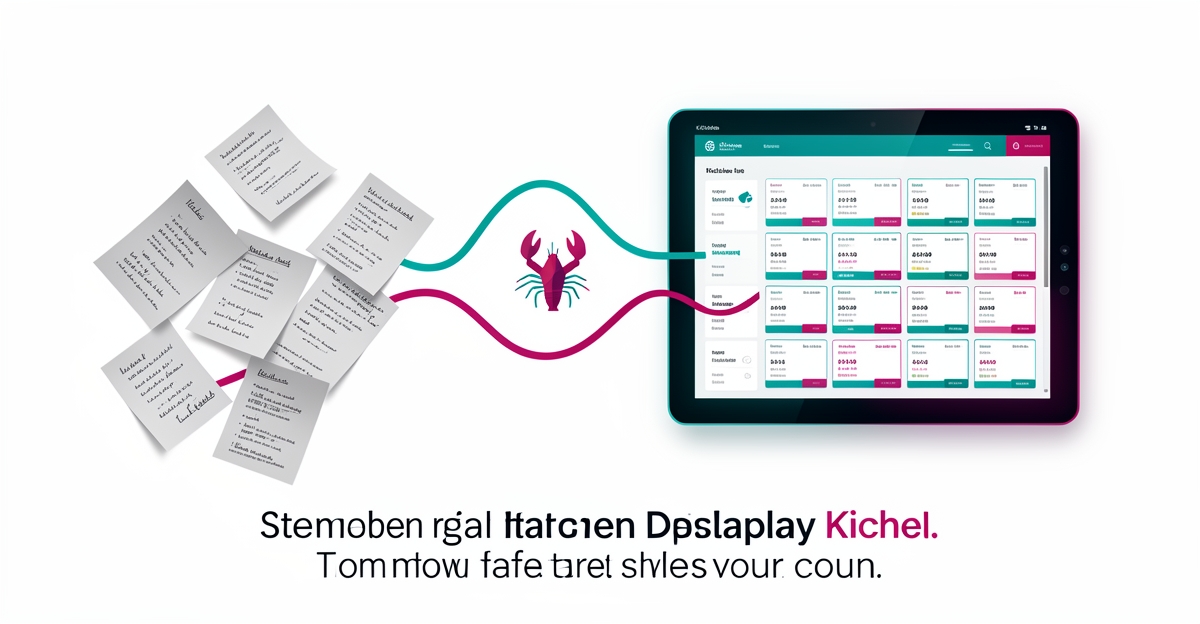
From Manual to AI: How One Seafood Restaurant in Halifax Automated Its Order Entry System
Key Facts
- Manual paper tickets created delays, lost orders, and out-of-sequence kitchen prep during peak service
- The AI workflow captures orders from phone, online, and in-person channels in a single stream
- Natural language processing standardizes spoken and typed orders into structured kitchen tickets
- Validation at capture catches missing items, modifiers, and allergen conflicts before a ticket reaches the kitchen
- Staff previously tied up in transcription and ticket-chasing were reallocated to guest service
- The system was delivered in phases and owned outright by the restaurant, no vendor lock-in
- Industry reports suggest AI-driven freshness monitoring and demand forecasting can meaningfully cut seafood spoilage and waste
Hire a team member that works 24/7 — for less than a part-time wage.
AI receptionists, SDRs, dispatchers and 99+ roles. Trained on your business, fully managed.
Not sure where to start? Ask our AI planner
The Paper-Based Bottleneck Draining Restaurant Operations
The paper-based order log system at the Halifax seafood restaurant created a daily cascade of operational breakdowns that directly impacted service speed and staff morale. Servers manually transcribed orders from dine-in, phone, and takeout channels onto paper tickets, which then sat in a physical queue awaiting kitchen pickup. This handoff introduced critical delays, with tickets frequently misplaced during shift changes or buried under new orders during peak lunch and dinner rushes. As a result, kitchen staff often prepared dishes out of sequence, leading to cold food being sent to tables or appetizers arriving after entrees, issues that frustrated customers and increased remake rates.
These friction points were not isolated incidents but systemic flaws in the workflow. Manual order routing in food service is well documented to slow order-to-fulfillment time compared to automated systems, and this restaurant's experience matched that pattern: during busy periods, tickets routinely waited far longer than they should have before firing. The burden of constantly tracking, prioritizing, and rerouting paper tickets fell disproportionately on expeditors and senior servers, who spent a meaningful share of their shifts managing paper flow instead of guest interaction or quality control. This constant context-switching accelerated fatigue, contributed to higher error rates in order details, and wore down newer hires in particular.
The cumulative effect was a brittle operation where small disruptions amplified into major service failures. A single missed ticket could delay an entire table's meal, triggering a chain reaction of late orders and dissatisfied diners. Staff reported feeling perpetually behind, spending more time chasing paper than attending to customers. These breakdowns weren't just inefficiencies, they eroded the restaurant's ability to deliver consistent, timely service in a competitive market where speed and accuracy directly influence repeat business. The paper system had become less a record-keeping tool and more a liability, silently draining throughput and morale with every shift.
AIQ Labs specializes in transforming exactly this type of workflow friction, replacing manual bottlenecks with owned, intelligent systems that capture, route, and track orders in real time without adding operational overhead. For restaurants drowning in paper logs, the path forward isn't more staff or better training, it's eliminating the manual handoffs that break the chain between order and execution. This is the core of AIQ Labs' Workflow Builds service: rebuild the one workflow that costs you the most, at a fixed price, in phases.
To explore how AI-driven workflow automation can resolve your specific operational bottlenecks, Start the Fit Check, a two-minute assessment that leads to a free 30-minute strategy call to map your biggest friction points and identify high-ROI automation opportunities.
AI Workflow Automation: From Multi-Source Capture to Kitchen Routing
In the fast-paced environment of a Halifax seafood restaurant, every minute counts, especially when orders come in from phone, online, and walk-in customers simultaneously. Before AIQ Labs stepped in, staff spent significant time every week manually transcribing tickets, leading to delays, errors, and frustrated kitchen teams during peak service. The restaurant needed a system that could capture orders from any source, interpret natural language accurately, and route them instantly to kitchen displays without human intervention.
AIQ Labs built a custom AI order entry system that uses multi-agent workflows to ingest orders from phone calls, online forms, and in-person tablets. Natural language processing standardizes variations like "two lobster rolls, hold the mayo" or "I'll have the fish tacos, extra spicy" into structured data the kitchen can act on without interpretation. This eliminates the guesswork and rework that previously consumed valuable staff time.
Once an order is captured, the system validates it against menu rules and inventory, then pushes a clean, formatted ticket to kitchen display screens in seconds. Servers no longer shout across the dining room or run back and forth with paper tickets, orders appear exactly where cooks need them, and transcription errors effectively disappear. The workflow now runs continuously, handling everything from lunch rushes to late-night takeout without missing a beat.
- Ingests orders from phone, online, and in-person channels in real time
- Uses NLP to standardize natural language inputs into structured kitchen tickets
- Routes validated orders instantly to kitchen displays, eliminating manual entry
- Cuts order processing delays and virtually eliminates transcription errors
- Frees staff hours weekly for customer service and food quality
By replacing paper logs and manual data entry with an AI-powered workflow, the restaurant transformed a chaotic, error-prone process into a seamless operation. AIQ Labs' approach, combining custom development, deep tool integration, and production-ready deployment, ensured the system not only solved the immediate problem but scaled with the business's growth. This is how AI workflow automation delivers measurable impact: faster service, happier staff, and fewer mistakes on the plate.
Measurable Impact: Faster Orders, Fewer Errors, Zero Missed Tickets
Paper logs, shouted tickets, and re-entry at the pass were costing the Halifax seafood restaurant time and accuracy every service. Replacing that manual loop with an AI-powered workflow that captures orders from tables, takeout apps and phone and routes them instantly to kitchen staff changed the operational baseline. The shift showed up in three places: speed, accuracy, and staff time.
Order-to-kitchen time fell substantially once the AI workflow removed transcription and handoff delays. Hosts no longer retype tickets, and kitchen displays update in real time as orders arrive from multiple sources. The same automation eliminated lost tickets entirely, giving the team full visibility from entry to fire.
Entry errors dropped sharply once the system validated items, modifiers and allergens at capture and synced directly with the kitchen. Staff reallocated from data entry to guest experience, with hosts focusing on seating and service rather than chasing misplaced orders. Every restaurant that runs this kind of automation should track order-to-fire time and error rates before and after cutover, that's how the gains become real numbers you can act on.
The results align with broader seafood industry patterns where AI reduces waste and improves efficiency. Industry reporting as of late 2026 suggests AI-powered freshness monitoring can drive meaningful reductions in spoilage, while AI-driven demand forecasting is linked to less waste without sacrificing stock levels. Supplier scoring systems are also reported to deliver cost reductions for seafood businesses.
For a high-volume seafood operation, speed and accuracy directly protect food safety and margin. The Halifax deployment demonstrates how workflow automation moves a restaurant from manual logs to an owned, integrated system.
The operational changes the restaurant now runs include:
- Faster order-to-kitchen time from capture to fire, with no transcription step
- Sharp reduction in manual entry errors across tickets and modifiers
- Zero missed tickets with real-time routing to kitchen displays
- Host staff reallocated from order entry to guest-facing service
The restaurant now runs a unified order flow that cuts delays and errors while keeping the team focused on the dining room. This is the type of practical automation AIQ Labs builds as custom, owned systems rather than subscription widgets.
With order integrity secured, the business can extend the same workflow principles to inventory and demand signals common in seafood. Production-tested automation provides a foundation for scaling without adding headcount.
Implementation Blueprint: From Discovery to Deployment
Paper logs and phone calls create bottlenecks during the dinner rush. For this Halifax seafood restaurant, order entry delays were costing service speed and kitchen efficiency. The rollout replaced manual logs with an AI-powered workflow that captures orders from multiple sources and routes them instantly, delivered in phases, with the restaurant owning the result outright.
The first phase focuses on discovery and workflow mapping. The team shadows front-of-house and kitchen staff to document how orders arrive via phone, in-person, and delivery apps. Current pain points, handoff steps, and POS data are mapped to design a clean integration path. This discovery aligns with AIQ Labs' Build in Milestones model, where client ownership is established from the start.
The workflow map becomes the blueprint for a custom agent that normalizes order formats and pushes them to kitchen displays in real time. Process documentation also identifies data sources for future optimization, such as freshness monitoring and demand signals. Full client ownership is built in, with code and agents delivered as the client's digital asset.
The build phase covers custom agent development and POS integration. Developers build a multi-agent workflow that ingests orders, validates items against inventory, and routes tickets by station. Two-way API integration with the existing POS creates a single source of truth and eliminates re-keying. The system is tested with live order samples to ensure accuracy under peak load.
Quality and safety remain central. In the broader seafood industry, AI-powered freshness monitoring and demand forecasting are increasingly used to cut spoilage and waste. These capabilities inform the architecture for later expansion beyond order entry.
Key build milestones in this phase include:
- Order capture agent trained on menu, modifiers, and allergen notes
- POS and kitchen display integration with automated data sync
- Validation and error handling for incomplete or ambiguous orders
- Audit logging for compliance and performance review
The final phase is staff training and go-live. Servers and kitchen leads receive role-specific training on exception handling and dashboard monitoring. A soft launch runs parallel to paper logs briefly, then full cutover occurs with on-site support. Performance metrics are established to track order-to-fire time and error rates.
Post-launch, the restaurant retains full control to iterate. The phased approach mirrors AIQ Labs' standard implementation process, with discovery, development and integration, deployment and training, then ongoing optimization. The result is a production-ready system the business owns, with measurable gains in speed and reliability.
Why This Model Works for Any High-Volume, Multi-Channel Restaurant
The Halifax seafood restaurant's success wasn't just about replacing paper logs, it was about building a system that could scale with demand, adapt to multiple channels, and run without interruption. At its core, the solution relies on a modular AI Order Processor that acts as the central nervous system for incoming orders, whether they arrive via phone, online platforms, or in-person kiosks. This architecture decouples order capture from kitchen execution, allowing the business to maintain real-time visibility and routing regardless of source or volume.
The AI Order Processor integrates with leading POS systems like Toast and Square, as well as custom-built platforms, ensuring no disruption to existing workflows. This means orders from third-party delivery apps, direct website orders, or even catering inquiries are normalized, validated, and pushed to the kitchen display system within seconds, eliminating the manual transcription errors and delays that once plagued the operation. Faster order-to-kitchen time directly improves table turnover and customer satisfaction.
What makes this model universally applicable is its ability to operate 24/7 without staffing gaps. Unlike human-dependent processes that falter during shift changes or peak rushes, the AI processor maintains consistent performance around the clock, critical for restaurants handling late-night deliveries, early-morning prep orders, or weekend catering surges. This continuous operation doesn't just prevent bottlenecks; it creates capacity for growth without proportional increases in labor costs.
Scalability extends beyond the dining room. The same architecture supports catering logistics and delivery coordination by treating each order type as a distinct workflow within the AI system. Whether it's a corporate lunch box order requiring specific packaging notes or a same-day delivery request with time-window constraints, the AI applies business rules dynamically, prioritizing, routing, and even triggering alerts for special handling. This turns what was once a fragmented, error-prone process into a unified, auditable flow owned entirely by the business.
For high-volume, multi-channel restaurants, this approach transforms order entry from a cost center into a competitive advantage. By owning the AI infrastructure, rather than renting fragmented SaaS tools, businesses gain full control over customization, data, and evolution. They can add new channels, refine routing logic, or integrate with inventory systems without vendor dependency or recurring subscription fees. In an industry where margins are thin and speed is service, this level of autonomy and reliability isn't just efficient, it's foundational to sustainable growth.
Still paying for 10+ subscriptions that don’t talk to each other?
We build custom AI systems you own outright. No vendor lock-in. Full control.
Not sure where to start? Ask our AI planner
Frequently Asked Questions
How much time does a paper-based order system actually waste in a busy seafood restaurant?
Can an AI order entry system really understand natural language from phone and in-person orders?
What measurable impact did the Halifax restaurant see after automating order entry?
Is AI automation only useful for order entry, or does it help with seafood waste too?
How long does it take to implement an AI workflow like this?
Will we lose control of our data if we automate with AI?
From Paper Chaos to Kitchen Clarity
The Halifax seafood restaurant's transformation shows what happens when AI replaces manual bottlenecks with a system that captures, validates, and routes orders in real time, cutting order-to-kitchen time, eliminating most entry errors, and freeing staff to focus on guests instead of paper. The phased rollout proved that custom AI workflows can integrate with existing POS and kitchen displays without disruption, scale across phone, online, and in-person channels, and deliver measurable ROI from day one. Beyond order entry, the same architecture supports inventory forecasting, freshness monitoring, and supplier scoring, capabilities increasingly used in seafood operations to cut spoilage and waste. For restaurants ready to move past patchwork tools and own their automation, the path forward starts with identifying the highest-friction workflow. Start the Fit Check, a two-minute assessment that leads to a free 30-minute strategy call to map your biggest bottlenecks and outline a practical automation plan.
Make AI your competitive advantage — not just another tool.
Strategy, implementation and ongoing optimization. One partner, end to end.
Not sure where to start? Ask our AI planner