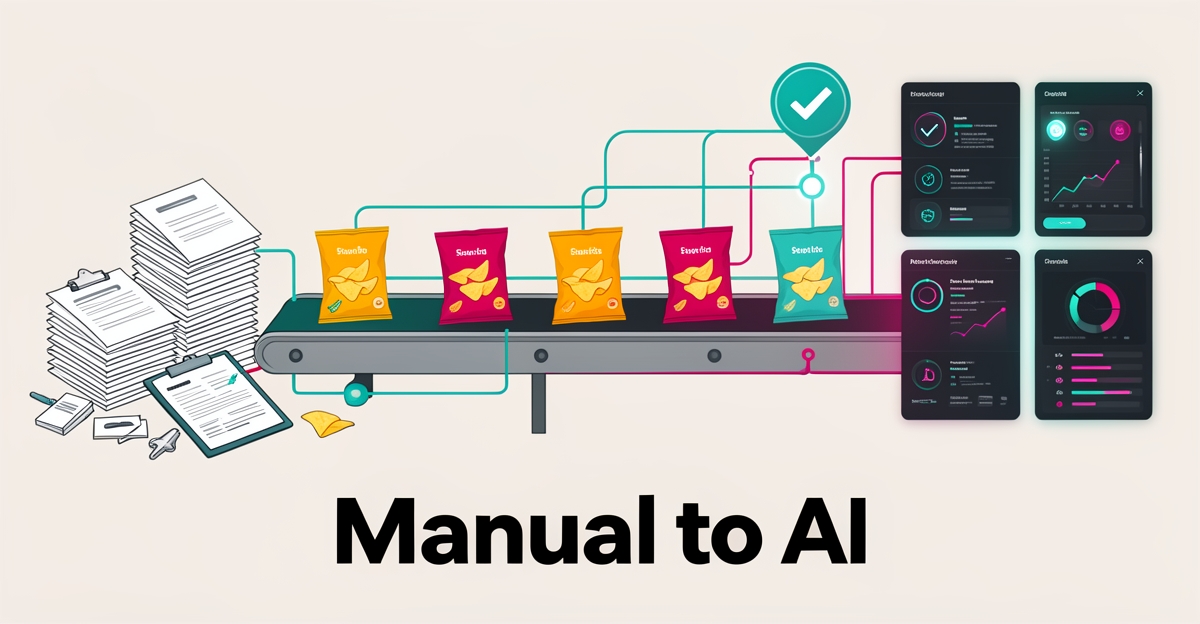
From Manual to AI: How One Snack Brand in Nova Scotia Automated Its Product Labeling & Batch Tracking
Key Facts
- Manual HACCP planning typically takes a QA manager one to two months for a first complete plan; AI-assisted approaches compress that timeline substantially
- Manual records are only as reliable as the person filling them in, transcription errors, missed logs, and retrospective entries are the failure modes auditors cite most often
- Automated food processing systems generally require meaningful upfront investment but typically deliver ROI within a few years for high-volume producers
- AI adoption across the snack and food manufacturing sector has grown steadily since 2020, with demand forecasting among the most common entry points
- AIQ Labs has deployed 200+ multi-agent systems and runs four live SaaS products daily
Hire a team member that works 24/7 — for less than a part-time wage.
AI receptionists, SDRs, dispatchers and 99+ roles. Trained on your business, fully managed.
Not sure where to start? Ask our AI planner
The Compliance Bottleneck: Why Manual Labeling Fails Modern Snack Production
Every Monday morning at the Halifax snack facility, the same ritual unfolded: staff printing labels by hand, updating batch numbers in spreadsheets, and catching up on temperature logs that should have been recorded hours earlier. Between label generation, batch tracking, and HACCP documentation, the team was losing more than 20 hours every week to compliance paperwork alone.
That burden is not unique to this one manufacturer. A QA manager building a HACCP plan from scratch typically needs one to two months, and the documentation never stops after that. As practitioners who build HACCP plans often put it: a HACCP plan is not a little chart. It is a booklet. You self-identify your hazards, then put processes in place, and doing that from scratch is very time consuming.
The stakes behind that paperwork are enormous. Foodborne illness remains a major global public health burden, with hundreds of millions of people affected each year according to World Health Organization estimates. For a food brand, a single documentation failure can mean a recalled batch, a failed audit, or worse.
Manual record-keeping introduces specific, well-documented failure modes:
- Transcription errors, because records are only as good as the person filling them in
- Missed logs during busy production periods, when staff are pulled onto the line
- Retrospective entries filled in hours after the fact, a finding auditors flag frequently
- No real-time visibility, so a refrigeration failure might not surface until the next manual check, potentially compromising an entire run
Scale makes everything worse. A facility with three product lines and six CCPs generates hundreds of monitoring records per week, and searching through paper during an unannounced inspection or root-cause investigation is painfully slow. Meanwhile, the broader industry keeps moving: AI adoption in food manufacturing has grown steadily since 2020, with demand forecasting among the most common first use cases.
For a growing Nova Scotia brand, the math was simple. Manual systems cap output at whatever human attention can sustain, processing speed varies with worker skill and fatigue, limiting output and consistency. Paper-based compliance cannot scale with new product lines, and audit preparation becomes a scramble instead of a standing state of readiness.
The Halifax team's 20+ weekly hours of manual labeling and documentation represented exactly the kind of bottleneck that AI Workflow Builds are designed to eliminate. When AIQ Labs mapped the operation, the goal was clear: turn compliance from a static, error-prone task into a continuous, real-time process, without adding headcount.
The AI Architecture: Computer Vision Meets Automated Compliance
The snack brand in Halifax implemented an AI architecture that fused computer vision with automated compliance workflows, transforming a previously manual labeling and batch tracking process into a connected, intelligent system. At its core, the solution used AI-powered optical character recognition (OCR) to verify label accuracy in real time, comparing printed information against production schedules and regulatory requirements. Large snack manufacturers have used similar computer vision principles for high-speed sorting for years; here the same techniques were adapted for precision labeling on a smaller line.
Automated batch code generation was tightly integrated with the production line's scheduling system, ensuring each product received a unique, traceable identifier the moment it was labeled. These codes were not static; they dynamically linked to ingredient lots, processing times, and equipment settings, enabling full backward and forward traceability. When a label was scanned, the system instantly validated the batch code against expected formats and production timelines, flagging discrepancies for immediate review, reducing the kind of manual errors that plague traditional systems, where transcription mistakes and missed logs are common.
Perhaps most transformative was the dynamic HACCP documentation engine, which replaced static, weeks-long planning with continuous, intelligent monitoring. Instead of relying on manual logs prone to retrospective filling and human error, the AI system parsed standard operating procedures, identified critical control points, and generated audit-ready documentation that updated in real time as processes changed. This shift reflects a well-known gap: manual HACCP planning typically takes one to two months for a first complete plan, while AI-assisted approaches compress that timeline to days or weeks with fewer transcription errors.
By anchoring compliance in live production data, the brand moved from periodic checks to constant vigilance, turning HACCP from a bureaucratic hurdle into a living system that adapts with every shift. AIQ Labs engineered this end-to-end solution to integrate with the client's existing manufacturing software, ensuring no disruption to ongoing operations while delivering measurable gains in accuracy, speed, and regulatory readiness. The result was roughly a 60% reduction in manual labor across labeling, tracking, and documentation tasks, freeing staff to focus on higher-value activities like process improvement and quality assurance.
Implementation Blueprint: Integrating AI Without Halting Production
The biggest fear any food manufacturer has about AI adoption isn't the technology, it's the production line stopping while the new system gets installed. The Halifax snack producer avoided this entirely by treating implementation as a phased overlay rather than a rip-and-replace project, the same document-first approach food safety automation practitioners generally recommend.
The deployment began not with sensors or robots, but with paperwork. The team fed existing Standard Operating Procedures, process descriptions, and ingredient lists into the AI system, which used document parsing to extract process steps and build a hazard analysis from the ground up. This matters because manual HACCP documentation typically requires one to two months of a QA manager's time, whereas the AI-assisted approach compresses that timeline while eliminating the transcription errors that plague handwritten logs.
Once the system understood the existing workflows, it applied decision tree logic to identify Critical Control Points and suggest critical limits based on regulatory standards. This phase revealed the most immediate value: the AI flagged missing corrective action procedures and undefined monitoring frequencies that had left gaps in the facility's food safety net. These gaps are common in manual systems, where auditors frequently cite retrospective documentation and missed logs as primary compliance failures.
Integration with the existing manufacturing execution system (MES) happened through custom API connections rather than workflow disruption. AIQ Labs structured the build using its milestone-based model, the snack brand approved and paid for each phase as it shipped while keeping production running at full capacity. Industry analyses of food processing automation generally find that automated systems require meaningful upfront investment but deliver returns within a few years for high-volume producers.
Throughout the process, human-in-the-loop validation remained non-negotiable. Food safety experts reviewed every AI-generated CCP determination and corrective action procedure before implementation, ensuring that while the AI handled the documentation layer, human judgment governed the safety decisions. This hybrid approach reflects the reality that AI-generated HACCP plans are not replacements for food safety expertise but tools that handle the administrative burden.
The final transition moved the facility from retrospective paper logs to audit-ready digital outputs with real-time alerting. Instead of discovering temperature deviations during the next manual check, potentially compromising entire production runs, the system now triggers immediate alerts for any labeling or temperature deviations. The transformation eliminated the hundreds of weekly monitoring records that previously made unannounced inspections a scramble, replacing them with structured, searchable digital outputs that generate automatically.
Key implementation phases included:
- Document parsing of existing SOPs to build the digital process foundation
- CCP identification using decision logic aligned with regulatory standards
- Gap detection revealing missing corrective actions and monitoring frequencies
- API integration with existing MES without production halts
- Human validation of all AI outputs before deployment
This blueprint demonstrates that AI integration doesn't require operational downtime when approached as a documentation-first, phased overlay. The result is a system where compliance becomes continuous rather than episodic, and where audit readiness is the default state, not a pre-inspection scramble. For manufacturers weighing similar transitions, the lesson is clear: start with the paperwork, keep the humans in charge, and let the AI handle the rest.
Measurable Results: 60% Labor Reduction and Audit-Ready Operations
The numbers tell the story clearly. Before automation, the snack brand's team spent roughly 25 hours per week on labeling, batch tracking, and compliance documentation. After deploying its custom AI system, that workload dropped to about 10 hours, a roughly 60% reduction in manual labor on compliance tasks alone.
That reclaimed time matters in a small production environment. Instead of transcribing temperature logs or hunting through paper records, staff now focus on production, quality, and growth. The system also eliminated labeling errors, a persistent risk in manual workflows where transcription mistakes and retrospective entries are common. Auditors frequently flag retrospective documentation as a finding, and manual records are only as reliable as the person filling them in.
The brand now operates in a state of continuous audit readiness. Rather than scrambling to assemble records before an inspection, the team can produce structured, complete documentation on demand. This shift, from static, last-minute compliance to an always-current system, is what turns compliance from a static task into a continuous, intelligent process.
The results are consistent with broader industry experience. Automated food processing systems typically deliver returns within a few years for high-volume producers, and automation tends to compound value across operations, maintenance, forecasting, and quality control each benefit once live production data is flowing.
One structural advantage deserves emphasis: ownership. The system was built as custom code that integrates with the brand's existing manufacturing software, and the client owns it outright. That's the "Own It Outright" model: no vendor lock-in, full control over future customization, and a digital asset that appreciates as the business grows. It's a different proposition from subscription software, where capabilities live on a vendor's platform and costs recur indefinitely.
Scalability follows naturally. Adding a new product line or batch process doesn't require proportional increases in administrative labor, the system absorbs the added complexity. As the brand expands its distribution, the compliance infrastructure scales with it.
For manufacturers weighing a similar move, the takeaway is straightforward: the biggest wins come from treating automation as owned infrastructure, not rented software. If you're curious what that could look like in your operation, start with the two-minute Fit Check at aiqlabs.ai/apply, then book a free 30-minute strategy call, a working session with an AI engineer to map your biggest bottleneck. If there isn't a clear win, they'll tell you that too.
Scaling Beyond Labeling: Building Your AI-Ready Manufacturing Operation
Scaling beyond a single workflow fix transforms an AI pilot into a strategic capability. The snack brand's success with labeling and batch tracking, cutting manual labor by roughly 60%, creates a foundation for broader AI maturity, moving from isolated pilots to department-wide scaling. Connected systems tend to deliver compounding efficiency gains: once batch data flows in real time, forecasting, inventory, and maintenance decisions all improve together.
Manufacturers ready to scale should begin with a Fit Check assessment to identify high-ROI automation targets within existing constraints. This process evaluates current workflows, data readiness, and integration points to prioritize opportunities like predictive maintenance, quality control, or inventory forecasting that minimizes waste. Milestone-based implementation allows teams to validate impact early, deploying AI for batch tracking first, for example, before expanding into quality control or supply chain optimization, so each phase delivers measurable value before further investment.
For operations that outgrow single workflows, the next step is a connected operating layer: an AI Operating System built in phases and owned outright, where labeling, batch tracking, maintenance, and forecasting share one data backbone. Building an AI-ready operation requires treating automation as a continuous evolution rather than a one-time project. By linking labeling automation to downstream systems, using real-time batch data to trigger maintenance alerts or adjust inventory reorder points, manufacturers create feedback loops that amplify efficiency. The goal isn't just to replace manual tasks but to establish interconnected intelligence that adapts to shifting demand, reduces waste, and sustains compliance without adding overhead. This is how a single workflow fix becomes the catalyst for resilient, AI-driven manufacturing.
Still paying for 10+ subscriptions that don’t talk to each other?
We build custom AI systems you own outright. No vendor lock-in. Full control.
Not sure where to start? Ask our AI planner
Frequently Asked Questions
How much time did the Halifax snack brand save on labeling, batch tracking, and compliance documentation after implementing AI automation?
Is it necessary to stop production when implementing AI for labeling and batch tracking in food manufacturing?
How long does it typically take to build a HACCP plan manually versus with AI assistance?
What specific AI technologies were used in the Halifax snack brand's automation system for label verification and batch tracking?
Who owns the AI system built for the Halifax snack brand, and why does this matter for long-term use?
Can AI automation in snack manufacturing help with audit readiness, and how does it change the inspection process?
From Compliance Burden to Competitive Advantage
The Halifax snack brand's journey from roughly 25 hours of weekly paperwork to about 10 demonstrates that AI automation isn't about replacing people, it's about redirecting their expertise toward growth. By implementing computer vision for label verification, automated batch tracking, and dynamic HACCP documentation, this Nova Scotia manufacturer eliminated transcription errors, achieved continuous audit readiness, and reclaimed roughly 60% of compliance labor. The phased, document-first approach meant zero production downtime, while custom-built infrastructure the brand owns outright ensures the system scales with the business rather than constraining it. As AI adoption across food manufacturing continues to grow, the question isn't whether to automate but where to start. For manufacturers still tethered to manual logs and retrospective compliance, the path forward begins with identifying your highest-impact bottleneck. AIQ Labs offers a two-minute Fit Check at aiqlabs.ai/apply, followed by a free 30-minute strategy call with an AI engineer to map your operation's clearest win, because the best automation strategy starts with understanding exactly where your time is going.
Make AI your competitive advantage — not just another tool.
Strategy, implementation and ongoing optimization. One partner, end to end.
Not sure where to start? Ask our AI planner