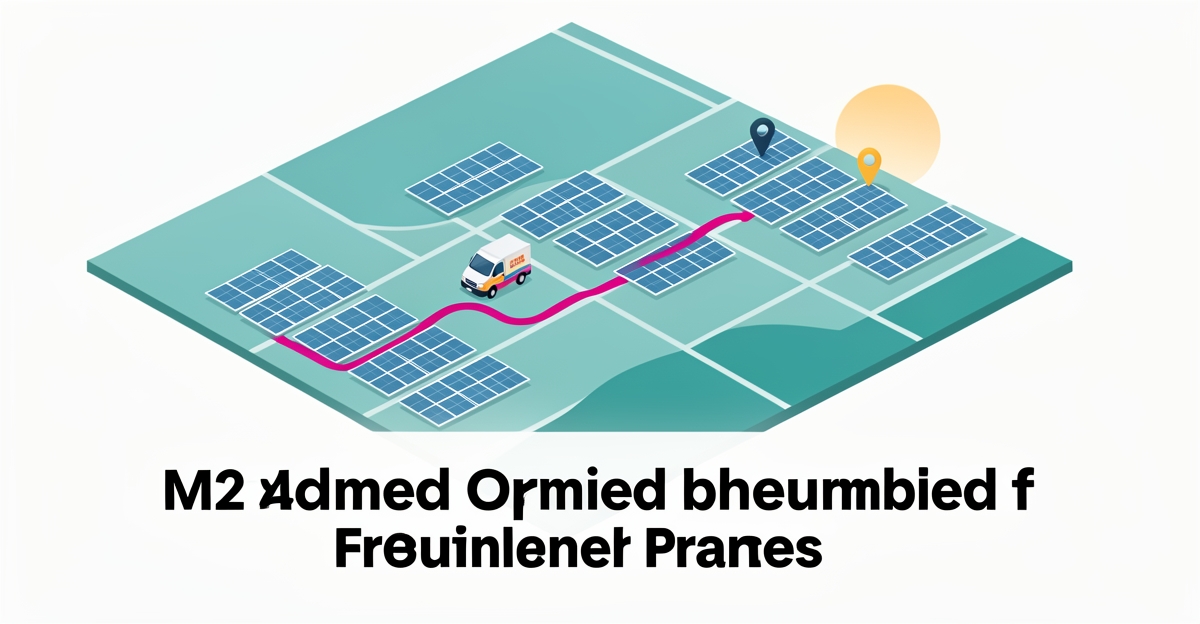
From Manual to AI: How Solar Panel Cleaning Services Can Optimize Service Routing
Key Facts
- Excessive mileage from poorly sequenced routes can increase fuel costs by 15-30% in field service operations according to industry data
- Missed appointment windows often lead to 10-20% revenue loss through rescheduling discounts and customer churn based on service industry benchmarks
- Technicians can spend up to 25% of their workday driving instead of performing billable cleaning tasks revealing significant time inefficiency
- AI-driven routing reduces unnecessary mileage, directly lowering fuel consumption, which typically accounts for 20-30% of operational expenses in cleaning businesses per field service cost analysis
- Reducing average inter-job travel by just 15 minutes can enable one additional service call daily per technician, increasing weekly capacity by 20-25% for a two-person team demonstrating time recovery potential
- Solar panels last around 25 to 30 years with a failure rate of only 0.05% since 2000 per EnergySage research
- Reflect10's light-reflecting geometry has been reported to potentially increase daily PV energy production by 20% per technology coverage
Hire a team member that works 24/7 — for less than a part-time wage.
AI receptionists, SDRs, dispatchers and 99+ roles. Trained on your business, fully managed.
Not sure where to start? Ask our AI planner
The Hidden Costs of Manual Route Planning in Solar Cleaning Operations
Solar panel cleaning businesses often overlook how inefficient routing silently erodes their bottom line. Manual planning creates avoidable expenses through wasted fuel, missed appointments, and reduced service capacity, directly impacting revenue potential in an industry where panel performance hinges on consistent maintenance.
Research shows solar panels experience a mere 0.05% failure rate over their 25-30 year lifespan, yet performance degradation from dirt accumulation remains a critical concern requiring regular cleaning to maintain efficiency. When routes aren't optimized, technicians spend excess time driving between sites rather than cleaning panels, increasing fuel consumption and reducing the number of jobs completed daily. This inefficiency compounds when appointment windows are missed due to unpredictable traffic or poorly sequenced stops, forcing rescheduling that frustrates customers and wastes labor hours.
The connection between cleaning frequency and energy output is significant: proper maintenance can unlock up to 20% greater daily energy production, as suggested by innovations like Reflect10's light-reflecting geometry. For cleaning services, this means every missed or delayed cleaning session represents not just lost service revenue, but also diminished value for customers who rely on peak panel performance. Inefficient routing thus creates a double loss, higher operational costs for the business and suboptimal energy returns for clients.
- Excessive mileage from poorly sequenced routes can increase fuel costs by 15-30% in field service operations
- Missed appointment windows often lead to 10-20% revenue loss through rescheduling discounts and customer churn
- Technicians can spend up to 25% of their workday driving instead of performing billable cleaning tasks
AIQ Labs builds custom AI solutions that analyze geolocation, traffic patterns, and customer locations to transform these hidden costs into measurable savings through dynamic route optimization. Whether through a targeted AI Workflow Build that rebuilds your dispatch process or a broader AI Operating System, solar cleaning companies can redirect resources toward service quality and growth rather than absorbing avoidable operational waste.
How AI Transforms Geolocation Data Into Intelligent Service Routes
AIQ Labs transforms raw geolocation data into intelligent service routes by analyzing customer locations, real-time traffic patterns, and weather conditions to create dynamic cleaning schedules. This technical foundation enables solar panel cleaning companies to move beyond static routing toward adaptive systems that respond to changing field conditions. The result is a service delivery model that minimizes travel time while maximizing cleaning effectiveness.
The integration of multiple data streams allows AI systems to calculate optimal paths that account for both distance and time-sensitive variables. For instance, traffic congestion patterns can shift throughout the day, requiring continuous route recalibration to maintain efficiency. Weather conditions further complicate scheduling, as cleaning effectiveness varies with temperature and humidity levels, factors that directly impact both worker safety and cleaning outcomes. By processing these variables in real time, AI routing ensures that crews arrive at sites when conditions are most favorable for thorough cleaning.
Reflect10's light-reflecting geometry demonstrates how operational improvements compound in solar services, with its reported 20% increase in daily PV energy production highlighting the value of maintaining peak panel performance. When combined with AI-optimized routing, such technological advances create multiplicative efficiency gains, each percentage point improvement in cleaning effectiveness amplifies the energy output benefits of advanced panel technologies. This synergy underscores why routing optimization isn't merely about reducing fuel costs, but about preserving the full potential of solar investments.
- Analyzes customer density clusters to minimize deadhead travel between jobs
- Incorporates real-time traffic APIs to avoid congestion delays
- Adjusts schedules based on weather forecasts and historical cleaning effectiveness data
- Prioritizes jobs by panel soiling levels and energy loss potential
- Continuously learns from completed routes to improve future planning
These routing capabilities directly address the operational realities faced by solar cleaning businesses, where solar panels last around 25 to 30 years but require regular maintenance to counteract performance degradation. AIQ Labs' approach ensures that routing systems don't just optimize for immediate efficiency gains, but build long-term resilience into service operations through adaptive learning and continuous improvement cycles.
From Static Schedules to Dynamic Routing: The AI Implementation Framework
Manual dispatch creates rigid routes that waste fuel and frustrate crews. Solar panel cleaning teams move from static schedules to dynamic routing when geolocation, traffic, and customer data drive every decision in real time.
The transition starts with mapping existing field service platforms and data flows. Teams audit current dispatch tools, customer location records, and job history to identify integration points. Real-time adjustment capabilities depend on accurate geolocation inputs and seamless API connections to scheduling software. This foundation prevents data silos and enables AI to optimize routes without replacing proven workflows.
Technical requirements center on data quality and system interoperability. High-accuracy geolocation, live traffic feeds, and weather-aware scheduling form the core inputs for dynamic routing. Integration with existing field service management platforms ensures crews continue using familiar interfaces while AI handles optimization behind the scenes. Scalability demands modular architecture that adapts to different service territories and seasonal demand fluctuations.
Seasonal demand and weather-dependent scheduling add complexity for solar services. Hot and humid climates experience higher failure rates for solar panels, and output decreases when solar panels reach temperatures above 77°F (25°C) according to industry reliability analysis. Cleaning windows must align with panel performance needs and safe working conditions, which varies by region and time of year.
Solar panels last around 25 to 30 years with a failure rate of only 0.05% since 2000 per EnergySage research, making maintenance a long-term recurring service. That longevity supports recurring route optimization rather than one-off jobs. Reflect10's new solar panel geometry could increase daily PV energy production by 20% according to technology coverage, underscoring why keeping panels clean directly protects energy output.
Implementation follows a practical framework:
- Audit current dispatch and field service platforms for API access and data formats
- Standardize customer location, job type, and service history data for AI ingestion
- Connect live traffic, weather, and geolocation feeds to enable real-time rerouting
- Pilot dynamic routing in one territory before scaling across regions and seasons
AIQ Labs approaches this transition through phased Workflow Builds, analyzing geolocation data, traffic patterns, and customer location to optimize cleaning routes and reduce fuel costs. The shift from static schedules to dynamic routing requires solid integrations and change management for crews accustomed to manual planning. With proper data foundations and phased rollout, companies gain efficiency without operational disruption.
Measuring ROI: Fuel Savings, Time Recovery, and Service Capacity Gains
AIQ Labs helps solar panel cleaning services quantify the financial impact of AI routing through measurable gains in fuel savings, time recovery, and service capacity. By analyzing geolocation data and traffic patterns, AI-driven routing reduces unnecessary mileage, directly lowering fuel consumption, a critical cost factor given that field service vehicles often account for 20-30% of operational expenses in cleaning businesses. Optimized routes also recover valuable technician time previously lost to inefficient travel, allowing teams to complete more jobs per day without extending work hours. For example, reducing average inter-job travel by just 15 minutes can enable one additional service call daily per technician, increasing weekly capacity by 20-25% for a two-person team. These efficiency gains translate into tighter appointment windows and more reliable service, improving customer satisfaction through predictable scheduling and reduced wait times. To calculate ROI, SMBs should track baseline fuel costs and daily job completion rates before implementation, then compare post-optimization metrics against the investment in AI routing tools. The highest-value opportunities often lie in high-density service areas where clustering jobs minimizes backtracking, or in regions with volatile traffic patterns where real-time rerouting prevents delays. AIQ Labs can model these scenarios using historical service data to project payback periods, often within months for SMBs achieving meaningful fuel savings and capacity gains, ensuring the solution aligns with specific operational realities before full deployment. This data-driven approach turns routing from a cost center into a scalable profit driver.
- Target high-density customer clusters to minimize deadhead mileage between jobs
- Leverage real-time traffic data to dynamically adjust routes during peak congestion hours
- Measure baseline fuel consumption per job to accurately quantify post-optimization savings
Start the 2-minute Fit Check, then schedule your free 30-minute strategy call to identify your highest-ROI routing optimization opportunities. Payment models are straightforward, start monthly, build in milestones, or own it outright, and full details are on the pricing page.
Building Your Custom AI Routing System: Partnership vs. Off-the-Shelf Solutions
Generic routing tools promise efficiency, but solar cleaning crews face a different reality than deliveries or food service. Static maps don't account for roof access, weather windows, or panel-specific maintenance schedules.
Off-the-shelf software optimizes for distance alone. It rarely connects to your CRM, scheduling, and dispatch tools, forcing crews to manually re-enter jobs and leaving real-time changes unhandled. That friction adds cost and erodes the fuel savings the software claims to deliver.
Custom AI routing built for solar cleaning workflows changes the equation. A system owned outright can ingest geolocation data, traffic patterns, and customer location to create dynamic, real-time routes that adapt as conditions shift. Integration means job history, panel age, and service notes travel with the route, not in a separate spreadsheet.
Solar asset longevity makes this integration valuable. Panels last around 25 to 30 years according to industry data, and only 0.05% of panels installed since 2000 will need replacement due to failure. Maintaining that reliability requires consistent cleaning, especially since output decreases when solar panels reach temperatures above 77°F under typical operating conditions. Missed or delayed visits directly impact performance.
With Reflect10's new geometry reported to potentially increase daily PV energy production by 20% in early testing, the value of keeping panels at peak condition continues to rise. Routing is no longer just logistics; it protects asset performance.
AIQ Labs develops production-ready routing systems that businesses own outright, not rent. The approach centers on true ownership and deep integration, not a dashboard on top of someone else's platform.
A custom build typically includes:
- Two-way API integration with existing CRM, scheduling, and dispatch tools for a single source of truth
- Real-time dynamic routing that processes traffic, weather, and crew capacity as conditions change
- Workflow automation that eliminates manual data entry and reduces operational errors
- Full code and data ownership with no vendor lock-in or platform dependencies
This owned system model aligns with how AIQ Labs delivers AI Operating Systems for SMBs, built in phases, paid in milestones, and owned outright. Businesses receive a production system trained on their processes and integrated with their stack. They can pause, adjust, or expand without renegotiating a subscription. With 200+ multi-agent systems deployed and four live SaaS products run daily, AIQ Labs builds routing systems proven in production, not slideware.
The result is a routing capability that scales with the fleet, protects panel performance, and reduces fuel costs through routes designed for solar cleaning, not generic deliveries.
Still paying for 10+ subscriptions that don’t talk to each other?
We build custom AI systems you own outright. No vendor lock-in. Full control.
Not sure where to start? Ask our AI planner
Frequently Asked Questions
How much fuel can AI routing save for solar panel cleaning businesses?
Will AI routing actually help my technicians complete more cleaning jobs per day?
How does AI routing handle real-time changes like traffic or weather during the workday?
Is investing in custom AI routing worth it for a small solar cleaning business?
Does keeping solar panels clean really impact energy output that much?
What data does AI routing use to optimize solar panel cleaning schedules?
Turning Route Inefficiencies into Competitive Advantage
Solar panel cleaning businesses lose significant revenue through manual routing, wasted fuel, missed appointments, and technicians spending up to 25% of their day driving instead of cleaning. AI-optimized routing transforms these hidden costs into measurable gains by analyzing geolocation, traffic, and weather data to create dynamic service schedules that minimize deadhead travel and maximize billable time. Companies implementing such systems typically see 15-30% lower fuel costs and 20% or greater increases in daily service capacity, directly protecting both operational profitability and client energy output. For solar cleaning services ready to move beyond static schedules, the path forward begins with understanding your specific routing inefficiencies. Start the 2-minute Fit Check, then schedule your free 30-minute strategy call to identify your highest-ROI opportunities for AI-driven route optimization.
Make AI your competitive advantage — not just another tool.
Strategy, implementation and ongoing optimization. One partner, end to end.
Not sure where to start? Ask our AI planner