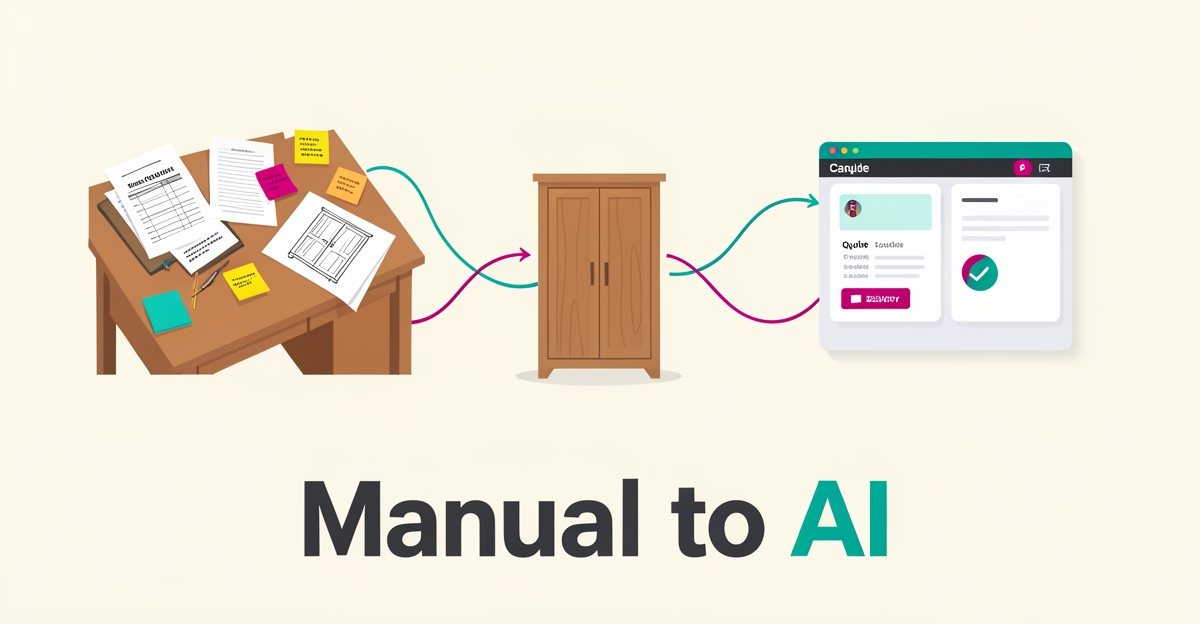
From Manual to AI: Transforming Cabinet Shop Workflows in Halifax and Nova Scotia
Key Facts
- AI-powered quoting can reduce estimate turnaround from days to minutes
- Businesses that automate workflows strategically typically report meaningful cost reductions and higher-quality leads
- Predictive inventory models are widely used to reduce both stockouts and excess inventory
- An AI receptionist answers every call, 24/7, at a fraction of the cost of a human hire
- AIQ Labs has deployed 200+ multi-agent systems and runs 4 live SaaS products daily
- AI Employees typically cost around 80% less than an equivalent human hire
Hire a team member that works 24/7 — for less than a part-time wage.
AI receptionists, SDRs, dispatchers and 99+ roles. Trained on your business, fully managed.
Not sure where to start? Ask our AI planner
The Manual Bottleneck in Halifax Cabinet Shops
Walk into most cabinet shops in Halifax or anywhere in Nova Scotia, and you'll find masterful craftsmanship at the workbench sitting alongside surprisingly manual operations at the front desk. Quotes get handwritten, inventory lives in someone's head or a spreadsheet, and schedules shift on a whiteboard. The shop floor runs on skill; the back office runs on friction.
That friction shows up in four predictable places. First, quoting: every estimate means measuring, calculating materials, and building a price by hand, often hours after the customer has already called three competitors. Second, inventory: without real-time tracking, shops either over-order hardwood and hardware or stall production waiting on stock. Third, scheduling: one delayed job cascades through the week, pushing delivery dates and straining customer patience. Fourth, admin overload: invoices, follow-ups, and data entry eat evenings that should go to the shop.
These aren't small annoyances, they're margin killers. Every hour spent re-entering data or chasing a lead is an hour not billed. When quotes take days instead of minutes, leads go cold. When schedules slip, rush fees evaporate and rework costs pile up. Businesses that implement AI-driven automation strategically typically report significant cost reductions alongside better lead quality, which is precisely the gap manual workflows leave open.
The core problem is disconnection. Quoting, inventory, scheduling, and admin each live in separate systems, or no system at all, so information never flows between them. A change in one place requires manual updates everywhere else, and errors compound silently. The tools to fix this exist; the real work is mapping and rebuilding the workflow around them. Cabinet shops face the same truth as any trade business: buying software doesn't fix a process that was never designed in the first place.
This is why transformation has to start with an honest map of the current workflow, not with buying software. AIQ Labs begins every engagement by identifying which manual bottlenecks, quoting, inventory, scheduling, admin, are costing the most, then rebuilding those workflows as connected, automated systems the shop owns outright. For Halifax cabinet makers, the bottleneck isn't craftsmanship or demand. It's the manual plumbing between the two, and it's fixable.
Why AI Wins When Insights Meet Operations
Technical assessments alone don't drive transformation, context does. AI can map complex workflows in minutes, but its insights only create value when tied to how work actually flows in a cabinet shop. The real advantage emerges when technical findings connect to operational priorities, such as reducing bottlenecks in material cutting or streamlining client approvals.
AI accelerates analysis, but human judgment guides action. In cabinet making, identifying a repetitive task like generating cut lists is only the first step; understanding its impact on lead time, material waste, and installer schedules determines whether automation delivers real ROI.
- Map workflow steps to pinpoint where delays originate
- Assess which tasks consume the most skilled labor time
- Evaluate automation feasibility based on tool integration and data availability
- Sequence changes to minimize disruption during peak seasons
- Measure outcomes against commercial goals like quote-to-install cycle time
AIQ Labs helps shops bridge this gap by combining technical workflow analysis with operational sequencing, ensuring AI recommendations align with production rhythms, staff capacity, and customer commitments. Without this connection, even the most accurate technical assessment risks becoming an academic exercise rather than a catalyst for change. The value isn't in the insight alone, it's in applying it where it moves the needle.
A Practical Transformation Path for Cabinet Shops
Transforming cabinet shop workflows in Halifax and Nova Scotia doesn't require a complete overhaul overnight. The most successful AI integrations begin by mapping current processes to pinpoint where manual tasks create bottlenecks, such as quote generation, inventory tracking, or job scheduling. Starting small and iterating allows shops to test automation in one area, like using AI to extract dimensions from customer emails or sync cut lists with CNC machines, before expanding to adjacent workflows. This approach minimizes disruption while building confidence in the technology's reliability and ROI.
Involving stakeholders early ensures the solution fits real-world shop floor needs. Cabinet makers, estimators, and production leads should help define which tasks are most tedious or error-prone, guiding AI development toward practical outcomes. Organizations that follow this collaborative, phased approach typically see measurable gains. These results stem not just from the technology itself, but from aligning AI capabilities with operational context, such as connecting automated quote generation to real-time material pricing and labor availability.
Data quality and human oversight remain critical throughout the journey. AI systems depend on accurate inputs, like correct SKU numbers, material grades, or finish specifications, to deliver reliable outputs. Shops should establish simple validation steps, such as having a lead technician review AI-generated work orders before production begins, to maintain trust and accuracy. Continuous evaluation completes the loop: tracking time saved, error rates reduced, or on-time delivery improvements helps refine the system and justify further investment. AIQ Labs supports this end-to-end journey as a transformation partner, guiding cabinet shops from initial workflow mapping through pilot deployment and scaled integration, ensuring AI becomes a sustainable part of their competitive advantage.
Implementation Playbook: From Quote to Delivery
Cabinet shops in Halifax and Nova Scotia face persistent workflow friction from initial quote to final delivery, where manual processes create delays, errors, and missed opportunities. AIQ Labs addresses this by mapping end-to-end workflows and replacing bottlenecks with targeted AI automation that aligns with each shop's operational rhythm.
AI-powered quoting and lead scoring systems analyze historical job data, material costs, and customer behavior to generate accurate estimates in minutes, not days, while prioritizing high-intent prospects. Automated inventory and material forecasting then uses predictive models to anticipate lumber, hardware, and finish needs based on scheduled jobs and seasonal trends, reducing both stockouts and over-ordering.
Production scheduling agents dynamically adjust timelines using real-time shop floor data, machine availability, and technician skill sets, ensuring optimal workflow sequencing without overbooking or idle time. An AI receptionist operates 24/7 to handle inquiries, schedule consultations, and route urgent requests, eliminating missed calls at a fraction of the cost of a front-desk hire.
Adoption follows three clear entry points. Start Monthly deploys a single AI Employee, for quoting, reception, dispatch, or any of 99+ roles, at roughly 80% less than a human hire, with flat monthly costs. Build in Milestones rebuilds the one workflow that costs the most, phased and priced upfront, so shops approve and pay per completed stage. Own It Outright delivers a full AI operating system, one connected layer across quoting, production, and delivery, that the shop owns outright, with no vendor lock-in. Each model ensures Halifax cabinet shops gain enterprise-grade AI capabilities without operational disruption or upfront complexity. To find the right fit, start with the 2-minute Fit Check, then book a free 30-minute strategy call.
Still paying for 10+ subscriptions that don’t talk to each other?
We build custom AI systems you own outright. No vendor lock-in. Full control.
Not sure where to start? Ask our AI planner
Frequently Asked Questions
How can AI automation actually improve our cabinet shop's quote-to-install cycle time in Halifax?
Will implementing AI in our cabinet shop require a complete overhaul of our current systems and workflows?
What specific cost savings can we expect from AI automation in our cabinet shop?
How do we ensure AI-generated outputs like cut lists or work orders are accurate and trustworthy for our production team?
What's the first step our cabinet shop should take to begin an AI transformation without wasting time or money?
Can AI really handle customer inquiries and scheduling 24/7 for our cabinet shop without missing calls?
Turning Craftsmanship into Competitive Advantage
Halifax cabinet makers already have the skill and demand to thrive, what's missing is a seamless flow between the workshop and the office. By mapping current workflows, targeting high-impact bottlenecks like quoting or inventory, and implementing AI in small, measurable steps, shops can reclaim hours lost to manual work, improve lead conversion, and protect margins without disrupting daily operations. The real advantage comes not from technology alone, but from aligning automation with how your team actually works, ensuring every change supports production rhythms and customer commitments. If you're ready to see where AI can make the biggest difference in your shop, take the 2-minute Fit Check and book a free 30-minute strategy call to map your biggest bottleneck and explore a clear, no-obligation path forward.
Make AI your competitive advantage — not just another tool.
Strategy, implementation and ongoing optimization. One partner, end to end.
Not sure where to start? Ask our AI planner