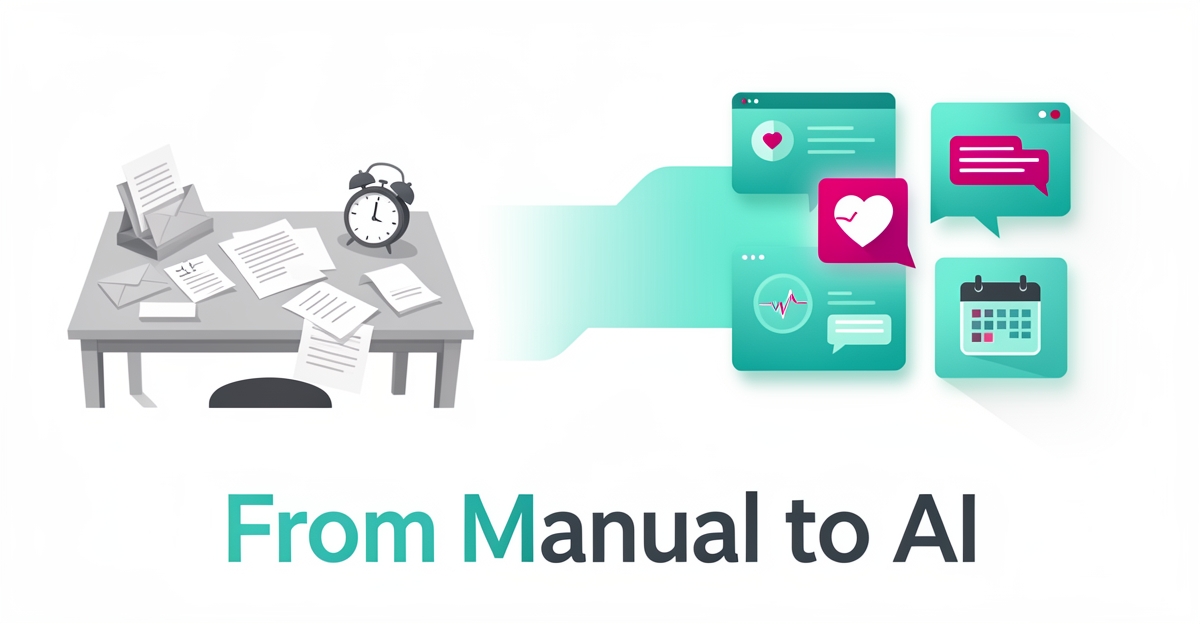
From Manual to AI: Transforming Client Communication in Nutrition Practices
Key Facts
- Routine follow-up tasks that take staff 10–20 minutes manually can typically be compressed to a few minutes with AI assistance
- Automating routine communication costs a fraction of equivalent human staff time, AIQ Labs' managed AI employees run at roughly 80% less cost than a human hire
- Well-designed AI communication systems handle routine touchpoints reliably, with flagged exceptions routed to a human for review
- Successful AI transformation is mostly workflow work: mapping processes, curating data, and managing change, the AI itself is one step among many
- AIQ Labs has deployed 200+ multi-agent systems and runs 4 live SaaS products daily, so these patterns are proven in production, not theory
Hire a team member that works 24/7 — for less than a part-time wage.
AI receptionists, SDRs, dispatchers and 99+ roles. Trained on your business, fully managed.
Not sure where to start? Ask our AI planner
The Hidden Cost of Manual Client Communication in Nutrition Practices
Manual client communication quietly drains nutrition practices every day. Repetitive emails, check-in calls, and progress updates pull practitioners away from clinical work and compound into lost revenue and client drop-off.
A single follow-up can consume 10–20 minutes of staff time, drafting the message, checking the client's history, logging the outcome. Multiply that across dozens of clients weekly and entire afternoons disappear into administrative work instead of care.
The cost is not just hours. When practitioners are tied up drafting emails and returning calls, response lag grows and engagement falls. Clients expect timely progress updates and quick answers to simple questions; when those arrive late, adherence slips and clients churn quietly.
The hidden cost reveals itself in capacity. Practitioners spend time on coordination instead of care, limiting how many clients they can serve well. AI communication systems shift that balance by replacing repetitive emails and phone calls with intelligent support that sends progress updates, asks follow-up questions, and tracks adherence autonomously.
Common manual burdens include:
- Daily check-in emails and meal log reviews that require individual replies
- Phone calls to confirm appointments, reschedule sessions, and answer routine plan questions
- Manual tracking of adherence, water intake, and habit completion across spreadsheets or notes
- Repetitive answers to FAQs about macros, supplements, and timing that interrupt clinical sessions
Transformation is not only about technology. Most of the work in a successful AI adoption is mapping workflows, curating data, and embedding new processes into daily operations, the AI itself is one step among many. The harder work is human, and skipping it is why many automation projects stall.
Practices that address this burden gain back clinical hours and improve continuity. AIQ Labs designs AI systems that understand clinical context and communicate with empathy and accuracy, freeing nutritionists to focus on high-value coaching while automation handles the routine client dialogue.
How AI Transforms Client Communication: Evidence-Based Benefits
Nutrition practices are drowning in repetitive check-ins, progress updates, and follow-up emails that eat into clinical time. AI shifts this workload from manual outreach to intelligent, context-aware communication that runs continuously.
The efficiency gain is straightforward: routine tasks that take a staff member 10–20 minutes, reviewing a client's week, drafting a personalized check-in, logging the response, can typically be handled by an AI system in a few minutes of oversight. Across a full client roster, that compounds into entire days returned to the practice each month.
That efficiency translates directly to client communication. Instead of staff sending individual emails or making phone calls, AI systems send progress updates, ask follow-up questions, and track adherence autonomously, with flagged exceptions routed to a human for review, so nothing risky runs unattended. This enables reliable scale without proportional headcount growth.
Personalization at scale becomes practical when AI handles routine touchpoints. Systems can review logged food, weight, and symptom data across your whole client base, spot adherence patterns, and tailor messaging accordingly, work that once required manual sequencing becomes a parallel, automated workflow.
For nutrition practices, this means consistent adherence monitoring without clinician burden. AI can:
- Send automated progress updates and check-ins on a client-preferred schedule
- Ask contextual follow-up questions based on logged food, weight, or symptom data
- Flag adherence risks and surface them for human review
- Maintain empathetic, accurate communication that reflects clinical context
The shift is from reactive messaging to proactive engagement. AI receptionists, follow-up agents, and support chatbots replace repetitive emails and calls with intelligent support that preserves the human touch for high-value coaching moments. AIQ Labs offers these as managed [AI Employees](/ai-employees), receptionists, follow-up coordinators, and 99+ other roles, at roughly 80% less cost than a human hire.
AIQ Labs builds AI systems that understand clinical context and communicate with empathy and accuracy, aligning with how nutrition practices need to operate. The result is more meaningful human interactions and better client outcomes, supported by automation that is measurable, reliable, and owned by the practice.
Implementing AI Communication Systems: A Phased Approach for Nutrition Practices
Manual client follow-ups eat a nutrition practice's day. Progress updates, adherence checks, and quick questions pile up into repetitive emails and phone calls that pull clinicians away from high-value care.
A phased implementation replaces that manual load with intelligent support that sends updates, asks follow-up questions, and tracks adherence autonomously. The approach mirrors how AIQ Labs delivers every build: in milestones, with a fixed price, so you see working software early and never sign up for an open-ended project.
Start by mapping the client journey as it exists today. Map intake, onboarding, weekly check-ins, meal logging reviews, and rebooking flows on paper or a whiteboard. Spending real time on workflow mapping reveals where manual handoffs create delays and where AI can safely step in.
Next, collect real sample data and edge cases for testing. Gather past messages, intake forms, meal logs, and common exceptions like missed check-ins or dietary restrictions. This data foundation lets prototypes learn clinical context and communicate with empathy and accuracy.
Prototyping comes third. Build a narrow pilot for a single high-impact loop, such as automated progress updates after a session. Test the hypothesis that the AI can ask relevant follow-up questions and flag adherence drops for clinician review. Keep the pilot small, measure honestly, and only expand what works.
Integration follows prototyping. Move from point-in-time data to live connections with practice tools, CRM, scheduling, and client portals. This is where a [workflow build](/workflow-builds) pays off: the one communication loop that costs you the most gets rebuilt properly, at a fixed price, in phases.
Rollout is hands-on. Provide guidance during onboarding, train staff on escalation paths, and make the AI's outputs visible inside existing workflows. Adoption accelerates when teams see time returned for meaningful human interactions.
A practical phased rollout for nutrition practices includes:
- Problem identification and workflow mapping of client communication touchpoints
- Data collection and prototype build for progress updates and adherence checks
- System integration with practice management and scheduling tools
- Staff training, adoption tracking, and contribution loops for continuous improvement
Measurement closes the loop. Track both technical metrics like response accuracy and business outcomes like time saved per client and adherence rates. Change management matters as much as model choice, which is why the phased approach front-loads the human work.
For practices ready to go further, an [AI Operating System](/ai-operating-systems) connects communication, scheduling, and adherence tracking into one operating layer, built in phases and owned outright by your practice, not rented as a subscription widget.
Still paying for 10+ subscriptions that don’t talk to each other?
We build custom AI systems you own outright. No vendor lock-in. Full control.
Not sure where to start? Ask our AI planner
Frequently Asked Questions
How much time can AI actually save my nutrition practice on client follow-ups?
Will AI communication feel robotic or impersonal to my clients?
What does it cost to automate routine client communication with AI?
How do I start implementing AI without disrupting my current workflow?
Can AI handle the specific nuances of nutrition coaching like macro questions and adherence tracking?
What happens if the AI makes a mistake with a client's plan or health data?
The Time You Reclaim Is the Care You Deliver
Manual client communication doesn't just consume hours, it limits how many people you can help well. The practices moving from reactive messaging to proactive, AI-supported engagement aren't replacing the human touch; they're protecting it. By offloading repetitive check-ins, adherence tracking, and routine follow-ups to systems that understand clinical context, nutritionists get back the capacity for high-value coaching that drives real outcomes. The shift follows a proven pattern: map the workflow, build on real data, pilot a single high-impact loop, then integrate and scale, in milestones, at a fixed price, with the practice owning the result. AIQ Labs has deployed 200+ multi-agent systems and runs 4 live SaaS products daily, so these patterns are proven in production. Start with the [two-minute Fit Check](/apply) to map your biggest bottleneck and see where intelligent automation delivers the clearest return.
Make AI your competitive advantage — not just another tool.
Strategy, implementation and ongoing optimization. One partner, end to end.
Not sure where to start? Ask our AI planner