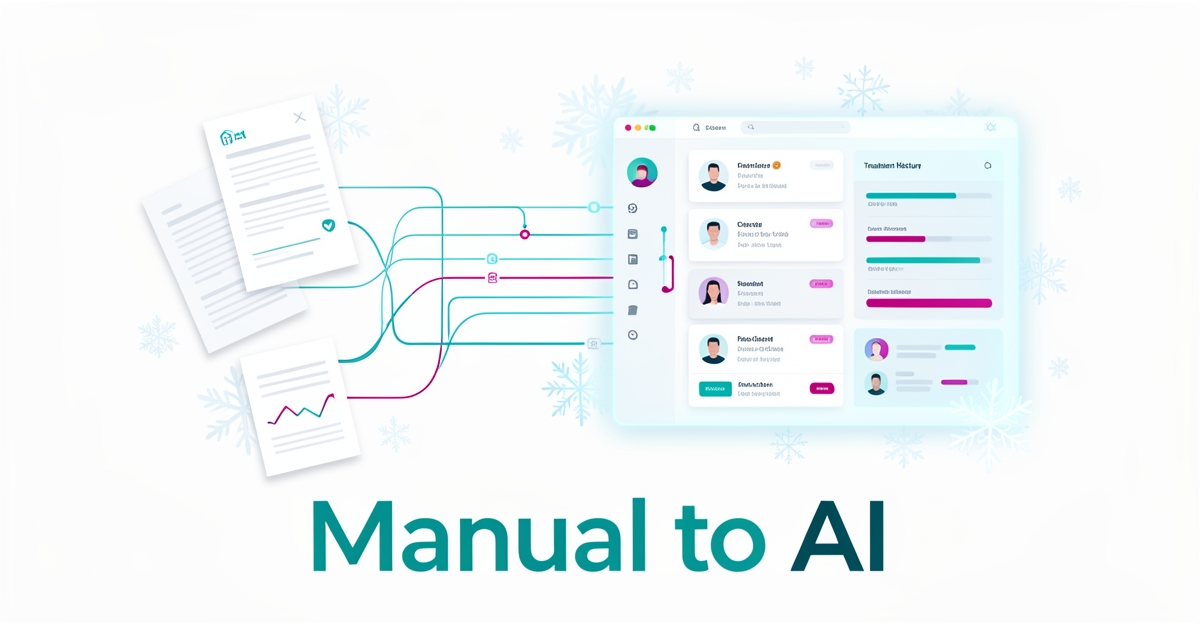
From Manual to AI: Transforming Client Data Management in Cryotherapy Studios
Key Facts
- Teams that automate client reporting typically recover dozens of staff hours per month, capacity that can be redirected to revenue-generating work.
- As of late 2026, most organizations report regular AI use in at least one business function, making manual reporting a growing competitive disadvantage.
- Consumers increasingly expect the speed of AI-assisted service over slow manual handoffs, and a growing share are comfortable with AI handling routine purchases and payments.
- A significant share of organizations struggle to scale AI due to governance and data challenges rooted in fragmented manual foundations.
- Manual data management acts as a growth ceiling, processes that work for 50 clients break down at 200 without a single source of truth.
Hire a team member that works 24/7 — for less than a part-time wage.
AI receptionists, SDRs, dispatchers and 99+ roles. Trained on your business, fully managed.
Not sure where to start? Ask our AI planner
The Hidden Cost of Manual Data Management in Cryotherapy Studios
Paper-based logs and fragmented spreadsheets quietly drain cryotherapy studios every day. Staff spend hours hunting for treatment histories, reconciling client preferences across notebooks and inboxes, and manually compiling reports that should inform retention.
Manual data management creates visible drag on operations. Front desk teams re-enter the same client details for each visit, while therapists lose time clarifying past protocols. That repetition slows intake, increases wait times, and pulls staff away from client care.
Error risks compound quickly when data lives in multiple places. Handwritten notes are misread, files are misplaced, and updates made in one system never reach another. Inconsistent records lead to wrong session recommendations, missed contraindications, and frustrated clients. The lack of a single source of truth makes it hard to spot engagement patterns or churn signals early.
Scalability limitations become urgent as studios grow. A process that works for 50 active clients breaks down at 200. Industry analysis consistently finds that a significant share of organizations struggle to scale AI because of governance and data challenges, a problem that starts with fragmented manual foundations.
The financial impact is measurable even before AI enters the picture. Teams that automate client reporting typically recover dozens of billable hours per month, capacity that can be redirected toward revenue-generating work. For a busy studio, those recovered hours translate directly into more sessions delivered, more memberships sold, and more attention on the clients who need it.
Studios face specific hidden costs from manual systems:
- Time lost to manual reporting and data reconciliation that could be spent on client engagement
- Error-driven rework, including rescheduled sessions and compliance risk from inaccurate health histories
- Limited personalization because staff lack real-time access to treatment history and preferences
- Inability to scale without adding headcount as client volume grows
Client experience also suffers. Consumer research on AI-assisted service consistently shows that a majority of consumers appreciate the time savings of AI-powered customer service, and a growing share are comfortable letting AI agents handle routine purchases and payments. Manual handoffs feel slow by comparison.
The broader market is already moving. As of late 2026, most organizations report regular AI use in at least one business function, a signal that manual reporting is becoming a competitive disadvantage, not just an inconvenience.
Manual data management is not just inefficient, it is a growth ceiling. For cryotherapy studios tracking treatment history, client preferences, and engagement patterns, the cost shows up as lost hours, lost revenue, and lost trust. AIQ Labs consolidates these records into owned, integrated databases, replacing fragmented tools with automated workflows studios control through AI Workflow Builds and, as needs grow, a full AI Operating System.
How AI-Powered Databases Solve Cryotherapy Data Challenges
Manual spreadsheets and paper logs create blind spots in cryotherapy studios. Treatment history lives in notebooks, client preferences scatter across texts, and engagement patterns remain invisible until it's too late to act.
AI-powered databases change that equation by turning fragmented records into a unified, intelligent client profile. Systems automate data collection, analysis, and visualization so staff can focus on strategic decisions and client relationships instead of chasing paperwork.
The shift is already underway across service businesses. Most organizations now report regular AI use in at least one business function, and in client reporting workflows, AI agents routinely turn raw data into polished, insight-rich reports in minutes rather than days.
The capacity gains are real. Studios that automate reporting and intake typically recover dozens of staff hours each month, hours that go back into delivering sessions, upselling memberships, and building retention instead of reconciling intake forms.
Client expectations reinforce the move. A majority of consumers appreciate the time savings of AI-powered customer service, and a growing share are comfortable with AI agents managing routine purchases and payments. When studios remember preferences, suggest optimal treatment cadence, and follow up proactively, trust compounds.
An AI-driven client data system built from the ground up can track treatment history, preferences, and engagement patterns in one owned database. AIQ Labs architects these systems as custom, integrated assets rather than subscription tools, built in phases, owned outright, and integrated with existing studio operations.
The practical benefits studios see include:
- Automated intake and visit logging that eliminates manual entry errors
- Real-time dashboards for treatment frequency, revenue per client, and churn risk
- Personalized outreach triggered by engagement patterns and preferences
- Unified reporting that replaces fragmented spreadsheets with a single source of truth
This is autonomous client experience in practice. AI understands intent, plans action, and executes workflows across systems without constant human input. It represents a fundamental shift from time-consuming manual processes to intelligent, automated workflows that generate deeper insights and stronger client relationships.
Implementation works best when starting focused. Pinpoint the tasks that drain resources without adding strategic value, select tools with seamless integration, and ensure expert involvement to maintain quality standards. With the right architecture, studios move from reactive record keeping to proactive client care, powered by data they own and control.
Implementing AI Data Systems: A Step-by-Step Guide for Cryotherapy Studios
Manual intake sheets and fragmented spreadsheets cost cryotherapy studios time, accuracy, and client retention. Moving to an AI-powered database changes data from a burden into a growth asset.
Start by pinpointing tasks that drain resources without adding strategic value. Staff hours lost to retyping treatment notes, chasing missing preferences, and building manual reports are classic low-value work. Teams that automate client reporting typically recover dozens of hours per month, capacity that goes straight back into revenue-generating work.
Select integrated tools that fit existing studio workflows. The right system connects booking, payments, and treatment history into a single source of truth with dynamic visualizations. Because a significant share of organizations struggle to scale AI due to governance and data challenges, integration choices matter from day one.
Start small with a focused pilot. A single workflow, such as post-treatment follow-up or preference tracking, minimizes disruption and builds learning. AIQ Labs' Workflow Builds are designed exactly for this: rebuild the one workflow that costs the most, at a fixed price, in phases, with the studio owning the result outright rather than renting a subscription.
Ensure expert involvement to maintain quality standards. AI-generated insights need human review early on to align with clinical goals and brand voice. Expert oversight prevents model drift and ensures reports meet quality standards before scaling.
Use proven patterns to accelerate adoption. Ready-to-use structures for client onboarding, treatment history summaries, and engagement scoring simplify rollout. This mirrors how AI agents are transforming client reporting across service businesses, turning raw data into polished, insight-rich reports within minutes.
Implementation follows a practical sequence tailored to cryotherapy operations:
- Map the current client journey from booking to retention and identify manual data touchpoints.
- Define the core data model for treatment history, preferences, contraindications, and engagement patterns.
- Build a pilot AI workflow for one high-friction process with integrated data capture.
- Validate outputs with studio staff and clients, then expand to reporting and personalization.
As adoption grows, studios can layer in autonomous customer experience capabilities where AI understands intent and executes workflows across systems, supported by managed AI Employees that handle front-desk intake, follow-ups, and outreach at a fraction of the cost of an additional hire.
With most organizations now reporting regular AI use in at least one business function, studios that move now avoid falling behind. The shift from manual to AI-powered data management creates deeper insights and stronger client relationships while freeing teams to focus on care, not clerical work.
Still paying for 10+ subscriptions that don’t talk to each other?
We build custom AI systems you own outright. No vendor lock-in. Full control.
Not sure where to start? Ask our AI planner
Frequently Asked Questions
How many staff hours per month can cryotherapy studios save by automating client reporting?
Do clients actually prefer AI-assisted service over manual handoffs?
Why do organizations struggle with scaling AI, and how does this relate to cryotherapy studios?
What is the main benefit of AI-powered databases for cryotherapy studios in terms of client experience?
Should a studio buy a subscription tool or build an owned system?
How should a cryotherapy studio get started with AI data management?
Turning Data into Your Studio's Greatest Asset
Manual data management quietly erodes cryotherapy studios through lost time, avoidable errors, and missed growth opportunities, costs that compound as client volume rises. By shifting to an AI-powered database built for ownership and integration, studios reclaim hours spent on repetitive tasks, gain real-time insights into treatment patterns and churn risk, and deliver the personalized, proactive experiences clients now expect. The result isn't just cleaner records; it's a foundation for scalable care, stronger retention, and teams free to focus on what matters most. If you're ready to see where AI can unlock capacity in your studio without adding complexity, take the two-minute Fit Check and book a free 30-minute strategy call to map your highest-impact opportunity. Teams that automate client reporting typically recover dozens of hours every month, imagine what that could mean for your studio's growth and client care.
Make AI your competitive advantage — not just another tool.
Strategy, implementation and ongoing optimization. One partner, end to end.
Not sure where to start? Ask our AI planner