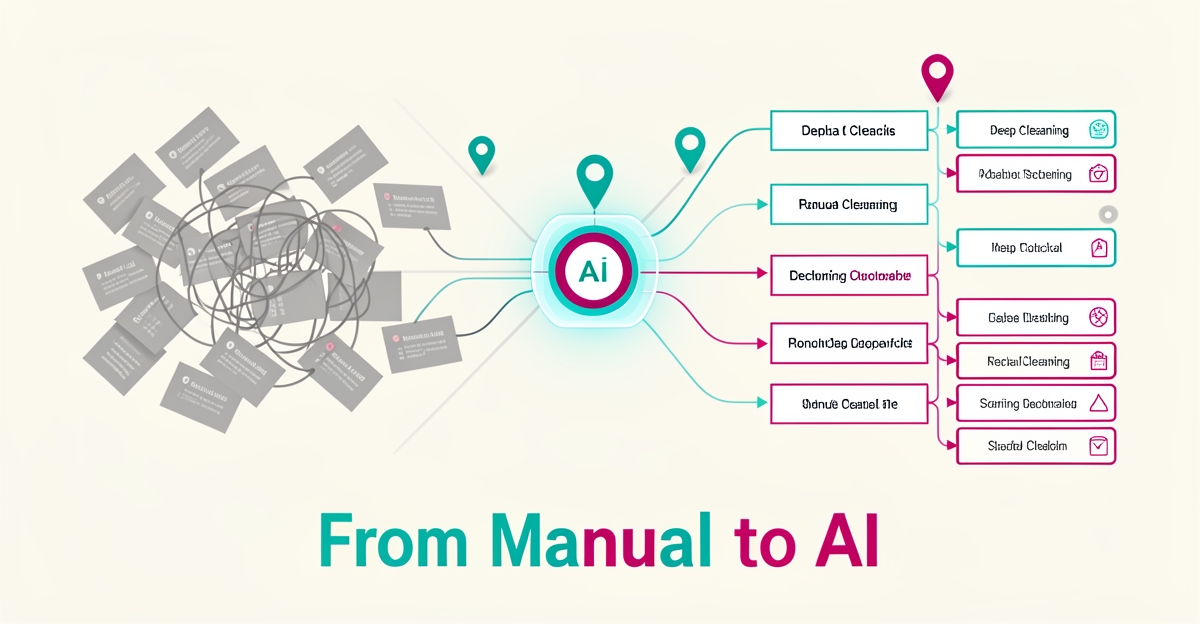
From Manual to AI: Transforming Deep Cleaning Workflows with Smart Task Routing
Key Facts
- Manual workflows are slow and error-prone, while AI-powered workflows are highly scalable for increasing workloads.
- Real-time task routing uses location, technician availability, and client priority to replace manual dispatch guesswork.
- AI augments technicians with intelligent guidance while managers gain dashboards for performance monitoring.
- A phased implementation roadmap from pilot to scale prevents disruption and supports measurable efficiency gains.
- AIQ Labs has deployed 200+ multi-agent systems and runs 4 live SaaS products daily, production experience, not theory.
Hire a team member that works 24/7 — for less than a part-time wage.
AI receptionists, SDRs, dispatchers and 99+ roles. Trained on your business, fully managed.
Not sure where to start? Ask our AI planner
Why Manual Deep Cleaning Workflows Break at Scale
Manual task lists feel manageable until the first missed window, double-booked crew, and angry client call arrive in the same afternoon.
Deep cleaning companies running on spreadsheets and intuition hit a ceiling fast. Reactive dispatching means jobs get assigned by whoever is free, not who is closest, qualified, or best suited. That friction compounds with every new client and technician.
Manual workflows are slow and error-prone by design. Teams still chasing paper checklists and phone confirmations lose time on coordination instead of service. The cost is not just time; it is inconsistent service and lost capacity.
Intuition-based routing leaves data on the table. Managers rely on memory and gut feel instead of location, availability, and client priority. Without a unified view, dispatchers over-communicate, technicians drive extra miles, and high-value jobs wait while low-priority tasks get done first.
Adoption still lags across field service industries, which leaves a real advantage for operators who move now. The gap between teams using AI well and those who aren't is widening every month.
Scale exposes every manual weakness. Common break points include:
- Slow, reactive dispatch that adds drive time and missed slots
- Error-prone task lists with missed steps and inconsistent quality
- Limited data utilization, so past jobs, technician performance, and client preferences are ignored
- Intuition-based resource allocation instead of optimized routing
These issues limit growth. Manual systems are difficult to scale, while AI-powered workflows are highly scalable to handle increasing workloads. Accuracy improves and resource allocation shifts from guesswork to data-driven decisions.
AIQ Labs builds [AI Workflow Builds](/workflow-builds) that rebuild the one workflow costing you the most, often dispatch and scheduling, at a fixed price, in phases. The shift is from reactive task management to proactive, data-driven routing based on location, technician availability, and client priority.
Human expertise remains central. AI augments technicians with intelligent guidance and gives managers dashboards to monitor performance and spot improvement areas. The goal is not replacement; it is removing the repetitive, error-prone work that slows teams down.
How AI Enables Real-Time Smart Task Routing
AI is shifting deep cleaning task routing from reactive fixes to proactive intelligence by analyzing real-time data on location, technician availability, and client priority. This transformation moves beyond static schedules to dynamic allocation that adapts as conditions change throughout the day. AI-powered workflow automation platforms orchestrate these decisions by connecting scheduling tools, CRM data, and field service systems into a unified operational view.
Intelligent document processing enhances this capability by extracting critical job details from work orders, service histories, and client communications, automating data entry that once consumed technician time. AI assistants further support this ecosystem by providing contextual guidance to dispatchers and field teams, reducing delays caused by manual coordination.
These systems leverage data-driven insights to optimize resource allocation, ensuring the right technician arrives at the right job with the correct specifications. By continuously analyzing performance metrics and job requirements, AI enables deep cleaning businesses to scale operations without proportional increases in overhead.
- Real-time location tracking enables dynamic rerouting based on traffic and job completion times
- Technician skill matching ensures complex jobs are assigned to qualified personnel
- Client priority scoring allocates resources to high-value or time-sensitive contracts
- Automated status updates keep clients informed without dispatcher intervention
- Predictive workload balancing prevents technician burnout and underutilization
For deep cleaning companies seeking these capabilities, AIQ Labs provides production-ready systems that transform manual routing into intelligent, adaptive workflows grounded in operational reality. The result is a shift from guessing where resources should go to knowing, with data-backed precision, how to maximize efficiency and service quality.
Building a Production-Ready Routing System That Works in the Field
Deep cleaning operations often stall when technicians arrive to find outdated task lists, unclear priorities, or inefficient routing that wastes time and fuel. This disconnect between office planning and field execution creates frustration, delays service delivery, and limits scalability. Building a production-ready routing system starts by mapping these pain points directly to field realities, such as last-minute cancellations, technician skill mismatches, or traffic delays that derail static schedules. AIQ Labs begins every implementation by shadowing crews and interviewing dispatchers to uncover where manual processes break down, ensuring the solution addresses actual workflow friction rather than theoretical inefficiencies.
Data preparation forms the foundation of any intelligent routing system, requiring clean, structured inputs from job histories, technician profiles, equipment logs, and client preferences. AI-driven workflows outperform manual methods in efficiency and accuracy by leveraging data for dynamic decision-making. Teams must standardize job types, geocode service areas, and synchronize calendars with CRM data to enable real-time matching of tasks to the nearest qualified technician. This step transforms scattered spreadsheets and paper logs into a unified data engine that powers adaptive routing decisions throughout the day.
Workflow design then translates this data into actionable field logic, prioritizing high-value clients, balancing workloads across teams, and adjusting routes in response to real-time changes like weather or urgent requests. AIQ Labs builds orchestration layers that continuously re-evaluate assignments based on live inputs, ensuring technicians receive optimized sequences via mobile apps or voice prompts. Integration with existing tools, like scheduling software, GPS trackers, and invoicing systems, creates a closed loop where completed jobs automatically update records and trigger next steps. Throughout this process, human-AI collaboration remains central: dispatchers retain override authority for exceptional cases, while technicians receive AI-suggested routes they can accept or modify based on on-the-ground insights, blending algorithmic efficiency with field expertise. To see how this approach fits your operation, start with the two-minute Fit Check and map your biggest bottlenecks.
From Pilot to Scale: Implementation Roadmap for Cleaning Operators
Moving from manual dispatch to intelligent routing fails when teams try to scale all at once. Cleaning operators get the best results by piloting small, proving value, and then expanding with governance built in from the start.
A phased roadmap protects data quality and integration complexity while keeping technicians in the loop. The first phase focuses on discovery and data readiness. Teams map current pain points, audit job history, technician availability, and client priority data, then clean and structure it for routing decisions. This foundation determines whether AI augments technicians rather than replaces them.
Pilot design keeps scope tight and measurable. One region or service type, a limited set of routes, and clear success metrics allow operators to test intelligent assignment based on location, availability, and priority. Early pilots surface integration needs with scheduling, CRM, and field tools, and reveal training gaps before wider rollout.
Scaling moves from pilot to departmental automation with governance and change management. Operators should formalize:
- Data standards and validation for jobs, skills, and client preferences
- Integration points between dispatch, routing, and technician apps
- Training programs that show technicians how AI provides intelligent guidance and real-time updates
- Human-in-the-loop controls for exceptions, priority overrides, and quality checks
Training is the adoption lever. Technicians need clear explanations of how routing suggestions are made and how to provide feedback. Managers need dashboards for performance monitoring and continuous improvement. This human-AI collaboration keeps expertise central while automating repetitive coordination.
AIQ Labs builds production-ready systems that adapt to real-world operations. For operators who want AI staff handling dispatch calls, scheduling confirmations, and client follow-ups, [AI Employees](/ai-employees) cover 99+ managed roles at roughly 80% less cost than a human hire. And for companies ready to connect dispatch, routing, CRM, and billing into one layer they own outright, [AI Operating Systems](/ai-operating-systems) are built in phases, no rented tooling, no lock-in. A phased approach with pilot validation, robust data prep, and ongoing optimization lets teams scale smart task routing without disruption and with measurable efficiency gains.
Still paying for 10+ subscriptions that don’t talk to each other?
We build custom AI systems you own outright. No vendor lock-in. Full control.
Not sure where to start? Ask our AI planner
Frequently Asked Questions
Will AI replace my dispatchers and cleaning technicians?
How much time can smart task routing actually save my cleaning crews?
Is my business too small to benefit from AI routing?
What data do I need to get started with real-time routing?
What's the ROI of implementing AI for deep cleaning operations?
How do I avoid a failed pilot when moving from manual dispatch to AI?
The Route to Smarter Operations Starts Now
Deep cleaning companies no longer need to accept missed windows, double-booked crews, and reactive dispatch as the cost of growth. As we have explored, shifting from manual task lists to AI-powered routing transforms operations by matching jobs to the right technician based on real-time location, availability, and client priority. This shift eliminates the friction of spreadsheets and intuition, replacing them with scalable, data-driven workflows that improve with every job, and the efficiency gap between early adopters and those waiting will only widen. The path forward begins with a focused pilot: map your current dispatch pain points, clean your job and technician data, and test intelligent routing on a single region or service line. AIQ Labs has deployed 200+ multi-agent systems and runs 4 live SaaS products daily, building production-ready systems through phased implementation that respects your field realities. Ready to stop guessing and start routing with precision? Complete the two-minute Fit Check at https://aiqlabs.ai/apply, then book your free 30-minute strategy call to identify your highest-ROI automation opportunity. Questions first? Reach the team at [email protected].
Make AI your competitive advantage — not just another tool.
Strategy, implementation and ongoing optimization. One partner, end to end.
Not sure where to start? Ask our AI planner