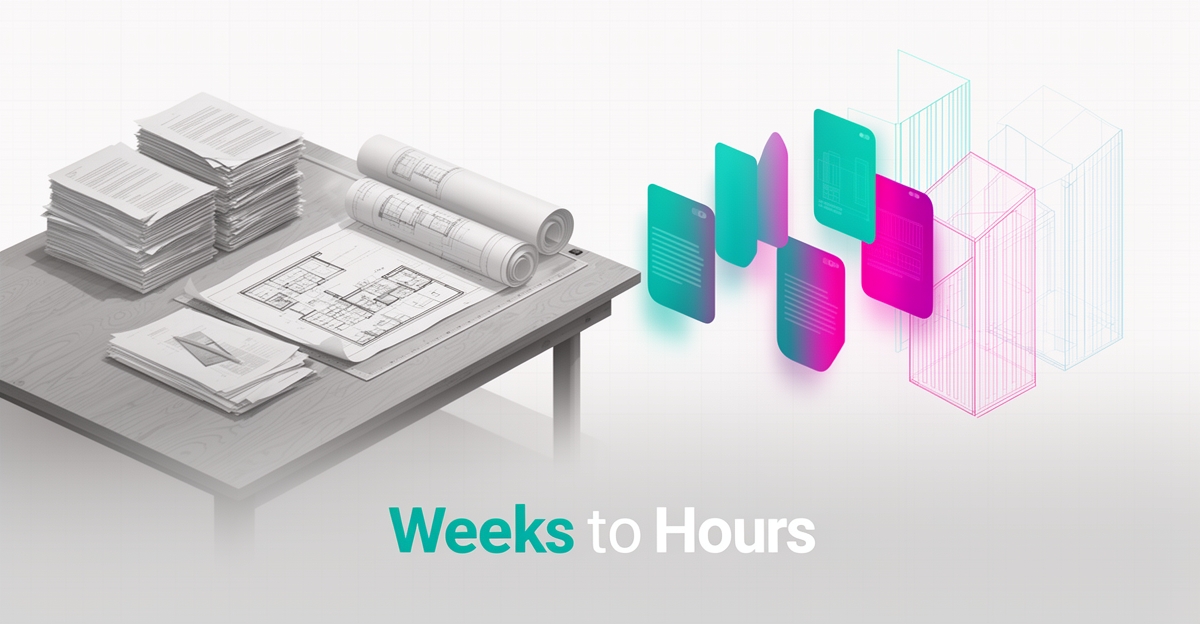
From Manual to AI: Transforming Design Proposal Generation in Architecture Firms
Key Facts
- RFP volumes have climbed steadily across bid-intensive industries, making manual drafting increasingly unsustainable
- Generative AI has become a mainstream tool for proposal teams as of late 2026, used widely for first drafts and content assembly
- A growing share of firms have automated at least part of their proposal process, per recent industry benchmark surveys
- AI systems reduce lead time from weeks to hours while preserving quality and brand control
- Automated first drafts cut initial proposal creation from days to hours
- A firm-owned system trained on past projects turns your proposal archive into a reusable engine
Hire a team member that works 24/7 — for less than a part-time wage.
AI receptionists, SDRs, dispatchers and 99+ roles. Trained on your business, fully managed.
Not sure where to start? Ask our AI planner
The Hidden Cost of Manual Proposals in Architecture Firms
For many architecture firms, the proposal process remains a significant, yet often underestimated, operational burden. A manual approach creates bottlenecks that directly limit a firm's capacity to secure new projects and grow.
The sheer volume of work is a primary challenge. Industry benchmark surveys consistently show organizations handling well over a hundred RFP submissions annually, and that volume has trended upward in recent years. Each submission demands considerable time and meticulous attention, diverting valuable resources from core design work.
Manual processes inherently lead to inconsistencies and inefficiencies. Crafting each proposal from scratch often results in a time-consuming process of creating and editing documents, making it difficult to maintain uniform branding and messaging across all submissions. This fragmented effort also hinders effective collaboration and communication among team members.
The operational drag extends beyond document creation. Firms struggle to maintain accuracy and consistency when relying on disparate templates and individual efforts. Valuable time goes to repetitive tasks rather than strategic client engagement or innovative design.
The pressure to respond faster without sacrificing quality is immense. Manual workflows make it hard to meet tight deadlines while ensuring every proposal is polished and persuasive. Firms end up choosing between speed and the meticulous detail that wins bids.
The consequences of this manual approach are clear:
- Slow turnaround times for critical proposals.
- Inconsistent formatting and branding across submissions.
- Increased potential for errors and inaccuracies.
- Significant operational drag from rising submission volumes.
Recent benchmark data suggests a majority of firms have now automated at least a quarter of their proposal process — a sign of widespread recognition of the problem, yet a persistent gap in fully addressing the underlying inefficiencies. With win rates in competitive RFP environments hovering near the mid-40s percent range, every advantage matters.
Many firms find themselves caught in a cycle where the effort required to produce proposals detracts from their ability to innovate and deliver. This is where the strategic application of AI document processing offers a pathway to transform these labor-intensive workflows. By automating the generation of tailored design proposals, firms can shift their focus back to creativity and client relationships.
Why AI-Powered Proposal Generation Is Gaining Ground
AI-powered proposal generation is gaining momentum across architecture firms as teams recognize its ability to transform a traditionally slow, error-prone process into a streamlined, collaborative workflow. By automating the creation of first drafts, these systems free designers and proposal writers to focus on strategy and client-specific customization rather than repetitive formatting and data entry. This shift accelerates turnaround times and establishes a consistent foundation that reflects the firm's branding, expertise, and compliance standards from the outset.
As of late 2026, a strong majority of proposal teams report using generative AI to initiate their workflows, and benchmark surveys show most firms have automated at least a quarter of their proposal process. These adoption trends reflect growing confidence in AI's capacity to handle structured, repeatable tasks while preserving the creative and strategic input that only human professionals can provide.
The impact extends beyond individual productivity to team dynamics. AI-powered platforms enable real-time collaboration by allowing multiple stakeholders — architects, estimators, and project managers — to review, comment, and refine proposals simultaneously within a shared interface. Version control is maintained automatically, reducing the risk of conflicting edits or outdated information circulating through email chains. Feedback loops become faster and more transparent, aligning cross-functional teams around a single source of truth throughout the proposal lifecycle.
- Automated first drafts reduce initial proposal creation time from days to hours
- Consistent branding and compliance are embedded in every AI-generated output
- Real-time collaboration tools eliminate version confusion and delays
- Teams spend less time on administrative tasks and more on client-focused strategy
- Faster turnaround increases capacity for higher proposal volume without added headcount
For architecture firms seeking to scale proposal capabilities without sacrificing quality, AI offers a practical path forward. By grounding automation in historical project data and firm-specific knowledge, these systems generate outputs that feel both personalized and professionally rigorous. Firms that integrate AI thoughtfully into their proposal workflows position themselves to respond faster, compete more effectively, and win more work in an increasingly demanding market. AIQ Labs supports this transition through AI Workflow Builds that rebuild the one workflow costing you the most — proposal generation included — at a fixed price, in phases.
What Modern AI Proposal Systems Actually Do
Proposal timelines are collapsing as firms move from manual drafting to intelligent automation. Architecture teams are under pressure to deliver more submissions with tighter consistency, and modern AI systems are built specifically to handle that load.
Automated proposal generation turns a client brief into a first-draft proposal, budget, and timeline without starting from a blank page. Systems learn a firm's past projects, fee structures, and design language to produce branded, compliant drafts in hours instead of weeks.
Reusable firm-specific content is what makes those drafts reliable. Modern platforms ingest historical proposals, project records, and standards to build a living knowledge base. The AI then assembles tailored narratives, scope descriptions, and visuals that reflect the firm's voice and past performance. This reduces rework and protects consistency across teams.
Real-time collaboration keeps proposals moving. Instead of email chains and versioned Word files, teams co-edit in a shared workspace with inline comments, approvals, and change tracking. The broader market reflects this shift: proposal management software has grown into a multi-billion-dollar category, with sustained investment in connected, AI-assisted workflows as of 2026.
Analytics turn submission activity into win-rate improvement. Dashboards track cycle time, content reuse, reviewer bottlenecks, and win/loss patterns. Firms use these signals to refine positioning and pricing over time.
Core capabilities that matter for architecture firms include:
- Automated proposal generation from a simple client request into tailored design proposals, budgets, and timelines
- Reusable firm-specific content trained on past projects for consistent, branded, and compliant output
- Real-time collaboration and feedback tools that let principals, designers, and estimators work in parallel
- Advanced analytics and reporting that link proposal performance to win rates and process improvements
With annual submission volumes in the hundreds for many bid-intensive firms, manual handling is unsustainable. AI systems reduce lead time from weeks to hours while preserving quality and brand control.
AIQ Labs builds custom systems trained on a firm's past projects to deliver consistent, branded, and compliant proposals — helping architecture practices scale proposal capacity without adding headcount. Faster, more consistent proposals become a competitive advantage when the system learns from every win and loss.
With the right architecture, proposal generation shifts from a bottleneck to a repeatable, measurable growth engine.
How Architecture Firms Can Implement AI Proposal Automation
Manual proposal generation is costing architecture firms time they cannot afford. With generative AI now a mainstream tool among proposal teams as of late 2026, the shift from weeks to hours is already underway.
The move starts with an honest audit of the current workflow. Map where requests enter, who edits, how budgets and timelines are assembled, and where revisions stall. Firms that have automated part of the process typically report faster turnaround and fewer errors. Bottlenecks become clear when you track handoffs and rework.
Choose a system built for ownership and integration, not a subscription template library. AIQ Labs rebuilds the one workflow that costs you the most — for many firms, that's proposals — at a fixed price and in phases, so you approve each milestone before the next dollar is spent. The right build connects to existing project management and accounting tools so data flows without re-entry. Payment models are straightforward: start monthly, build in milestones, or own it outright. Details are on the pricing page.
Training is where adoption succeeds or stalls. Teams need clear roles for human review, prompts for client-specific requests, and guardrails for brand voice and compliance. Phased implementation lets principals approve outputs before client delivery and builds trust with designers and estimators.
A practical path looks like this:
- Assess bottlenecks and document current proposal steps, approval points, and data sources
- Select a custom system that integrates with existing tools and learns from past project history
- Train teams on prompt use, review workflows, and quality checks for budgets and timelines
- Track performance on lead time, revision cycles, and win rate to refine the model
Integration matters more than features. Automated proposal generation works when it pulls from live project data and pushes outputs back into CRM and accounting. Sustained market investment in proposal management software through 2026 signals this capability is now table stakes in bid-intensive industries.
Performance tracking closes the loop. Monitor time-to-proposal, consistency of branding, accuracy of estimates, and close rates by project type. With feedback, the system improves its templates and reasoning, and teams gain confidence that AI-assisted proposals reflect firm expertise rather than generic text.
From Weeks to Hours: Building a Scalable Proposal Engine
Manual proposal cycles in architecture are collapsing under their own weight. Firms juggle repetitive drafting, brand consistency checks, and compliance reviews while submission volume climbs. In competitive RFP environments, speed and precision are a genuine edge.
When AI is trained on a firm's past projects, brand language, budgets, timelines, and compliance requirements, proposal generation shifts from weeks to hours. The system learns how proposals are structured, what fee logic applies to specific typologies, and how the firm describes its process and values. That history becomes a reusable engine rather than a folder archive.
This is where custom-owned AI systems change the economics. Instead of renting generic proposal tools forever, firms build a proposal engine that reflects their own standards and data — and own it outright. AIQ Labs builds these systems in phases, at a fixed price, so the investment is controlled and the asset stays yours.
The transformation is measurable across the workflow. Generative AI has moved from experiment to standard practice among proposal teams, and the market for proposal management software continues to grow as firms invest in connected, AI-assisted workflows.
A scalable proposal engine typically consolidates:
- Project history and fee models for instant budget and timeline drafting
- Brand language and compliance rules for consistent tone and requirements
- Real-time collaboration and feedback tools for faster internal review
- Advanced analytics and reporting to track win rates and improve content
With these inputs, a simple client brief triggers a first-draft proposal with scope narrative, illustrative precedents, staffing plan, and priced schedule. Reviewers edit in context, and the engine learns from each change. Consistency improves while manual copy-paste work disappears.
The result is a repeatable, firm-owned asset. Lead time compresses from weeks to hours, teams focus on strategy instead of formatting, and every submission carries the same quality bar. For architecture practices navigating higher submission volumes, that scalability protects margin and reputation without adding headcount.
From Bottleneck to Growth Engine
Manual proposal cycles are no longer sustainable when submission volumes keep climbing and every bid is contested. The shift from weeks to hours isn't about replacing designers — it's about removing repetitive drafting, version chaos, and brand inconsistency so teams can focus on strategy, client fit, and persuasive storytelling. AI-powered systems that learn a firm's past projects, fee logic, and design language create a reusable, firm-owned engine for branded, compliant first drafts with real-time collaboration and analytics that improve over time. For architecture practices ready to scale capacity without adding headcount, the next step is an honest workflow audit and a phased build that protects quality while building trust. Start the 2-minute Fit Check at https://aiqlabs.ai/apply to book a free 30-minute strategy call with AIQ Labs — map your biggest bottleneck and identify high-ROI automation opportunities, with no obligation, just clarity.
Make AI your competitive advantage — not just another tool.
Strategy, implementation and ongoing optimization. One partner, end to end.
Not sure where to start? Ask our AI planner