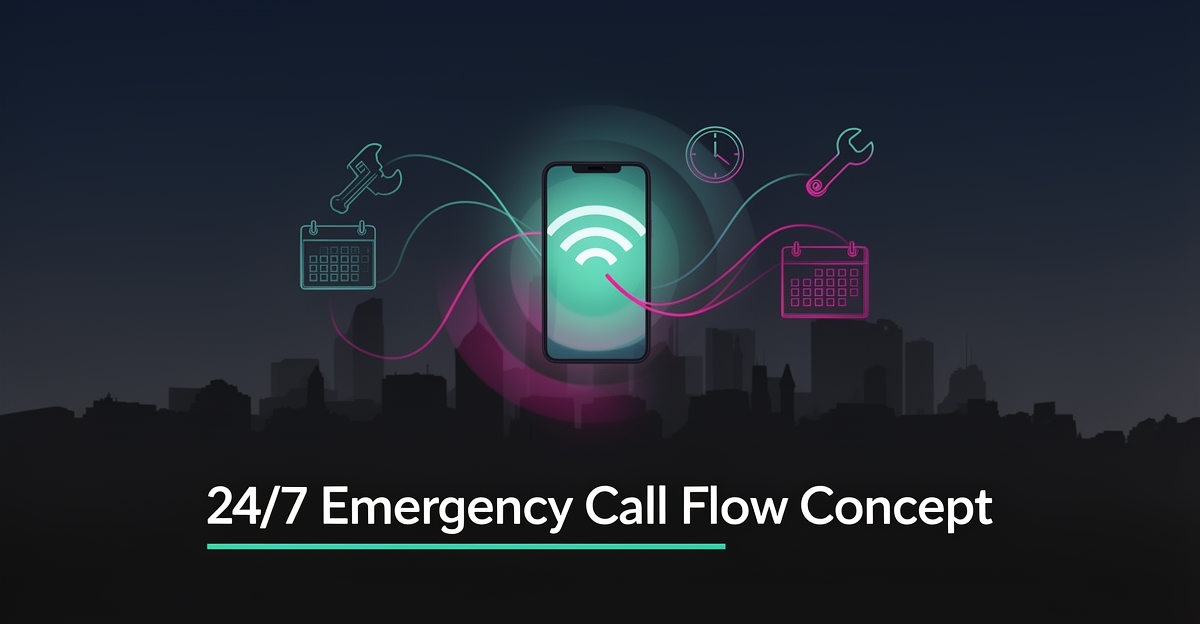
From Manual to AI: Transforming Emergency Plumbing Call Handling in Halifax
Key Facts
- Industry analyses of AI scheduling in field service report substantially fewer job delays and higher on-job productivity for plumbing teams per research cited in the Simpro industry overview
- AI-powered accounts receivable automation can lower the cost per invoice dramatically, from roughly $20 toward a few dollars through automation
- First-time fix rates, typically around 75%–80% industry-wide, can rise toward 90%+ with AI-generated pre-dispatch briefings improving completion quality
- Traditional booking can require 20 minutes of staff time per job across three interactions creating operational bottlenecks
- The large majority of local consumers read online reviews, and most favor businesses that respond to each review according to industry data
- AI estimating tools can automate a large share of manual takeoff work, saving significant time per sheet and enabling more bids
- AI call-answering tools improve lead capture and revenue retention for 10-tech plumbing operations earning $2M–$3M annually by eliminating missed calls
Hire a team member that works 24/7 — for less than a part-time wage.
AI receptionists, SDRs, dispatchers and 99+ roles. Trained on your business, fully managed.
Not sure where to start? Ask our AI planner
The After-Hours Revenue Leak: Why Emergency Plumbing Calls Slip Through
After-hours calls don't wait for business hours, and manual call handling makes sure those calls don't get answered. For emergency plumbing teams in Halifax, the gap between a ringing phone and a dispatched technician is where revenue leaks.
A 10-tech plumbing operation running $2 million–$3 million in annual revenue loses significant revenue when calls go unanswered during after-hours, lunch breaks, and peak job hours. Simpro's analysis of AI in plumbing shows that AI call-answering tools can meaningfully improve lead capture and revenue retention for businesses of this size.
The cost compounds in the booking process. Traditional booking requiring three interactions, initial call, callback for details, confirmation, can burn 20 minutes of office staff time on every job. That manual burden repeats across emergencies, routine service, and follow-ups, creating bottlenecks when demand spikes.
Missed calls cluster in predictable windows. Peak hours, lunch breaks, and overnight shifts leave voicemail as the default response. Without immediate triage, emergency situations like burst pipes or water damage sit unanswered while routine requests also slip through. Manual dispatch then adds delays because scheduling is a constraint problem with skills, locations, and urgency.
AI call agents address this by answering immediately around the clock, triaging inquiries for emergency dispatch versus standard booking, handling service requests, and scheduling appointments. The operational lift is integration with scheduling software so captured leads flow into dispatch without manual handoffs.
The downstream impact is measurable. Research cited in the Simpro industry overview suggests AI scheduling can produce dramatically fewer job delays per week and notably higher on-job productivity. For a 10-tech team, that translates to recoverable billable hours every week and fewer lost leads from slow response.
Manual call handling creates specific leak points:
- Missed after-hours emergency calls with no callback until morning
- Roughly 20 minutes of staff time per job lost to multi-step booking and confirmation
- Delayed dispatch from manual daily adjustments with incomplete information
- Unanswered peak-hour calls while technicians are on jobs
These bottlenecks are not a staffing problem, they are a process problem. AIQ Labs works with SMBs to map these call patterns and redesign intake so every lead is captured and routed, whether that starts with a managed AI receptionist or dispatcher or a full rebuild of your intake workflow. The transformation is rooted in process analysis: how calls arrive, where they stall, and how dispatch can respond faster.
When call handling remains manual, the business pays for it in lost jobs, overtime, and technician idle time. Automating the first point of contact closes the revenue leak at its source.
The AI Triage System: 24/7 Call Answering Meets Intelligent Dispatch
For emergency plumbing businesses, after-hours calls represent both critical opportunities and operational vulnerabilities. AI receptionists now handle 24/7 call answering with the ability to distinguish between burst-pipe emergencies requiring immediate dispatch and routine maintenance requests that can be scheduled for later, eliminating the costly problem of missed calls during peak hours or off-hours according to industry analysis. This immediate triage ensures every inquiry receives appropriate attention without overwhelming human staff.
Behind the scenes, integrated scheduling algorithms transform dispatch from an availability-based guessing game into a precision matching system. These AI-driven tools match technicians to jobs based on verified skill sets, real-time proximity, current workload, and historical job performance rather than simple calendar availability as demonstrated in field service research. The result is measurable efficiency: smart scheduling can produce dramatically fewer job delays per week and higher on-job productivity for plumbing operations per data cited in industry reports.
Workflow automation completes the transformation by collapsing the traditional three-interaction booking process into a single seamless flow. AI systems now handle initial call triage, automated appointment confirmation, technician dispatch notifications, and post-job follow-ups without manual intervention reducing administrative burden significantly. This end-to-end approach ensures zero missed calls while freeing office staff to focus on complex customer interactions and business growth rather than repetitive scheduling tasks. AIQ Labs provides the strategic consulting and technical implementation needed to deploy such integrated systems, helping Halifax businesses convert call handling from a liability into a competitive advantage.
- Emergency call triage with zero missed calls
- Skill and proximity-based technician matching
- Automated end-to-end booking workflow
- 24/7 intelligent dispatch operations
Measurable Transformation: Lifting First-Time Fix Rates
The numbers on the dispatch board change fast once AI starts handling the call flow. What used to be a manual scramble for after-hours coverage and technician matching becomes a measurable lift in completion quality and cost efficiency.
For a 10-tech plumbing operation running $2 million–$3 million in annual revenue, AI call-answering tools improve lead capture and revenue retention by ensuring every emergency and routine inquiry is triaged immediately. That capture is only valuable if the job gets done right the first time.
Smart scheduling is where the productivity gain materializes. According to research cited in the Simpro industry overview, AI scheduling can produce dramatically fewer job delays per week and meaningfully higher on-job productivity. The algorithm matches technicians to jobs based on skill, proximity, availability, and job history, recovering billable hours previously lost to drive time and manual re-routing.
First-time fix rate is the clearest quality signal. The plumbing industry's average first-time fix rate typically sits at 75%–80%. With AI-generated pre-dispatch briefings, first-time fix rates can rise toward 90%+. Technicians arrive with customer notes, site history, likely parts required, and safety considerations, reducing return visits and truck rolls.
Cost structure shifts as back-office work automates. AI-powered accounts receivable solutions can reduce the cost per invoice from roughly $20 to a few dollars. Invoicing triggers automatically from time logs, parts used, and field-captured notes, with automated payment reminders following up without manual intervention.
The transformation is not a single tool but a connected workflow. AIQ Labs approaches this as process analysis and optimization, examining call patterns to reduce idle time and streamline dispatch across the entire operation.
Measurable outcomes that typically emerge after implementation include:
- Substantially fewer job delays per week from intelligent dispatch matching
- Higher on-job productivity through optimized routing and skill alignment
- First-time fix rates rising from the industry average of roughly 75% toward 90%+ with pre-dispatch briefings
- Invoice cost dropping from around $20 to a few dollars via automated generation and reminders
AI-generated pre-dispatch briefings give technicians full job context before arrival, directly lifting completion quality. Combined with 24/7 call answering and automated invoicing, the business moves from reactive firefighting to a responsive, data-driven model that captures leads, reduces delays, and maximizes technician utilization.
Your Implementation Roadmap: From Manual Chaos to AI-Driven Operations
Manual dispatch is bleeding billable hours before the first truck rolls. Halifax plumbing SMBs can close that gap with a phased roadmap that moves from measurement to full AI-driven operations without interrupting emergency service.
Start with a baseline audit. A one-week audit of current dispatch measures delays, missed calls, and idle time before any tools are installed. Simpro's research on AI in plumbing shows this baseline is critical to prove ROI later. Document where calls are missed during after-hours, lunch breaks, and peak job windows, and how long manual scheduling adjustments take each day.
Phase one is a controlled pilot with call handling. Deploy an AI receptionist that answers 24/7, triages emergencies like burst pipes versus routine bookings, and integrates directly with existing scheduling software, at a fraction of the cost of a human hire. Integration prevents manual handoffs downstream that erase efficiency gains. The pilot should run on a limited set of technicians so emergency coverage remains intact.
Phase two connects dispatch intelligence. Once call capture is stable, activate smart scheduling that matches technicians to jobs based on skill, proximity, availability, and job history. According to research cited by Simpro, this can produce dramatically fewer job delays per week and higher on-job productivity. For a 10-tech operation, that is recoverable billable hours every week.
Phase three scales automation and change management. Expand to automated follow-ups, pre-dispatch briefings, and customer touchpoints. AI briefings can lift first-time fix rate from the industry average of 75%–80% toward 90%+ by giving technicians customer notes, site history, and likely parts before arrival. Industry analysis confirms that improvement reduces truck rolls and frees capacity.
A practical rollout sequence for Halifax-area teams:
- Audit one week of dispatch to quantify delays and missed calls
- Pilot AI call answering integrated with your current scheduling system
- Enable AI scheduling with skill and proximity matching for a small crew
- Train dispatchers and technicians on human-in-the-loop escalation and briefings
- Scale to full deployment with automated confirmations, reminders, and review requests
Change management matters as much as technology. Leadership alignment and role-specific training prevent adoption stalls. True ownership of custom-built systems ensures the workflow remains yours and can evolve with the business, the way AIQ Labs delivers every build, owned outright with no licensing lock-in. For teams whose whole operation depends on this workflow, an AI Operating System built in phases connects intake, dispatch, and follow-up into one layer you own.
Move deliberately, measure continuously, and keep emergency response human-led while AI handles the repetitive coordination.
Close the Gap Between the Ring and the Repair
Manual call handling is the after-hours revenue leak Halifax emergency plumbers can no longer afford. 24/7 AI triage captures every emergency and routine inquiry, smart scheduling cuts delays and lifts on-job productivity, and pre-dispatch briefings push first-time fix rates from the industry average toward 90%+. The real gain is turning the first point of contact from a liability into a consistent, measurable workflow that recovers billable hours and reduces overtime.
The shift starts with measurement, not software. Audit one week of missed calls, idle time, and manual booking steps, then pilot AI answering integrated with your existing scheduling system before expanding to skill-based dispatch and automated follow-ups. For teams ready to move deliberately, AIQ Labs partners with SMBs to redesign intake so every lead is captured and routed, with systems the business owns outright. Start the 2-minute Fit Check at https://aiqlabs.ai/apply, then book a free 30-minute strategy call to map your biggest bottleneck and identify high-ROI automation opportunities.
Make AI your competitive advantage — not just another tool.
Strategy, implementation and ongoing optimization. One partner, end to end.
Not sure where to start? Ask our AI planner