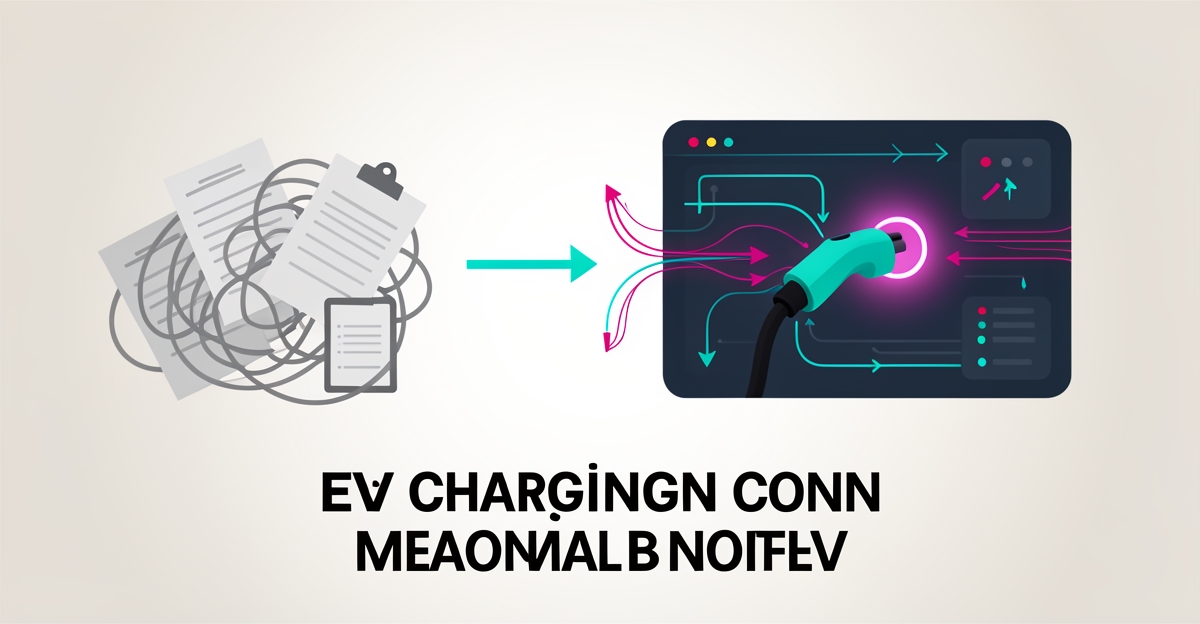
From Manual to AI: Transforming EV Charger Service Workflows with Automation
Key Facts
- Home service businesses commonly reclaim 20 or more hours per week by automating repetitive administrative tasks, according to industry commentary on AI-driven workflow optimization
- Many enterprises struggle with AI implementation due to technical complexity, which is why scoping and phasing matter more than tool selection
- AI-powered tools can automate repetitive tasks and save meaningful time in EV charging operations, based on business operations research
- AI can improve customer retention by delivering a more consistent customer experience across every service touchpoint
- AI can help optimize pricing strategies in EV charging by dynamically adjusting prices based on demand and competition
- AI can help identify, select, and manage the best distribution channels for EV charging products or services
- Automating repetitive tasks and streamlining processes delivers compounding time savings across daily operations
Hire a team member that works 24/7 — for less than a part-time wage.
AI receptionists, SDRs, dispatchers and 99+ roles. Trained on your business, fully managed.
Not sure where to start? Ask our AI planner
The Hidden Cost of Manual Workflows in EV Charging Operations
Every time a technician misses a service window because a dispatcher was juggling spreadsheets, or a follow-up call slips through the cracks because someone relied on memory instead of a system, the business pays a price that never appears on an invoice. For EV charging companies still running on manual workflows, these invisible costs compound daily, eroding margins, frustrating customers, and capping growth.
The root problem is that manual scheduling, dispatch, and service follow-ups depend entirely on human bandwidth. As service volume grows, so does the risk of double-bookings, forgotten callbacks, and miscommunication between the office and the field. Industry commentary on AI-driven workflow optimization suggests businesses that adopt automation can often reclaim 20 or more hours per week previously lost to repetitive administrative tasks, time that could otherwise go toward revenue-generating service calls.
The operational bottlenecks tend to cluster in a few predictable areas:
- Technicians dispatched to the wrong site or without the right equipment, triggering costly return visits
- Service follow-ups and customer status updates handled inconsistently, damaging trust and retention
- Scheduling decisions made without real-time data on charger status, location, or priority
- Growing service demand outpacing the team's ability to coordinate manually
These are not edge cases. They represent the daily reality for field service businesses that rely on phone calls, whiteboards, and disconnected spreadsheets to manage complex operations. Research on accelerating workflows with AI confirms that automating repetitive tasks and streamlining processes saves measurable time across daily work routines, a finding that applies directly to the dispatch-and-service cycles EV charging companies run every day.
There is also a scalability ceiling that manual processes impose. A five-person team might manage 30 service calls a week through sheer effort, but doubling that volume without automation means doubling headcount, or accepting declining service quality. Many enterprises hit roadblocks when they try to implement AI on their own, typically because of technical complexity rather than a failure to recognize the problem. The hard part is knowing how to build a system that actually solves it.
That is where purpose-built automation changes the equation. AIQ Labs works with field service and trades businesses to replace fragmented manual workflows with custom, production-grade AI systems, whether that's a managed AI Dispatcher handling scheduling end to end, or a full workflow rebuild for the one process that costs you the most. The goal is eliminating bottlenecks before they cost another customer.
How AI Automation Solves Core EV Charging Service Challenges
Imagine transforming your EV charging service operations from a manual, time-consuming process into a streamlined, efficient machine. AI-powered workflow automation is making this a reality, specifically targeting scheduling, equipment dispatch, and service follow-ups.
According to industry research, AI tools can automate repetitive tasks, streamline processes, and save significant time. For EV charging businesses, this means less manual effort in coordinating service calls and more focus on critical operations.
AI doesn't just automate; it optimizes. By analyzing data, AI can predict maintenance needs, optimize dispatch routes, and even personalize customer follow-ups. This leads to faster service cycles and improved customer satisfaction.
One of the most significant benefits of AI is its ability to reduce manual effort. Industry experts suggest home service businesses, including EV charging services, can often reclaim 20 or more hours per week through automation. That time saving translates directly into cost savings and increased productivity.
AI-driven automation also enhances consistency across service workflows. By standardizing processes and reducing human error, AI ensures that every customer receives the same high level of service. This consistency builds trust and strengthens your brand reputation.
AIQ Labs builds custom AI systems that handle entire service cycles, from initial scheduling to final follow-up. Our solutions are designed to reduce manual effort and increase consistency, allowing you to focus on growing your business.
Here are some specific ways AI automation can transform your EV charging service workflows:
- Automated scheduling and dispatching of technicians
- Predictive maintenance alerts to prevent downtime
- Personalized customer follow-ups based on service history
- Optimized routing for efficient service delivery
By implementing AI-powered workflow automation, EV charging businesses can overcome operational bottlenecks and achieve new levels of efficiency. The result is a more streamlined, consistent, and customer-focused service operation.
Ready to see how AI can reshape your EV charging service workflows? Start the Fit Check, a two-minute assessment at aiqlabs.ai/apply, and then book a free 30-minute strategy call at aiqlabs.ai/book. It's a no-obligation working session to map your biggest bottleneck and identify high-ROI automation opportunities.
Implementing AI Workflow Automation: A Practical Roadmap for EV Charging Providers
Most EV charging providers don't struggle with AI because the technology fails, they struggle because they start in the wrong place. Many enterprises hit roadblocks during implementation due to technical complexity. A structured roadmap changes that outcome entirely.
The first step is a task audit. Map every recurring activity in your service cycle, scheduling technician visits, dispatching equipment, sending post-repair follow-ups, logging work orders. Research on AI tools for business operations confirms that identifying repetitive tasks before selecting any tool is what separates successful deployments from stalled pilots.
Once you've catalogued those tasks, match them against AI capabilities and verify how each option connects to your existing systems. Your scheduling software, CRM, and dispatch platform all need to exchange data cleanly, integration gaps are where most automation projects quietly die.
From there, prioritize ruthlessly. Not every workflow deserves automation on day one. Focus on use cases that combine high volume, clean data, and measurable impact:
- Service scheduling, the highest-frequency touchpoint in most charging operations
- Dispatch coordination, where delays directly cost revenue and customer trust
- Post-service follow-ups, often skipped manually, easily automated, and proven to lift retention
- Work order documentation, repetitive data entry that drains technician hours
Before deploying anything, establish secure, scalable foundations. This means encrypted data pipelines, role-based access controls, and infrastructure that grows with your charger network. Skipping this step creates technical debt that compounds fast.
Industry experts reinforce this sequencing: home service businesses can often reclaim 20 or more hours per week through AI automation, but only when workflows are properly scoped first. Workflow acceleration research shows that automating repetitive tasks and streamlining processes delivers compounding time savings across daily operations.
For EV charging providers ready to move beyond theory, the deployment model matters as much as the technology. AIQ Labs offers three clear entry points: an AI Dispatcher as a managed AI employee, a fixed-price workflow build targeting the one workflow that costs you the most, or a full AI Operating System built in phases and owned outright. Every engagement follows the same phased process, discovery and architecture, then development and integration, followed by deployment and ongoing optimization, so you get production-grade systems that eliminate bottlenecks, not add new ones.
The providers seeing real returns aren't the ones chasing every AI trend. They're the ones who audited their workflows, picked the right entry point, and built on foundations designed to last.
Still paying for 10+ subscriptions that don’t talk to each other?
We build custom AI systems you own outright. No vendor lock-in. Full control.
Not sure where to start? Ask our AI planner
Frequently Asked Questions
How much time can AI automation save for EV charging service teams each week?
What are the most common operational bottlenecks in EV charger service workflows?
Why do so many enterprises struggle with AI implementation, and how can EV charging providers avoid this?
Which EV charging service workflows should be automated first for the highest impact?
How does AI improve customer retention in EV charging services?
Can AI help optimize pricing strategies for EV charging services?
Key Takeaways
Turning Service Bottlenecks into Strategic Advantage. EV charging businesses stuck in manual workflows face hidden costs: missed appointments, inconsistent follow-ups, and scalability limits that erode margins and customer trust. AI automation solves these pain points by standardizing scheduling, dispatch, and follow-ups, and the right entry point depends on your stage: an AI Dispatcher to handle scheduling end to end, a fixed-price workflow build for your costliest process, or a full AI Operating System owned outright. Start with the 2-minute Fit Check, then book a free 30-minute strategy call at aiqlabs.ai/book to map your biggest bottleneck.
Make AI your competitive advantage — not just another tool.
Strategy, implementation and ongoing optimization. One partner, end to end.
Not sure where to start? Ask our AI planner