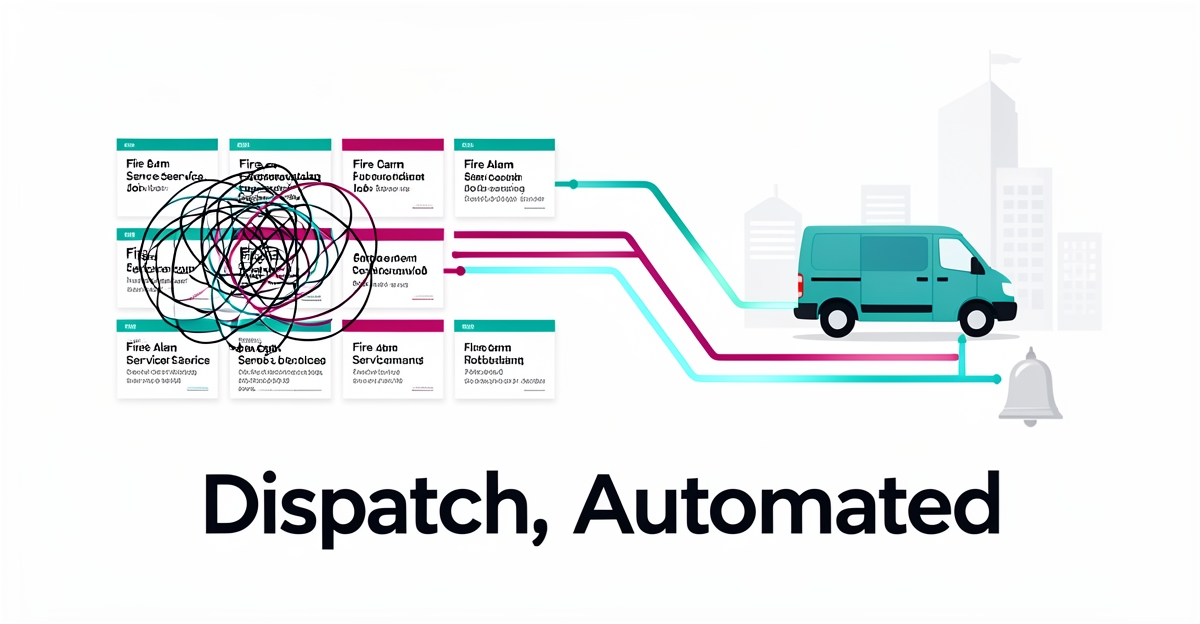
From Manual to AI: Transforming Fire Alarm Job Dispatching with Automated Scheduling
Key Facts
- AI-powered scheduling eliminates double-booking by matching technician skills and certifications to job requirements algorithmically
- Companies typically lose significant administrative hours to resolving manual scheduling conflicts instead of focusing on customer engagement and preventive maintenance planning
- AI dispatch systems can provide real-time customer updates and technician ETAs, reducing inbound status calls
- Predictive capacity planning forecasts workload from historical patterns, preventing overcommitment before scheduling conflicts occur
- Skipping a baseline assessment often leads teams to automate the wrong bottleneck, leaving core inefficiencies untouched
- Phased rollouts are generally safer than immediate full deployment in safety-critical dispatch environments
- Human dispatchers transition from manual assignment to exception management and strategic oversight when AI handles routine scheduling
Hire a team member that works 24/7 — for less than a part-time wage.
AI receptionists, SDRs, dispatchers and 99+ roles. Trained on your business, fully managed.
Not sure where to start? Ask our AI planner
The Hidden Costs of Manual Fire Alarm Dispatching
Manual fire alarm dispatching creates hidden costs that undermine operational efficiency and customer trust. Traditional scheduling methods rely heavily on human coordination, leading to frequent scheduling conflicts and inefficient technician routing. These bottlenecks increase response times and administrative overhead, preventing fire safety companies from scaling effectively. In an industry where delays can have serious consequences, these inefficiencies directly impact service reliability and satisfaction.
Human error in manual dispatching often results in double-booked technicians or missed appointments, disrupting workflow and delaying critical fire safety responses. Without real-time visibility into technician availability and location, companies struggle to optimize routes, leading to unnecessary travel time and fuel costs. Administrative staff spend excessive time resolving scheduling conflicts and managing last-minute changes, diverting focus from higher-value tasks like customer engagement and preventive maintenance planning. This operational drag limits the ability to handle increased job volumes without proportional staffing growth.
The cumulative effect of these inefficiencies erodes customer confidence, particularly when delayed responses occur during urgent fire alarm inspections or repairs. Customers expect timely, reliable service, and repeated scheduling failures damage long-term relationships and referral potential. As demand for fire safety services grows, companies dependent on manual dispatching find themselves unable to meet expectations without sacrificing quality or overburdening teams. Addressing these hidden costs requires moving beyond spreadsheets and phone calls toward intelligent automation that aligns technician capacity with job demands in real time. For fire safety providers seeking to eliminate these operational constraints, AIQ Labs offers AI Workflow Builds that rebuild your dispatch workflow at a fixed price, integrating with existing job management systems to reduce errors, optimize routing, and free teams to focus on delivering timely, life-saving service. To explore how AI transformation can resolve your specific dispatching challenges, start the two-minute Fit Check at https://aiqlabs.ai/apply, then book a free 30-minute strategy call to map your biggest bottlenecks and identify high-ROI automation opportunities.
How AI Transforms Dispatch Operations: Efficiency, Accuracy, and Customer Experience
Manual dispatching in fire alarm services leaves capacity on the table and customers waiting for answers. AI changes that by turning historical job data into clear, actionable scheduling decisions.
AI-powered scheduling improves efficiency by analyzing data and optimizing assignments across technicians and routes. Automated systems typically reduce the time spent on manual scheduling, producing faster job starts and fewer idle hours for field teams.
Accuracy rises when algorithms eliminate double-booking and match skills to requirements. AI can minimize errors and conflicts in scheduling, and predictive capacity planning forecasts workload from historical patterns, preventing overcommitment before it happens.
Customer experience improves through real-time updates and transparent communication. AI systems can provide real-time updates and notifications, improving communication with customers. Customers see confirmed windows, technician ETA, and status changes without calling the office.
The core benefits of AI-powered dispatch operations include:
- Algorithmic optimization that eliminates double-booking and balances daily workload
- Predictive capacity planning that matches technician skills and certifications to job requirements
- Real-time updates that keep customers informed and reduce inbound status calls
- Historical data analysis that forecasts demand and prevents scheduling conflicts before they occur
These capabilities are delivered through AI Workflow Builds that integrate with existing job management software and field tools. AIQ Labs designs production-grade workflow automation that assigns jobs, predicts technician capacity, and avoids scheduling conflicts as part of a step-by-step dispatch transformation, built in milestones, at a fixed price, so you always know what you're paying for.
Firms adopting these systems typically report improved efficiency, fewer errors, and stronger customer satisfaction as core outcomes. The shift moves dispatch from reactive juggling to proactive orchestration, with data driving every assignment decision.
With the right architecture, automated scheduling becomes a competitive advantage rather than an operational risk.
Navigating the Transition: Security, Skills, and Workforce Integration
Navigating the transition to AI-powered fire alarm job dispatching requires addressing core operational and human factors that determine long-term success. Data security remains a paramount concern, as AI systems process sensitive customer information including property details, emergency contacts, and service histories. Implementing robust encryption protocols, role-based access controls, and regular security audits is essential to mitigate cyber threats and maintain trust, particularly given the regulated nature of life-safety services. Organizations must ensure their AI partners adhere to industry-standard data protection frameworks to safeguard against breaches that could compromise both privacy and system integrity.
Equally critical is the reskilling of existing dispatch staff into supervisory and exception-management roles rather than viewing AI as a replacement. Dispatchers possess invaluable contextual knowledge about technician capabilities, geographic nuances, and customer histories that AI alone cannot replicate. By transitioning these employees into roles focused on monitoring AI performance, handling complex escalations, and refining system inputs, companies preserve institutional wisdom while enhancing human-AI collaboration. This approach not only alleviates fears of job displacement but also elevates workforce value by shifting focus from routine scheduling to strategic oversight and continuous improvement. For teams short on dispatch capacity, AIQ Labs also offers AI Employees, managed AI staff such as dispatchers and receptionists that work alongside your human team at a fraction of the cost of a hire.
Technical integration with existing job management platforms demands careful planning to avoid operational disruption. Successful implementation requires APIs that enable seamless data exchange between AI scheduling engines and current systems for work orders, technician availability, and customer records. Prioritizing compatibility with widely used field service software ensures minimal retraining and maintains continuity during the transition. AIQ Labs emphasizes this interoperability as a foundational element of every build, ensuring custom solutions enhance rather than replace existing technology investments. By addressing security, workforce evolution, and technical compatibility in tandem, fire alarm service providers can adopt AI scheduling with confidence, maintaining service reliability while unlocking greater efficiency and responsiveness.
Implementing Automated Scheduling: A Step-by-Step Framework
Moving from manual dispatch boards to AI-driven scheduling is a structured transformation, not a flip of a switch. The companies that succeed treat it as a phased operational rebuild rather than a software install.
Before any automation, map every step of your existing process, how jobs come in, who assigns them, how conflicts get resolved, and where delays happen. Document the time your team spends on phone calls, spreadsheets, and last-minute reshuffles. This baseline becomes the benchmark against which you measure every improvement.
Teams that skip this assessment phase often deploy AI systems that automate the wrong bottlenecks, leaving core inefficiencies untouched.
Automated scheduling only works when the AI can see real-time data, technician locations, job statuses, customer histories, and equipment requirements. That means deep, two-way integration with your job management platform, CRM, and communication tools. AIQ Labs builds these connections using production-grade API integrations rather than surface-level connectors, so the system operates on live operational data rather than stale exports.
A phased rollout minimizes disruption and builds team confidence. Start with a single function, then expand as each phase proves stable:
- Phase 1: Automate job assignment based on technician availability, skill set, and proximity.
- Phase 2: Add predictive capacity planning so the system anticipates demand spikes and adjusts schedules proactively.
- Phase 3: Enable real-time conflict resolution, when a job runs long or a technician calls out, the system reshuffles assignments instantly.
- Phase 4: Layer in customer-facing notifications so clients receive automatic arrival windows and status updates.
Phased adoption is widely recommended in safety-critical dispatch environments because it reduces errors during transition periods and improves long-term system reliability.
AI dispatching does not eliminate human judgment, it redirects it. Dispatchers shift from manually assigning jobs to overseeing exceptions, handling complex scenarios, and managing customer relationships. Define clear escalation rules: which decisions the AI handles autonomously and which require human approval. This human-in-the-loop framework is especially critical in fire alarm work, where regulatory compliance and life safety standards leave no room for unverified automation.
Track metrics that tie directly to business outcomes, administrative hours saved, jobs completed per technician per day, scheduling conflict frequency, and customer satisfaction scores. AI-powered systems improve over time as they accumulate operational data, so the ROI compounds. Organizations that commit to ongoing optimization rather than treating deployment as the finish line consistently see the strongest returns.
The path from manual to automated dispatch is methodical. Each step builds on the last, and the result is a scheduling operation that runs faster, makes fewer errors, and frees your team to focus on the work that actually requires a human. For providers ready to go beyond a single workflow, AIQ Labs also builds AI Operating Systems, one connected operating layer for your entire business, built in phases and owned outright.
Still paying for 10+ subscriptions that don’t talk to each other?
We build custom AI systems you own outright. No vendor lock-in. Full control.
Not sure where to start? Ask our AI planner
Frequently Asked Questions
How does manual fire alarm dispatching hurt my business?
What does AI actually change about dispatch operations?
Will AI replace my dispatchers?
How do we keep customer data safe with AI dispatch?
Can AI dispatch integrate with the job management software we already use?
What does a phased rollout look like for fire alarm dispatch?
From Reactive Dispatch to Proactive Command
Fire alarm service providers stand at a crossroads where manual scheduling no longer meets the demands of modern operations or customer expectations. The shift to AI-driven dispatch isn't merely about replacing spreadsheets with algorithms, it's about transforming your entire operational rhythm from reactive scrambling to proactive orchestration. By implementing automated scheduling that integrates seamlessly with existing job management systems, companies eliminate double-bookings, optimize technician routes, and deliver the real-time transparency that builds lasting customer trust. The path forward requires careful attention to security protocols, workforce evolution, and phased implementation that respects the life-safety nature of your work. AIQ Labs builds these production-grade automation systems in milestones at a fixed price, and you own what gets built outright, so your dispatch operation scales without sacrificing reliability or compliance. Ready to map your specific bottlenecks and identify high-ROI automation opportunities? Start the two-minute Fit Check at https://aiqlabs.ai/apply, then book a free 30-minute strategy call with an AI engineer who understands the unique demands of fire alarm service operations.
Make AI your competitive advantage — not just another tool.
Strategy, implementation and ongoing optimization. One partner, end to end.
Not sure where to start? Ask our AI planner