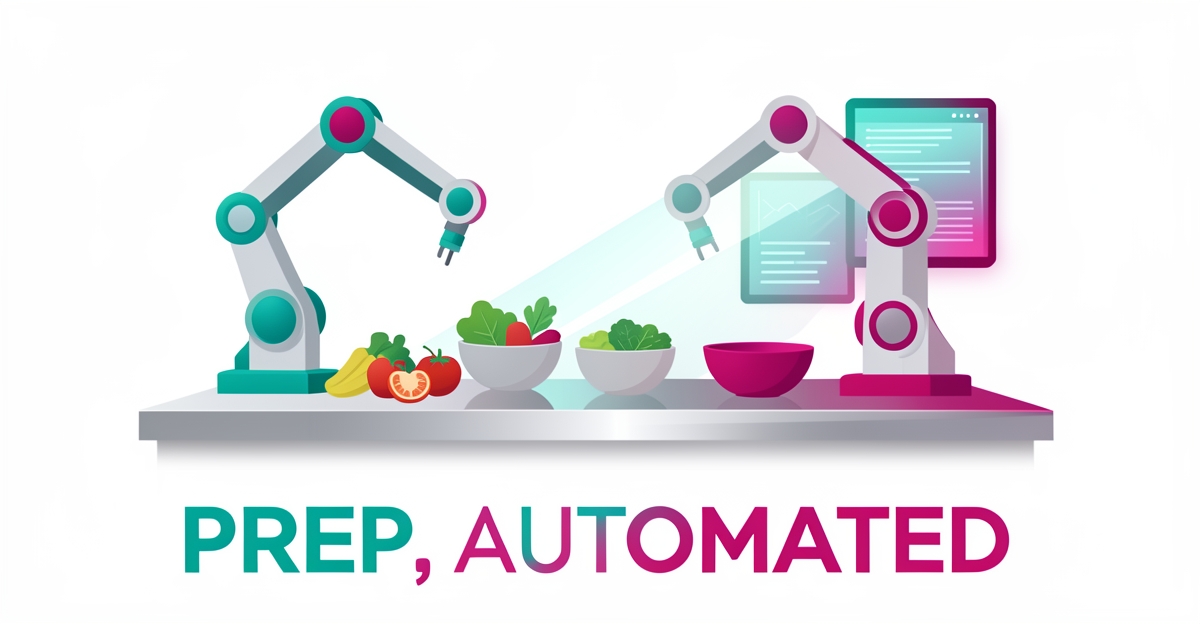
From Manual to AI: Transforming Food Prep Workflows in Fast-Casual Chains
Key Facts
- A large majority of food and beverage manufacturers use automation to address labor shortages, according to CRB's industry research
- Roughly 30% of food and drink is wasted annually in the U.S., representing tens of billions in lost value per CRB research
- Around 70% of food and beverage manufacturers cite productivity as the top benefit of automation based on CRB's study
- Nearly half of capital expenditure in the food and beverage industry is focused on automation projects per industry research
- AI-powered portioning systems reduce human error and improve consistency in ingredient prep as shown in CRB findings
- Predictive inventory management using AI minimizes spoilage by aligning orders with actual demand per CRB research
- A significant share of food and beverage manufacturers leverage automation to respond to market trends and demand shifts according to CRB data
Hire a team member that works 24/7 — for less than a part-time wage.
AI receptionists, SDRs, dispatchers and 99+ roles. Trained on your business, fully managed.
Not sure where to start? Ask our AI planner
The Hidden Cost of Manual Food Prep in Fast-Casual Operations
Every morning in fast-casual kitchens across the country, teams spend hours on repetitive prep tasks, chopping, portioning, weighing, and tracking inventory by hand. This manual approach isn't just slow; it's quietly eroding profit margins through labor inefficiency, inconsistent portions, and preventable waste.
The labor challenge is particularly acute. According to CRB's food and beverage industry research, roughly 78% of food manufacturers use automation specifically to address labor shortages. Fast-casual operations face the same pressure: prep work is repetitive, physically demanding, and difficult to staff consistently. When experienced prep cooks leave, training replacements takes weeks, and portioning consistency suffers in the interim.
The waste problem compounds these labor costs. Research from the same CRB study indicates that roughly 30% of food and drink is thrown away annually in the U.S., representing an estimated $48.3 billion in lost value. In manual prep environments, over-portioning, spoilage from poor inventory rotation, and trimming waste all contribute to this figure. Without precise portioning systems and real-time inventory tracking, kitchens operate on guesswork rather than data.
Manual workflows introduce several operational vulnerabilities:
- Inconsistent portioning: Hand-portioned ingredients vary by worker, shift, and even time of day, affecting food costs and customer experience
- Limited scalability: Adding menu items or locations requires proportional increases in prep labor, constraining growth
- Inventory blind spots: Manual counts and spreadsheets can't predict demand patterns, leading to over-ordering or stockouts
- Quality control gaps: Visual inspection alone misses early signs of spoilage or contamination
The productivity gap is significant. The CRB research found that around 70% of food and beverage manufacturers cite productivity as the top benefit of automation. For fast-casual chains operating on thin margins, the difference between manual and automated prep workflows can determine whether a location is profitable or struggling.
These challenges explain why AI-driven workflow automation is gaining traction in food service. AIQ Labs works with restaurant operators to identify which prep bottlenecks deliver the highest ROI when automated, whether that's portioning consistency, inventory forecasting, or prep scheduling. The goal isn't to eliminate kitchen staff but to redirect their expertise toward tasks that genuinely require human judgment while systems handle repetitive precision work.
The hidden costs of manual prep are measurable, significant, and increasingly avoidable.
How AI-Driven Automation Solves Core Food Prep Pain Points
Imagine a kitchen where ingredient prep is precise, portions are consistent, and inventory alerts prevent costly spoilage before it happens. AI-driven automation is turning this into reality for fast-casual chains, transforming manual workflows into streamlined, error-resistant operations.
One of the most impactful ways AI addresses food prep pain points is through automated ingredient cutting and portioning. According to industry research, around 70% of food and beverage manufacturers cite productivity as the top benefit of automation. AI-powered systems can handle repetitive tasks like slicing vegetables or portioning proteins with consistent speed and accuracy, reducing human error and freeing up staff for higher-value tasks.
Inventory management is another critical area where AI delivers. By analyzing demand patterns and historical data, AI systems enable predictive inventory management, helping restaurants reduce spoilage and optimize ordering. This is especially vital in an industry where, as industry findings suggest, roughly 30% of food and drink is thrown away annually in the US. AI-driven alerts can notify managers when stock levels are low or when ingredients are nearing expiration, ensuring nothing goes to waste.
Here are three key ways AI-driven automation solves core food prep pain points:
- Enhanced Efficiency: Automating ingredient prep and portioning speeds up workflows, allowing kitchens to serve more customers without compromising quality.
- Reduced Waste: Predictive inventory management minimizes spoilage by aligning orders with actual demand, cutting costs and supporting sustainability goals.
- Labor Optimization: With most manufacturers leveraging automation to address labor shortages, AI helps kitchens operate smoothly even with limited staff.
AIQ Labs builds production-ready AI workflows that integrate with kitchen operations. If one prep workflow is costing you the most, portioning, inventory, or prep scheduling, a Workflow Build rebuilds it at a fixed price, in phases. For chains ready to connect everything into one operating layer, AI Operating Systems are built the same way: in milestones, owned outright.
Ready to see how AI can transform your food prep workflows? Start the Fit Check today, a 2-minute assessment that surfaces the highest-ROI opportunities in your kitchen.
Implementation Roadmap: From Pilot to Production-Ready AI Workflows
Fast-casual kitchens are moving from manual prep to owned AI workflows because labor shortages and waste are compounding. With industry research showing most food and beverage manufacturers leveraging automation to address labor shortages, a structured rollout reduces risk.
Start with a focused needs assessment. Map high-touch prep tasks like portioning, chopping and inventory checks, then define measurable goals for speed, consistency and waste reduction. This clarity prevents pilot creep and aligns kitchen staff with outcomes.
A pilot should target one workflow, not the whole line. For ingredient portioning, a small-scale test with a single station validates accuracy, throughput and staff interaction. Pilots prove feasibility before capital is scaled, which matters in a sector where nearly half of capital expenditure is focused on automation projects.
Integration is the make-or-break step. AI prep systems connect to existing kitchen tools to sync with inventory, POS and scheduling. Two-way API integration creates a single source of truth and eliminates the manual re-entry that drives errors.
Training and change management follow deployment. Staff learn to supervise the system, handle exceptions and interpret real-time alerts. Workforce adaptation is essential as teams shift from repetitive prep to quality control and customer-facing roles.
Scale only after metrics are stable. Expand from pilot station to multiple locations, add predictive inventory alerts and refine portioning models with live data. Continuous monitoring keeps performance aligned with service standards.
A practical implementation roadmap for fast-casual chains typically follows:
- Assess current prep bottlenecks and define ROI targets for efficiency and waste reduction
- Pilot AI portioning and inventory alerts on one station with integrated kitchen tools
- Train crew on operation, exception handling and daily monitoring routines
- Measure throughput, consistency and food waste, then optimize models
- Scale production-ready workflows across locations with owned systems and no vendor lock-in
Production-ready ownership matters. True ownership of custom-built systems lets chains control customization and future development without subscription churn. AIQ Labs builds these workflows as owned assets, not rented software, pay to build in milestones, then own it outright. See the payment models for how the phases work.
When automation is applied to prep and inventory, the impact compounds. With roughly 70% of manufacturers seeing productivity as the top benefit of automation, consistent portioning reduces overuse and supports food safety. Fewer manual touches also help address the fact that roughly 30% of food and drink is thrown away annually in the US.
Start the Fit Check, it takes 2 minutes, and book a free 30-minute strategy call to map your biggest prep bottleneck and identify high-ROI automation opportunities.
Still paying for 10+ subscriptions that don’t talk to each other?
We build custom AI systems you own outright. No vendor lock-in. Full control.
Not sure where to start? Ask our AI planner
Frequently Asked Questions
How much waste does manual food prep actually create for fast-casual chains?
Is AI automation really about solving labor shortages or just cutting staff?
What's the biggest operational benefit restaurants see from automating prep?
Can AI inventory management actually reduce spoilage?
How much are food companies investing in automation right now?
Do I need to automate my whole kitchen at once?
From Cost Center to Competitive Edge
Manual prep is quietly draining fast-casual margins through inconsistent portions, labor churn, and preventable waste. Industry research is clear: most food and beverage manufacturers now use automation to address labor shortages, roughly 70% cite productivity as the top benefit, and roughly 30% of food and drink is thrown away annually in the U.S., representing an estimated $48.3 billion in lost value. AI-driven automation flips that equation by delivering precise portioning, predictive inventory alerts, and prep scheduling that frees your team for quality control and guest experience instead of repetitive tasks. A focused roadmap, assess bottlenecks, pilot one station, integrate with POS and inventory via API, train for exception handling, then scale, turns risk into measurable ROI without vendor lock-in. AIQ Labs builds production-ready, owned AI workflows that integrate with kitchen operations and reduce human error, so you keep control of customization and future development. Start the Fit Check, it takes 2 minutes, then book a free 30-minute strategy call to map your biggest prep bottleneck and identify high-ROI automation opportunities.
Make AI your competitive advantage — not just another tool.
Strategy, implementation and ongoing optimization. One partner, end to end.
Not sure where to start? Ask our AI planner