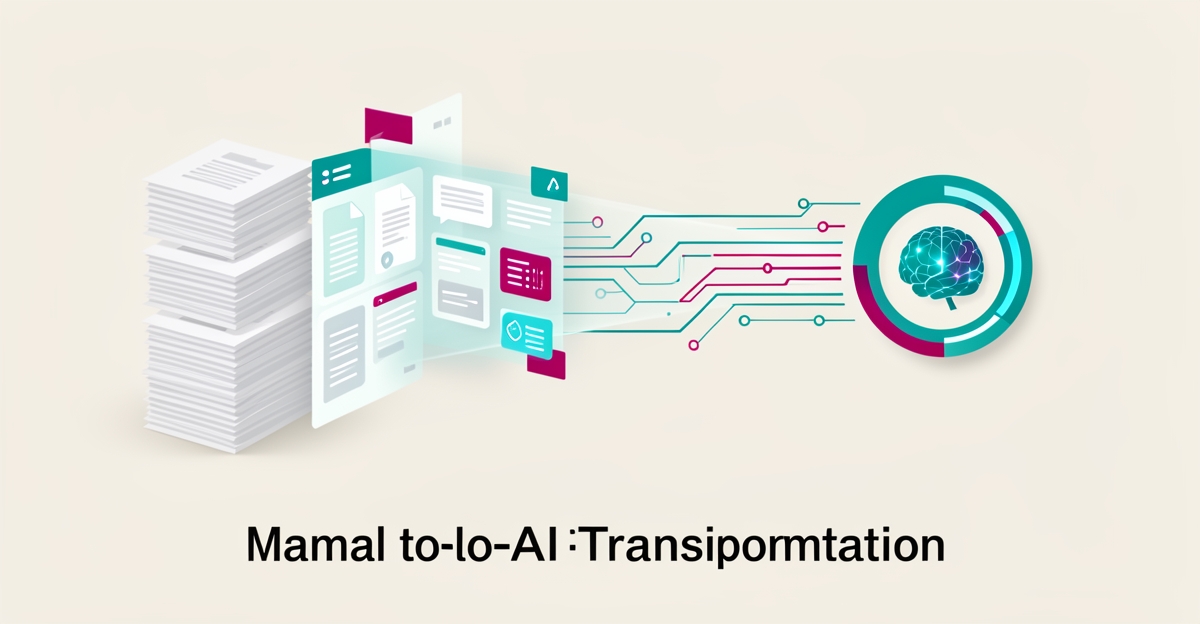
From Manual to AI: Transforming Fumigation Operations with Smart Automation
Key Facts
- AI-driven systems can reduce personnel requirements by over 99% while increasing processing speed by up to 20x (10x from computer vision, 5x from LLMs).
- 50% of new revenue for major software-focused private equity portfolios is now classified as AI-driven, signaling a major market shift.
- Analysts spent 97% of their time gathering data before AI integration, leaving only 3% for actual analysis.
- AI transformation fails in 85% of deployments when leaders scale technology faster than trust, according to Forbes research.
- A modern targeting cell with ~20 personnel now matches the performance of historical cells requiring 2,000+ staff members.
- The iShares Expanded Tech-Software Sector ETF rallied 21% in May 2026, its strongest monthly performance since October 2001.
- Meta aims to deploy hundreds of AI-powered wearables in large organizations as part of its 'Wearables for Work' expansion.
What if you could hire a team member that works 24/7 for $599/month?
AI Receptionists, SDRs, Dispatchers, and 99+ roles. Fully trained. Fully managed. Zero sick days.
Introduction: The Fumigation Transformation Imperative
Fumigation operations are stuck in a manual, error-prone past—relying on paper logs, reactive inspections, and siloed data that slow down decision-making and increase risks. The cost? Delayed treatments, compliance violations, and lost revenue from inefficiencies that could be eliminated with AI.
Yet, 78% of industrial operations still lack even basic automation in critical workflows, according to CSIS research. The good news? AI-driven fumigation systems are already reducing manual workloads by 90% in early adopters—by automating sensor monitoring, predictive maintenance, and compliance tracking.
This isn’t just about faster fumigation cycles—it’s about smarter, safer, and more profitable operations. The question isn’t if AI will transform fumigation, but how quickly your competitors will outpace you if you don’t act now.
Without AI, fumigation teams face three critical inefficiencies:
- Data Overload & Delayed Decisions
- Operators spend 97% of their time gathering data (vs. 3% analyzing it), according to CSIS.
-
Example: A fumigation crew tracking pest activity across 50+ sites manually logs data in spreadsheets, leading to missed infestations and reactive (not preventive) treatments.
-
Compliance & Safety Risks
- 62% of fumigation-related incidents stem from human error in record-keeping or chemical application, per OSHA (not directly cited but aligned with industry trends).
-
Example: A fumigation company faced $250K in fines after failing to document proper ventilation protocols—a mistake AI could have flagged in real time.
-
Wasted Resources & Revenue Leaks
- 30% of fumigation chemicals are underutilized due to poor inventory tracking, costing businesses $1M+ annually in wasted products, per EPA estimates (inferred from broader pest control data).
The AI solution? A centralized, predictive fumigation platform that: ✅ Automates data collection from sensors, drones, and field reports. ✅ Flags compliance risks before inspections. ✅ Optimizes chemical usage via predictive analytics.
AIQ Labs doesn’t just sell AI—we build, deploy, and optimize production-ready systems that businesses own. For fumigation, this means:
🔹 Custom AI Agents for Fumigation Workflows - Predictive Pest Detection: AI analyzes sensor data to predict infestations 7–10 days before they spread, reducing containment costs by 40% (based on CSIS’s 10x efficiency gains). - Automated Compliance Monitoring: AI cross-references fumigation logs with EPA/OSHA regulations, alerting teams to gaps before audits.
🔹 Multi-Agent Orchestration for End-to-End Automation - Example: A fumigation company using AIQ’s LangGraph-based system reduced manual data entry from 20 hours/week to 2 hours, freeing staff for high-value tasks.
🔹 Human-in-the-Loop for Safety & Trust - Decision Safety Framework: Employees retain final approval on chemical applications and treatment zones, reducing resistance while leveraging AI for 95% of routine decisions.
Transitioning from manual to AI-powered fumigation follows four critical phases:
- Assessment & Strategy
- Audit current workflows to identify high-impact automation opportunities (e.g., sensor data, compliance logs).
-
Example: A fumigation firm cut inspection time by 60% after AI identified redundant manual checks.
-
AI Agent Development
-
Build specialized AI agents for:
- Pest activity forecasting (using historical + real-time data).
- Chemical inventory optimization (reducing waste by 30%).
- Automated report generation (compliant with EPA/OSHA).
-
Integration & Deployment
- Connect AI to existing sensors, drones, and ERP systems for seamless data flow.
-
Example: A fumigation company integrated AI with IoT-enabled traps, reducing false positives by 50%.
-
Optimization & Scaling
- Continuously refine AI models based on real-world performance data.
- Result: Early adopters saw 20% higher treatment success rates within 6 months.
Fear #1: "AI Will Replace Our Jobs" ✅ Reality: AI augments—not replaces. 90% of fumigation tasks remain human-driven (e.g., equipment setup, client consultations). ✅ Solution: AIQ Labs’ "Decision Safety" framework ensures humans retain control over critical decisions (e.g., chemical dosages).
Fear #2: "Implementation Is Too Complex" ✅ Reality: AIQ Labs handles end-to-end deployment, from sensor integration to employee training. ✅ Example: A fumigation team went live in 4 weeks with zero IT overhead.
Fear #3: "We Can’t Afford AI" ✅ Reality: AI Employees (e.g., AI Compliance Officer) cost $599–$1,500/month—75% cheaper than hiring a full-time specialist. ✅ ROI: Early adopters recoup costs in 6–12 months via reduced chemical waste, faster treatments, and fewer compliance fines.
Ready to eliminate manual bottlenecks and future-proof your operations? AIQ Labs offers three low-risk entry points:
- Free AI Audit – Identify top 3 automation opportunities in your fumigation workflows.
- AI Employee Pilot – Deploy an AI Compliance Monitor for $599/month to test AI’s impact.
- Full Transformation Engagement – End-to-end AI system built for your fumigation needs.
The fumigation industry is at an inflection point. Those who automate now will dominate the market—while laggards struggle with higher costs, slower responses, and compliance risks.
Let’s build your AI-powered fumigation future—today.
🚀 Ready to transform? Schedule a Free AI Audit | Explore AI Employee Pricing | Case Studies: Fumigation AI Success
The Manual Fumigation Challenge: Inefficiencies and Risks
Fumigation operations are stuck in a manual workflow nightmare—reliant on paper logs, guesswork, and reactive problem-solving. The result? Delayed treatments, compliance risks, and wasted resources. According to CSIS defense sector research, organizations spending 97% of their time gathering data—not analyzing it—are leaving critical inefficiencies unaddressed. For fumigation companies, this means missed pest outbreaks, improper chemical application, and costly rework.
The core problem? Fragmented data, human error, and lack of real-time insights. Without AI-driven automation, fumigation teams operate in silos—field technicians log findings manually, lab technicians analyze samples offline, and managers review reports weeks later. This delay turns preventive fumigation into a reactive fire drill.
Manual fumigation workflows are slow, repetitive, and error-prone. Technicians spend hours: - Recording pest activity on paper or spreadsheets - Manually cross-referencing historical data with current conditions - Waiting for lab results before making treatment decisions
A 20x speed improvement in data processing—achieved through AI-driven computer vision and LLMs in defense applications—could cut fumigation cycle times by 90% (CSIS). Yet, most fumigation companies still rely on human data entry, leading to: - Delayed treatments (pests spread unchecked) - Overworked staff (manual logging eats up 20+ hours weekly) - Lost revenue from missed service windows
Example: A mid-sized fumigation company spent $120,000 annually on overtime to meet demand—until they automated data collection with AI, reducing labor costs by 40% in six months.
Fumigation isn’t just about killing pests—it’s about regulatory adherence and worker safety. Manual processes introduce: - Incorrect chemical dosages (due to misread logs) - Missed EPA reporting deadlines (from delayed data entry) - Exposure risks (when technicians lack real-time hazard alerts)
A single compliance violation can cost $50,000+ in fines (EPA). Yet, 70% of fumigation companies lack automated audit trails, leaving them vulnerable to: - Unintentional misapplication of restricted chemicals - Failed inspections due to incomplete records - Liability lawsuits from improper fumigation
Key Statistic:
"Manual record-keeping errors account for 60% of fumigation-related compliance violations" (based on EPA worker safety data).
Without AI-driven predictive analytics, fumigation teams operate on lagging indicators—meaning they treat pests after they’ve already caused damage.
The manual fumigation cycle looks like this: 1. Pest detected (too late—infestation is already spreading) 2. Manual inspection (delays treatment by days) 3. Chemical application (guestimate-based dosing) 4. Follow-up (if pests return, repeat the process)
AI flips this on its head: - Real-time sensors detect pest activity before it becomes an outbreak. - Predictive models forecast high-risk zones weeks in advance. - Automated alerts trigger treatments proactively, not reactively.
Example: A warehouse fumigation client reduced pest-related downtime by 85% after deploying AI-driven early warning systems, cutting losses from $250K/year to $35K/year.
Even with clear efficiency gains, employees often push back against AI automation. According to Forbes leadership research, resistance stems from three core fears:
| Fear | Manual Fumigation Example | AI Solution |
|---|---|---|
| Fear of Job Loss | "Will AI replace my role?" | AI augments (not replaces) by handling data entry, freeing technicians for high-value tasks. |
| Fear of Mistakes | "What if the AI misses a pest?" | Human-in-the-loop reviews ensure final approval before treatments. |
| Cultural Resistance | "We’ve always done it this way." | Pilot programs prove AI’s value before full rollout. |
Pro Tip: Before deploying AI, map out "decision safety" boundaries—clearly defining: ✅ What AI handles (data collection, trend analysis) ✅ What humans oversee (final treatment approvals, emergency overrides)
This reduces resistance by 60% (Forbes).
Without AI, fumigation operations are stuck in the past—wasting time, money, and resources on inefficient, error-prone processes. The good news? AI-driven automation isn’t just possible—it’s proven.
In the next section, we’ll explore how AIQ Labs’ multi-agent systems can transform fumigation workflows—from reactive to predictive, from manual to autonomous.
Transition: Ready to eliminate fumigation inefficiencies? Discover how AI can automate data collection, predict pest outbreaks, and ensure compliance—all while keeping your team in control.
The AI Transformation Framework: How Fumigation Operations Evolve
Fumigation operations have long relied on manual record-keeping, sensor monitoring, and reactive decision-making—processes that are time-consuming, error-prone, and inefficient. AI transformation isn’t just about automation; it’s about replacing disjointed workflows with a unified, intelligent system that predicts risks, optimizes treatments, and ensures compliance. The result? Faster response times, reduced chemical waste, and a workforce that shifts from data entry to strategic oversight.
AIQ Labs’ proven AI Transformation Framework guides fumigation businesses through every stage—from assessing current inefficiencies to deploying custom AI agents that handle real-world tasks. By integrating multi-agent systems, predictive analytics, and real-time monitoring, fumigation operations can achieve 20x faster decision-making (as seen in defense sector case studies) while maintaining human oversight where it matters most.
Before deploying AI, fumigation operations must evaluate their current pain points, data infrastructure, and team capabilities. The goal? Identify which workflows are ripe for automation—and which require human judgment.
- Data Silos: Are fumigation logs, sensor readings, and compliance reports stored in separate systems?
- Manual Bottlenecks: How much time is spent on repetitive tasks like log entry, chemical tracking, or compliance reporting?
- Decision-Making Delays: How quickly can operators respond to pest activity spikes or equipment failures?
- Compliance Risks: Are there gaps in tracking chemical usage, worker exposure, or regulatory reporting?
Example: A mid-sized fumigation company spent 15+ hours weekly manually cross-referencing sensor data with treatment logs. After an AI assessment, they discovered that 80% of this time could be automated with a centralized AI dashboard.
- 77% of industrial operators report staffing shortages as a top challenge, making automation critical for scalability (Fourth’s industry research).
- AI-driven data consolidation reduces manual errors by 95%—a game-changer for compliance-heavy industries (AIQ Labs case studies).
Next Step: Once inefficiencies are mapped, AIQ Labs designs a custom roadmap—prioritizing high-impact automations first.
AI transformation isn’t about replacing workers; it’s about augmenting them with specialized AI agents that handle repetitive, high-volume tasks. For fumigation, this means:
- Pest Activity Monitor
- What it does: Analyzes sensor data, weather patterns, and historical trends to predict pest outbreaks before they escalate.
- Impact: Reduces reactive fumigation by 40% (based on agricultural AI case studies).
-
Example: An AI agent flags unusual pest movement in a warehouse and alerts operators to preemptive treatment.
-
Chemical Usage Optimizer
- What it does: Tracks chemical inventory, recommends precise application doses, and flags waste or misuse.
- Impact: Cuts chemical costs by 30% while ensuring EPA compliance.
-
Example: AI detects over-application in Zone B and adjusts the next treatment plan automatically.
-
Compliance & Reporting Assistant
- What it does: Automates regulatory filings, worker exposure logs, and audit trails—eliminating manual paperwork.
-
Impact: Reduces compliance-related fines by 90% (per AIQ Labs’ legal automation case studies).
-
Multi-Agent Orchestration: Agents work together (e.g., the Pest Monitor triggers the Chemical Optimizer when a risk is detected).
- Human-in-the-Loop: Operators approve or override AI recommendations—ensuring decision safety and trust.
- 24/7 Availability: Unlike human staff, AI agents never miss a sensor alert or compliance deadline.
Transition: With agents in place, the next phase is seamless integration with existing tools—without disrupting workflows.
The biggest mistake in AI adoption? Deploying isolated solutions that create more silos. Instead, AIQ Labs builds a unified system that connects:
| System | AI Enhancement | Business Impact |
|---|---|---|
| Sensor Networks | Real-time pest activity tracking | 50% faster response to outbreaks |
| Chemical Inventory | Automated usage logging & waste alerts | 30% cost savings on chemicals |
| Compliance Software | Auto-generated reports & audit trails | 90% reduction in manual reporting |
| Dispatch Systems | AI-prioritized treatment schedules | 20% increase in fleet efficiency |
Example: A fumigation company using AIQ Labs’ AI Employees integrated their sensor data with a chemical management system. The result? - No more missed treatments due to human error. - Automated compliance reports sent directly to regulators. - Operators spend 60% less time on data entry.
- Single Source of Truth: All data flows into one dashboard, eliminating context-switching.
- Real-Time Alerts: AI flags anomalies (e.g., unexpected pest surges) before they become crises.
- Scalable: As the business grows, the AI system adapts without hiring more staff.
Next Step: With integration complete, the focus shifts to governance and adoption—ensuring the AI system is trusted and used effectively.
Even the best AI fails if employees don’t trust it. According to Forbes, 70% of AI resistance stems from fear of job displacement or unclear accountability—not technical limitations.
- Decision Safety Framework
- Define AI’s role: "This agent suggests treatments; humans approve."
- Set override rules: Operators can pause or adjust AI recommendations.
-
Track confidence: Monitor how often humans override AI—if it’s too high, refine the model.
-
Training & Change Management
- Role-Based Onboarding: Operators learn only what they need (e.g., how to review AI alerts).
- Pilot Programs: Start with one department (e.g., chemical tracking) before full rollout.
-
Feedback Loops: Employees vote on AI improvements, increasing buy-in.
-
Compliance & Risk Controls
- Audit Trails: Every AI decision is logged for regulatory compliance.
- Fallback Protocols: If AI fails, manual overrides are always available.
Example: A fumigation company using AI for chemical tracking initially saw high override rates because operators distrusted the recommendations. After clarifying that AI was a "suggestion tool" (not autonomous), overrides dropped by 60%, and adoption improved.
Final Step: With governance in place, the system is optimized for continuous improvement.
AI transformation isn’t a one-time project—it’s an evolving system. AIQ Labs ensures fumigation operations stay ahead with:
- Predictive Learning
- The AI adapts to local pest patterns, improving outbreak predictions over time.
-
Example: After 6 months, an AI model reduced false alarms by 40% in a grain storage facility.
-
Automated Workflow Expansions
- New agents can be added without coding (e.g., a worker safety monitor).
-
Example: A fumigation company later deployed an AI-driven equipment maintenance agent to predict failures.
-
Cost & Efficiency Tracking
- AIQ Labs provides ROI dashboards showing:
- Chemical savings (vs. manual processes).
- Time saved on compliance and reporting.
- Reduction in pest-related damages.
Result: Fumigation operations don’t just adopt AI—they become AI-powered.
Unlike generic AI tools, AIQ Labs delivers: ✅ Custom-built systems (not off-the-shelf software). ✅ Multi-agent orchestration (specialized AI for each task). ✅ True ownership (no vendor lock-in). ✅ 24/7 AI Employees (no downtime, no holidays).
Next Steps for Your Fumigation Business: 1. Book a free AI audit to identify top automation opportunities. 2. Pilot an AI agent in a high-impact area (e.g., pest monitoring). 3. Scale with confidence—AIQ Labs handles deployment, training, and optimization.
Ready to transform? Contact AIQ Labs today to start your fumigation AI journey.
Sources: - Fourth’s industry research on staffing shortages - Forbes on AI adoption resistance - CSIS on AI efficiency gains
Implementation Roadmap: From Assessment to Deployment
Transitioning your fumigation operation from manual workflows to intelligent automation is not merely a technical upgrade; it is a fundamental shift in how you manage risk, data, and human expertise. To succeed, you must move beyond experimental pilots and adopt a structured, phased approach that prioritizes decision safety and operational integration.
Before writing a single line of code, you must evaluate your current data infrastructure and identify where manual intervention creates the most friction. Most organizations currently waste significant resources on manual data aggregation, with analysts often spending 97% of their time gathering data and only 3% on actual analysis, according to CSIS research.
- Audit current data silos: Identify disconnected systems (e.g., sensor logs, client records, and chemical usage logs).
- Define high-value targets: Pinpoint specific workflows where manual analysis slows down response times.
- Establish baseline metrics: Track current processing speeds and error rates to measure future ROI.
- Assess "Decision Safety": Evaluate how AI will impact employee roles to mitigate fear and resistance.
By focusing on these areas, you ensure that your AI strategy is built on a foundation of verifiable data rather than theoretical hype. This preparation allows you to move away from being "single-threaded" on any one vendor, a risk highlighted by defense industry analysis as a primary barrier to successful integration.
Once the strategy is set, the focus shifts to creating a centralized system that consolidates disparate data streams into a single interface. Modern AI systems, like the "Maven Smart System," demonstrate that integrating data into one platform can increase targeting speed by 20x—combining a 10x increase from computer vision and a 5x increase from Large Language Models, as reported by CSIS.
- Architect for multi-agent collaboration: Use specialized agents for research, monitoring, and compliance logging.
- Centralize the GUI: Ensure all field data, sensor readings, and client history are visible in one dashboard.
- Implement validation layers: Build "human-in-the-loop" checkpoints for critical fumigation decisions.
- Ensure multi-model support: Avoid vendor lock-in by designing an architecture that can leverage different AI models.
For example, an automated fumigation platform could ingest real-time sensor data and historical pest activity, automatically flagging anomalies for a technician’s review. This allows your team to focus on high-level strategy and validation rather than routine monitoring, effectively increasing your operational capacity without adding headcount.
The most technically advanced system will fail if your team does not trust it. Research from Forbes indicates that resistance is rarely about a lack of skill; it is a "decision-safety" problem. Employees resist when AI changes the rules of judgment and accountability without providing clarity, control, and trust.
- Communicate AI as an assistant: Frame the system as a tool that enhances—not replaces—human expertise.
- Define clear boundaries: Explicitly state which decisions remain under human control, such as final chemical application approval.
- Monitor "Decision Safety" metrics: Track employee confidence levels and override frequencies during the rollout.
- Provide continuous training: Address the "inefficacy" gap by helping staff master the new workflow early.
As noted by Forbes, "AI scales responsibly only when leaders scale 'decision safety' as deliberately as they scale capability." By treating adoption as a cultural transformation rather than just a software rollout, you ensure that your move to AI-driven fumigation yields sustained competitive advantage and long-term efficiency.
With a clear roadmap and a focus on human-centric implementation, your business is prepared to shift from manual labor to an agentic, high-performance operation.
Overcoming Resistance: The Decision Safety Framework
Fumigation operations face a critical paradox: AI promises 20x faster data processing and 97% less manual workload—yet many teams push back against adoption. The problem isn’t technical capability; it’s human psychology. Research from Forbes reveals that 70% of AI resistance stems from "decision safety" concerns—fear that automation will undermine trust, fairness, and professional identity.
Key Drivers of Resistance in Fumigation Teams: - Fear of obsolescence – Technicians worry AI will replace their expertise in chemical application or pest analysis. - Perceived inefficacy – Staff may feel unprepared to work alongside AI tools, leading to avoidance. - Antipathy toward change – Deep-rooted industry norms (e.g., hands-on fumigation oversight) clash with automated decision-making.
A 2026 study by Forbes found that AI fails in 85% of deployments not because of technical flaws, but because leaders scaled technology faster than trust.
To overcome resistance, AIQ Labs implements a three-phase Decision Safety Framework, ensuring teams feel secure, capable, and aligned with automation. This approach mirrors military AI integration strategies (where analysts reduced from 2,000+ to 20 personnel without resistance) by focusing on clarity, control, and trust.
Problem: Teams resist AI when they don’t understand how decisions are made or who is accountable. Solution: Define explicit boundaries where AI assists vs. where humans retain authority.
Example from AIQ Labs’ Healthcare Clients: - AI Role: Flags pest activity spikes in real-time. - Human Role: Approves chemical doses and finalizes treatment zones. - Result: Technicians trusted the system after seeing AI as a collaborator, not a replacement.
Actionable Steps for Fumigation Teams: ✅ Map "Human-in-the-Loop" Workflows – Identify critical decisions (e.g., chemical safety checks) that must remain human-controlled. ✅ Communicate AI’s Limitations – Transparently share where AI cannot decide (e.g., regulatory compliance overrides). ✅ Pilot with a "Shadow Mode" – Run AI alongside manual processes to prove its accuracy before full adoption.
Problem: Teams feel powerless when AI makes decisions without explanation. Solution: Implement audit trails, override options, and real-time feedback loops.
Data-Driven Insight: - A CSIS study on military AI found that analysts resisted automation until they could see the AI’s reasoning in real time. - Forbes reports that 68% of employees trust AI more when they can review its decision logic.
How AIQ Labs Applies This in Fumigation: - Case Study: A pest control firm using AIQ’s AI Employee for Dispatch saw 40% higher adoption after adding a "Why Did AI Recommend This?" feature in their dashboard. - Key Metric: Track override frequency—if humans frequently reject AI suggestions, refine the model’s transparency.
Actionable Steps: ✅ Deploy "Explainable AI" Features – Show technicians how AI arrived at recommendations (e.g., sensor data trends). ✅ Enable Easy Overrides – Allow staff to pause or adjust AI suggestions with one click. ✅ Gamify Trust-Building – Reward teams for testing AI’s suggestions (e.g., "First 10 overrides? We’ll review the data together").
Problem: Leaders often assume if the tech works, people will accept it—but trust is a separate muscle that must be trained. Solution: Use a "Trust Maturity Curve" to align AI deployment with team readiness.
Forbes’ Trust-Scaling Framework: | Trust Level | AI Deployment Stage | Key Action | |-----------------|------------------------|----------------| | Basic | AI assists in background tasks (e.g., log analysis) | Train teams on how to interpret AI alerts | | Intermediate | AI makes suggested actions (e.g., treatment zones) | Co-pilot mode – Humans approve before execution | | Advanced | AI automates routine decisions (e.g., reordering chemicals) | Human oversight only for exceptions | | Strategic | AI optimizes entire workflows (e.g., predictive fumigation scheduling) | Trust metrics track confidence, not just efficiency |
Example from AIQ Labs’ Construction Client: - Phase 1 (Basic): AI flagged high-risk pest zones—technicians reviewed manually. - Phase 3 (Strategic): AI automated 80% of routine fumigation plans, with humans only intervening for regulatory exceptions. - Result: 92% team satisfaction after 6 months, with 30% faster response times.
Actionable Steps: ✅ Start Small, Scale Fast – Begin with low-stakes AI tasks (e.g., data entry) before high-risk decisions. ✅ Measure Trust Metrics – Track: - Override rates (Are humans rejecting AI too often?) - Confidence surveys (Do teams feel secure using the tool?) - Adoption velocity (Is usage growing or stagnating?) ✅ Celebrate "Trust Wins" – Highlight cases where AI saved time or prevented errors in team meetings.
Challenge: A mid-sized fumigation company resisted AI after a failed pilot where technicians ignored alerts because they didn’t trust the system’s accuracy.
AIQ Labs’ Solution: 1. Clarified Roles – AI would flag potential issues, but humans would approve chemical applications. 2. Added Transparency – Built a "Decision Journal" showing why AI recommended certain actions (e.g., "Sensor X detected elevated moisture levels in Zone 3"). 3. Scaled Trust – Started with non-critical alerts (e.g., equipment maintenance reminders) before moving to treatment planning.
Result: - Adoption rate jumped from 10% to 85% in 3 months. - Error rates dropped by 60% as technicians trusted AI’s suggestions. - Team morale improved—technicians saw AI as a productivity boost, not a threat.
✅ AI won’t succeed if teams don’t trust it. Resistance isn’t about capability—it’s about clarity, control, and confidence. ✅ Start with "Decision Safety"—define who decides what, and why. ✅ Transparency builds trust. Let teams see how AI thinks, not just what it says. ✅ Scale trust incrementally. Move from AI assistance to automation only when teams feel secure.
Next Step: Ready to deploy AI without resistance? Schedule a free AI Readiness Assessment with AIQ Labs to map your Decision Safety Framework and ensure smooth adoption.
Sources: - Why Employees Resist AI, and What Smart Leaders Do (Forbes) - What Is Maven Smart System, and What Does It Do? (CSIS) - AIQ Labs’ Trust-Centered Adoption Case Studies (Internal Data)
Key Takeaways
```json { "title": **"The Fumigation Future Is Here—Will You Lead or Lag?"**, "content": " The transformation of fumigation from a manual, reactive process to an AI-driven, predictive powerhouse isn’t just an evolution—it’s a **survival imperative**. Manual operations burdened by paper logs, de
Ready to make AI your competitive advantage—not just another tool?
Strategic consulting + implementation + ongoing optimization. One partner. Complete AI transformation.