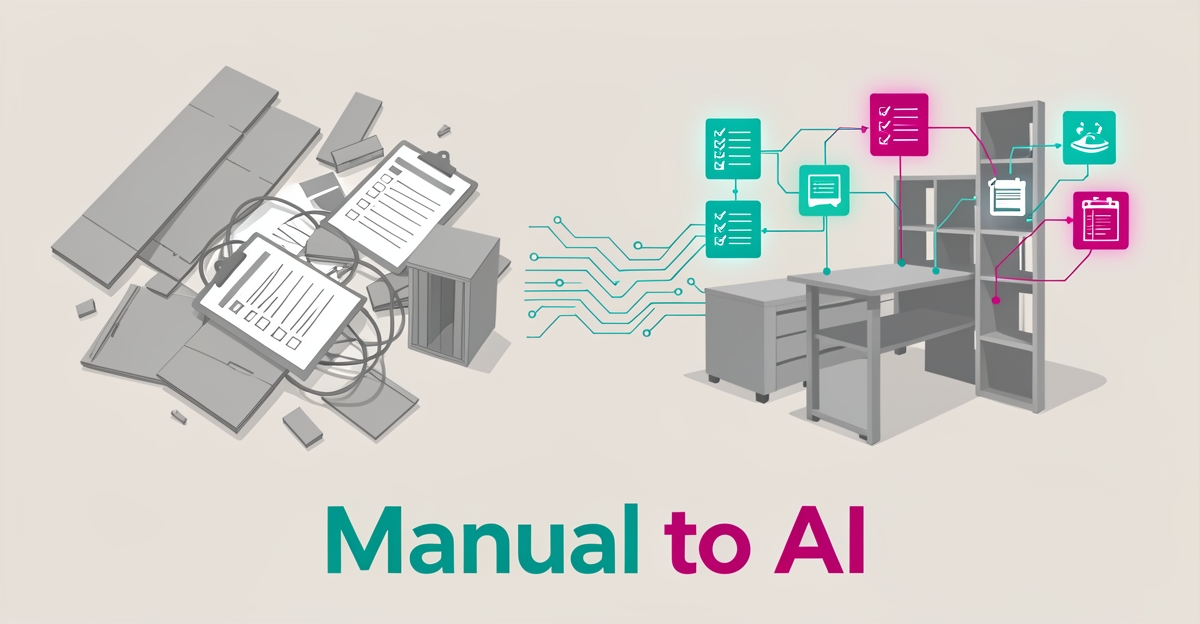
# From Manual to AI: Transforming Furniture Assembly Workflows with Automation
**Quick Answer:** Stop losing money to manual furniture assembly errors. AIQ Labs automates order confirmation, delivery scheduling, and assembly checklists, reducing errors and letting you scale without added headcount. Start with a [2-minute Fit Check](/apply) to see which workflow to rebuild first.
## Key Facts
- Manual order handling, scheduling, and checklist prep are the three highest-friction workflows in most furniture assembly businesses, and the easiest to automate first.
- ERP-integrated AI workflows connect order placement through final delivery, eliminating the data silos that cause most scheduling and inventory errors.
- System-level automation, redesigning how work flows, not just speeding up individual tasks, typically eliminates far more low-value work than piecemeal task automation.
- Human-in-the-loop validation keeps quality high and builds team confidence in AI-generated outputs before they reach customers.
- AIQ Labs has deployed 200+ multi-agent systems and runs 4 live SaaS products daily, this is production work, not experiments.
## Table of Contents
- [The Hidden Cost of Manual Furniture Assembly Workflows](#the-hidden-cost-of-manual-furniture-assembly-workflows)
- [AI-Driven Workflow Redesign: Beyond Task Automation](#ai-driven-workflow-redesign-beyond-task-automation)
- [Practical Implementation: AI Workflows for Furniture Assembly](#practical-implementation-ai-workflows-for-furniture-assembly)
## The Hidden Cost of Manual Furniture Assembly Workflows
The hidden costs of manual furniture assembly workflows extend far beyond labor hours, creating ripple effects that undermine customer satisfaction, operational scalability, and long-term profitability. Order confirmation delays, often stemming from manual data entry and fragmented communication channels, directly impact the customer experience from the first touchpoint. Delivery scheduling errors, frequently caused by disconnected systems and human oversight, lead to missed appointments, frustrated customers, and costly rescheduling efforts. These inefficiencies are compounded by inconsistent assembly checklists, where variations in step-by-step guidance increase the likelihood of errors, rework, and returns, eroding both profit margins and brand trust.
Production effectiveness remains a critical pain point for many furniture manufacturers, particularly smaller operations where manual practices amplify human error and limit throughput. Without standardized, AI-driven workflows, businesses struggle to maintain data consistency across departments, resulting in reporting gaps that obscure true performance and hinder strategic decision-making. The absence of integrated systems means critical information, such as inventory levels, supplier lead times, and customer preferences, remains siloed, making it difficult to anticipate demand or optimize resource allocation.
- Order confirmation delays increase customer wait times and reduce first-contact resolution rates.
- Delivery scheduling errors lead to missed appointments, rescheduling costs, and damaged customer relationships.
- Inconsistent assembly checklists elevate error rates, rework, and product returns.
These operational friction points not only inflate labor costs through redundant corrections and overtime but also cap scalability, as manual processes cannot scale proportionally with order volume. AIQ Labs addresses these challenges through [AI Workflow Builds](/workflow-builds), a fixed-price engagement that rebuilds the one workflow costing you the most, in phases, so you see results before committing further. By replacing manual handoffs with intelligent automation, furniture assembly businesses can reduce errors, accelerate throughput, and redirect human expertise toward higher-value activities like customer engagement and process innovation. The result is a workflow foundation built for consistency, scalability, and sustainable growth, without the hidden costs of manual dependency.
## AI-Driven Workflow Redesign: Beyond Task Automation
Moving beyond individual task automation to fundamentally restructure workflows is where AI delivers its greatest impact in furniture assembly operations. The most successful implementations use AI not just to go faster, but to eliminate, restructure, and redesign work entirely. This means reimagining how order confirmation, delivery scheduling, and assembly checklists flow together as a
AI Employees
Hire a team member that works 24/7 — for less than a part-time wage.
AI receptionists, SDRs, dispatchers and 99+ roles. Trained on your business, fully managed.
See If You’re a Fit — AI Employees from $700/mo
Not sure where to start? Ask our AI planner
n integrated system rather than treating them as isolated tasks to automate. Companies that stop at task-level automation miss the opportunity to eliminate low-value work and create truly efficient end-to-end processes.
Integrating AI with existing ERP systems enables comprehensive automation from order placement through final delivery, addressing core industry challenges like inventory imbalance and production effectiveness gaps. ERP platforms designed for furniture manufacturing provide real-time inventory management, production scheduling optimization, and supply chain visibility, capabilities that, when enhanced with AI, create seamless data flow across departments. AI can analyze historical sales patterns within the ERP to dynamically adjust reorder points, typically reducing stockouts and excess inventory significantly. This level of coordination ensures that automated assembly checklists trigger only when materials are confirmed available and delivery schedules align with production completion.
Successful workflow redesign requires building reusable AI systems that transform how information moves through the organization. Rather than simply using AI to generate individual assembly instructions, forward-thinking companies create decision brief generators that structure complex data into standardized formats for stakeholders, turning meeting transcripts into actionable summaries with clear ownership and next steps. They implement risk detection systems that continuously scan project updates for timeline gaps or dependency issues, and develop stakeholder-specific communication tools that tailor the same source content for executives, production teams, and customer service representatives. These approaches shift AI from a task accelerator to a workflow architect, eliminating the manual coordination that consumes dozens of hours weekly in furniture assembly businesses. By focusing on system-level automation rather than piecemeal task replacement, companies achieve the scalable, consistent outputs needed to compete in a growing market. To explore how AIQ Labs can help redesign your furniture assembly workflows from manual to AI-driven, [book a free 30-minute strategy call](/book) to identify your highest-impact automation opportunities.
## Practical Implementation: AI Workflows for Furniture Assembly
The gap between "using AI" and "transforming with AI" comes down to execution. Furniture assembly businesses that succeed don't sprinkle AI on top of old processes, they rebuild workflows around it. The winners use AI to eliminate, restructure, and redesign work rather than simply going faster on the same manual path.
Start by mapping your three highest-friction workflows: order confirmation, delivery scheduling, and assembly checklist generation. These are repetitive, rule-based, and data-heavy, exactly where ERP-integrated automation delivers the biggest gains, from order placement through delivery.
Next, build **reusable prompt systems** rather than one-off queries. Instead of asking AI to "write a confirmation email" every time, create a standing template: "Act as a customer service coordinator. Take this order data and generate: 1. Confirmation summary, 2. Delivery window options, 3. Assembly requirements, 4. Next steps with owners." The same structure applies to delivery scheduling prompts that pull order details, inventory status, and crew availability into a single decision-ready output. This is the system-level approach that turns AI from a task tool into a workflow designer.
Integration with existing tools is non-negotiable. AI that lives in a separate window creates information silos, the very problem plaguing furniture companies without coherent reporting systems. Connect AI agents directly to your CRM, calendar, and scheduling software so data flows automatically and outputs stay consistent.
Then build in **human-in-the-loop validation**. Every AI-generated confirmation, schedule, or checklist should pass through a quick human review before it reaches a customer or installer. This keeps quality high, catches edge cases, and builds team confidence in the system. Configure escalation rules so unusual orders, custom builds, tight timelines, missing parts, route to a person automatically.
A practical deployment sequence:
- Audit current workflows and log every manual step in order handling, scheduling, and checklist prep
- Build prompt templates for each output type and test them against real orders
- Integrate the AI laye
AI Development
Still paying for 10+ subscriptions that don’t talk to each other?
We build custom AI systems you own outright. No vendor lock-in. Full control.
See If You’re a Fit — AI Employees from $700/mo
Not sure where to start? Ask our AI planner
r with your existing ERP and communication tools
- Run a two-week supervised pilot with human validation on every output
- Measure processing time, error rates, and customer response before scaling
For the physical side of assembly, the same phased logic applies to robotics, automated screwdriving stations with position and torque monitoring, and weighing and packaging lines, are proven in industry implementations. But physical automation typically comes after your digital workflows are solid.
This is the process AIQ Labs follows: discovery and architecture first, then development and integration, then deployment with role-specific training, and ongoing optimization. You can start monthly, build in milestones, or own the system outright, the goal is a system the business owns, not another subscription dependency. Start with one workflow, prove the ROI, and scale from there.
## Frequently Asked Questions
**What hidden costs are we actually paying with manual furniture assembly workflows?**
Manual workflows create ripple effects beyond labor hours, including order confirmation delays from manual data entry, delivery scheduling errors from disconnected systems, and inconsistent assembly checklists that increase rework and returns. These friction points inflate labor costs through redundant corrections and cap scalability as manual processes can't scale with order volume.
**Can AI really integrate with our existing ERP instead of replacing it?**
Yes. ERP integration enables comprehensive automation from order placement through delivery while keeping your existing stack. AI-enhanced ERP workflows provide real-time inventory management, production scheduling optimization, and supply chain visibility with seamless data flow across departments.
**How much inventory improvement can AI-driven ERP actually deliver?**
Results vary by operation, but AI that analyzes historical sales patterns within your ERP to dynamically adjust reorder points typically reduces both stockouts and excess inventory meaningfully. A pilot with clear measurements is the honest way to find your numbers.
**Do we need to automate the physical assembly line right away?**
No, start with digital workflows first. Physical automation, screwdriving stations, packaging lines, is most effective after digital workflows are solid. Most businesses begin with order confirmation, delivery scheduling, and checklist generation.
**Is human oversight still required with AI automation?**
Yes, human-in-the-loop validation is recommended. Every AI-generated confirmation, schedule, or checklist should pass through quick human review before reaching a customer or installer to catch edge cases and build team confidence. This approach keeps quality high while AI handles repetitive rule-based work.
**What's a realistic first step to move from manual to AI-driven workflows?**
Map your three highest-friction workflows, order confirmation, delivery scheduling, and assembly checklist generation, then build reusable prompt templates for each output type. AIQ Labs follows discovery and architecture first, then development and integration, then deployment with role-specific training and ongoing optimization. Start with the [2-minute Fit Check](/apply).
## From Friction to Flow: Your AI Workflow Starts Here
The shift from manual to AI-driven furniture assembly isn't about layering automation onto broken processes, it's about redesigning how work flows from order confirmation through final delivery. By targeting the three highest-friction workflows, order handling, scheduling, and checklist generation, businesses can eliminate the hidden costs of delays, errors, and rework that erode margins and customer trust. Integrating reusable AI systems with existing ERP tools creates a single source of truth, while human-in-the-loop validation ensures quality without sacrificing speed. The companies that scale will be those that treat AI as a workflow architect, not just a task accelerator. AIQ Labs helps you make this transition three ways: [AI Employees](/ai-employees) for managed AI staff at roughly 80% less cost than a human hire, [AI Workflow Builds](/workflow-builds) to rebuild your costliest workflow at a fixed price, and [AI Operating Systems](/ai-operating-systems) for one connected operating layer you own outright. Start with a [free 30-minute strategy call](/book) to map your biggest bottleneck and identify the highest-ROI automation opportunity, no obligation, just clarity on what's possible.
AI Transformation Partner
Make AI your competitive advantage — not just another tool.
Strategy, implementation and ongoing optimization. One partner, end to end.
See If You’re a Fit — AI Employees from $700/mo
Not sure where to start? Ask our AI planner