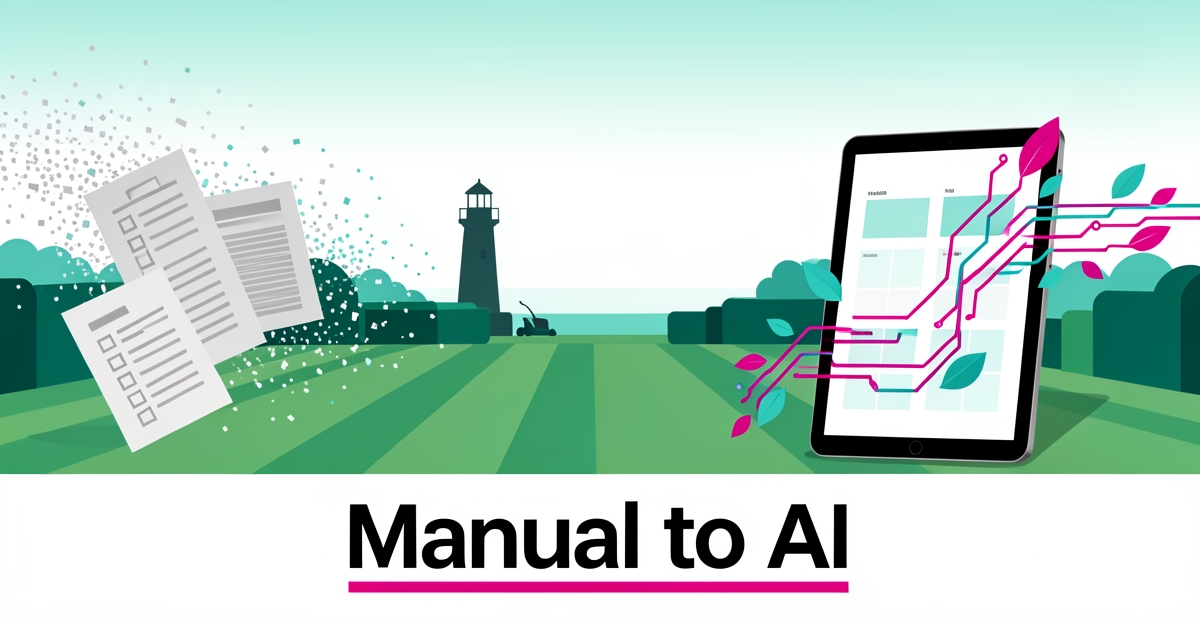
From Manual to AI: Transforming Grounds Maintenance Workflows in Halifax
Key Facts
- As of late 2026, 80% of organizations use Generative AI APIs or deploy GenAI-enabled applications Databricks research
- Half of all work activities could already be automated with existing technology TCI IT Services
- AI-powered automation reduces task completion time by 60-80% compared to manual processes Kissflow
- Manual invoice processing costs $12 to $30 per invoice, while automation drops that to $1 to $5 TCI IT Services
- 60% of occupations have at least 30% of their tasks automatable with current technology TCI IT Services
- The goal of AI in maintenance is to give technicians a superpower, not replace them Fabrico
- Cultural resistance and inadequate change management are primary barriers preventing successful AI adoption Databricks research
Hire a team member that works 24/7 — for less than a part-time wage.
AI receptionists, SDRs, dispatchers and 99+ roles. Trained on your business, fully managed.
Not sure where to start? Ask our AI planner
Assessing the Current State: Why Manual Grounds Maintenance Is Holding Halifax Businesses Back
Halifax grounds maintenance businesses face mounting pressure to deliver consistent, high-quality service while managing rising labor costs and operational complexity. Many still rely on spreadsheets, paper logs, and disjointed communication tools to coordinate crews, track equipment, and schedule tasks, a fragmented approach that creates avoidable inefficiencies. A workflow audit reveals that manual processes in grounds maintenance often involve repetitive data entry, delayed issue reporting, and inconsistent task prioritization, all of which drain productivity and increase the risk of human error. Workflow mapping is the critical first step to uncover these hidden bottlenecks, allowing businesses to see exactly where time is lost and where errors commonly occur.
Research shows that 50% of all work activities could already be automated with existing technology, and in grounds maintenance, this includes routine tasks like route planning, work order creation, and equipment tracking. When teams spend hours each week manually logging service visits or chasing down missing information, they have less capacity for proactive maintenance, client communication, or skill development. AI-powered automation can reduce task completion time by 60-80% compared to manual processes, freeing up valuable labor hours for higher-value activities. For Halifax businesses operating in seasonal cycles with tight windows for service delivery, reclaiming even a fraction of this time can significantly impact annual output and customer satisfaction.
- Crews wasting time on manual data entry instead of field work
- Delayed responses to equipment issues due to paper-based reporting
- Inconsistent scheduling leading to over- or under-serviced properties
- Difficulty tracking material usage and labor costs across sites
- Limited visibility into performance metrics for continuous improvement
These pain points are not just operational, they directly affect profitability and scalability. Without a clear understanding of where inefficiencies exist, investments in new tools or training can miss the mark, automating the wrong processes or failing to address root causes. Data governance becomes essential here, ensuring that any AI system built on top of existing workflows receives accurate, timely, and secure data from the start. AIQ Labs helps Halifax grounds maintenance companies begin this journey with a structured workflow audit, identifying high-impact opportunities where AI can deliver measurable improvements in efficiency, accuracy, and service consistency, laying the foundation for a transformation that scales with the business.
Prioritizing High-Impact AI Opportunities: Where Automation Delivers the Fastest ROI in Grounds Maintenance
Identifying where to begin your AI transformation requires a strategic focus on tasks that deliver the fastest return. Not all processes offer equal value when automated; prioritization should center on frequency, volume, complexity, and resource consumption. As research shows, 50% of all work activities could already be automated with existing technology, and 60% of occupations have at least 30% of their tasks automatable, indicating significant near-term potential across many operational areas.
Grounds maintenance teams in Halifax can start by auditing workflows to pinpoint repetitive, high-volume tasks such as scheduling, route optimization, equipment tracking, and client communication. These activities often consume disproportionate time relative to their strategic value, making them ideal candidates for initial automation. Prioritizing based on these criteria ensures early wins that build momentum and fund further investment.
Tasks performed daily or multiple times per day yield the highest automation ROI due to cumulative time savings. For example, automating manual invoice processing, currently costing $12 to $30 per invoice, can reduce expenses to $1 to $5 per invoice once streamlined. Similarly, AI-powered automation can cut task completion time by 60-80% compared to manual methods, directly freeing up skilled staff for higher-value work like client relations or site planning.
To systematically evaluate opportunities, grounds maintenance leaders should assess each process against four key dimensions: how often it occurs, the volume of instances handled, its technical complexity, and the labor or financial resources it consumes. This structured approach, supported by workflow audit best practices, helps avoid low-impact pilots and focuses efforts where automation drives measurable efficiency gains. By targeting these high-leverage areas first, Halifax-based grounds companies can achieve rapid ROI while laying the foundation for broader AI integration.
Building the AI-Powered Maintenance System: Integration, Governance, and Change Management
Successfully transitioning from manual to AI-powered grounds maintenance requires more than just deploying new technology, it demands a structured approach that aligns AI capabilities with real-world operational needs. As of late 2026, 80% of organizations have used Generative AI APIs or deployed Generative AI-enabled applications, underscoring the urgency for businesses to act strategically rather than reactively. Databricks emphasizes that strong governance becomes critical as AI technologies are integrated, managing risks like algorithmic bias and ensuring explainable decisions.
AIQ Labs follows a six-pillar transformation model to guide this journey, beginning with assessment and strategy before moving into AI agent and system development. Custom agents are built using advanced frameworks, enabling multi-agent orchestration for complex tasks such as scheduling, dispatch, and client communication. These systems are then integrated into existing business infrastructure, including CRM, accounting, and operations tools, through deep two-way API connections that create a unified operational workflow. Choosing the right mix of AI tools depends on integration capabilities, scalability, and vendor support, all of which are addressed during the enterprise integration phase. Kissflow reports that AI-powered automation can reduce task completion time by 60-80% compared to manual processes, a gain only achievable when systems are properly connected and optimized.
Governance and compliance form the foundation of sustainable AI adoption. This includes establishing trust and ethics guidelines, enforcing data security and privacy protections, and implementing human-in-the-loop controls for critical decisions. Audit trails and documentation ensure accountability, while regulatory alignment addresses industry-specific requirements. Equally vital is adoption and change management: team training programs are customized to each role, communication strategies build stakeholder buy-in, and feedback loops drive continuous improvement. Without addressing cultural resistance and insufficient change management, common barriers highlighted in the research, even the most advanced AI systems fail to deliver lasting value. TCI IT Services advises that mapping existing workflows and identifying inefficiencies is crucial before automation begins.
The final pillar, innovation and scaling, ensures AI impact grows over time through new use case identification, performance optimization, and emerging technology integration. By following this end-to-end approach, Halifax-based grounds maintenance providers can transform fragmented, manual processes into a cohesive, intelligent system that enhances efficiency, reduces errors, and positions teams for higher-value work, all while maintaining full ownership and control of their AI assets. AIQ Labs offers [AI Operating Systems](/ai-operating-systems) to help with this transition.
Still paying for 10+ subscriptions that don’t talk to each other?
We build custom AI systems you own outright. No vendor lock-in. Full control.
Not sure where to start? Ask our AI planner
Frequently Asked Questions
How much time can AI automation actually save my grounds maintenance business?
What's the first step to implementing AI in my grounds maintenance operations?
Which tasks should I automate first for the fastest ROI?
Will AI replace my grounds maintenance crew?
How much of my current workload could realistically be automated?
What happens if my team resists adopting new AI systems?
Your Next Season Starts With Smarter Workflows
Halifax grounds maintenance teams are moving from spreadsheets and paper logs to connected, AI-driven operations because manual friction is no longer sustainable. A structured workflow audit exposes where time is lost to repetitive data entry, delayed reporting and inconsistent scheduling, while prioritization focuses automation on high-frequency tasks like route planning, work orders and equipment tracking where ROI compounds fastest. Building the system requires integration with existing CRM and operations tools, strong data governance, and change management so teams adopt rather than resist the new way of working. The result is less rework, clearer visibility, and crews freed for proactive service instead of chasing information. AIQ Labs supports Halifax companies through this end-to-end shift with assessment, custom system development and [AI Employees](/ai-employees) tailored to local service demands. Start the [Fit Check](/apply) for a free 30-minute strategy call to map your biggest bottleneck and identify high-ROI automation opportunities. AI-powered automation can reduce task completion time by 60-80% compared to manual processes when systems are properly connected and optimized.
Make AI your competitive advantage — not just another tool.
Strategy, implementation and ongoing optimization. One partner, end to end.
Not sure where to start? Ask our AI planner