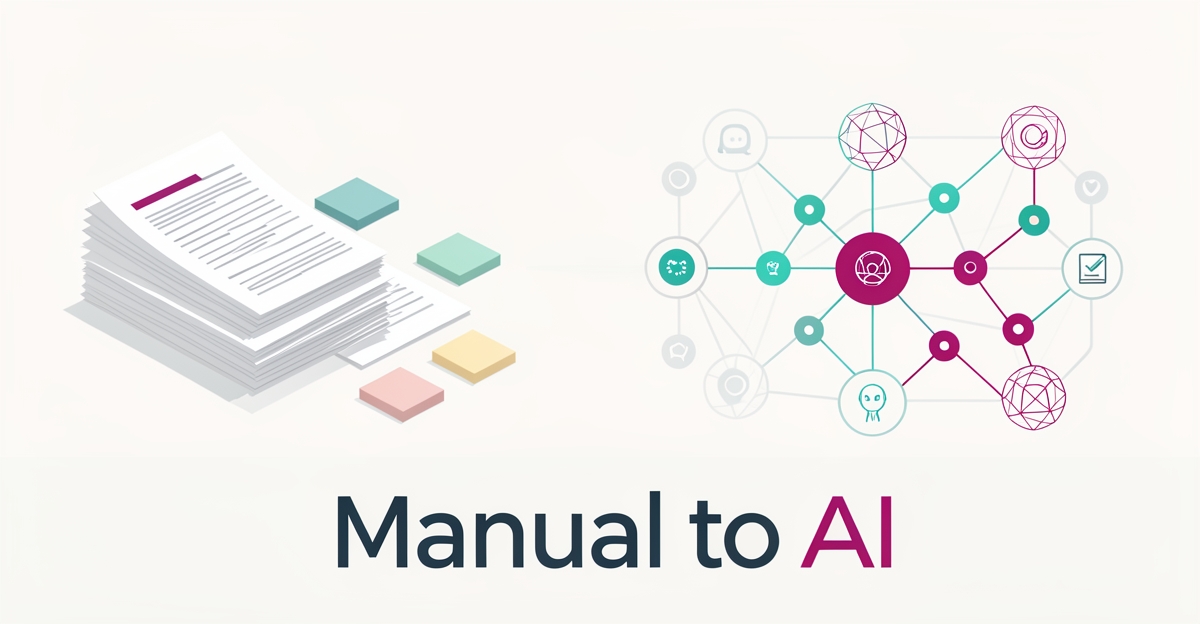
From Manual to AI: Transforming Homeschool Curriculum Delivery Workflows
Key Facts
- Industry research suggests a large share of employee time, often cited at around 60%, is consumed by coordination tasks like status updates and information chasing
- Businesses standardizing processes with AI typically report operational efficiency gains in the range of 30%
- Most organizations that integrate AI properly into workflows report faster, clearer decisions
- AI agents can plan, execute, and refine multi-step processes across operations autonomously with human oversight
- Homeschool curriculum providers can reclaim much of the staff time currently lost to email chains, spreadsheet updates, and scheduling conflicts
- Agentic AI workflows enable autonomous course updates, parent communication drafting, and content scheduling while maintaining pedagogical oversight
- As execution speeds up, decision quality, not implementation, becomes the primary bottleneck
Hire a team member that works 24/7 — for less than a part-time wage.
AI receptionists, SDRs, dispatchers and 99+ roles. Trained on your business, fully managed.
Not sure where to start? Ask our AI planner
The Hidden Cost of Manual Curriculum Delivery in Homeschooling
The average homeschool curriculum provider spends more time coordinating logistics than actually educating students. Behind every lesson plan lies an invisible web of administrative tasks that fragments focus and drains resources.
Industry research on agentic workflows consistently finds that a large share of employee time, often cited at around 60%, disappears into coordination tasks: status updates, information chasing, and manual scheduling. In homeschool operations, this translates to staff hours consumed by email chains confirming curriculum shipments, spreadsheet updates tracking student progress, and phone calls resolving scheduling conflicts. The result is an operational bottleneck where growth stalls not from lack of demand, but from inability to scale administrative capacity.
The inefficiency compounds as student counts rise. Each new family adds exponential coordination complexity: more emails to answer, more schedules to align, more records to update. Organizations that standardize processes with AI typically report operational efficiency improvements in the range of 30%, suggesting that manual workflows leave significant value on the table. When staff are trapped in reactive coordination mode, they cannot focus on curriculum quality or educational outcomes, the work that actually differentiates a provider.
The specific pain points cluster around predictable friction points:
- Email chains replacing automated status updates for curriculum shipments
- Manual calendar reconciliation across multiple time zones and family schedules
- Paper-based tracking systems requiring duplicate data entry
- Reactive parent communication that consumes hours weekly
These coordination costs create a hidden tax on every educational interaction. As workflow research indicates, when implementation speeds up, decision quality becomes the constraint, but manual curriculum delivery prevents teams from ever reaching that strategic level. Staff remain mired in tactical execution, unable to optimize learning pathways or personalize student experiences.
AIQ Labs has observed this pattern across education-adjacent operations: talented educators reduced to data entry clerks, their expertise squandered on tasks that follow predictable rules. The burnout is predictable. When most businesses report faster decision-making with AI integration, the inverse is equally true, manual processes slow everything down, creating frustration that drives turnover and limits organizational ambition.
The true cost isn't just wasted hours. It's the opportunity cost of what those hours could have built: deeper parent relationships, refined curriculum, expanded course offerings. Manual delivery doesn't just slow operations, it caps potential.
How Agentic AI Workflows Redefine Curriculum Operations
Imagine a curriculum coordinator who no longer spends Monday mornings manually updating course catalogs, chasing parent confirmations, or scheduling content releases. Instead, they arrive to find AI agents have already drafted the updates, flagged scheduling conflicts, and prepared personalized parent communications, waiting only for final pedagogical approval.
This shift from task-based automation to agentic AI workflows represents a fundamental redesign of curriculum operations. Unlike traditional automation that simply moves data between fields, these systems autonomously plan, execute, and refine multi-step processes across your entire operation. Organizations implementing these intelligent workflows typically report efficiency gains around 30%, along with faster and clearer decision-making when AI integrates properly into their systems.
The distinction lies in autonomy with boundaries. Traditional automation follows rigid if-then rules: when a parent emails, send a template response. Agentic workflows, however, perceive context, make decisions, and take action across multiple platforms. An AI agent might notice a curriculum update affects three grade levels, cross-reference state standards, draft parent notifications, schedule the content release, and flag potential learning gaps for human review, all without manual intervention between steps.
For homeschool curriculum providers, this means transforming three critical operational areas:
- Course updates: AI agents monitor curriculum changes, automatically update course materials across platforms, and version-control content while maintaining audit trails
- Parent communication: Intelligent systems draft personalized progress updates, answer routine inquiries, and escalate complex educational concerns to human advisors
- Content scheduling: Agents analyze student pacing data, optimize release timing for maximum engagement, and adjust schedules based on real-time completion rates
The efficiency gains prove substantial. Research indicates that a large share of employee time, often cited around 60%, currently disappears into coordination tasks: status updates, information chasing, and administrative overhead. Agentic workflows reclaim this capacity by handling the orchestration layer autonomously.
However, successful implementation requires maintaining human oversight for pedagogical decisions. While AI excels at logistics, scheduling, and data processing, educational judgment remains distinctly human. The goal is augmented intelligence: AI handles the operational heavy lifting while educators focus on curriculum quality, student relationships, and learning outcomes.
This balance reflects broader transformation patterns in software delivery, where clear specifications guide AI execution and verification systems ensure quality standards. In curriculum operations, the same principle applies: clear educational specifications guide AI execution, with verification systems ensuring quality standards.
AIQ Labs builds these production-ready systems specifically for education providers. Through [AI Workflow Builds](/workflow-builds), we rebuild the one workflow that costs you the most, course updates, parent communication, or content scheduling, at a fixed price, in phases. For providers who want managed AI staff handling routine parent inquiries and scheduling, [AI Employees](/ai-employees) cover 99+ roles at roughly 80% less cost than a human hire. The result is not replacement but elevation, operations staff shift from manual coordination to strategic oversight, supported by systems that learn and improve with every interaction.
A Step-by-Step Blueprint for AI-Powered Curriculum Transformation
Manual curriculum delivery traps homeschool providers in email threads, spreadsheets, and paper packets that stall growth. Moving to AI-powered operations means redesigning the workflow, not just adding tools.
Start by mapping current workflows with precision. Trace every handoff between course updates, parent communication, and content scheduling to expose repetitive coordination work. Industry research suggests a large share of employee time, often around 60%, is consumed by coordination tasks like status updates and information chasing. Naming those steps creates the blueprint for automation.
Define clear requirements and goals before building anything. Unclear direction slows even the fastest AI teams, and as implementation accelerates, poor decisions become more expensive. Align stakeholders on what “done” looks like for each curriculum process, then embed those requirements directly into the workflow so compliance and quality are enforced automatically.
Embed AI literacy into curriculum design from the start. The research is clear that AI literacy should precede generative AI integration, and AI should support rather than circumvent productive struggle. Build AI activities into existing subjects, teach students to critique AI outputs against disciplinary evidence, and model precise prompting tied to learning objectives.
Set up verification systems that become the new management layer. As agentic workflows take over routine execution, human oversight shifts to validation. Create robust checks for educational standards, content accuracy, and parent communication tone. Organizations standardizing processes with AI typically report efficiency improvements around 30% alongside faster, more consistent execution.
Establish feedback loops that let the system learn continuously. Design quick decision loops with parents and educators to validate choices before costly mistakes compound. Build mechanisms that analyze outcomes, update future behavior, and surface exceptions for human review. This closes the loop between autonomous action and pedagogical judgment.
A practical phased roadmap for providers looks like this:
- Map and document current manual steps for updates, communication, and scheduling to quantify coordination waste
- Define success criteria and verification rules for each workflow, embedding requirements so they cannot be skipped
- Pilot an owned AI system for one high-volume process, such as parent updates or course material distribution
- Integrate AI literacy practices into curriculum materials and teacher guides, not as a separate course
- Scale with monitoring, feedback, and continuous improvement while maintaining human oversight for critical decisions
Organizations that integrate AI properly see decision quality improve, with most reporting faster and clearer decisions once AI is embedded in workflows. That clarity is essential when curriculum decisions affect learning outcomes.
AIQ Labs applies this methodology through production-ready AI systems that manage course updates, parent communication, and content scheduling with full ownership and control. Whether you start with a single [Workflow Build](/workflow-builds) or scale into a connected [AI Operating System](/ai-operating-systems) built in phases and owned outright, the approach mirrors proven agentic workflows: AI agents plan and execute multiple steps autonomously while humans supervise where judgment matters.
If you're not sure where your workflow leaks the most time, start with the [2-minute Fit Check](/apply), then book a free 30-minute strategy call. You can also review [pricing and engagement models](/pricing), Start Monthly, Build in Milestones, or Own It Outright, to see which fits your stage of growth.
Still paying for 10+ subscriptions that don’t talk to each other?
We build custom AI systems you own outright. No vendor lock-in. Full control.
Not sure where to start? Ask our AI planner
Frequently Asked Questions
How much time does manual curriculum delivery actually waste?
Can AI really improve efficiency for homeschool curriculum providers?
Will agentic AI replace educators in homeschooling?
What does an AI-powered curriculum workflow actually do day-to-day?
Is decision-making faster with AI in curriculum operations?
Where should we start transforming manual curriculum delivery to AI?
Make AI your competitive advantage — not just another tool.
Strategy, implementation and ongoing optimization. One partner, end to end.
Not sure where to start? Ask our AI planner