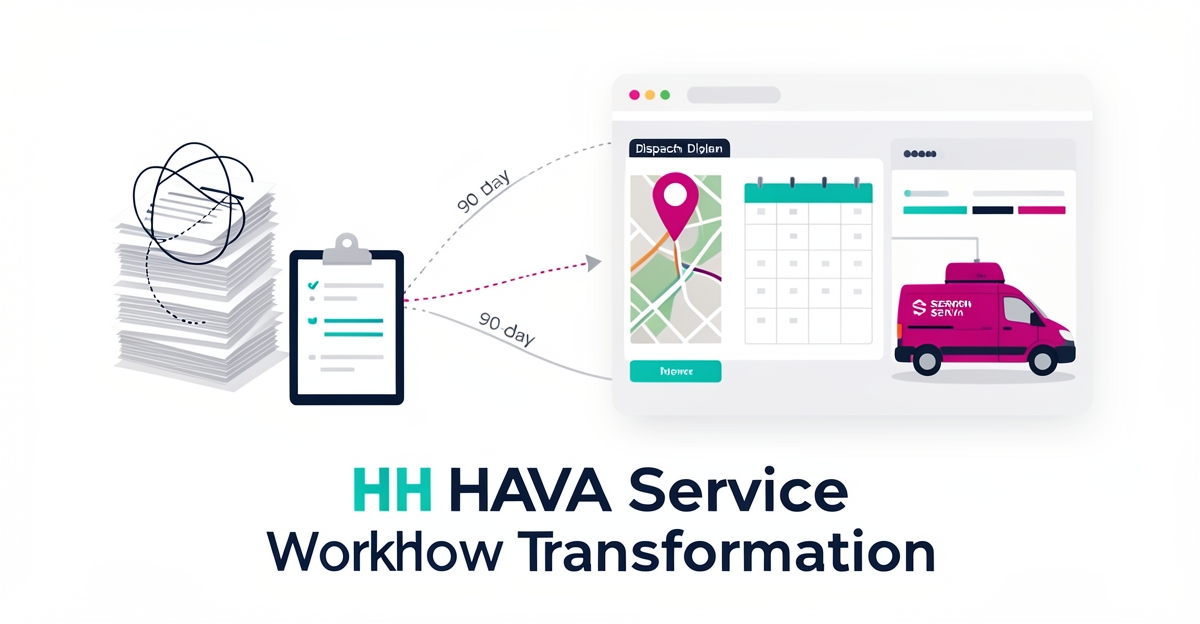
From Manual to AI: Transforming HVAC Work Order Processing in 90 Days
Key Facts
- Most HVAC contractors operate on thin margins, typically in the 5-12% range, leaving little room for operational waste.
- Capturing two to three extra service calls weekly can typically generate $40,000-$90,000 in annual revenue.
- AI takeoff software can process a project in minutes versus the 4-8 hours manual takeoff often requires.
- Technicians commonly spend a meaningful share of their day waiting on unclear work orders or missing parts.
- Phone-based dispatch is more error-prone than digital systems, especially during peak season.
Hire a team member that works 24/7 — for less than a part-time wage.
AI receptionists, SDRs, dispatchers and 99+ roles. Trained on your business, fully managed.
Not sure where to start? Ask our AI planner
The Manual Work Order Bottleneck Costing HVAC Contractors Revenue
The traditional approach to HVAC work order processing creates a silent revenue drain that many contractors overlook until it's too late. Paper-based systems and phone-driven dispatch force technicians into idle time between jobs, directly eroding already thin profit margins. This operational friction isn't just inconvenient, it's actively costing businesses thousands in lost revenue each year.
Most HVAC contractors operate on thin margins, typically in the 5-12% range, leaving little room for inefficiencies to accumulate. When dispatch relies on manual coordination, technicians frequently arrive at job sites only to find incomplete information or scheduling conflicts, resulting in avoidable downtime that compounds daily. These gaps in workflow don't just waste time, they prevent crews from completing additional billable jobs that could significantly impact the bottom line.
The financial impact becomes stark when examining missed communication opportunities. Capturing just two or three additional service calls per week through reliable dispatch can typically generate $40,000-$90,000 in annual revenue, yet paper-based systems routinely fail to capture these opportunities due to after-hours calls, busy lines, or human error. Every missed call represents not just a lost job, but a potential long-term customer relationship that walks to a competitor with better responsiveness.
- Technicians commonly spend a meaningful share of their day waiting for unclear work orders or missing parts
- Phone-based dispatch produces more scheduling errors than digital systems, especially under peak-season load
- Manual paperwork adds hours of administrative work per technician daily
- Inconsistent follow-up erodes customer retention over time
These inefficiencies create a cascading effect: frustrated technicians, dissatisfied customers, and managers constantly firefighting instead of growing the business. The margin pressure intensifies as fuel costs, parts pricing, and labor expenses continue to rise, making operational excellence not just beneficial but essential for survival. Recognizing this bottleneck is the first step toward reclaiming lost revenue and building a more resilient HVAC operation. For contractors ready to move beyond manual limitations, [AIQ Labs' AI Workflow Builds](/workflow-builds) target the single workflow that costs you the most, rebuild it first, at a fixed price, in phases.
How AI Transforms Work Orders, Takeoff, and Routing
AI is reshaping how HVAC companies handle work orders from the first customer contact to final job completion. Workflow optimization is consistently where trade business owners report AI's biggest impact, directly reducing technician downtime and improving routing efficiency. This shift begins with AI-powered intake systems that operate 24/7, qualifying job types, capturing essential details, and scheduling service windows without human intervention, ensuring no lead slips through and driving measurable gains in job completion rates and customer satisfaction.
Beyond intake, AI transforms the takeoff process with speed and precision. AI takeoff software can process complex HVAC projects in minutes, compared to the 4-8 hours often required manually. This dramatic reduction in pre-work time allows estimators to focus on higher-value tasks and accelerates the entire project lifecycle from quote to dispatch.
The operational benefits extend into field execution, where AI-driven routing optimizes technician schedules based on real-time traffic, job priority, and skill matching. Companies using these systems typically report fewer missed appointments, lower fuel costs, and higher daily job throughput, directly protecting the thin margins most contractors operate on. When paired with AI-enabled work order management, these improvements create a closed-loop system where data from completed jobs continuously refines scheduling and resource allocation.
AIQ Labs supports this transformation through [managed AI Employees](/ai-employees), receptionists, dispatchers, and coordinators across 99+ roles that handle intake, qualification, and scheduling around the clock, typically at roughly 80% less cost than a human hire. The result is a resilient, data-driven operation where every stage, from intake to invoicing, benefits from reduced latency, higher accuracy, and continuous optimization.
Start the Fit Check, a free two-minute assessment followed by a 30-minute strategy call to identify your highest-ROI AI automation opportunities.
90-Day Phased Rollout From Paper to AI-Driven Dispatch
HVAC contractors still relying on paper work orders face mounting pressure to modernize as competitors adopt AI-driven dispatch systems. The shift isn't just about technology, it's about capturing missed revenue opportunities and reducing operational waste that erodes thin industry margins. Workflow optimization remains the area where owners see AI's clearest impact, directly addressing technician downtime and routing inefficiencies that plague paper-based processes.
A realistic 90-day transformation requires three distinct phases with clear milestones to manage integration risks and employee adoption. Phase 1 (Days 1-30) focuses on assessment: mapping current work order flows, identifying legacy system integration points, and evaluating technician pain points with paper systems. This phase establishes baseline metrics for job completion rates and average dispatch time, critical for measuring improvement later. Phase 2 (Days 31-60) launches a pilot with AI-driven intake and dispatch automation for a portion of service requests, using AI Employees to handle initial job qualification, scheduling, and technician routing while maintaining human oversight for complex cases. Phase 3 (Days 61-90) scales the system to all work orders, refines behavior based on pilot performance data, and implements change management strategies to address resistance to new workflows.
Success depends on solving two core challenges: legacy system integration and employee adaptation. Integrating AI with older ERP platforms requires careful API mapping and middleware solutions to avoid data silos during transition. Simultaneously, technicians and dispatchers need structured training periods to build trust in AI recommendations, particularly for emergency service prioritization and parts ordering workflows. Companies that phase implementation alongside targeted change management see faster adoption, as employees experience tangible benefits like reduced phone tag and clearer job details before full rollout.
The pilot phase should prioritize capturing the missed-call revenue potential identified earlier, each additional service window secured through 24/7 AI intake directly impacts the thin margins typical in HVAC. By Day 90, businesses should measure improvements in first-time fix rates and technician utilization against Phase 1 baselines, creating a foundation for scaling AI into preventive maintenance scheduling and inventory forecasting. This measured approach transforms work order processing from a cost center into a predictable revenue driver while respecting the operational realities of field service teams.
Building an Owned AI System for HVAC Operations
Many HVAC businesses still rely on paper logs and manual scheduling, creating bottlenecks that slow response times and increase errors. Transitioning to an owned AI system eliminates these inefficiencies while giving you full control over your technology stack, no vendor lock-in, no forced migrations.
An AI Dispatcher, for example, can handle 24/7 intake, qualify service requests, and schedule technicians without human intervention, freeing your team to focus on complex jobs and customer relationships. This shift doesn't just automate tasks; it redefines operational capacity.
AIQ Labs builds custom AI systems tailored to HVAC workflows, integrating directly with your existing tools like scheduling software and CRM platforms through secure API connections. Unlike off-the-shelf solutions that force you into rigid workflows, our approach ensures the system adapts to your business, not the other way around. You own the code, the data, and the AI agents we build, meaning you can modify, scale, or integrate new features anytime without dependency on a third-party provider.
The transformation follows a clear, phased roadmap: first, we map your current work order process to identify pain points and automation opportunities; second, we develop and test the AI Dispatcher and supporting workflows in a sandbox environment; third, we deploy the system with hands-on training for your team; and finally, we provide ongoing optimization to improve accuracy and expand capabilities. Each phase includes measurable milestones, such as sharply reducing manual data entry or cutting average response time from hours to minutes.
With managed AI Employees working alongside your staff, you gain 24/7 operational coverage without the overhead of hiring additional personnel. These AI team members handle repetitive tasks like work order creation, parts lookup, and status updates, continuously improving from interactions over time. Because we manage updates, monitoring, and retraining, your internal team stays focused on high-value activities that require human expertise.
By owning your AI system, you avoid the trap of subscription creep and gain the flexibility to scale as your business grows. Whether you start with a single workflow fix or build a complete [AI Operating System](/ai-operating-systems), one connected operating layer, built in phases and owned outright, the foundation remains yours. This is how HVAC companies achieve sustainable efficiency gains: not by renting AI, but by building it as a permanent asset.
Still paying for 10+ subscriptions that don’t talk to each other?
We build custom AI systems you own outright. No vendor lock-in. Full control.
Not sure where to start? Ask our AI planner
Frequently Asked Questions
How much time do HVAC technicians typically waste waiting for unclear work orders or missing parts?
How much faster is AI takeoff software compared to manual takeoff for HVAC projects?
What revenue can HVAC contractors gain by capturing just a few additional service calls per week?
What are the biggest challenges when implementing AI in HVAC work order processing?
How does owning an AI system differ from using off-the-shelf AI solutions for HVAC businesses?
What does an AIQ Labs engagement cost?
Turn Your HVAC Work Orders Into a Revenue Engine
The journey from paper-based work orders to AI-driven dispatch isn't just about upgrading technology, it's about reclaiming lost time, reducing costly errors, and turning every customer interaction into an opportunity. By implementing a phased 90-day rollout, HVAC contractors can start capturing the revenue hiding in missed calls while cutting technician idle time and administrative overload. AIQ Labs helps businesses make this shift with owned, custom-built systems that integrate with existing tools and grow with your operation, no vendor lock-in, no subscription creep. Ready to see where your biggest bottleneck lies and what AI could fix in weeks, not months? Start the Fit Check for a free two-minute assessment followed by a 30-minute strategy call to map your highest-ROI automation opportunities. Questions first? Reach us at [email protected].
Make AI your competitive advantage — not just another tool.
Strategy, implementation and ongoing optimization. One partner, end to end.
Not sure where to start? Ask our AI planner