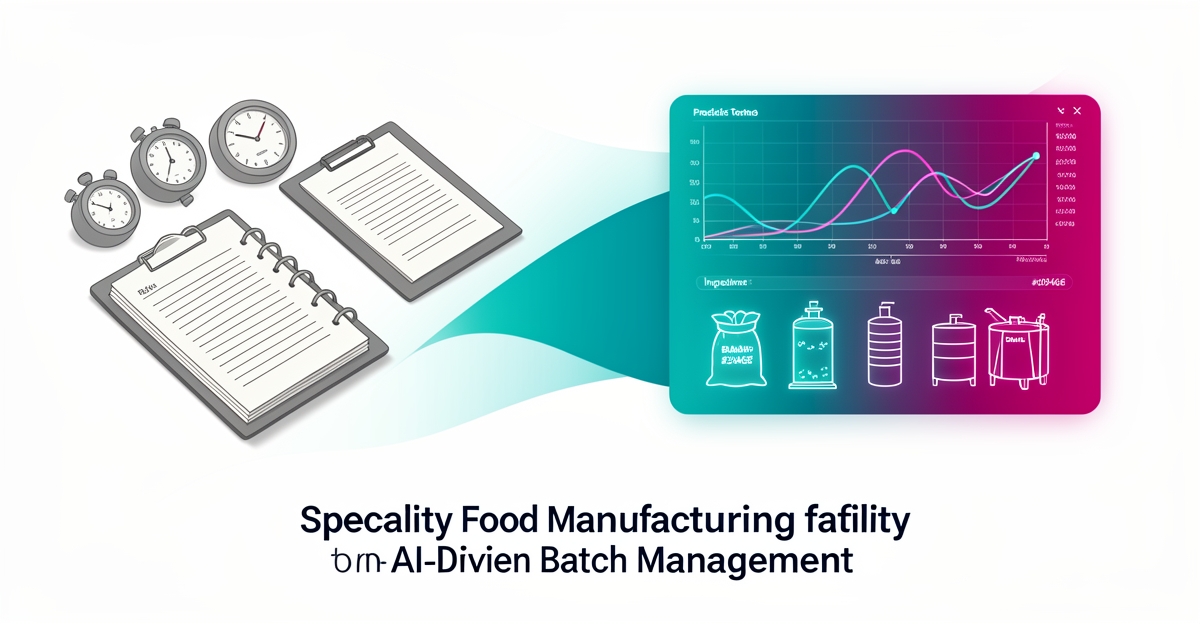
From Manual to AI: Transforming Ingredient Tracking and Batch Management in Specialty Food Manufacturing
Key Facts
- AI-powered batch monitoring can flag the large majority of anomalies before measurable quality deviation appears, according to vendor deployment data
- Vendor-reported results show substantial reductions in off-spec batches versus traditional SPC-based monitoring based on production monitoring results
- Predictive models can provide hours of advance warning before batches trend toward quality deviation via LSTM-based forecasting
- AI integration with existing DCS/LIMS systems typically completes in under 2 weeks via OPC-UA, MQTT, and REST APIs with no new hardware required in most cases
Hire a team member that works 24/7 — for less than a part-time wage.
AI receptionists, SDRs, dispatchers and 99+ roles. Trained on your business, fully managed.
Not sure where to start? Ask our AI planner
The Hidden Cost of Manual Ingredient Tracking: Where Specialty Food Manufacturers Lose Millions
The hidden cost of manual ingredient tracking in specialty food manufacturing isn't always visible on the balance sheet, it accumulates silently through undetected process variability that erodes batch production efficiency over time, according to vendor analyses of batch operations with parallels to food manufacturing. Gradual deviations in ingredient ratios, mixing times, or temperature profiles often go unnoticed until lab results or final product testing reveal off-spec batches, by which point yield loss, rework, and compliance risks have already incurred significant costs. Reactive quality control, reliant on periodic sampling and post-batch analysis, fails to catch these slow drifts before quality degradation occurs, turning preventable inefficiencies into avoidable waste.
This reactive approach creates a cascade of hidden expenses: extended cycle times, increased scrap rates, and unnecessary rework that strains both operational capacity and supplier relationships. Vendor deployment data suggests AI-powered batch monitoring can detect most anomalies before measurable quality deviation appears, with substantial reductions in off-spec batches versus traditional SPC-based monitoring. For specialty food manufacturers, where precise ingredient traceability directly impacts safety, labeling accuracy, and regulatory compliance under FDA 21 CFR Part 11 or GMP, the inability to monitor these variables in real time transforms routine production into a liability.
The financial toll extends beyond immediate waste. Every batch lost to a drift that could have been caught mid-process is margin you never recover. Without predictive visibility into batch health, manufacturers operate blind to the cumulative impact of minor ingredient variances, supplier inconsistencies, or environmental fluctuations that silently degrade product integrity. AIQ Labs helps close this gap through AI Workflow Builds that rebuild the one workflow costing you the most, automatically extracting, validating, and storing ingredient data from supplier invoices, purchase orders, and production logs, creating a foundation for real-time traceability and proactive deviation detection.
- Flags most batch anomalies before quality deviation appears, per vendor deployment data
- Substantially reduces off-spec batches versus traditional monitoring
- Turns supplier invoices, POs, and production logs into validated, traceable records
- Creates audit-ready documentation for FDA 21 CFR Part 11 and GMP
By shifting from reactive checks to continuous, AI-augmented oversight, specialty food manufacturers reclaim control over batch integrity, protecting both product quality and bottom-line profitability before variability becomes a costly surprise.
How AI Shifts Ingredient Tracking from Reactive to Predictive: Real-Time Anomaly Detection and Automated Data Extraction
Manual ingredient logs and spreadsheet reconciliation create the lag where errors become compliance events. AI closes that gap by turning invoices, purchase orders, and production logs into validated, traceable data before a batch starts, while monitoring the batch in real time.
Systems automatically extract and validate ingredient data from supplier invoices, POs, and production logs, reducing transcription errors and supporting labeling and traceability compliance. This is AI document processing applied to manufacturing operations, where extraction accuracy supports audit-ready records without manual re-entry.
Once data is captured, multi-phase process fusion ingests temperature arrays, pressure transmitters, flow meters, pH probes, and online analyzers simultaneously across all batch phases. The fused signals update a batch health score continuously, giving operators a single view instead of alarm floods.
Predictive forecasting shifts control from reactive to preemptive. LSTM-based forecasting identifies batches trending toward quality deviation hours before endpoint, giving process teams time to adjust parameters mid-batch. According to vendor deployment data, AI-powered batch optimization can detect most batch anomalies before measurable quality deviation appears.
The same platforms reduce off-spec outcomes and false alarms. Production monitoring results reported by vendors show substantial reductions in off-spec batches versus traditional SPC-based monitoring, with low false positive rates.
Integration happens without replacing existing control infrastructure. Connections to DCS, Batch, and LIMS systems typically complete in under 2 weeks via OPC-UA, MQTT, and REST APIs, with no new hardware required in most deployments. That speed matters for specialty food manufacturers who need compliance continuity.
AIQ Labs approaches this through AI Operating Systems, one connected operating layer that links AI document processing for ingredient intake with real-time anomaly detection for batch execution. The result is a closed loop from receipt to release, built in phases and owned outright.
Key capabilities manufacturers gain:
- Automated extraction and validation of ingredient specs from invoices, POs, and logs with structured storage for traceability
- Multi-phase process fusion and LSTM forecasting that provides hours of advance warning before quality deviation
- Graded alerts with confidence scores classifying drift as feed composition, mixing inefficiency, thermal deviation, or endpoint prediction error
- Native integration with existing DCS/LIMS via OPC-UA, MQTT, and REST APIs, typically deployed in under 2 weeks
With predictive monitoring, teams move from confirming failure after lab analysis to correcting it while the batch is still in process. That shift preserves yield, reduces rework, and creates audit-ready documentation for FDA 21 CFR Part 11, GMP, and REACH requirements.
Implementation Roadmap: Deploying AI for Ingredient Traceability Without Disrupting Production
Manufacturers can transform ingredient tracking and batch management in a matter of weeks without disrupting production by following a structured, phased deployment model. This approach ensures compliance readiness, measurable ROI, and seamless integration with existing systems, no hardware replacement required.
The process begins with a batch audit to assess critical processes and map sensor data across production lines. Simultaneously, system integration connects DCS, batch management, and LIMS platforms via OPC-UA, MQTT, and REST APIs, typically completed in under two weeks. During these initial weeks, AI models are trained on historical batch and quality data to establish a baseline, and can be fine-tuned to specific food recipes.
The next phase focuses on pilot validation, where live AI monitoring runs on your highest-variability batches. This phase delivers early evidence of ROI, with batch consistency gains typically detectable within the first month. Alert thresholds are then calibrated to keep false positives low, while operations teams receive training on graded alert responses and risk-scored recommendations. Finally, full production monitoring goes live across all processes, activating audit-ready compliance reporting for FDA 21 CFR Part 11 and GMP.
This phased roadmap eliminates scope creep, delivers predictable timelines, and enables specialty food manufacturers to shift from reactive quality control to predictive, real-time ingredient traceability, all while maintaining continuous production. AIQ Labs builds these systems in milestones with fixed pricing, so you know what each phase costs before it starts. For guidance on implementing this model in your facility, start with the 2-minute Fit Check, then schedule your free 30-minute strategy call to map high-ROI opportunities.
Still paying for 10+ subscriptions that don’t talk to each other?
We build custom AI systems you own outright. No vendor lock-in. Full control.
Not sure where to start? Ask our AI planner
Frequently Asked Questions
How much production efficiency are we losing with manual ingredient tracking?
Can AI really catch problems before a batch is ruined?
How long does it take to implement AI for ingredient traceability without disrupting production?
Will we have to rip out our existing control systems?
What kind of financial return should we expect early on?
Is AI-generated documentation audit-ready for FDA 21 CFR Part 11 and GMP?
From Hidden Loss to Measurable Control
Manual ingredient tracking quietly erodes specialty food margins through undetected variability that shows up only after the batch is lost. Shifting to predictive, real-time oversight changes that equation: automated extraction and validation of invoices, POs and production logs creates an audit-ready foundation, while multi-phase process fusion and LSTM forecasting provide hours of advance warning before quality deviation appears. The result is fewer off-spec batches, less rework, and preserved batch consistency value without ripping out existing DCS, Batch or LIMS systems. For manufacturers ready to act, the path is structured and fast. Start with a focused batch audit and pilot on your highest-variability recipes, calibrate alerts to keep false positives low, and train teams on graded, risk-scored recommendations. This is where AIQ Labs' AI Workflow Builds and AI Operating Systems add business value, combining AI document processing for ingredient intake with continuous batch health monitoring, built in phases, at a fixed price you approve up front. If you want to map where predictive traceability will deliver the highest ROI in your facility, start the 2-minute Fit Check at aiqlabs.ai/apply, then book your free 30-minute strategy call to assess readiness and prioritize high-impact opportunities.
Make AI your competitive advantage — not just another tool.
Strategy, implementation and ongoing optimization. One partner, end to end.
Not sure where to start? Ask our AI planner