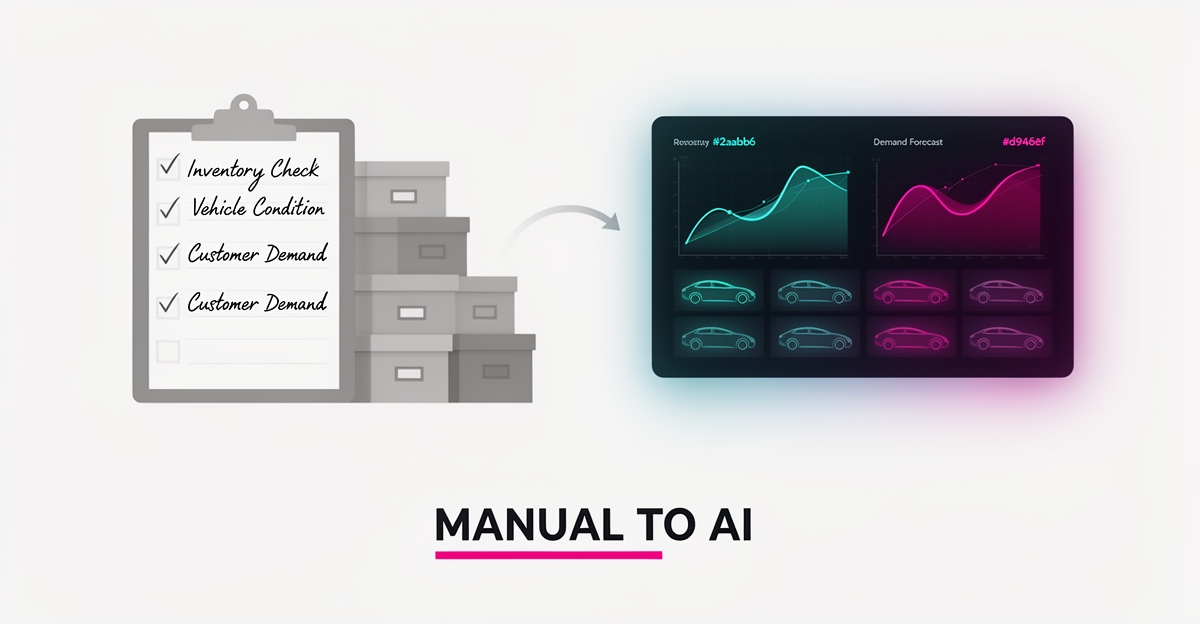
From Manual to AI: Transforming Inventory Management in New Car Dealerships
Key Facts
- AI-driven planning systems typically reduce inventory levels meaningfully, freeing working capital tied to depreciating assets
- Adoption of AI for inventory among small and mid-sized businesses is still in the minority as of late 2026, but intent to invest keeps growing
- Traditional inventory management relies on weekly or monthly updates with high error rates, while AI enables continuous real-time monitoring
- Large retailers like Walmart and Amazon have publicly credited AI forecasting with fewer stockouts and demand prediction at massive scale
- AIQ Labs has deployed 200+ multi-agent systems and runs 4 live SaaS products daily—the same operational discipline applied to dealership inventory builds
Hire a team member that works 24/7 — for less than a part-time wage.
AI receptionists, SDRs, dispatchers and 99+ roles. Trained on your business, fully managed.
Not sure where to start? Ask our AI planner
The Hidden Cost of Manual Inventory Management
Most dealerships don't realize how much money walks out the door while they're counting cars on clipboards. Spreadsheets and periodic counts create blind spots that silently erode margins through stockouts, aging inventory, and pricing that lags behind the market.
Industry analyses of AI-driven planning consistently point to meaningful inventory reductions—often in the double-digit percentage range—freeing up working capital tied to depreciating assets. Yet as of late 2026, only a minority of small and mid-sized businesses use AI for inventory, even though most plan to invest soon. The gap isn't awareness—it's the perceived complexity of switching from familiar manual processes.
Traditional methods fail in three specific ways:
- Weekly or monthly counts miss real-time movement, leaving staff blind to sudden demand shifts
- Fixed reorder points ignore seasonality, promotions, and regional buying patterns
- Pricing updates lag across websites and third-party platforms, creating trust gaps with buyers
AIQ Labs replaces these reactive workflows with predictive systems through [AI Workflow Builds](/workflow-builds)—we rebuild the one workflow that costs you the most, at a fixed price and in phases. The shift from periodic counts to continuous monitoring means staff receive alerts about low stock or upcoming model changes before they become emergencies—turning inventory from a cost center into a strategic advantage.
How AI Transforms Dealership Inventory Operations
The shift from manual to AI-powered inventory management transforms dealership operations from reactive to predictive. Traditional methods relying on periodic counts and historical averages are replaced by systems that continuously analyze sales data, market trends, and external signals to forecast demand with precision. This proactive approach helps ensure the right vehicles are available when customers are ready to buy, minimizing both stockouts and costly overstock situations.
AI-driven forecasting typically outperforms basic historical methods, which often lead to costly miscalculations around key sales events. By processing large datasets in real time—including seasonality, promotions, weather, and economic indicators—dealerships gain actionable insights that were previously impossible to uncover manually. This level of precision enables smarter purchasing decisions and reduces the guesswork that has long plagued inventory planning.
Real-time tracking and automated replenishment further enhance operational efficiency. Major retailers have publicly credited AI forecasting with significant stockout reductions during peak periods and demand prediction across hundreds of millions of products. These capabilities translate directly to dealerships, where AI can monitor lot activity, synchronize inventory across websites and third-party platforms, and trigger reorder alerts before stock levels become critical.
- Analyze sales history, market trends, and buyer behavior simultaneously
- Forecast demand around key sales events and model-year transitions
- Trigger automated replenishment based on real-time stock levels
- Reduce stockouts during peak demand periods
- Optimize safety stock dynamically using demand variability and lead time data
By integrating AI with existing dealership management systems, AIQ Labs creates a seamless ecosystem where inventory updates happen instantly and staff receive proactive alerts about low stock or upcoming model changes. This eliminates manual data entry and reduces the risk of human error, freeing up teams to focus on customer engagement and sales strategy rather than administrative tasks. The result is a more agile, responsive operation that aligns inventory with actual market demand.
Real-Time Synchronization Across Every Sales Channel
Manual updates create duplicate listings, phantom inventory, and lost sales the moment a car moves. AI removes the lag between the lot and the customer by synchronizing inventory the instant it changes.
As soon as a vehicle is added, sold, or repriced in the dealership management system, AI automatically updates this information across the website and all third-party platforms. This eliminates manual updates and prevents the errors or duplicate listings that plague traditional systems. Real-time capability replaces weekly or monthly update cycles with continuous monitoring.
Traditional inventory management carries high error rates with weekly or monthly update frequency, versus AI's continuous real-time monitoring. The shift is from reactive control to predictive planning, where inventory visibility is real-time or near-real-time across multiple locations. Dealerships that make this shift typically see meaningful reductions in inventory levels and carrying costs.
AI systems provide comprehensive visibility that answers practical operational questions instantly:
- Which warehouse or lot has available stock for a specific VIN or trim
- Which items are committed to open orders and cannot be sold
- Which vehicles are in transit and expected arrival dates
- Which units are listed online but not physically available for immediate delivery
This visibility helps dealerships optimize inventory placement and respond quickly to customer inquiries without manual checks. Real-time synchronization also ensures pricing adjusts dynamically to market conditions and stays consistent across all channels, reducing confusion and increasing trust.
Integration with existing dealership software is critical for this capability. AIQ Labs builds custom systems that connect to your existing dealership software to automate inventory updates and alert staff to low stock or upcoming model changes—part of a broader [AI Operating System](/ai-operating-systems) that connects your workflows into one operating layer you own outright. Most organizations now use AI in at least one function, and inventory is one of the fastest-growing use cases.
Accuracy compounds when every sales channel reflects the same source of truth. Staff receive alerts about low stock or upcoming model changes before problems emerge, and customers see accurate availability instead of driving to a lot for a car already sold.
The result is fewer stockouts, less overstocking, and a seamless buying experience from website to showroom to third-party marketplace.
From Forecast to Floor: Implementation Roadmap
Moving from manual spreadsheets to predictive inventory is a staged build, not a big bang. Dealerships that sequence the work around data readiness, DMS integration, and human oversight see faster adoption and fewer exceptions. AIQ Labs builds in milestones for exactly this reason—you pay as each phase proves itself.
Start with an honest assessment of current processes. Review stock tracking, demand forecasting, and replenishment pain points to identify where AI can make an immediate difference. Most organizations now use AI in at least one function, and inventory and supply chain are among the most common areas.
Data infrastructure comes before models. Ensure clean historical sales data and SKU tracking are in place to support accurate predictions. Integration planning must verify compatibility with existing dealership management systems, POS, and warehouse platforms so updates flow automatically and in real time.
Build compatibility first, then capability. Verify DMS integration compatibility early to enable smooth data sharing between AI tools and current operations. Starting with core tracking creates quick wins before expanding to advanced forecasting.
A practical rollout follows this sequence:
- Assessment and readiness evaluation of data, systems, and team skills
- DMS and third-party platform integration for real-time inventory sync
- Core automated tracking deployment before predictive demand forecasting
- Staff training and exception-handling protocols for supplier issues and high-value decisions
- Continuous monitoring and model retraining as demand patterns evolve
Start small with automated inventory tracking to prove value, then layer demand forecasting and dynamic pricing. AI helps dealerships keep high-demand vehicles in stock by analyzing sales history and buyer behavior—and each phase should show measurable results before the next begins.
Human-in-the-loop processes protect strategic decisions. Establish clear rules for human review of exceptions, supplier issues, strategic orders, seasonal demand, and high-value inventory decisions. AI can process more data than a person can manually review, but it does not automatically understand every business constraint.
Data infrastructure readiness determines forecast accuracy. Only a minority of SMBs currently use AI for inventory, but most plan to invest soon—the gap between intent and execution usually comes down to data readiness.
Ongoing monitoring keeps models reliable. Implement continuous monitoring and maintenance to ensure AI models remain accurate as assortments, suppliers, and market conditions change. AIQ Labs handles this as part of the build, so your team isn't stuck maintaining models.
With the right roadmap, dealerships shift from reactive control to predictive planning while keeping experienced operators in control of exceptions. Start with the [2-minute Fit Check](/apply) to see where your inventory workflow stands.
Measuring Success: KPIs and Continuous Optimization
An AI inventory system is only as valuable as the results it proves, and dealerships that fail to measure performance end up flying blind after go-live. The good news: the same data that powers AI forecasting also makes success measurable in ways manual processes never could.
The starting point is a handful of core KPIs. Inventory turnover and days-to-sell reveal whether the right vehicles are on the lot, while carrying cost reduction captures the financial impact of holding less stock. Dealerships that move to AI-driven planning typically see meaningful inventory reductions, directly lowering storage, insurance, and obsolescence costs.
Stockout frequency and forecast accuracy round out the picture. AI-driven systems consistently outperform basic historical data methods, and large retailers have demonstrated what's possible at scale. Tracking these metrics before and after deployment gives dealerships an honest baseline for ROI.
But measurement is not a one-time exercise. AI models degrade over time and must be retrained as demand patterns, product assortments, or supplier behavior evolve—without regular updates, predictions lose accuracy and erode confidence in the system. Market shifts, model-year changes, and regional demand swings all affect forecast reliability.
Dealerships should watch for warning signs such as:
- Forecast accuracy drifting below established baselines
- Rising stockouts on previously well-predicted models
- Growing gaps between projected and actual days-to-sell
- Alerts that no longer match real inventory conditions
This is where ongoing management matters more than the initial build. The traditional alternative—hiring in-house data science talent or burdening sales and inventory staff with model maintenance—is precisely the skills gap that causes many AI projects to stall. A managed approach handles retraining, monitoring, and exception review behind the scenes, keeping the human-in-the-loop model intact: AI accelerates decisions while experienced operators still review supplier issues, strategic orders, and high-value inventory calls.
At AIQ Labs, continuous optimization is built into every engagement rather than sold as an afterthought. Custom systems integrate with existing dealership software, monitor their own performance, and are retrained as market conditions shift—so the dealership's team stays focused on selling cars, not maintaining models.
The dealerships that win with AI are the ones that treat measurement and optimization as ongoing disciplines, not launch-day checkboxes.
Still paying for 10+ subscriptions that don’t talk to each other?
We build custom AI systems you own outright. No vendor lock-in. Full control.
Not sure where to start? Ask our AI planner
Frequently Asked Questions
How much can AI really reduce inventory levels for car dealerships?
Is AI inventory management too complex for small dealerships to implement?
How accurate is AI at predicting vehicle demand compared to old methods?
Can AI really prevent stockouts during busy sales periods?
What happens if I don't have clean data—will AI still work for my dealership?
Will AI replace my inventory staff or take over important decisions?
Drive Your Dealership Forward with AI-Powered Inventory
Transitioning from manual spreadsheets to AI-powered inventory management transforms dealerships from reactive to predictive operations. With real-time tracking, demand forecasting, and automated replenishment, dealerships can reduce inventory levels, minimize stockouts, and optimize pricing across all channels. AIQ Labs builds custom systems that integrate with your existing dealership software—starting with the one workflow that costs you the most, at a fixed price, built in phases you approve. The result? Fewer errors, less overstocking, and a buying experience that keeps customers coming back. Ready to turn inventory into a strategic advantage? Start with the [2-minute Fit Check](/apply), then [book a free 30-minute strategy call](/book)—no obligation, just clarity on how AI can work for your dealership. You can also reach the team at [email protected].
Make AI your competitive advantage — not just another tool.
Strategy, implementation and ongoing optimization. One partner, end to end.
Not sure where to start? Ask our AI planner