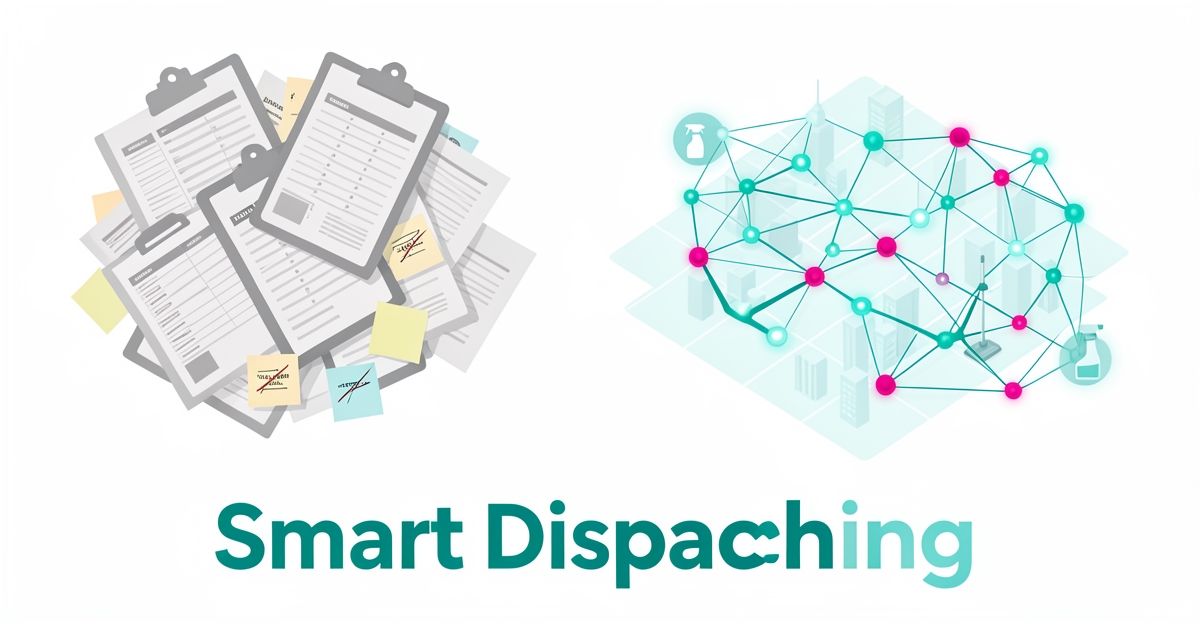
From Manual to AI: Transforming Janitorial Workflows with Smart Dispatching
Key Facts
- AI adoption in commercial cleaning has grown sharply since 2022, with automated scheduling and dispatching among the most common first use cases as of late 2026
- Manual dispatching typically produces more scheduling conflicts and lower staff utilization than AI-optimized scheduling
- AI-powered route optimization meaningfully reduces daily mileage and fuel spend per technician, with savings scaling by territory size
- Small cleaning businesses typically reach ROI within months of automating scheduling and client communication
- Automating scheduling, coordination, and invoicing can offset a large share of administrative payroll for a mid-sized cleaning operation
- Automated inventory management reduces both supply shortages and excess carrying costs
- AI quality control systems typically reduce client complaints and improve contract renewal rates
Hire a team member that works 24/7 — for less than a part-time wage.
AI receptionists, SDRs, dispatchers and 99+ roles. Trained on your business, fully managed.
Not sure where to start? Ask our AI planner
The Hidden Costs of Manual Dispatching in Janitorial Operations
The traditional approach to janitorial dispatching relies heavily on manual coordination, creating operational drag that impacts both efficiency and profitability. Operations managers spend countless hours juggling schedules, resolving conflicts, and making reactive decisions that could be automated. This constant firefighting not only consumes valuable time but also introduces human error into critical workflows.
Janitorial businesses using manual dispatching typically experience noticeably more scheduling conflicts than those using automated systems. These conflicts often result in late arrivals, missed appointments, and frustrated clients, directly impacting service quality and retention rates. The ripple effect extends to staff utilization, with manual processes leaving teams under-deployed compared to AI-optimized scheduling.
The financial toll of manual dispatching accumulates through multiple channels that are often overlooked in day-to-day operations. Fuel costs represent a substantial burden, with inefficient routing driving up vehicle-related expenses per technician. Administrative overhead also swells, as dispatching tasks consume far more labor hours than necessary, pulling skilled workers away from value-added activities.
- Increased overtime costs due to poor schedule optimization
- Higher vehicle maintenance expenses from unnecessary mileage
- Lost revenue opportunities from underutilized staff capacity
- Elevated administrative burden on operations management
- Reduced client satisfaction from inconsistent service delivery
Beyond direct costs, manual dispatching creates hidden opportunity costs that hinder business growth. When operations managers are trapped in scheduling logistics, they lack bandwidth to pursue new clients, refine service offerings, or implement quality improvements. This operational bottleneck prevents scaling efforts and keeps businesses stuck in reactive mode rather than proactive growth. For janitorial companies aiming to compete in an increasingly AI-driven market, continuing with manual dispatching isn't just inefficient, it's a strategic disadvantage that limits potential while competitors embrace smarter workflows. AIQ Labs helps janitorial businesses identify these hidden costs and rebuild the one workflow that costs the most, eliminating manual bottlenecks while maintaining full operational control.
The AI Shift in Janitorial Workflows: Key Benefits & ROI
Janitorial businesses adopting AI-driven smart dispatching are seeing meaningful results across operational efficiency, cost savings, and service quality. Companies implementing automated scheduling systems report fewer scheduling conflicts and better staff utilization, directly addressing core pain points in daily operations. Route optimization through AI-powered planning cuts daily mileage, translating to real fuel savings per cleaning technician depending on territory size.
These efficiency gains compound to create substantial financial impact, with small cleaning business owners typically reaching ROI within months of implementing basic automated scheduling and customer communication systems. A mid-sized cleaning operation can offset a significant share of administrative payroll by automating client scheduling, staff coordination, and invoice generation processes that previously required dedicated staff. Inventory management automation reduces supply shortages while cutting excess inventory carrying costs.
- Meaningful reductions in operational costs through AI automation
- Improvements in service quality metrics
- More billable hours per day from optimized routing
- Fewer client complaints through AI quality control systems
- Stronger contract renewal rates
Beyond immediate cost savings, AI-driven dispatching enhances long-term business value through improved customer retention and satisfaction. Automated customer communication cuts response times from hours to minutes, while AI quality control systems standardize service delivery and reduce complaints. Each retained commercial client represents significant recurring revenue, making retention gains from automated feedback systems a major driver of sustainable growth. For janitorial businesses ready to transform their operations, AIQ Labs provides purpose-built solutions designed specifically for small and medium-sized cleaning operations, ensuring seamless integration with existing workflows while delivering measurable ROI.
Implementing AI Dispatching: A Practical Roadmap for Cleaning Businesses
Moving from spreadsheets and phone calls to AI-driven dispatching works best as a phased rollout, not a big bang. Cleaning businesses that map the transition step by step avoid disruption while capturing early wins in speed and utilization.
Start with an honest assessment of current dispatching. Document where manual decisions create delays, scheduling conflicts, and overtime. Staff training and adoption resistance are common in cleaning companies, so identifying change champions early reduces friction.
Choose a platform built for workflow automation, not just digitization. AI operating systems embed machine learning directly into scheduling, routing, and resource allocation, while traditional software requires constant manual oversight. This distinction matters because automated scheduling is typically the first use case businesses adopt when they move to AI.
Data readiness determines success speed. Clean and standardize client locations, service specs, and technician availability before integration. Businesses moving from paper-based systems often need one to three months to standardize historical data for effective AI utilization. Consolidate existing tools such as ServiceTitan, Jobber, or legacy schedulers into a unified system to avoid silos.
Implementation follows a practical sequence:
- Integrate and standardize data, then connect CRM, scheduling, and communication tools
- Deploy automated scheduling with rules for skills, certifications, and travel time
- Activate AI-powered route optimization with real-time traffic, weather, and priority handling
- Train technicians on mobile check-in and status updates with role-based support
- Monitor KPIs and let the system learn from operational data for continuous improvement
Staff training is the make-or-break step. Less experienced staff often adapt to new tools faster than veterans, so pair digital natives with experienced cleaners and provide consistent reinforcement for several weeks. Real-time visibility through GPS routing and status tracking reduces missed visits and builds trust with both crews and clients.
Measure early and often. Small cleaning business owners typically see ROI within months on basic automation, with reductions in administrative overhead and improvements in staff utilization. AIQ Labs builds custom systems for janitorial businesses, built in phases and owned outright, to ensure real-time visibility and operational efficiency without disrupting daily operations, aligning with the step-by-step approach that supports adoption.
Continuous optimization turns the initial rollout into a competitive advantage. As the system learns, it predicts needs, adjusts routes automatically, and flags supply or compliance gaps before they impact service.
Overcoming Common Implementation Challenges and Ensuring Adoption
Transitioning to AI-driven dispatching in janitorial operations often encounters real-world hurdles that can slow progress if not addressed proactively. Staff resistance remains one of the most significant barriers, with many cleaning companies reporting training and adoption challenges when implementing new AI systems. Technicians who are newer to the workforce often adapt faster than long-tenured staff, highlighting the need for tailored onboarding approaches that acknowledge varying comfort levels with technology. Data quality and standardization also pose ongoing difficulties, particularly for organizations migrating from paper-based or fragmented digital systems, which typically need one to three months to clean and structure historical data for effective AI utilization. Integration complexity varies widely depending on existing technology stacks, with businesses using multiple separate tools facing longer timelines compared to those on unified platforms.
To overcome these challenges, successful implementation hinges on strategic change management and targeted support. Phased rollouts allow teams to build confidence gradually, starting with non-disruptive features like automated scheduling before advancing to real-time routing or inventory management. Providing role-specific training that emphasizes how AI reduces repetitive tasks, such as manual job assignment or supply tracking, helps staff see immediate value in their daily work. Establishing clear feedback loops where technicians can report issues and suggest improvements fosters ownership and reduces apprehension. For small businesses lacking dedicated IT support, purpose-built AI platforms designed for simplicity minimize technical barriers, enabling adoption without requiring specialized expertise. AIQ Labs supports this transition through hands-on implementation guidance, ensuring systems are configured to align with existing workflows while delivering measurable efficiency gains from the outset. Monitoring key metrics like staff utilization rates and scheduling conflict reduction during the initial phases provides tangible evidence of progress, reinforcing adoption and justifying continued investment. By addressing human, technical, and operational factors in tandem, janitorial businesses can navigate implementation smoothly and unlock the full potential of smart dispatching.
Still paying for 10+ subscriptions that don’t talk to each other?
We build custom AI systems you own outright. No vendor lock-in. Full control.
Not sure where to start? Ask our AI planner
Frequently Asked Questions
How much can a janitorial business save by switching from manual to AI-driven dispatching?
What is the typical timeline for seeing ROI after implementing AI dispatching in a cleaning business?
How does AI-powered route optimization reduce fuel costs for janitorial teams?
What are the biggest challenges janitorial businesses face when adopting AI dispatching systems?
How much faster do younger technicians adapt to AI dispatching compared to experienced cleaners?
What impact does AI have on client satisfaction and retention in janitorial services?
Your Dispatch Board Is Costing You More Than You Think
The math is hard to ignore: manual dispatching drains janitorial businesses through scheduling conflicts, inflated fuel costs, and administrative overhead, while AI-driven systems deliver fewer conflicts, better staff utilization, and ROI within months for most small operations. The phased roadmap we've outlined, assessing your current workflows, standardizing your data, deploying automated scheduling and route optimization first, then training your team with role-specific support, shows this transition doesn't require a big bang or a dedicated IT department. With a growing share of commercial cleaning operations now using at least one automated workflow system as of late 2026, the question is no longer whether to automate your dispatching, but how quickly you can do it without disrupting daily operations. That's where AIQ Labs comes in: we build dispatch automation systems for janitorial businesses that you own outright, configured around your existing workflows and built in phases so nothing breaks along the way. Start with the two-minute Fit Check at aiqlabs.ai/apply, then book a free 30-minute strategy call, a real working session with an AI engineer to map your biggest bottleneck and identify your highest-ROI automation opportunities. If there isn't a clear win, we'll tell you that too.
Make AI your competitive advantage — not just another tool.
Strategy, implementation and ongoing optimization. One partner, end to end.
Not sure where to start? Ask our AI planner