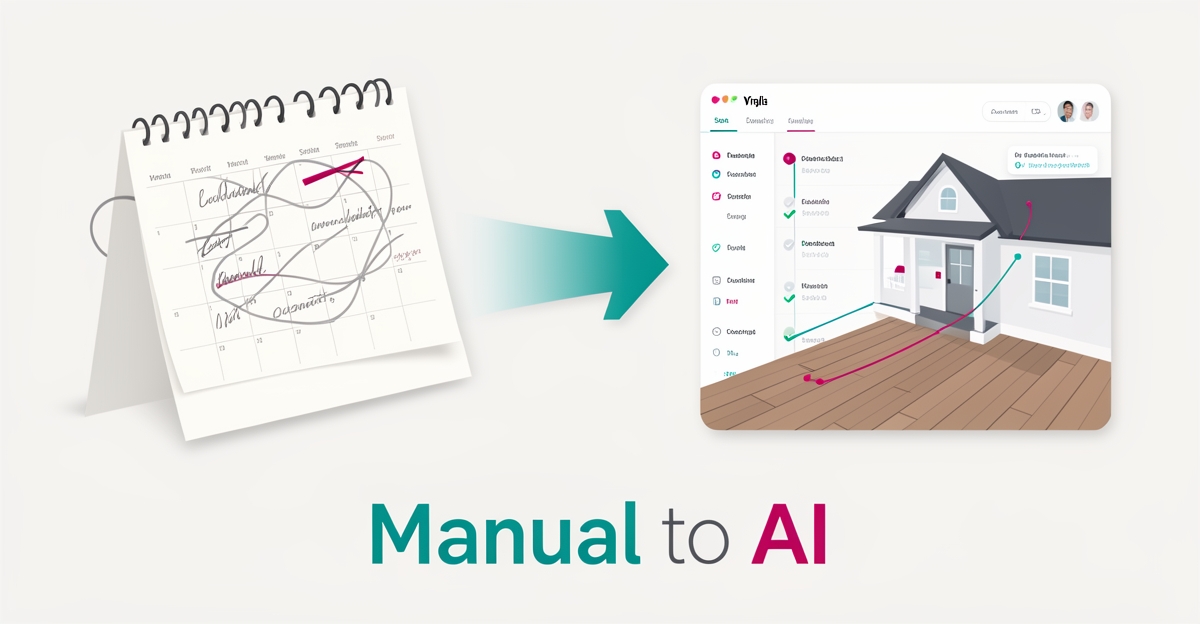
From Manual to AI: Transforming Job Scheduling in a Vinyl Installer Business
Key Facts
- Job-shop scheduling is NP-hard, meaning possible arrangements explode exponentially as jobs increase, a genuinely difficult computational challenge for humans to solve by hand
- AI scheduling systems typically reduce scheduling conflicts through predictive conflict detection and automated reminders that cut missed appointments
- AI-powered scheduling optimizes appointments by analyzing customer preferences, crew availability, and project timelines
- As of late 2026, AI adoption in operations is mainstream across service businesses of all sizes
- AIQ Labs has deployed 200+ multi-agent systems and runs 4 live SaaS products daily
Hire a team member that works 24/7 — for less than a part-time wage.
AI receptionists, SDRs, dispatchers and 99+ roles. Trained on your business, fully managed.
Not sure where to start? Ask our AI planner
The Hidden Cost of Manual Scheduling in Vinyl Installation
Every missed appointment in a vinyl installation business is more than an inconvenience, it's a crew sitting idle, a customer waiting, and revenue quietly leaking out of the business. For most installers, the root cause isn't laziness or poor workmanship. It's the scheduling system itself.
Traditional scheduling in the vinyl trade still relies on whiteboards, paper job tickets, and a dispatcher's memory. When a customer calls to move an appointment, someone has to cross-reference multiple jobs, check crew availability, and update the calendar by hand. Inevitably, details slip through the cracks. The result is the familiar pattern of missed appointments and double bookings, where two crews arrive at the same address or no one shows up at all.
This isn't a small problem. Job-shop scheduling, assigning jobs to crews and time slots to minimize total completion time, is a well-known optimization problem in computer science and operations research. It's classified as NP-hard, meaning the number of possible arrangements explodes exponentially as jobs increase. A human juggling ten installations with varying material deliveries, customer time windows, and crew skills is attempting, by hand, what mathematicians treat as a genuinely difficult computational challenge.
The operational toll compounds quickly:
- Wasted drive time and fuel when crews are routed inefficiently across the service area
- Lost revenue when double bookings force cancellations or rushed, lower-quality installs
- Administrative hours burned on manual data entry and constant rescheduling calls
- Damaged customer relationships when promised arrival windows are missed
- No reliable way to scale, more jobs simply mean more chaos
The broader market has already moved. As of late 2026, generative AI is firmly mainstream in business operations, and service companies that still run scheduling by hand are competing against operations that predict conflicts before they happen. AI-powered tools analyze customer preferences, crew availability, and project timelines to optimize every appointment automatically, eliminating the guesswork behind crew availability and project timelines.
The gap is stark. Traditional scheduling is manual, error-prone, and limited in flexibility, while AI-driven scheduling automates the process, minimizes errors, and scales effortlessly. This is precisely the kind of workflow automation that AIQ Labs builds through [AI Workflow Builds](/workflow-builds), custom scheduling systems that sync with tools a business already uses, such as Google Calendar or field dispatch apps, rather than forcing a disruptive software migration.
For a vinyl installer running on manual scheduling, the question isn't whether inefficiency is costing money. It's how much, and how long the business can afford to keep paying it.
How AI-Powered Scheduling Tools Solve Core Scheduling Challenges
Manual scheduling in service businesses like vinyl installation often creates avoidable friction, missed appointments, overlapping jobs, and frustrated customers. AI-powered scheduling tools address these pain points by analyzing customer preferences, real-time availability, and project timelines to optimize appointment slots. These systems go beyond simple calendar syncing by using intelligent algorithms to balance workload, reduce idle time, and prevent double bookings. For vinyl installers managing variable job durations and client-specific material needs, this precision directly translates to fewer disruptions and better resource utilization.
AI scheduling systems also automate routine coordination tasks that traditionally consume administrative time. They send automated reminders, reschedule appointments based on crew availability, and factor in travel time between job sites, minimizing inefficiencies that manual methods overlook. In field service contexts, this means fewer no-shows, better first-time fix rates, and stronger client trust, all critical for businesses relying on repeat work and referrals.
- Analyzes customer preferred time windows and project complexity to suggest optimal slots
- Syncs with tools like Google Calendar or dispatch apps to reflect real-time crew availability
- Flags likely conflicts before they happen through predictive conflict detection
- Automates follow-ups and reminders, cutting down missed appointments
- Provides rescheduling suggestions when delays occur, maintaining workflow continuity
AIQ Labs builds custom AI scheduling systems that integrate directly with existing workflows, ensuring vinyl installers gain these benefits without overhauling their current tools. For businesses that want scheduling handled end-to-end, including customer calls, confirmations, and dispatch coordination, an [AI Employee](/ai-employees) can act as a managed dispatcher or scheduler at a fraction of the cost of a human hire. By grounding scheduling decisions in data rather than guesswork, businesses shift from reactive firefighting to proactive planning, freeing up time to focus on quality installations and customer relationships. The result is a smoother, more predictable operation where every appointment adds value instead of creating risk.
Implementing AI Scheduling: From Assessment to Ongoing Optimization
Many vinyl installers still rely on manual scheduling methods that lead to missed appointments and double bookings, wasting valuable time and resources. AI-powered scheduling tools can analyze customer preferences, availability, and project timelines to optimize appointments and automate routine tasks like reminders, significantly reducing errors and improving efficiency. This shift not only enhances the customer experience but also increases revenue potential by ensuring teams are consistently booked at optimal capacity.
Implementing AI scheduling begins with a thorough assessment of current workflows to pinpoint pain points such as overlapping bookings or last-minute cancellations. AIQ Labs follows a structured implementation process starting with Discovery & Architecture, where business process analysis and technology infrastructure evaluation help design a solution tailored to the installer's specific needs. This phase includes ROI projection and timeline development to ensure alignment with business goals before any development begins.
The next step involves building an AI-powered scheduling system that integrates seamlessly with existing systems like Google Calendar or field dispatch apps. During the Development & Integration phase, custom AI agents are built with deep two-way API integrations that create unified operational workflows. Security implementation and compliance verification are also completed to protect sensitive customer and scheduling data.
Deployment includes user training customized to each role, ensuring installers and office staff can confidently use the new system from day one. Documentation is delivered, and performance monitoring is set up to track improvements in real time. Ongoing optimization continues after launch, with continuous performance monitoring, feature enhancement, and scaling support as the business grows, ensuring the scheduling system evolves alongside operational demands.
For installers who want scheduling to become part of a broader connected operation, rather than a standalone tool, [AI Operating Systems](/ai-operating-systems) connect scheduling, dispatch, quoting, and customer communication into one operating layer, built in phases and owned outright. Payment is flexible: start monthly, build in milestones, or own the system outright. For vinyl installers looking to make this transformation, starting with a 2-minute Fit Check at [Apply](/apply) helps identify high-ROI automation opportunities tailored to their workflow, followed by a free 30-minute strategy call to explore how AI scheduling can eliminate manual bottlenecks and create a more reliable, scalable operation.
Still paying for 10+ subscriptions that don’t talk to each other?
We build custom AI systems you own outright. No vendor lock-in. Full control.
Not sure where to start? Ask our AI planner
Frequently Asked Questions
Why do vinyl installation businesses keep missing appointments even with careful scheduling?
How much can AI scheduling actually reduce missed appointments and errors?
Will AI scheduling work with the tools my business already uses?
Is AI scheduling overkill for a small vinyl installation business?
What does implementing AI scheduling involve, and how long does it take?
How do I know if AI scheduling is worth the investment for my business?
Your Next Move: From Scheduling Chaos to Seamless Operations
The transition from manual scheduling to AI-powered optimization represents more than just an upgrade in tools, it's a fundamental shift in how vinyl installation businesses operate. By addressing the core challenges of missed appointments, double bookings, and inefficient resource allocation, AI scheduling systems transform what was once a daily operational headache into a competitive advantage. Businesses adopting these technologies typically see measurable improvements in efficiency, customer satisfaction, and ultimately, revenue. For vinyl installers ready to make this transition, the path forward starts with understanding your specific scheduling challenges and identifying the right solution for your workflow. AIQ Labs has deployed 200+ multi-agent systems and builds custom AI scheduling systems that integrate seamlessly with your existing tools, ensuring you gain these benefits without disrupting your current operations. The question isn't whether AI can transform your scheduling, it's whether you're ready to stop losing revenue to manual processes. Take the first step toward a more efficient, scalable operation with a 2-minute Fit Check and a free strategy call.
Make AI your competitive advantage — not just another tool.
Strategy, implementation and ongoing optimization. One partner, end to end.
Not sure where to start? Ask our AI planner