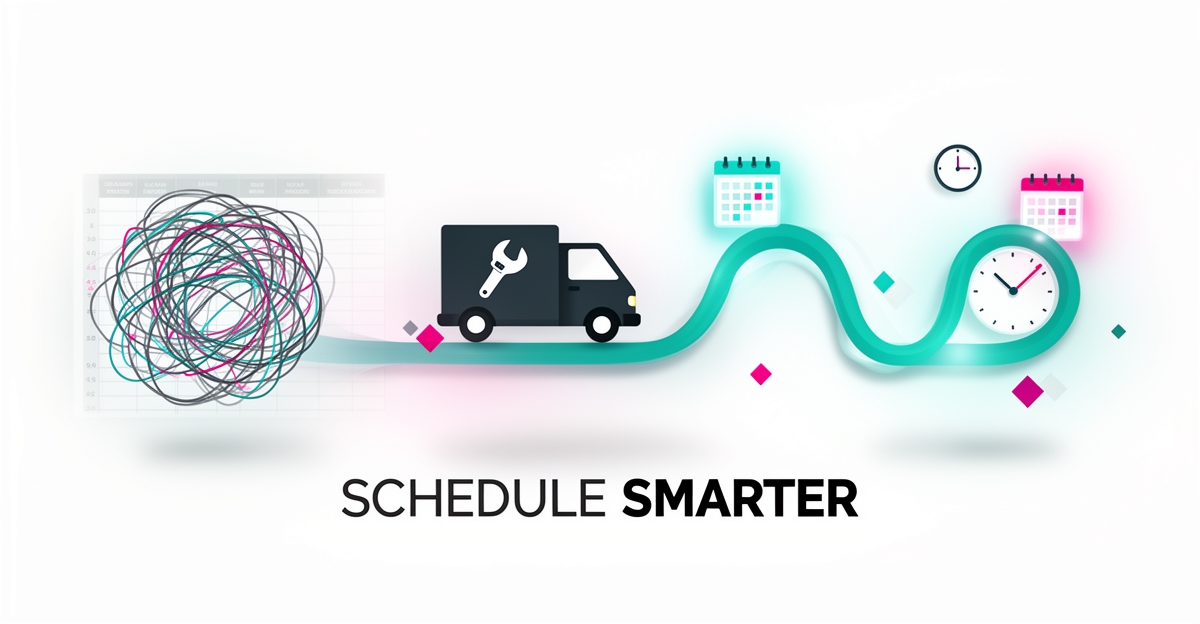
From Manual to AI: Transforming Job Scheduling in Small Drain Cleaning Operations
Key Facts
- Idle time, technicians who are paid but not billable, can consume a significant share of available work hours in poorly scheduled operations.
- Preventable scheduling inefficiencies like overbooking and underutilization typically cost service businesses a meaningful percentage of potential revenue.
- Technicians in inefficiently routed operations can spend a large portion of their day traveling between jobs.
- AI-driven scheduling shifts dispatching from reactive guesswork to proactive, data-informed decisions.
- Small and medium-sized businesses that delay AI adoption risk a widening efficiency gap with larger competitors.
Hire a team member that works 24/7 — for less than a part-time wage.
AI receptionists, SDRs, dispatchers and 99+ roles. Trained on your business, fully managed.
Not sure where to start? Ask our AI planner
The Hidden Costs of Manual Scheduling in Drain Cleaning Operations
Manual scheduling in small drain cleaning operations creates hidden costs that erode profitability and customer trust. When dispatchers rely on paper logs or basic spreadsheets, they often overbook technicians during peak demand while leaving gaps of idle time during slower periods. This imbalance directly impacts service quality, as rushed jobs lead to incomplete work and frustrated customers, while idle time represents wasted labor costs with no revenue generated. These inefficiencies are not just operational hiccups, they are systemic drains on small service businesses that compete on responsiveness and reliability. In home service industries, where timely arrival and job completion are critical satisfaction drivers, poor scheduling practices contribute meaningfully to customer churn.
The financial toll of manual scheduling extends beyond obvious labor waste. Idle time, when technicians are paid but not billable, can consume a substantial portion of available work hours in poorly scheduled operations, turning fixed labor costs into pure overhead. Simultaneously, overbooking forces technicians to rush between jobs or arrive late, increasing the likelihood of callbacks, negative reviews, and emergency re-dispatches that further strain resources. These compounding issues create a cycle where businesses spend more to fix scheduling failures than they would invest in preventive solutions. Industry analysis consistently finds that service businesses lose a meaningful share of potential revenue to preventable scheduling inefficiencies like overbooking and underutilization.
Specific pain points manifest in predictable ways that undermine both daily operations and long-term growth. Dispatchers spend excessive time manually coordinating schedules, leaving less capacity for customer service or business development. Technicians face unpredictable routes that increase fuel costs and vehicle wear, while customers experience inconsistent arrival windows that damage trust. The lack of real-time visibility means problems are often discovered only after a job is missed or a complaint is filed, making recovery more expensive than prevention. These challenges are particularly acute for small drain cleaning businesses operating with limited staff, where one scheduling error can disproportionately impact daily revenue and reputation.
- Technicians spending a large share of their day traveling between inefficiently sequenced jobs
- Missed appointments and late arrivals driven by poorly communicated arrival windows
- Emergency re-dispatches when initial jobs are rushed or incompletely completed
- Dispatcher overtime as staff manually resolve scheduling conflicts
- Repeat service calls when technicians skip diagnostic steps to stay on schedule
AIQ Labs addresses these hidden costs through custom AI scheduling systems that learn from historical job patterns, technician performance, and customer location data to optimize dispatches in real time. Whether through a focused AI Workflow Build that rebuilds your dispatch process at a fixed price, or a broader AI Operating System that connects scheduling with the rest of your operation, these systems reduce idle time, prevent overbooking, and improve first-time fix rates, directly translating operational efficiency into better service quality and stronger customer relationships. The result is a scheduling process that doesn't just avoid waste but actively enhances the reliability and responsiveness that define successful drain cleaning operations.
How AI-Driven Scheduling Solves Real-Time Dispatch Challenges
Manual scheduling in drain cleaning operations often leads to technicians being overbooked or sitting idle between jobs, directly impacting service quality and operational efficiency. This reactive approach fails to account for real-time variables like traffic, job complexity, or technician skill sets, resulting in delayed responses and frustrated customers. Without a system that learns from past patterns, businesses remain stuck in a cycle of guesswork and inefficiency.
AI-driven scheduling transforms this dynamic by analyzing historical job data to predict demand and optimize technician availability in real time. By continuously learning from completed jobs, service durations, and geographic patterns, AI systems can anticipate peak periods and allocate resources proactively. This enables drain cleaning businesses to shift from reactive dispatching to intelligent, data-informed decision-making that aligns workforce capacity with actual service needs.
AI-driven scheduling improves service quality by matching the right technician to the right job based on availability and expertise, which directly enhances customer satisfaction. It also reduces idle time by minimizing gaps between appointments, lowering operational costs and improving efficiency. Furthermore, AI systems increase technician productivity by helping workers prioritize tasks and manage their schedules more effectively, leading to higher output without additional staffing. These benefits are especially valuable for small operations where every hour counts.
- AI analyzes historical job data to forecast demand and optimize future dispatches
- Real-time adjustments account for traffic, job duration, and technician location
- Skill-based matching ensures the right technician handles each job type
- Continuous learning improves scheduling accuracy over time
- Integration with existing tools enables seamless workflow automation
AIQ Labs builds custom AI scheduling systems that learn from a drain cleaning business's unique operational data, such as average job times per service type, common complaint areas, and seasonal demand spikes, to create a dispatch engine that evolves with the business. Unlike generic scheduling tools, these systems are designed to reflect the specific rhythms and challenges of field service operations, ensuring recommendations are both practical and actionable. The result is a smarter, more responsive operation where technicians spend less time waiting and more time solving problems.
By grounding scheduling decisions in data rather than intuition, drain cleaning businesses can eliminate the costly inefficiencies of manual planning. AI doesn't just fill calendars, it optimizes them for speed, accuracy, and service excellence, turning scheduling from a daily headache into a competitive advantage. As the industry moves toward smarter resource allocation, businesses that adopt AI-driven scheduling position themselves to deliver faster, more reliable service while maximizing the productivity of their existing teams.
Implementing AI Scheduling: From Data Integration to Technician Adoption
Moving from a whiteboard and sticky notes to AI-driven scheduling is less about the technology itself and more about preparation, integration, and people. Done in the right sequence, the transition delivers real results; done carelessly, it stalls before it starts.
The first step is data preparation. AI scheduling systems learn from historical data to optimize future dispatches, which means poor data quality or missing records lead directly to suboptimal scheduling decisions. Before anything else, a drain cleaning business should consolidate its past job records, technician availability, and job durations into a clean, accurate form the system can learn from.
Next comes integration with existing tools. AI systems need to connect with current scheduling and dispatch software, and integration remains one of the most common technical challenges of AI adoption in field operations. The goal is a two-way flow of information, jobs in, assignments out, without disrupting how the office already works. This is where custom builds matter: AIQ Labs architects systems with deep integrations into a business's existing CRM, calendar, and dispatch tools, so the AI becomes part of the workflow rather than another disconnected app.
Then comes the human side, which is often the hardest. Small and medium-sized businesses frequently worry that AI investment is out of reach, and limited resources also make technician buy-in and training a genuine challenge. To overcome it, owners should:
- Position AI as a dispatcher's assistant, not a replacement, technicians keep control of what happens in the field
- Provide hands-on training tailored to each role, from office staff to field technicians
- Run the AI alongside manual scheduling for a trial period so the team can compare results
- Create a feedback loop so technicians can flag bad assignments and improve the system
This framing matters because AI represents a fundamental shift in how small businesses approach work, skills, and professional development, not just a technological trend. Technicians who understand the system's reasoning are far more likely to trust and adopt it.
Finally, treat launch as the beginning, not the end. Businesses that succeed with AI continuously monitor and evaluate performance to identify areas for improvement. Track metrics like idle time, jobs completed per day, and customer response, then feed those results back into the system so it keeps learning.
For small operations worried about cost, the path doesn't have to be all-or-nothing. AIQ Labs offers flexible engagement models, you can start monthly, build in milestones, or own the system outright, so you can begin with a single scheduling workflow, prove the value, and scale from there. The businesses that start now will be the ones closing the gap, rather than watching it widen.
Still paying for 10+ subscriptions that don’t talk to each other?
We build custom AI systems you own outright. No vendor lock-in. Full control.
Not sure where to start? Ask our AI planner
Frequently Asked Questions
How much revenue am I actually losing to manual scheduling in my drain cleaning business?
Will AI scheduling replace my dispatcher or technicians?
How does AI actually improve scheduling compared to my current spreadsheet or whiteboard system?
What kind of data do I need before implementing AI scheduling, and what if my records are messy?
Isn't AI scheduling too expensive for a small drain cleaning operation?
How do I get my technicians to actually trust and use an AI scheduling system?
The Scheduling Gap Is Widening, Don't Be on the Wrong Side of It
Manual scheduling quietly drains small drain cleaning operations through idle time, overbooking, and rushed jobs that trigger callbacks and lost customers. AI-driven scheduling flips that equation, matching the right technician to the right job in real time, learning from your historical data, and turning dispatching from a daily headache into a competitive advantage. The real barriers aren't technical; they're preparation, integration, and technician buy-in, all of which are manageable with a phased approach. And the timing matters: small and medium-sized businesses that delay adoption risk a widening efficiency gap with larger competitors. You don't have to overhaul everything at once, start with a single scheduling workflow, prove the value, and scale from there. If you're ready to see what that could look like in your operation, take the two-minute Fit Check at aiqlabs.ai/apply and book a free 30-minute strategy call with an AIQ Labs engineer. It's a working session, not a sales pitch, and if there isn't a clear win for your business, we'll tell you that too.
Make AI your competitive advantage — not just another tool.
Strategy, implementation and ongoing optimization. One partner, end to end.
Not sure where to start? Ask our AI planner