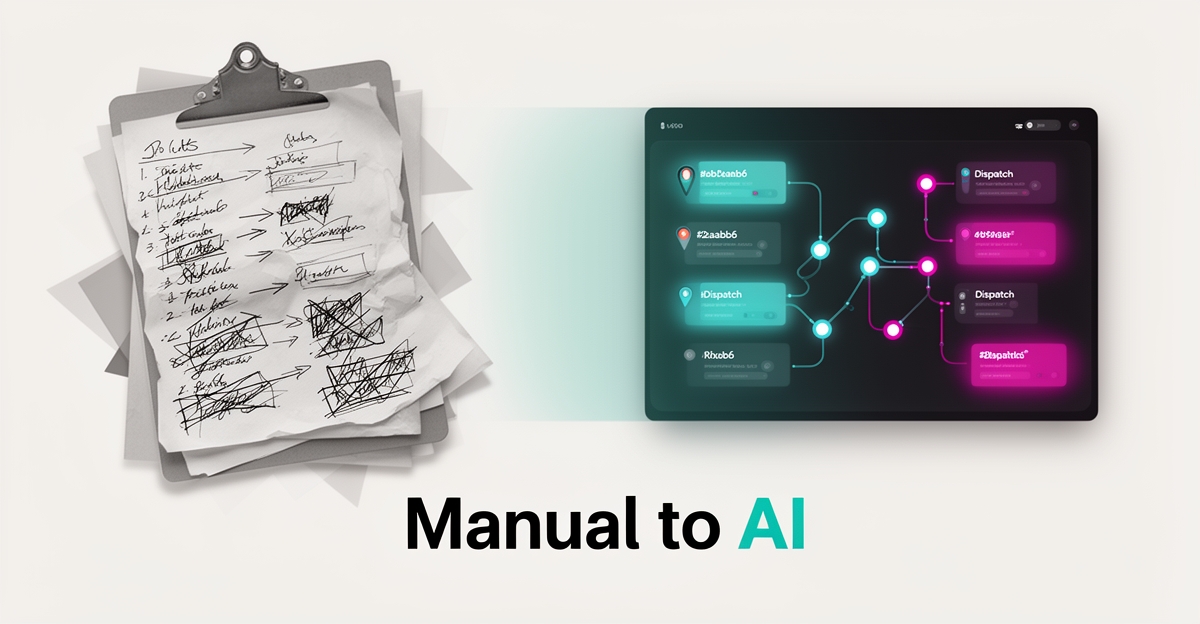
From Manual to AI: Transforming Job Tracking in Furniture Removal
Key Facts
- Manual job tracking creates errors, siloed data, and delayed decisions that compound as job volume grows
- Process mining turns historical job logs into a map of where time and money leak out of every move
- AI dispatch works best with human-in-the-loop controls: AI proposes, your dispatcher approves
- AIQ Labs has deployed 200+ multi-agent systems and runs 4 live SaaS products daily
- AI Employees can handle intake, scheduling follow-ups, and dispatch support at roughly 80% less cost than a comparable human hire
Hire a team member that works 24/7 — for less than a part-time wage.
AI receptionists, SDRs, dispatchers and 99+ roles. Trained on your business, fully managed.
Not sure where to start? Ask our AI planner
Why Paper-Based Job Tracking Is Breaking Furniture Removal Operations
Furniture removal businesses still relying on paper-based job tracking are fighting an uphill battle against inefficiencies that directly impact their bottom line. Manual data entry introduces costly errors, siloed information prevents real-time visibility, and slow decision-making cascades into delayed jobs and frustrated customers. These pain points aren't just inconvenient, they're systemic barriers to scaling operations in an industry where timing and accuracy are everything.
Field services like furniture removal have been slow to adopt AI-driven tooling, and the gap shows up in daily operations: jobs booked twice, crews waiting on updated manifests, dispatchers reconstructing the day from voicemails and sticky notes. Manual processes stay entrenched because they're familiar, not because they work. AI-driven systems can eliminate these bottlenecks through automated job tracking, intelligent dispatching, and real-time performance monitoring.
- Manual entry errors leading to incorrect job details, missed appointments, and billing disputes
- Siloed data preventing dispatchers from seeing crew availability or job status in real time
- Slow decision-making due to delayed information flow between field crews and office staff
- Inability to scale operations without proportional increases in administrative overhead
- Limited visibility into performance metrics that could identify bottlenecks or training needs
AIQ Labs helps furniture removal companies bridge this gap by transforming paper-based workflows into AI-powered systems that continuously learn and optimize. Through [AI Workflow Builds](/workflow-builds), we rebuild the one workflow that costs you the most, often dispatch and job tracking, at a fixed price, in phases. The result isn't just digitization; it's a foundation for operational resilience.
The AI Transformation Framework for Job Tracking
The shift from manual job tracking to AI-driven systems demands more than just new technology, it requires a holistic transformation framework. For furniture removal businesses, this means aligning AI initiatives with core operational goals like route optimization and crew scheduling while building a resilient data foundation from job logs, customer details, and equipment usage. AIQ Labs' approach integrates strategic planning with technical execution to ensure AI enhances, rather than disrupts, existing workflows.
A strong data foundation is critical, as AI systems rely on accurate, accessible information to function effectively. Organizations that invest in data governance and modern platforms typically see faster AI adoption and better returns on investment. Preparing your team alongside the technology matters just as much: dispatchers and drivers need to know how to interpret AI-generated insights and act on recommendations, or the system becomes shelfware.
The technology stack must support scalability and real-time collaboration, combining modern foundation models with MLOps practices for continuous monitoring and retraining. Connecting AI to your CRM, scheduling, and inventory systems enables end-to-end visibility, turning fragmented paper logs into a unified operational view. AI can weigh far more variables at once than any dispatcher, but human oversight remains essential for contextual decisions like handling fragile items or accommodating last-minute client changes. Governance frameworks ensure ethical use, bias mitigation, and compliance, while change management addresses workforce concerns through clear communication and upskilling.
Ultimately, success lies in creating agentic systems where AI agents orchestrate tasks across tools, learn from outcomes, and collaborate with human teams. This isn't about replacing workers, it's about augmenting their expertise with machine efficiency to unlock capacity, reduce errors, and enable continuous improvement. As AI handles routine tracking and alerts, human teams focus on complex problem-solving and customer relationships, driving both operational excellence and sustainable growth.
From Baseline to AI-Powered Dispatch: A Practical Implementation Path
Paper-based job tracking in furniture removal creates delays, lost updates, and crews waiting on information. Moving to AI-driven dispatch starts with understanding the current reality before layering intelligence on top.
Establish a baseline for your organization's needs by mapping volume, crew capacity, and the legal and regulatory environment relevant to removals. Document processes, roles, and responsibilities for job intake, quoting, scheduling, and completion. This creates the data foundation AI systems need to learn and optimize.
Define clear objectives for cost and speed while maintaining quality and compliance. Know what "better" looks like before you build: fewer double-bookings, faster quote turnaround, fewer billing disputes.
Document processes and roles with precision. Outline how jobs are identified, quoted, scheduled, and closed. Describe how vendors and subcontractors are evaluated and selected, including criteria and evaluation steps. Set out how agreements are managed, including execution, monitoring, and renewal or termination.
Establish policies and standards that govern who is authorized to initiate, approve, and finalize jobs and purchases. Link policies to ethical standards, conflict of interest, and confidentiality guidelines. Specify oversight and accountability for compliance.
Build supporting tools and templates for quotes, evaluation checklists, and job intake forms. Evaluate capabilities honestly: assess staff, budget, expertise, and whether current technology supports your operations or requires new investment.
Integrate AI for workforce transformation by investing in training so employees build new capabilities. Review job structures and daily tasks to create dynamic roles where humans and AI contribute. For routine intake and follow-up, an [AI Employee](/ai-employees), a managed digital receptionist or dispatcher, can handle the repetitive layer at roughly 80% less cost than a comparable human hire, while your team keeps judgment calls.
Design better AI experiences with step-by-step visibility and workflow integration. AI should weave into existing dispatch journeys, not interrupt them. Prioritize user needs first, revisit key journeys, and track accuracy, failure rates, and drop-offs.
A practical implementation path for furniture removal includes:
- Baseline tracking needs and current dispatch bottlenecks
- Define objectives for cost, speed, and service quality
- Document processes, roles, policies, and supporting templates
- Evaluate capabilities and integrate AI where it pays back fastest
- Design AI experiences with visibility and workflow integration
AIQ Labs approaches this as process mining and optimization, building systems that continuously learn and improve operations. For companies ready to go further, an [AI Operating System](/ai-operating-systems) connects dispatch, scheduling, billing, and customer communication into one operating layer, built in phases and owned outright. Human judgment remains irreplaceable for high-stakes decisions, while AI handles pattern detection and efficiency at scale.
Human-AI Collaboration and Governance in the Field
Furniture removal crews live on context, the narrow stairwell, the fragile heirloom, the customer's timeline. AI can map bottlenecks and suggest routes, but it cannot feel the job.
Trust breaks when automation ignores that reality. Adoption gaps in field services usually signal trust deficits, skills gaps, and cultural resistance that surface in the field, not in the dashboard.
Human judgment remains irreplaceable in high-stakes decisions because AI optimizes for efficiency without access to relationship history, ethical weight, and lived experience. AI can process enormous volumes of variables at once, yet judgment is still not quantifiable.
Designing collaboration starts with governance that makes augmentation explicit.
Human-in-the-loop controls keep dispatchers and crews in authority. AI proposes job sequences and flags exceptions; humans approve changes that affect customers, safety, or crew capacity. Explainability is built in so teams can ask "why did AI do that?" and refine inputs without losing confidence.
Bias mitigation and privacy compliance are operational, not theoretical. Process mining surfaces patterns from historical job tracking, but models must be audited for bias in routing, prioritization, and crew assignment. Data handling should follow applicable privacy regulations with audit trails for every automated suggestion.
Change management closes the adoption gap. Short, role-specific training for dispatchers and crews, clear playbooks for when to override AI, and feedback loops that feed field experience back into the model build competence and ownership.
AIQ Labs approaches this through process mining and automation that continuously learns from operations, while keeping human judgment at the decision point. The result is a system that augments dispatchers and crews rather than replacing contextual decision making.
- Define escalation rules for safety, customer relationship, and exception handling
- Provide step-by-step visibility into AI recommendations with editable outcomes
- Run structured AI literacy and change programs to reduce resistance
- Monitor performance, drift, and cost with human review checkpoints
When crews see AI as a partner that handles repetition and surfaces insight, adoption shifts from compliance to preference.
Still paying for 10+ subscriptions that don’t talk to each other?
We build custom AI systems you own outright. No vendor lock-in. Full control.
Not sure where to start? Ask our AI planner
Frequently Asked Questions
Why should I switch from paper-based job tracking to AI for my furniture removal business?
Will AI replace my dispatchers and moving crews?
How long does it take to implement AI job tracking, and what's the ROI?
What are the biggest challenges when moving from manual to AI-driven dispatch?
How does AI job tracking actually work with my existing systems?
What kind of results can furniture removal companies expect from AI transformation?
Your Dispatch Advantage Starts With Better Tracking
Moving from paper logs to AI-driven job tracking isn't about replacing crews, it's about removing the friction that slows them down. When manual entry errors, siloed data, and delayed decisions are replaced with real-time visibility, automated dispatch, and continuous process learning, furniture removal businesses gain speed, accuracy, and capacity without proportional overhead. The transformation works best when AI augments human judgment: machines handle pattern detection and repetition while dispatchers and crews keep authority over safety, customer relationships, and exceptions. Start by mapping your current dispatch bottlenecks, defining clear objectives for cost and service quality, and building a data foundation that AI can learn from. The gap between manual and AI-enabled operations widens every year you wait. AIQ Labs can help you assess fit and design a practical path forward. Start the 2-minute Fit Check at aiqlabs.ai/apply to book a free 30-minute strategy call, or reach us at [email protected].
Make AI your competitive advantage — not just another tool.
Strategy, implementation and ongoing optimization. One partner, end to end.
Not sure where to start? Ask our AI planner