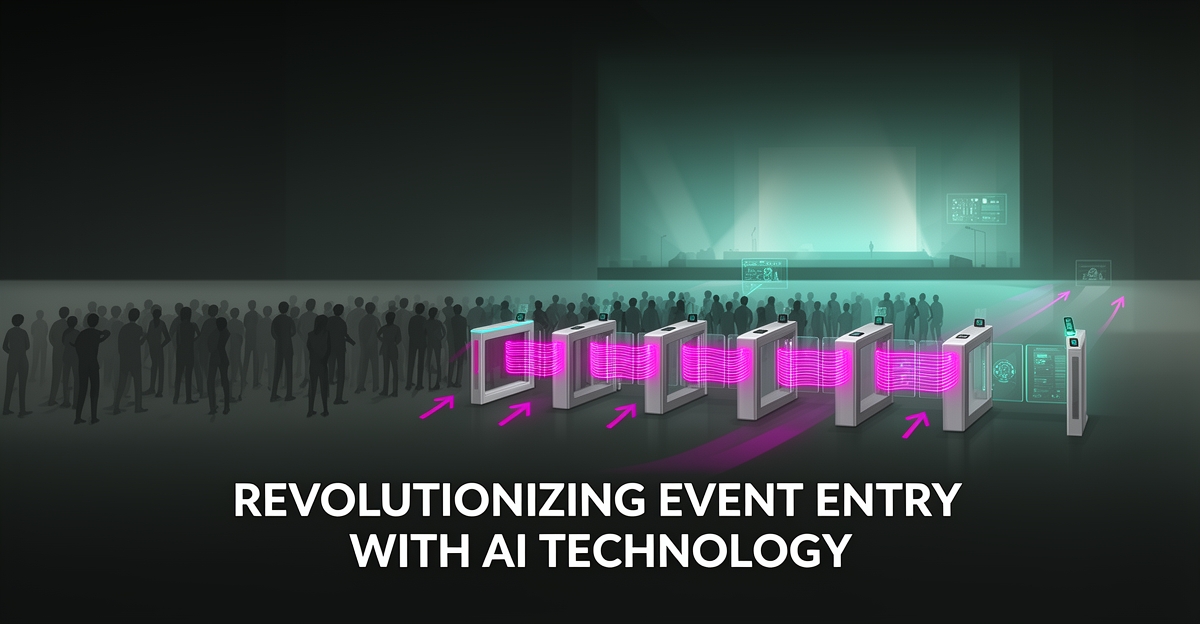
From Manual to AI: Transforming Line Management at Live Music Events
Key Facts
- Manual entry checks, crowd counting and stage changeovers are among the largest controllable labor expenses a venue carries
- AI-driven crowd flow tools use computer vision and predictive analytics to adjust entry points and staffing in real time
- Automated entry validation typically verifies tickets and credentials far faster than manual ID checks, reducing bottlenecks
- AI-orchestrated stage transitions coordinate lighting, sound, rigging and crew cues to minimize downtime between acts
- AIQ Labs has deployed 200+ multi-agent systems and runs 4 live SaaS products daily
- AI Employees typically cost around 80% less than an equivalent human hire
Hire a team member that works 24/7 — for less than a part-time wage.
AI receptionists, SDRs, dispatchers and 99+ roles. Trained on your business, fully managed.
Not sure where to start? Ask our AI planner
The Hidden Cost of Manual Line Management at Live Events
Every sold-out show depends on hundreds of invisible tasks happening in perfect sequence—queues moving, IDs checked, stages swapped between sets. When those tasks run manually, the costs pile up quietly: overtime pay, frustrated fans, and minutes of dead air that no one invoices for but everyone remembers.
The scale of the problem is easy to underestimate. Stage changeovers, gate staffing and queue management consume enormous blocks of paid labor across a tour calendar. Multiply those hours across a season and staffing becomes one of the largest controllable expenses a venue carries.
Manual line management creates its own compounding costs:
- Staffing overhead that scales linearly—more attendees means more door staff, more supervisors, more overtime.
- Entry bottlenecks from human-paced ticket and ID checks, which push arrivals back and compress pre-show spending windows.
- Stage transition downtime where manual changeovers stretch into hours of idle crowd time.
- Human error in access control and scheduling, creating security gaps and inconsistent guest experiences.
The fan experience suffers alongside the balance sheet. Bottlenecks at entry points mean fans miss opening acts, and long changeovers drain energy from the room. Meanwhile, most venue operations still run on clipboard-era processes—spreadsheets, radios, and paper checklists—while the industry steadily shifts toward connected, automated operations.
There's also a labor dimension. Event operations are repetitive, checklist-driven and time-sensitive—exactly the kind of work AI systems now handle faster and more consistently. Venues that keep these workflows manual will keep paying premium wages for work machines can do around the clock. Managed AI staff such as [AI Employees](/ai-employees) typically run around 80% less than an equivalent human hire, and they don't call in sick on a sold-out Saturday.
Capital is flowing toward venues that automate, and the gap between automated and manual operations widens every season. This is precisely where AI workflow and task automation changes the math. Systems like those built by AIQ Labs handle real-time event operations—crowd flow, entry checks, stage transitions—with minimal downtime, freeing human staff for judgment calls and guest care rather than gate counting. For venue operators, the hidden cost of manual management isn't just inefficiency; it's the competitive ground ceded to venues that have already automated it.
How AI Automates Critical Event Workflows in Real Time
Live music events demand precision timing and seamless coordination to deliver flawless experiences. AI-driven automation is now transforming critical workflows in real time, allowing venues to optimize crowd flow, streamline entry validation, and manage stage transitions with minimal human intervention. These systems process live sensor and ticketing data to make instant adjustments that keep events running smoothly and safely.
AI-powered crowd flow optimization uses computer vision and predictive analytics to monitor attendee movement and dynamically adjust entry points, concession staffing, and security deployment. By analyzing real-time density patterns, these systems reduce bottlenecks and improve evacuation readiness—translating to faster turnarounds and more reliable scheduling.
Automated entry validation leverages AI to verify tickets, scan credentials, and detect fraudulent access attempts at speeds far exceeding manual checks. Integrated with barcode scanning and credential databases, these systems typically validate entry in a matter of seconds per attendee while flagging anomalies for human review. This cuts wait times and enhances security, reducing the rushed, error-prone handoffs that lead to show delays.
Dynamic stage transition management coordinates lighting, sound, rigging, and crew movements through AI-orchestrated workflows that adapt to real-time performance data. By synchronizing technical teams via intelligent alerts and automated cues, venues minimize downtime between acts and reduce human error. This level of automation reflects a broader industry trend: organizations increasingly trust AI with complex, time-sensitive frontline operations.
For venues seeking to implement these capabilities, AIQ Labs offers [AI Workflow Builds](/workflow-builds) designed specifically for live event environments: rebuild the one workflow that costs you the most, at a fixed price, delivered in phases. These production-ready systems integrate with existing ticketing, access control, and production tools—delivering measurable improvements in safety, efficiency, and attendee satisfaction without requiring venues to manage the underlying AI infrastructure themselves. As event technology continues to evolve, real-time AI automation is becoming a foundational element of modern music venue operations.
From Pilot to Platform: Implementing AI Line Management with AIQ Labs
AIQ Labs follows a proven, phased approach to deploying AI-powered line management at live music events, starting with workflow assessment and scaling through iterative milestones. The process begins with a discovery phase where business process analysis and requirements gathering identify bottlenecks in gate scanning, crowd density monitoring, or stage transition workflows. This is followed by solution architecture design and ROI projection, ensuring the AI system aligns with operational goals before any development begins.
Next, custom AI agents are built using enterprise-grade multi-agent frameworks, enabling specialized functions such as real-time crowd analysis via computer vision or automated ticket validation through integrated API connections. These agents are developed and tested in isolation, then integrated with existing venue systems—including access control platforms, CRM tools, and scheduling software—during the development and integration phase. Security implementation and compliance verification are embedded throughout, particularly important for systems handling attendee credentials and payment data.
Deployment occurs in controlled stages, starting with a pilot focused on a single high-impact task—such as monitoring entry queues or detecting overcrowding zones—allowing venues to validate performance before broader rollout. During this phase, user training is customized to each role, documentation is delivered, and performance monitoring is set up to track key metrics. AIQ Labs' Build in Milestones model supports this approach: venues approve and pay for each phase as it ships, retain all work completed, and can pause or adjust anytime without losing progress. This reduces risk while enabling steady advancement toward full automation.
Once the pilot demonstrates measurable improvements—such as reduced entry wait times or faster incident response—the system scales to additional workflows, like dynamic concession staffing or real-time stage transition coordination. Continuous optimization follows, with feature enhancements and capability expansion driven by real-time performance data. Throughout, AIQ Labs provides ongoing management, retraining, and support as part of the Start Monthly model, ensuring the AI Employees or custom systems keep improving. For venues that want a single connected layer across ticketing, staffing, access control and guest communication, an [AI Operating System](/ai-operating-systems) ties it all together—built in phases and owned outright. This structured, low-risk path transforms manual line management into a resilient, AI-driven operation—boosting safety, satisfaction, and efficiency without requiring venues to build internal AI expertise from scratch.
Still paying for 10+ subscriptions that don’t talk to each other?
We build custom AI systems you own outright. No vendor lock-in. Full control.
Not sure where to start? Ask our AI planner
Frequently Asked Questions
How much time can AI actually save on event setup compared to manual line management?
Will AI replace my door staff and security team?
How fast is automated entry validation compared to manual ID checks?
What's the risk of investing in AI for a single venue or smaller event space?
Can AI really manage unpredictable crowd flow better than experienced staff?
How do I start implementing AI line management without disrupting current operations?
Turn Invisible Work into Visible Value
From entry bottlenecks to stage changeovers, manual line management silently drains resources at live events—costing venues in overtime, missed revenue, and frustrated fans. AI automation flips that script: cutting labor hours, reducing errors, and freeing staff to focus on guest experience instead of gatekeeping. Venues investing in real-time workflow automation are gaining efficiency, safety, and scalability while those relying on clipboards and guesswork fall behind. For live music operators ready to stop paying for inefficiency, the path forward starts with pinpointing where AI can deliver the fastest impact. Take the first step with a free strategy session to map your biggest operational bottleneck and see where AI can unlock measurable gains—no obligation, just clarity on your opportunity to transform how your venue runs. Start with the 2-minute Fit Check at [/apply](/apply) or reach the team at [email protected].
Make AI your competitive advantage — not just another tool.
Strategy, implementation and ongoing optimization. One partner, end to end.
Not sure where to start? Ask our AI planner