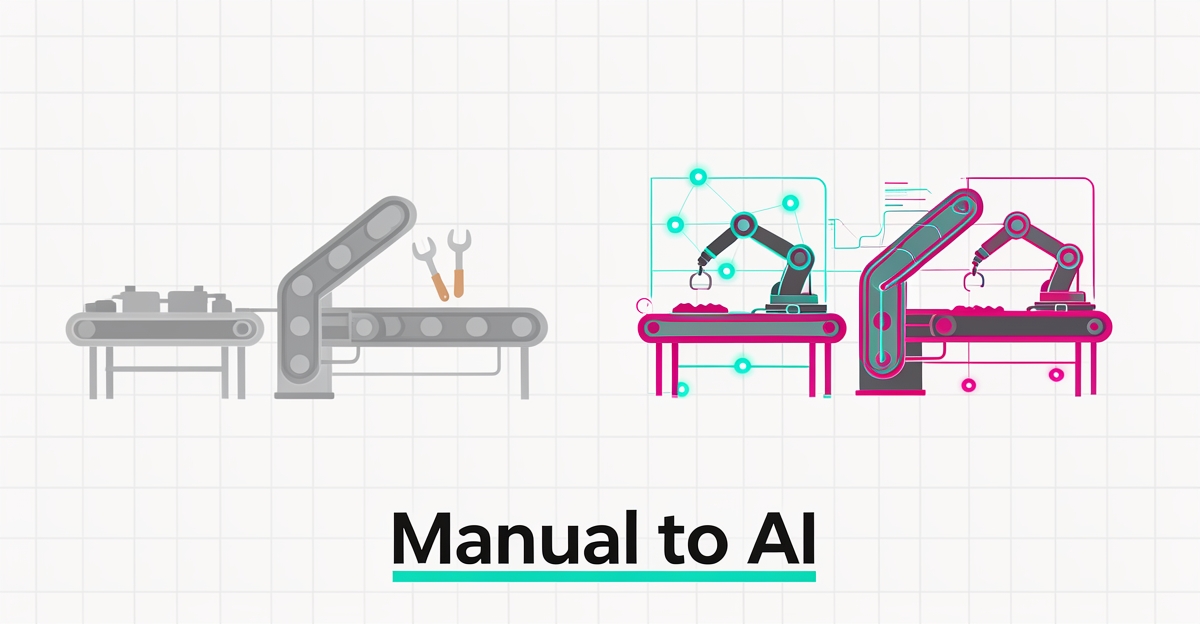
From Manual to AI: Transforming Meat Processing Workflows with Smart Automation
Key Facts
- Global meat demand continues to climb, putting sustained throughput pressure on processing plants
- Meat is classified as a non-standard flexible material with significant variations in mechanical properties
- Labor scarcity, injury risk, and contamination exposure make manual workflows increasingly costly
- Effective automation requires a sensing-control-actuation stack, not simple pick-and-place robotics
- AIQ Labs has deployed 200+ multi-agent systems and runs 4 live SaaS products daily
- AIQ Labs offers a free two-minute Fit Check followed by a 30-minute strategy call to assess AI transformation opportunities
Hire a team member that works 24/7 — for less than a part-time wage.
AI receptionists, SDRs, dispatchers and 99+ roles. Trained on your business, fully managed.
Not sure where to start? Ask our AI planner
The Pressure Point: Why Manual Meat Processing Can't Keep Up
The meat processing floor is hitting a wall it cannot cut through with hands alone. Demand keeps climbing while the workforce to meet it keeps shrinking, and manual workflows are buckling under the weight of scale, variability, and risk.
Global meat demand has grown steadily for decades and shows no sign of reversing as of late 2026. Every point of that growth lands on processing floors as throughput pressure that manual lines increasingly cannot sustain.
Labor scarcity is the most visible pressure point. Physically demanding, repetitive tasks drive turnover and limit shift coverage, while experienced operators are hard to recruit and retain. The result is overtime, bottlenecks, and inconsistent output across shifts.
Safety and contamination risk compound the problem. Manual handling exposes workers to injury and increases the chance of cross-contamination. Inconsistent manual workflows also create variability in cut quality, yield, and waste, which erodes margin on every carcass.
Product variability makes standardization difficult. Meat is a non-standard flexible material with varying viscoelasticity and stickiness. Different parts require different forces and handling, and size variation across livestock means a single manual method rarely fits all.
These constraints show up daily as:
- Throughput ceilings during peak production windows
- Yield loss from inconsistent cuts and handling errors
- Increased injury rates and absenteeism on the line
- Difficulty maintaining traceability and quality standards at scale
Plant managers face a compounding equation: more animals to process, fewer people to process them, and higher expectations for safety and food safety compliance. Without change, the gap widens between demand and reliable capacity.
This is where process mapping becomes critical. A step-by-step mapping of current meat processing operations reveals where time, labor, and product are lost. AIQ Labs approaches this through [AI Workflow Builds](/workflow-builds), rebuilding the one workflow that costs you the most, at a fixed price, in phases, so improvements are targeted where the waste actually is.
The pressure is not theoretical. It is measured in missed production targets, rising labor costs, and inconsistent manual workflows that cannot keep pace with demand. Automation is no longer optional; it is the only way to meet volume, safety, and quality demands simultaneously.
Why Meat Resists Traditional Automation (And What Actually Works)
Meat processing defies the clean, repeatable motions that make automation easy in other industries. The material itself fights back, and the environment makes precision hard to sustain.
Meat is widely classified in robotics research as a non-standard flexible material with significant variations in mechanical properties. Different cuts exhibit varying viscoelasticity, stickiness and deformability, so a grip or cut that works on one piece fails on the next.
That variability forces a sensing-control-actuation stack far beyond simple pick-and-place. Systems must integrate perception, real-time force adjustment and robust manipulation to handle inconsistency without damage or waste.
The sensing layer is the first barrier. Accurate execution requires detecting external features, internal characteristics and tissue boundaries in a wet, fast-moving line. Common approaches include:
- Color cameras for external features like tag detection and surface inspection
- Ultrasound imaging for internal carcass grading
- Laser profiling for tissue boundary identification during precision cutting
Control must translate those perceptions into safe motion. Complex contours are discretized into points and fitted into seamless curves for cutting routes, while force control dynamically adjusts to varying elasticity and stickiness at different points.
Actuation adds another layer of difficulty. Processing large livestock requires heavier, more robust machinery with greater range of motion and degrees of freedom. Industrial manipulators from manufacturers such as KUKA, FANUC and ABB are commonly employed, but even these need adaptive end-effectors and compliance control to avoid tearing.
Environmental factors compound the challenge. Harsh, wet conditions with contamination risk limit sensor durability and robot sensitivity to size variations and material deformability. Traditional automation struggles where flexibility is the norm.
Scale intensifies pressure. As global production volumes grow, manual labor cannot absorb the increase safely. This is why mapping current operations and identifying inefficiencies is the starting point for change. AIQ Labs works with SMBs to map meat processing workflows and restructure them with data-driven systems for faster throughput and fewer waste points. The technical barriers are real, but they are solvable with the right sensing, control and actuation integration.
Mapping Before Machines: Finding Your Inefficiencies and Waste Points
Before any robot touches meat, the workflow has to be understood in detail. Mapping current operations reveals where labor, risk, and variability accumulate, and where AI can deliver the highest return.
Meat processing is not a uniform line. Meat's classification as a non-standard flexible material with significant variations in mechanical properties drives inefficiency across cutting, trimming, and packaging stages.
With production volumes rising industry-wide, throughput pressure is intensifying, and every point of growth amplifies the cost of waste and downtime.
Comprehensive operational mapping starts with documenting every stage from receiving to cold storage. Teams log cycle times, hand-offs, rework loops, and where products wait. This diagnostic groundwork makes inefficiencies visible before any technology is selected.
A focused mapping exercise typically surfaces:
- Labor-intensive and repetitive tasks prone to worker scarcity and fatigue
- Safety and contamination risks from manual handling in wet, cold environments
- Product variability points where size, viscoelasticity, and stickiness change cutting forces
- Bottlenecks between stations that create queues and temperature exposure
Identifying labor-intensive processes is critical because physically demanding, repetitive work is both a safety concern and a recruitment challenge. Assessing safety and contamination risks shows where mechanization reduces human exposure while improving food safety compliance.
Analyzing product variability requirements is equally important. Different cuts require different forces and tool paths, and robotic systems must adapt to inconsistencies in real time. Mapping these characteristics informs sensing and control design later.
This step is the foundation of process mining and optimization. AIQ Labs uses this diagnostic phase to pinpoint where custom data-driven systems can restructure workflows for faster throughput and fewer waste points. Without clear baseline data, automation targets are guesses.
The output is a current-state map with quantified waste points, risk zones, and variability drivers. That map determines where AI delivers the highest ROI and guides the design of sensing, control, and actuation modules tailored to the facility.
Rebuilding the Workflow: AI-Driven Throughput and Waste Reduction
Rebuilding the workflow in meat processing requires more than just adding automation, it demands a complete restructuring of operations using AI-driven systems that adapt in real time. By mapping current processes first, facilities can pinpoint where manual handling creates bottlenecks, safety risks, and inconsistent yields. This foundational step enables AIQ Labs to design custom solutions that replace guesswork with data-driven precision, aligning every stage of processing with measurable outcomes.
Adaptive sensing and control systems form the core of this transformation, using computer vision and force feedback to handle meat's natural variability. Unlike rigid robotic arms that fail with irregular shapes, AI-powered systems adjust cutting paths and pressure in real time based on imaging, laser profiling, and color detection, ensuring clean cuts even as tissue density shifts. These capabilities directly address the industry's challenge with non-standard flexible materials, where traditional automation struggles due to inconsistent viscoelasticity across carcasses.
Throughput optimization emerges from continuous data analysis, where AI identifies patterns in yield loss, rework rates, and cycle times that human operators miss. Facilities implementing such systems typically see fewer trim losses and more consistent portion weights, directly impacting profitability. By reducing reliance on skilled labor for repetitive, high-risk tasks, AI also mitigates safety concerns, cutting exposure to sharp tools and contamination zones.
A layered monitoring and governance framework ensures these gains are sustainable, tracking AI performance against KPIs like waste reduction and throughput consistency. This approach contrasts sharply with traditional methods, where quality depends on individual operator skill and fatigue levels. With AI, decisions become repeatable, traceable, and scalable across shifts and facilities, turning variability into a controllable variable rather than a source of waste. The result is a workflow that doesn't just run faster, it runs smarter, safer, and with significantly less loss at every stage.
Your Implementation Path: From Pilot to Owned AI System
Starting with a clear discovery phase ensures your AI transformation addresses real operational pain points rather than chasing technology for its own sake. AIQ Labs begins by mapping your current meat processing workflows to identify labor-intensive tasks, safety risks, and waste points. This foundational analysis informs a tailored architecture that aligns with your facility's specific product variability and throughput goals.
Development and integration follow a phased approach where you validate each component before moving forward. Whether you choose to Start Monthly with an [AI Employee](/ai-employees) handling a single workflow like inventory forecasting or scheduling, Build in Milestones for a department-scale system such as cutting line optimization, or Own It Outright for a complete [AI Operating System](/ai-operating-systems) connecting your entire operation, progress is transparent and measurable. Each phase includes rigorous testing against real-world conditions, adapting to meat's non-standard flexible material properties and integrating sensing systems for external feature detection and tissue boundary identification.
Deployment and training focus on seamless adoption by your team, with customized role-based instruction and performance monitoring setup from day one. Ongoing optimization then drives continuous improvement, leveraging AI to restructure workflows for faster throughput and fewer waste points through data-driven decision making. As your system evolves, AIQ Labs provides the governance, scalability, and innovation support needed to maintain peak performance in demanding processing environments.
Ready to map your specific opportunity? Start the Fit Check, a two-minute assessment, then schedule your Free 30-Minute Strategy Call to see exactly how AI can transform your meat processing workflows with clear ROI projections and zero obligation.
Still paying for 10+ subscriptions that don’t talk to each other?
We build custom AI systems you own outright. No vendor lock-in. Full control.
Not sure where to start? Ask our AI planner
Frequently Asked Questions
Why is manual meat processing struggling to keep up right now?
What makes meat so hard to automate compared to other products?
Do robots actually work in wet, cold processing environments?
Where should we start if we want to automate our plant?
Will automation reduce injuries and contamination risk?
How much does it cost to get started?
Your Path to Smarter Meat Processing Starts Here
The meat processing industry stands at a critical inflection point where rising demand, labor constraints, and safety pressures can no longer be met by manual workflows alone. As outlined, the path forward begins with detailed operational mapping to uncover inefficiencies, followed by AI-driven restructuring that adapts to meat's natural variability through intelligent sensing, control, and actuation. This isn't about replacing workers, it's about empowering teams with systems that reduce waste, improve yield, and create safer, more consistent operations at scale. AIQ Labs helps SMBs navigate this transformation with end-to-end support, from process mining to owned AI solutions that deliver measurable throughput gains and fewer waste points. If you're ready to see where AI can make the biggest impact in your facility, start with the two-minute [Fit Check](/apply) to map your specific opportunity, then schedule your free 30-minute strategy call for clear ROI projections and zero obligation.
Make AI your competitive advantage — not just another tool.
Strategy, implementation and ongoing optimization. One partner, end to end.
Not sure where to start? Ask our AI planner