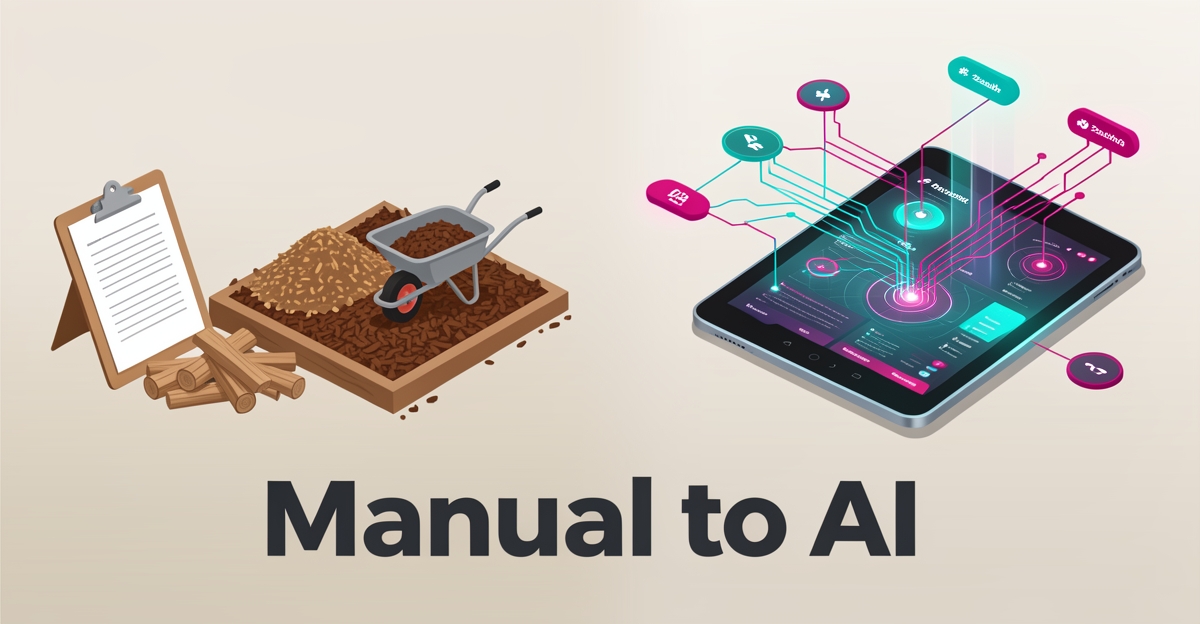
From Manual to AI: Transforming Mulching Service Job Tracking and Reporting
Key Facts
- Paper-based job tracking fragments information across clipboards, filing cabinets, and individual memories, making a real-time view of crew progress and material usage nearly impossible.
- Automation doesn't magically fix problems, it makes them visible, revealing hidden inefficiencies like undocumented field adjustments and inconsistent shift practices.
- Digitizing a broken process just produces the same errors faster; real gains come from redesigning end-to-end information flows.
- AI-powered tracking can dramatically reduce manual effort on routine tasks like reporting and job logging for mulching services.
- Owned AI systems eliminate per-seat subscription costs and vendor lock-in, keeping your operational data under your control.
Hire a team member that works 24/7 — for less than a part-time wage.
AI receptionists, SDRs, dispatchers and 99+ roles. Trained on your business, fully managed.
Not sure where to start? Ask our AI planner
The Hidden Costs of Paper-Based Mulching Operations
Many mulching services still rely on paper forms and manual logs to track jobs, creating a hidden drag on operations that grows with every completed project. This approach fragments information across clipboards, filing cabinets, and individual memories, making it nearly impossible to get a real-time view of crew progress, material usage, or client commitments. As a result, reporting delays of days or even weeks become routine, forcing managers to make scheduling and invoicing decisions based on stale or incomplete data. These visibility gaps don't just slow daily operations, they actively prevent service businesses from identifying inefficiencies or scaling reliably.
The consequences of paper-based tracking extend far beyond administrative hassle. Manual handoffs between field crews, dispatchers, and office staff introduce consistent error rates, with misread handwriting, lost forms, and duplicate entries corrupting job records and client histories. When information must be re-entered multiple times, from field notes to paper logs to billing systems, each transfer point becomes a risk for inaccuracies that ripple through payroll, inventory, and customer communication. Over time, these small errors accumulate into significant operational friction, eroding trust in the data and forcing teams to spend hours verifying details that should be automatic.
Automation doesn't just speed up existing tasks, it exposes the hidden flaws in current processes. It reveals undocumented workarounds, inconsistent shift practices, and resource waste that paper systems inadvertently conceal. For mulching services, this means that moving to digital tracking isn't just about replacing forms with tablets; it's an opportunity to redesign how job data flows from the field to the invoice, eliminating redundant steps and creating a single source of truth. Without this visibility, businesses remain trapped in a cycle of reactive firefighting, unable to predict bottlenecks or optimize routes based on actual performance data. AIQ Labs helps uncover these hidden inefficiencies through process mining, laying the groundwork for systems that don't just track work, but improve it.
Why Workflow Redesign Beats Simple Digitization
Many mulching businesses start their digital journey by simply converting paper forms to digital ones, only to discover that their operational bottlenecks remain stubbornly intact. The uncomfortable truth is that digitizing a broken process merely creates a faster way to generate the same errors.
The real power of AI lies not in helping people complete isolated tasks faster, but in redesigning end-to-end information flows. When you simply layer AI tools onto existing manual workflows, you may capture some efficiency gains, but you leave significant value on the table. The fundamental question isn't how to digitize your current job tracking, it's how information enters your organization, how it's validated, and where manual handoffs create friction.
This distinction separates incremental improvement from genuine transformation. Automation doesn't magically fix problems, it makes them visible. When mulching operations implement true workflow redesign, hidden inefficiencies surface immediately, revealing where paper-based processes masked deeper operational issues.
Consider what workflow redesign actually examines:
- How job data enters the system and gets validated
- Where teams repeatedly recreate the same analysis
- Which handoffs require too many documents and manual interventions
- How information moves between field crews and office staff
For mulching businesses, this shift means moving beyond simple scheduling apps to integrated systems where job data flows seamlessly from initial client contact through completion and reporting. AIQ Labs approaches this through AI Workflow Builds, rebuilding the one workflow that costs you the most, at a fixed price and in phases, so automation addresses root causes rather than symptoms. The goal isn't just faster paperwork; it's operational leverage that transforms how your entire business functions.
The Visibility-First Approach to AI Implementation
The first week of digital tracking is rarely smooth because the system starts telling the truth. Manual mulching operations hide variation in paper logs, verbal hand-offs, and field adjustments that never get recorded. When real-time monitoring goes live, those undocumented workarounds surface immediately.
Automation does not magically fix problems, it makes them visible. Hidden practices like leaving equipment partially operational or making undocumented manual adjustments show up the moment digital systems go live. That visibility is the prerequisite for real improvement.
Process mining exposes where gut-feel management has been masking inconsistency. One dashboard that shows all flows prevents cascading failures and removes the confusion and blame that comes from shift-to-shift differences. When every crew sees the same numbers, decisions stop being personal and start being operational.
Real-time monitoring changes the quality of information managers can act on. End-of-day reports arrive too late to correct a route or a mix ratio. Automated data collection gives immediate quality data so teams can adjust processes quickly and boost output, industrial operations that have moved to real-time monitoring typically report tighter process variation and meaningful throughput gains.
For mulching services, visibility-first implementation typically surfaces:
- Job start and completion times that differ from what dispatch believed
- Material usage variances tied to undocumented field adjustments
- Route deviations and rework loops that are invisible on paper
- Client communication gaps between crews and office staff
The shift moves leadership from intuition to consistent metrics across all teams. Businesses that commit fully to redesigning processes around AI, rather than just adding tools, tend to see better decision-making and stronger customer relationships. That shift is driven by labor shortages and rising demand for precision and automation across field services.
AIQ Labs applies this visibility-first logic through process mining to identify bottlenecks before building tailored systems that standardize service delivery. The goal is not faster paperwork, but redesigning end-to-end information and workflows so teams share a single source of truth.
Operator trust determines whether visibility turns into improvement. The system only works if staff believe in it, and early training plus visible wins build confidence. When crews see consistent data reflected back to them, adoption accelerates and manual workarounds fade.
A Practical Roadmap for Transitioning to AI-Powered Tracking
Transitioning from paper-based job tracking to AI-powered systems doesn't require a complete overhaul overnight. Mulching businesses can start small by auditing current workflows to identify where manual processes create friction, such as handwritten job logs, delayed reporting, or repeated data entry across systems. The real power of AI lies in redesigning end-to-end workflows rather than simply adding tools to existing processes, which means focusing on how information flows from job intake to completion and reporting.
Begin by targeting low-value administrative tasks that consume time but don't directly impact service quality, like scheduling confirmations, invoice generation, or status update emails. Automating these first builds operator trust through quick wins, especially when paired with hands-on training and clear dashboards. Systems only work when staff believe in them; early successes and visible improvements in efficiency help build confidence and adoption across teams.
AIQ Labs supports this phased approach through three entry points: AI Employees for managed AI staff who handle dispatch, scheduling, and reporting at a fraction of the cost of a human hire; AI Workflow Builds to rebuild the single workflow that costs the most, at a fixed price and in phases; and AI Operating Systems when you're ready for one connected operating layer across the whole business. Starting with AI-powered tracking for routine reporting and job logging lets mulching companies cut manual effort on routine tasks while laying the foundation for broader workflow transformation. This strategy minimizes upfront costs, avoids infrastructure overhauls, and positions the business to scale AI integration as trust and capability grow, with payment models that let you start monthly, build in milestones, or own the system outright.
Building an Owned AI System vs. Renting Generic Tools
For mulching service businesses exploring AI-powered tracking, the choice between renting generic tools and building owned systems shapes long-term operational flexibility and cost control. Subscription-based AI-as-a-Service platforms offer quick deployment but often lock businesses into per-seat pricing that scales against growth, creating unexpected expenses as teams expand or job volumes increase. These generic tools frequently require costly workarounds to fit mulching-specific workflows like route optimization for material delivery or real-time job status updates across multiple crews, leading to integration challenges that erode initial efficiency gains. More critically, businesses surrender data ownership, limiting their ability to analyze historical trends, customize reporting, or migrate systems later without losing valuable operational insights.
In contrast, custom-built AI systems designed around mulching workflows eliminate vendor lock-in while delivering tracking capabilities tailored to actual service delivery patterns. The real power of AI lies not in helping people complete isolated tasks faster, but in redesigning end-to-end information and workflows, a principle AIQ Labs applies when building owned systems that replace paper-based tracking with unified digital assets. This approach ensures data remains under business control, enabling deep process mining to identify bottlenecks in scheduling, material allocation, or client reporting without dependency on external platforms. For SMBs, this means achieving scalable, high-precision tracking without recurring subscription fees that penalize growth.
Owned systems also solve the "access vs. transformation" trap, where simply giving employees AI tools without workflow redesign yields limited results. By contrast, custom development embeds AI directly into mulching operations, automating job intake, crew dispatch, and completion reporting while preserving human judgment for quality control and client relationships. Unlike AIaaS models that democratize access but often force adaptation to rigid platform constraints, owned systems evolve with the business, supporting additions like IoT-enabled equipment tracking or predictive maintenance as needs change. AIQ Labs builds these systems in phases and hands over full ownership, so the asset you build keeps working for you, with no rent due on your own operation. This foundation allows mulching services to transform manual tracking into a strategic advantage, where data ownership, workflow integrity, and scalable architecture combine to eliminate inefficiencies at the source rather than layering AI onto broken processes.
Still paying for 10+ subscriptions that don’t talk to each other?
We build custom AI systems you own outright. No vendor lock-in. Full control.
Not sure where to start? Ask our AI planner
Frequently Asked Questions
How does AI-powered tracking actually improve mulching service operations beyond just digitizing paper forms?
What specific inefficiencies do mulching services typically uncover when they first implement real-time digital tracking?
Is it better for a mulching business to rent generic AI tools or build a custom-owned system for job tracking?
How can a mulching service start transitioning to AI-powered tracking without a large upfront investment or operational disruption?
What market trends support investing in AI-powered tracking for mulching and landscaping services?
Will AI-powered tracking replace human workers in mulching services, or is it meant to augment their roles?
The Clipboard Is Costing You More Than You Think
The path from paper logs to AI-powered job tracking isn't about buying another app, it's about seeing your operation clearly, then rebuilding the workflows that paper was hiding. Digitizing broken processes just speeds up the same errors; real gains come from visibility-first implementation, phased automation that builds team trust, and owned systems that grow with your business instead of renting generic tools that lock you in. Your next step is simple: audit one workflow, job intake, crew dispatch, or client reporting, and ask where information gets re-entered, delayed, or lost. If you want a second set of eyes on that audit, AIQ Labs offers a free 30-minute strategy call to map your biggest bottleneck and identify where automation delivers a clear win, and if there isn't one, we'll tell you that too. Take the two-minute Fit Check at aiqlabs.ai/apply to get started.
Make AI your competitive advantage — not just another tool.
Strategy, implementation and ongoing optimization. One partner, end to end.
Not sure where to start? Ask our AI planner