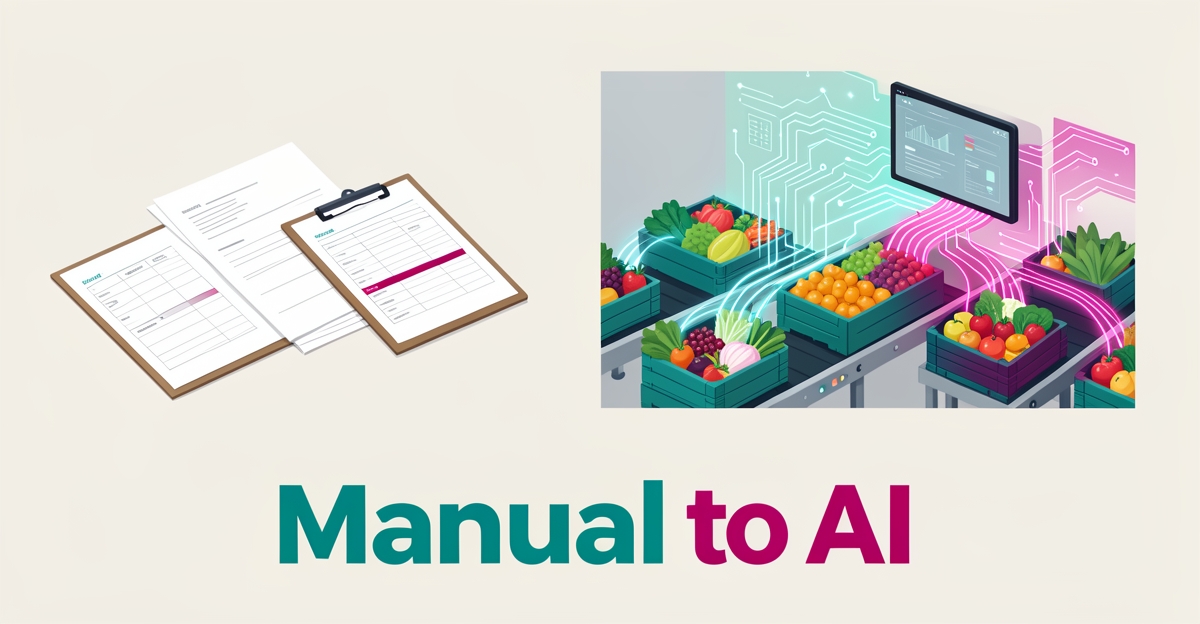
From Manual to AI: Transforming Order Fulfillment in a Mid-Size Produce Wholesaler
Key Facts
- AI-driven order automation typically reduces sales order cycle times significantly by eliminating re-keying and errors
- Automated order processing commonly saves several dollars per order in reduced re-keying and error correction
- Only 1 of 10 steps in a typical AI transformation is actually about AI according to Alex Lieberman
- Fulfillment speed and AI-powered inventory analytics rank among supply chain leaders' top priorities
- AI helps eliminate re-keying and repeated work in order processing as noted by Prokeep
Hire a team member that works 24/7 — for less than a part-time wage.
AI receptionists, SDRs, dispatchers and 99+ roles. Trained on your business, fully managed.
Not sure where to start? Ask our AI planner
The Hidden Cost of Manual Order Intake in Produce Wholesaling
Paper-based intake and channel sprawl feel personal until volume hits, and then the cracks show up in the P&L. In mid-size produce wholesaling, orders arrive by text, voicemail, email, and phone with no standard intake, and reps spend their day re-keying and chasing instead of selling.
Manual work creates four compounding problems that scale with growth. According to Prokeep's analysis of manual order processing, the core issue isn't effort, it's capacity. When reps are buried in intake, re-keying, and follow-ups, there's no room left for proactive selling.
- Missed orders: Texts, voicemails, and emails get overlooked or answered too late
- Customer churn: Buyers move to distributors who respond faster
- Reactive reps: Teams spend all day keeping up instead of driving more orders
- Stalled growth: The business feels busy, but order volume doesn't increase
The error profile worsens as channels multiply. Manual processing is highly susceptible to errors due to manual data entry leading to typos, mistakes, and misinterpretation of information. The process is time-consuming, labor-intensive, and error-prone. Research on manual vs AI order processing highlights the lack of real-time visibility because paperwork and non-digital methods create obstacles in decision-making and timely responses to customer inquiries.
Speed and cost pressure make the gap visible. Industry research on AI in order management suggests automation can save businesses several dollars per sales order and meaningfully shorten order cycle times. Supply chain surveys consistently find that a meaningful share of leaders identify improving fulfillment speed as a top business priority, and many see AI-powered analytics as key to optimizing inventory management.
In produce, where freshness windows and daily availability drive trust, delayed acknowledgment and re-keying directly erode margin. Reps lose the context across shifts, quotes go cold, and SKU lookups slow fulfillment. The business ends up busy but not growing.
This is where AI workflow and task automation shifts the dynamic from reactive intake to owned, repeatable fulfillment. At AIQ Labs, we see mid-size wholesalers stabilize order intake first, then connect workflows and data, without requiring costly tech overhauls. Our [AI Workflow Builds](/workflow-builds) rebuild the one workflow that costs you the most, like order intake, at a fixed price, in phases. The goal is not to replace reps. It's about giving them back time and making that time usable for proactive selling, which is the capacity constraint that stalls growth.
The Crawl-Walk-Run Framework for AI-Driven Fulfillment
The path to AI-driven order fulfillment isn't about flipping a switch, it's about building momentum through deliberate phases. For mid-size produce wholesalers drowning in manual intake, the transformation follows a proven 90-day crawl-walk-run framework that delivers measurable results without requiring a full tech overhaul. This approach lets teams adapt gradually while unlocking value at each stage, turning operational friction into proactive revenue opportunities.
During the Crawl phase (Days 0-30), the focus is stabilizing order intake by standardizing channels and eliminating chaos. Most wholesalers juggle orders across texts, emails, and voicemails with no consistent process, leading to missed details and delayed responses. By capturing required information uniformly and acknowledging requests immediately, businesses reduce re-keying and create a reliable foundation. As Prokeep notes, this phase isn't about AI yet, it's about removing the noise that buries reps in reactive work, freeing capacity for what comes next. Prokeep's practical guide emphasizes that stabilizing intake is the critical first step before any automation can succeed.
In the Walk phase (Days 31-60), the workflow connects disparate data points and automates follow-through. Quotes stop going cold as systems automatically tag and route conversations, link quotes to final orders, and speed up SKU lookups. This is where the initial time savings begin to compound, businesses typically see meaningful per-order savings while cycle times shorten as re-keying disappears. Industry research on AI in order management confirms these efficiency gains come not from flashy AI, but from systematically connecting existing workflows so information flows seamlessly between intake, fulfillment, and sales teams. The goal here is turning isolated tasks into a coordinated process where context isn't lost between shifts.
The Run phase (Days 61-90) leverages the stabilized foundation to drive proactive revenue. With reps no longer buried in manual data entry and follow-ups, they gain capacity to use AI for add-on suggestions, identify at-risk accounts, and trigger seasonal reorders. This is where transformation shifts from cost avoidance to growth enablement, AI doesn't replace reps but gives them back time to apply their expertise. As Erika Torres of Prokeep observes, "It's not about replacing reps. It's about giving them back time, and making that time usable." Prokeep's insight underscores that the real value emerges when teams can shift from keeping up with orders to actively growing them. AIQ Labs helps wholesalers navigate this journey by building custom systems that own the process, not just automate it, ensuring each phase delivers tangible progress toward a fully AI-native fulfillment operation.
From Process Mapping to Production: The 10-Step AI-Native Build
Alex Lieberman, co-founder of Morning Brew, offers a sobering reality check for businesses eager to jump into AI: only 1 of 10 steps in his AI-native sequence actually involves AI. The other nine steps, problem identification, workflow mapping, data collection, integration, and measurement, are where most transformations succeed or fail. For produce wholesalers, this framework provides a practical roadmap that avoids the trap of chasing shiny technology before laying the groundwork.
The first three steps focus on understanding before building. Identify the problem by turning on your "suck meter" to find the most time-consuming, error-prone process in your operation. Then map the workflow from beginning to end, Lieberman calls this the "least sexy part" but notes that companies become more efficient just by documenting processes, even before AI enters the picture. Finally, collect the data: gather sample orders, edge cases, and past communications to test against.
Steps four through six involve building and refining. Create a prototype without worrying about perfect code, then test it relentlessly with real-world scenarios. According to Prokeep's phased framework, this aligns with the "Walk" phase (Days 31–60) where businesses connect workflows and eliminate re-keying. AIQ Labs structures this phase through milestone-based builds, allowing wholesalers to approve each stage before proceeding.
The final four steps separate successful implementations from stalled pilots:
- Integrate with live systems, point-in-time data works for testing, but production requires real-time ERP and CRM connections
- Roll out with hands-on training and hand-holding through onboarding
- Drive adoption by embedding the workflow in company culture
- Measure hard ROI through reduced hiring needs, faster sales cycles, or reskilled employees
Fulfillment speed remains a top priority for supply chain leaders, yet many AI initiatives stall because they skip these foundational steps. The 10-step sequence works because it treats AI as the final layer on a solid operational foundation, not a shortcut around it.
Implementation Playbook for Mid-Size Produce Operations
The journey from manual to AI-driven order fulfillment begins with stabilizing the intake process, because when orders come through texts, emails, and voicemails without standardization, reps waste precious time on re-keying and chasing details instead of selling. As Prokeep notes, the real bottleneck isn't effort but capacity: when teams are buried in manual intake, there's no room left for proactive selling according to their research. AIQ Labs helps mid-size produce wholesalers start by unifying all order channels, phone, email, SMS, and web forms, into a single, standardized intake system that captures required details consistently and acknowledges every request immediately, eliminating the chaos that leads to missed orders and delayed follow-ups. For teams that want intake handled end-to-end from day one, managed [AI Employees](/ai-employees) can act as around-the-clock order desk staff at a fraction of a human hire's cost.
Once intake is stable, the next phase focuses on connecting workflows and data to prevent quotes from going cold and reduce duplicate work. This involves automating quote follow-ups, tagging and routing order conversations by customer or SKU, linking quotes directly to final orders, and enabling real-time SKU lookup so reps no longer waste time flipping through catalogs or guessing availability. Industry research suggests automation saves businesses several dollars per sales order by reducing re-keying and errors, while meaningfully shortening order cycle times, critical advantages in a perishable goods environment where speed and accuracy directly impact waste and customer satisfaction as the data shows. These improvements free up reps to focus on relationships rather than routine tasks.
With workflows connected, AI begins driving proactive revenue through intelligent triggers: suggesting relevant add-ons or upsells based on order history, identifying dormant or at-risk accounts, and automatically generating reorder prompts for seasonal staples. These capabilities transform order fulfillment from a reactive cost center into a growth engine, without requiring a full tech overhaul. For wholesalers ready to go further, a connected [AI Operating System](/ai-operating-systems) ties intake, fulfillment, inventory, and sales into one operating layer you own outright. Throughout this transformation, AIQ Labs emphasizes human-in-the-loop design, ensuring that AI handles routine tasks while experienced staff manage exceptions, complex orders, and customer relationships. Governance frameworks are built in from the start, covering data quality, audit trails, and escalation paths, while change management strategies include role-specific training and feedback loops to drive adoption. The result is a system that doesn't just automate steps, it gives your team back the time to sell smarter, not harder.
Still paying for 10+ subscriptions that don’t talk to each other?
We build custom AI systems you own outright. No vendor lock-in. Full control.
Not sure where to start? Ask our AI planner
Frequently Asked Questions
Why is manual order intake costing my produce wholesale business growth?
How much time and money can AI actually save on order processing?
Do I need to overhaul my ERP and tech stack to start with AI?
What does a realistic 90-day AI rollout look like for a mid-size wholesaler?
Is AI transformation mostly about the AI model itself?
Will AI replace my sales reps in produce wholesaling?
Turn Order Chaos into Competitive Advantage
The path from manual order intake to AI-driven fulfillment isn't about replacing your team, it's about giving them back the time they lose to re-keying, chasing details, and reactive firefighting. As we've seen, stabilizing intake, connecting workflows, and then using AI to drive proactive sales creates a 90-day journey that turns operational friction into revenue opportunities. The real bottleneck isn't effort, it's capacity. When your reps aren't buried in manual work, they can focus on what they do best: building relationships and growing orders. If you're ready to map your biggest bottleneck and see where AI can unlock measurable gains without a tech overhaul, start with a 2-minute [Fit Check](/apply) and a free 30-minute strategy call.
Make AI your competitive advantage — not just another tool.
Strategy, implementation and ongoing optimization. One partner, end to end.
Not sure where to start? Ask our AI planner