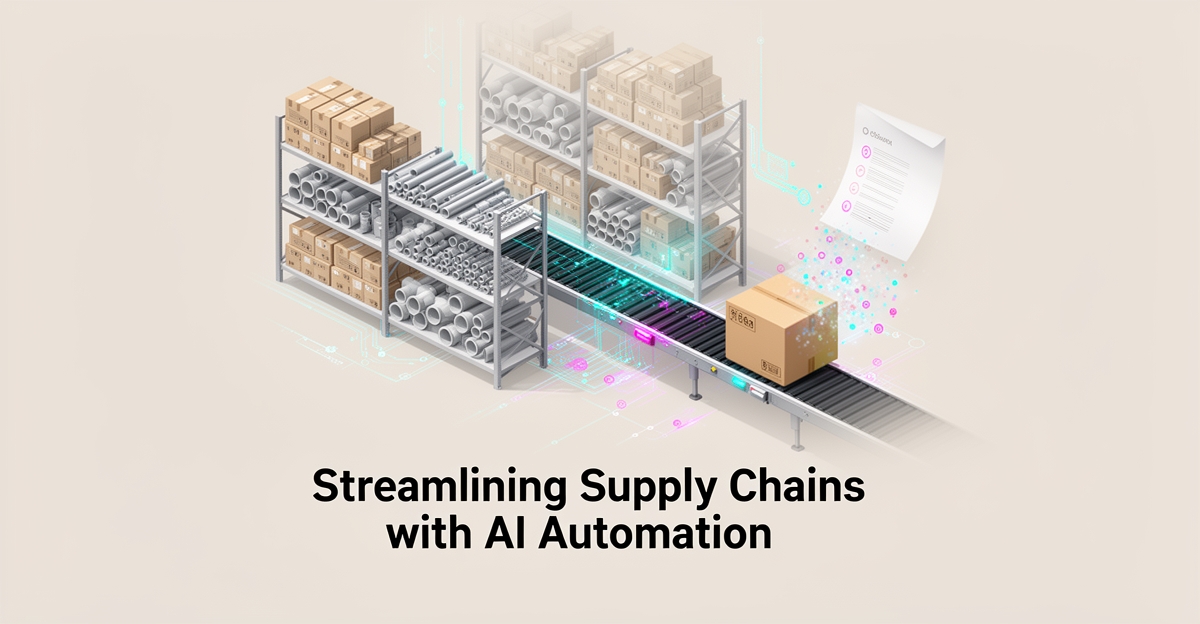
From Manual to AI: Transforming Order Fulfillment in Plumbing Supply Distributors
Key Facts
- Only 12.1% of supply chain technology programs achieve their expected business outcomes.
- Nearly 89% of AI programs realize less than 76% of their projected return on investment.
- More than 91% of automation programs experience significant budget overruns.
- Only 8.2% of organizations provide role-specific, workflow-based training for employees.
- 82.6% of organizations require more than six months to reach full operational adoption.
- 32% of respondents cite data quality and system integration as their primary operational challenge.
- 29% of organizations remain stuck in pilot stages without scaling to enterprise-wide value.
What if you could hire a team member that works 24/7 for $599/month?
AI Receptionists, SDRs, Dispatchers, and 99+ roles. Fully trained. Fully managed. Zero sick days.
The High Cost of Manual Fulfillment
Most plumbing supply distributors operate under the illusion that their current manual processes are manageable. However, the gap between the potential of AI technology and actual ROI realization reveals a stark operational reality. Only 12.1% of supply chain technology programs successfully achieve their expected business outcomes, leaving the vast majority of distributors stuck in inefficient cycles.
The financial impact of this gap is severe. Research indicates that nearly 89% of organizations realize less than 76% of their projected ROI from automation initiatives. This shortfall is not due to flawed technology, but rather a lack of operational readiness and poor data integration. More than 91% of programs experience budget overruns, turning potential efficiency gains into costly operational burdens.
The primary culprit behind these failures is the confusion between "systems integration" and "business integration." Many distributors focus solely on technical connectivity, assuming that plugging new tools into existing ERP or WMS platforms will automatically fix workflow bottlenecks. This approach ignores the critical human and procedural elements required for success.
Technology amplifies organizational discipline; it does not replace it. If underlying processes are flawed, AI will simply automate inefficiencies at a faster rate. Successful transformation requires redesigning workflows to align with new capabilities, ensuring that governance and accountability are embedded in the process. Without this alignment, even the most advanced AI tools become expensive liabilities rather than competitive advantages.
Technical deployment is only half the battle; human adoption is often where initiatives stall. 82.6% of organizations require more than six months to reach full operational adoption, with 11.6% taking over a year. This prolonged ramp-up time delays ROI and frustrates staff who are expected to manage complex new systems without adequate support.
Furthermore, training efforts are typically misaligned with actual job functions. Only 8.2% of organizations provide role-specific, workflow-based training tailored to how employees actually perform their jobs. This lack of targeted education leads to poor adoption rates and resistance to change. When staff cannot see how AI simplifies their daily tasks rather than complicates them, they revert to manual workarounds, nullifying the technology’s benefits.
Consider a mid-sized distributor attempting to implement a new automated ordering system. Without a structured transition plan, they face mid-project corrections that derail timelines. Research shows that while 61.4% of leaders identify structured transitions as key to reducing these corrections, fewer than 10% have the discipline in place. The result is a system that is technically functional but operationally unusable, leading to 32% of respondents citing data quality and system integration as their largest operational challenge.
AIQ Labs addresses these specific pain points by offering end-to-end partnership. We don’t just deploy software; we integrate AI into your existing workflows through custom development, managed AI employees, and strategic consulting. This holistic approach ensures that technology serves your business model, not the other way around.
By prioritizing business integration over mere technical connectivity, distributors can avoid the pitfalls that trap 89% of their peers. The next step is understanding how to architect a solution that fits your unique operational landscape.
The Integration Imperative: Systems vs. Business
Most plumbing supply distributors assume that connecting their AI tools to existing Warehouse Management Systems (WMS) is the final step toward automation. They are wrong. This misconception is the primary reason why 89% of AI programs realize less than 76% of projected ROI according to My Total Retail. Technical connectivity is merely the baseline; true transformation requires business integration, which focuses on operational readiness and workflow redesign.
When distributors treat AI as a standalone IT project, they often amplify existing inefficiencies rather than solving them. Technology acts as a multiplier for organizational discipline, meaning flawed processes will yield flawed automated results at scale. Successful implementation demands that AI operates inside established workflows, acting as agentic middleware that coordinates data without disrupting core operations.
The gap between technical capability and operational reality is stark. While the industry buzzes about agentic AI, the execution often stalls due to a lack of structured transition planning. Consider these critical failure points:
- Low Success Rates: Only 12.1% of supply chain technology programs achieve their expected business outcomes, delivering on time and within budget reports My Total Retail.
- Adoption Delays: 82.6% of organizations require more than six months to reach full operational adoption, with 11.6% taking over a year according to industry analysis.
- Training Gaps: A mere 8.2% of organizations provide role-specific, workflow-based training tailored to actual employee tasks as reported by My Total Retail.
Bryan Stone, Principal of JBF Consulting, argues that the core issue is not whether employees understand the software, but whether they understand how the business now operates through it. High-performing organizations treat AI implementation as an enterprise operational transformation involving governance and accountability. Without this mindset, even the most sophisticated multi-agent architectures will fail to integrate into daily dispatch and fulfillment routines.
Nishkam Batta, Founder of GrayCyan, emphasizes that AI adoption becomes an integration challenge where systems must support coordination without introducing uncertainty. This requires human-in-the-loop controls that allow operators to retain authority over high-impact decisions. For plumbing distributors, this means AI handles routine order routing and inventory checks, while humans manage exceptions and supplier negotiations.
AIQ Labs addresses this integration imperative by offering end-to-end partnership rather than point solutions. Our AI Transformation Partner model ensures that technical development is paired with strategic change management. We build custom systems that integrate directly into your ERP and WMS, ensuring AI acts as seamless operational support rather than a disruptive new tool.
By focusing on true ownership and engineering excellence, we help distributors move beyond pilot paralysis. We don’t just deploy software; we architect the operational discipline required to sustain AI-driven growth. This holistic approach transforms order fulfillment from a manual bottleneck into a competitive advantage.
Ready to move beyond technical connectivity and achieve real operational readiness?
Agentic AI: The Shift to Proactive Operations
Most warehouse dashboards are reactive, showing you problems only after they happen. This passive monitoring leaves plumbing supply distributors vulnerable to stockouts and delayed shipments. The industry is rapidly shifting toward agentic AI architectures that anticipate issues before they disrupt operations.
Unlike static reports, agentic systems analyze real-time data to make autonomous decisions. They interact with your entire ecosystem simultaneously to resolve conflicts instantly. This transition transforms AI from a passive observer into an active operational partner.
Traditional systems require humans to interpret data and initiate actions. This manual step creates latency and increases the risk of human error during high-volume periods. Agentic AI removes this bottleneck by executing multi-step workflows independently.
These systems operate as agentic middleware within your ERP and WMS. They coordinate data across platforms without disrupting core business processes. This integration ensures that decision-making happens in real-time, not in hindsight.
- Proactive Problem Solving: Systems detect inventory discrepancies and reorder automatically before stock runs out.
- Real-Time Adaptation: Agents adjust shipping routes instantly based on traffic, weather, or carrier delays.
- Continuous Optimization: AI learns from every transaction to improve future fulfillment accuracy and speed.
Despite the clear benefits, most organizations fail to realize their expected ROI. The primary reason is a lack of operational readiness rather than technical limitations. Technology amplifies existing organizational discipline; if processes are flawed, AI will simply automate inefficiencies.
Research indicates that only 12.1% of supply chain technology programs achieve their expected business outcomes according to industry analysis. Furthermore, nearly 89% of programs realize less than 76% of their projected return on investment as reported by My Total Retail.
Agentic AI is not about replacing human workers; it is about augmenting their capabilities. Experts emphasize that these systems should function as cybernetic augmentation that works alongside the workforce. This approach fosters trust and ensures accountability in critical fulfillment tasks.
Operators must retain authority over high-impact decisions while AI handles routine complexity. Clear escalation paths allow humans to intervene when situations exceed AI authority. This human-in-the-loop design ensures that the system remains reliable and explainable.
- Trust Through Transparency: AI recommendations are tied to specific data sources and timestamps.
- Accountability: Human supervisors override AI decisions when necessary for compliance or strategy.
- Efficiency: Employees focus on exception handling rather than repetitive data entry.
Successful deployment depends on operating inside established workflows rather than alongside them. AI must execute structured, multi-step actions within defined guardrails. This ensures that the system supports coordination without introducing uncertainty.
As noted by industry experts, AI adoption becomes an integration challenge that requires seamless connection to existing tools according to GrayCyan. This strategy prevents disruption and ensures that the technology delivers immediate value.
By moving from reactive monitoring to proactive execution, distributors can achieve the operational excellence required to compete in modern markets.
Implementation Strategy: The AIQ Labs Approach
Most AI projects fail because they focus on technology rather than operations. Research indicates that only 12.1% of supply chain technology programs achieve their expected business outcomes, while 89% realize less than 76% of projected ROI according to industry analysis. This disparity exists because organizations confuse technical connectivity with operational readiness.
To succeed, plumbing supply distributors must prioritize business integration alongside systems integration. AIQ Labs delivers this through a structured, four-phase partnership model that ensures your new AI systems work seamlessly within existing workflows.
Before writing a single line of code, we assess your operational discipline. Technology amplifies existing processes; if your workflows are flawed, AI will only amplify inefficiencies. We begin with a thorough AI Readiness Evaluation to understand your current technology stack and data infrastructure.
During this phase, we conduct a deep-dive into your existing ERP, WMS, and CRM systems. Since 32% of respondents cite data quality as the primary operational challenge, we ensure your AI has access to clean, real-time data according to supply chain research. We also develop a prioritized implementation plan with clear milestones and ROI projections.
- Business Process Analysis: Mapping current manual workflows to identify automation targets.
- Data Infrastructure Assessment: Ensuring data quality for accurate AI decision-making.
- Solution Architecture Design: Building systems that operate inside established workflows.
- ROI Projection: Defining clear financial goals and timelines for success.
We build production-ready, custom AI systems using advanced multi-agent architectures like LangGraph. Unlike generic chatbots, our AI Employees are trained to perform specific job tasks end-to-end, from order intake to invoice processing. We focus on agentic AI that makes proactive decisions in real-time, rather than relying on static dashboards as reported by Logistics Reply.
A critical component of this phase is human-in-the-loop design. We configure escalating paths for high-impact decisions, ensuring operators retain authority over critical fulfillment tasks. This builds trust and ensures accountability in your warehouse and office operations.
- Custom Agent Development: Building specialized AI staff for dispatch, sales, and support.
- System Integration: Connecting AI tools directly to your existing business software.
- Security Implementation: Ensuring data privacy and compliance with industry standards.
- Performance Optimization: Testing workflows to ensure reliability under load.
Adoption is where most transformations stall. With 82.6% of organizations requiring more than six months to reach full operational adoption, a rushed launch guarantees failure according to Total Retail. Furthermore, only 8.2% of organizations provide role-specific, workflow-based training according to industry data.
We correct this by providing comprehensive, role-specific training. Our team works with your staff to demonstrate how the AI integrates into their daily tasks, focusing on operational changes rather than just software interfaces. This ensures your team understands how the business now operates, not just how to use a new tool.
- Role-Specific Training: Teaching staff how to interact with AI within their specific workflows.
- Documentation Delivery: Providing clear guides for ongoing support and troubleshooting.
- Performance Monitoring Setup: Establishing metrics to track success and identify improvements.
- Change Management: Guiding your team through the cultural shift to AI-assisted work.
AI transformation is a continuous journey, not a one-time event. We provide ongoing optimization to ensure your systems evolve with your business needs. Our team continuously monitors performance, handles updates, and retrain AI Employees as necessary to maintain peak efficiency.
We also identify new opportunities for expansion as your capabilities grow. Whether you need to scale to additional locations or add new AI roles, AIQ Labs serves as your long-term partner. We ensure your AI investment delivers sustained competitive advantage by adapting to changing market conditions and operational demands.
- Continuous Monitoring: Tracking AI performance against defined KPIs.
- Feature Enhancement: Adding new capabilities based on business growth.
- Scale Support: Assisting with expansion to new locations or product lines.
- ROI Tracking: Regular reporting to demonstrate ongoing value and efficiency gains.
By following this structured approach, we ensure your AI implementation drives real results, not just technical complexity.
Next Steps: From Pilot to Transformation
Many plumbing supply distributors find themselves trapped in the "pilot purgatory," where isolated AI experiments fail to scale into operational reality. Research indicates that 29% of organizations remain in pilot stages, unable to move beyond initial trials to deliver enterprise-wide value. This stagnation often stems from focusing on "systems integration" (technical connectivity) while neglecting "business integration" (workflow redesign and governance).
Key Insight: Technology amplifies organizational discipline; it does not replace it. Without structural change, AI simply automates existing inefficiencies.
The path forward requires a partner who bridges the gap between code and culture. AIQ Labs serves as a lifecycle partner, ensuring your AI investment delivers sustainable competitive advantage rather than temporary novelty.
Scaling AI requires more than just better algorithms; it demands a holistic approach to operational readiness. The majority of supply chain technology programs struggle to realize expected ROI due to a lack of structured transition plans.
- Implementation Reality: Only 12.1% of supply chain technology programs achieve their expected business outcomes.
- ROI Shortfalls: Nearly 89% of programs realize less than 76% of projected return on investment.
- Adoption Delays: 82.6% of organizations require more than six months to reach full operational adoption.
These statistics highlight a critical market gap: most vendors deliver software, but few deliver the operational transformation required to make that software work.
Unlike vendors who offer disconnected tools, AIQ Labs provides an end-to-end partnership model. We build complete AI systems that integrate directly with your warehouse management and delivery logistics platforms, ensuring seamless data flow and workflow automation.
Our approach is built on three integrated pillars:
- AI Development Services: Custom-built, production-ready systems that your business owns outright, eliminating vendor lock-in.
- AI Employees: Managed AI staff that work alongside your team, handling repetitive tasks like order processing and dispatch.
- AI Transformation Consulting: Strategic guidance to navigate change management, governance, and continuous optimization.
This comprehensive model addresses the 32% of respondents who cite data quality and system integration as their primary operational challenge.
The future of fulfillment is not static dashboards, but proactive, "agentic AI." This shift allows systems to analyze real-time data—such as inventory levels and delivery routes—and make autonomous decisions without constant human intervention. However, this requires human-in-the-loop controls to maintain accountability and trust.
AIQ Labs specializes in building these complex, multi-agent architectures. We ensure that AI recommendations are explainable and tied to specific data sources, fostering operator confidence. This is not just about automation; it’s about creating a cybernetic augmentation that enhances your workforce’s capabilities.
To move from pilot to transformation, you need a partner who understands both the technology and the trade. AIQ Labs offers a clear pathway to success:
- Start with Clarity: Begin with a Free AI Audit to assess your current systems and identify high-ROI opportunities.
- Prove the Value: Deploy a targeted AI Employee for a specific role, such as an AI Dispatcher or Order Processor.
- Scale with Confidence: Expand into a complete business AI system with ongoing optimization and support.
Don’t let your AI journey stall in the pilot phase. Partner with AIQ Labs to architect a fulfillment system that is fast, accurate, and deeply integrated into your business operations.
Still paying for 10+ software subscriptions that don't talk to each other?
We build custom AI systems you own. No vendor lock-in. Full control. Starting at $2,000.
Frequently Asked Questions
Why do most AI fulfillment projects fail to hit their ROI targets?
Will AI replace my warehouse staff or just make their jobs easier?
How can I trust AI decisions if I don't understand how they're made?
How long does it usually take for staff to actually start using the new AI tools?
What is the biggest technical hurdle for integrating AI into my current warehouse system?
Can I test AI with a small pilot before committing to a full transformation?
Beyond Automation: Architecting Your Fulfillment Advantage
The high cost of manual fulfillment extends far beyond immediate operational inefficiencies; it represents a strategic gap where 89% of organizations fail to realize projected ROI due to poor data integration and a lack of business readiness. True transformation requires moving beyond simple systems integration to redesign workflows with embedded governance and accountability, ensuring technology amplifies organizational discipline rather than automating errors. For plumbing supply distributors, the path to reducing errors, speeding up delivery, and improving customer satisfaction lies in adopting a complete, end-to-end approach. AIQ Labs specializes in building comprehensive AI systems that integrate seamlessly with warehouse management and delivery logistics platforms, turning theoretical potential into measurable competitive advantage. Don’t let your operations stagnate in the pilot phase. Schedule your free AI Audit & Strategy Session today to discover how we can architect your competitive advantage.
Ready to make AI your competitive advantage—not just another tool?
Strategic consulting + implementation + ongoing optimization. One partner. Complete AI transformation.